 Add to Chrome
 Add to Firefox
 Add to Edge
Beyond Text Conditioning: A Systematic Study of MLLM-DiT Fusion for Video Generation
Aug 14, 2026
Diffusion Transformers (DiTs) have become the dominant paradigm for high-fidelity video generation, yet their ability to perform high-level semantic planning remains limited. While hybrid architectures integrating MLLMs with diffusion backbones have shown strong advantages in image synthesis, such designs remain underexplored in video generation, where existing approaches often treat MLLMs primarily as frozen feature encoders rather than semantic generators. To fill this gap, we systematically study how an MLLM should be integrated with a DiT for video generation by answering three questions: what intermediate representation should bridge the MLLM and DiT, how the MLLM should generate it, and how the DiT should incorporate it during diffusion rendering. Our analysis reveals three key findings: (1) discrete semantic visual tokens produced by an EMA-based tokenizer provide a stable and expressive interface, (2) autoregressive causal modeling is effective for generating these tokens, and (3) explicit visual-token conditioning is more effective than prompt refinement or latent bridging. Based on these findings, we propose BiVidGen, a hybrid framework where an MLLM first generates semantic visual tokens and a DiT renders videos conditioned on both text and these tokens via multi-layer cross-attention. Extensive experiments show that BiVidGen improves semantic alignment and temporal coherence over a fine-tuned DiT baseline, achieving stronger performance on VBench-Long. These results demonstrate that explicit MLLM-based visual planning provides an effective intermediate interface for text-to-video generation beyond text-only conditioning.

Argus: A General-Purpose Agentic Reasoning Runtime for Long-Horizon Tasks
Aug 07, 2026Long-horizon reasoning requires an agentic runtime that can persist when evidence supports its current approach and pivot when measurements reveal failure, hidden constraints, or a misspecified objective. We present Argus, a persistent, self-evolving runtime in which Manager, Planner, Engineer, and Reviewer execute bounded missions over durable project state. Argus separates stable user intent from operational objectives, constraints, and verification criteria, and admits memories, skills, procedures, verifiers, routing decisions, and rejected routes only after role-owned review and, when available, task-native verification. Model weights remain fixed; self-evolution occurs through persistent runtime state and control policy, with autonomous execution between operator-owned escalation points. Across seven GPT-5.5 benchmark arenas, Argus achieves about 78% on SWE-Bench Pro versus 59% for Direct Copilot while using 1.41 times the aggregate tokens. After verification-gated self-evolution, mature SWE-Bench waves use 21% fewer solve-input tokens and 15% less active workflow time per task than startup waves, while recording 34 verifier recoveries and 22 strict review-loop rescues. Argus also reaches 76.8% on AARRI-Bench and a 28.0-point gap on mathematical data synthesis, with competitive GPU-kernel and language-model-training results. Beyond benchmarks, an optimized RWKV6 kernel was merged upstream; a multi-day mathematics campaign retained falsified routes and proof-backed frontier updates; and six paper pipelines completed 254 missions with 16 stage rollbacks. These results show that a fixed-weight, self-evolving harness can revise, recover, and accumulate verified approaches while producing structured trajectories for future supervised and reinforcement learning.
Argus: A General-Purpose Agentic Runtime for Long-Horizon Reasoning
Aug 05, 2026Long-horizon reasoning requires an agentic runtime that can persist when evidence supports its current approach and pivot when measurements reveal failure, hidden constraints, or a misspecified objective. We present Argus, a persistent, self-evolving runtime in which Manager, Planner, Engineer, and Reviewer execute bounded missions over durable project state. Argus separates stable user intent from operational objectives, constraints, and verification criteria, and admits memories, skills, procedures, verifiers, routing decisions, and rejected routes only after role-owned review and, when available, task-native verification. Model weights remain fixed; self-evolution occurs through persistent runtime state and control policy, with autonomous execution between operator-owned escalation points. Across seven GPT-5.5 benchmark arenas, Argus achieves about 78% on SWE-Bench Pro versus 59% for Direct Copilot while using 1.41 times the aggregate tokens. After verification-gated self-evolution, mature SWE-Bench waves use 21% fewer solve-input tokens and 15% less active workflow time per task than startup waves, while recording 34 verifier recoveries and 22 strict review-loop rescues. Argus also reaches 76.8% on AARRI-Bench and a 28.0-point gap on mathematical data synthesis, with competitive GPU-kernel and language-model-training results. Beyond benchmarks, an optimized RWKV6 kernel was merged upstream; a multi-day mathematics campaign retained falsified routes and proof-backed frontier updates; and six paper pipelines completed 254 missions with 16 stage rollbacks. These results show that a fixed-weight, self-evolving harness can revise, recover, and accumulate verified approaches while producing structured trajectories for future supervised and reinforcement learning.
RESOURCE2SKILL: Distilling Executable Agent Skills from Human-Created Multimodal Resources
Jun 28, 2026Skills are a useful abstraction for software agents, turning human and agent experience into reusable procedural knowledge. Yet existing skill libraries are mostly hand-written, text-centric, or derived from agent traces, leaving tutorial videos and other multimodal human resources largely underused. We present RESOURCE2SKILL, a framework that distills multimodal resources, including tutorial videos, repositories, articles, and reference artifacts, into executable skills for software agents. RESOURCE2SKILL organizes these skills as a hierarchical multimodal Skill Wiki, where each entry combines structured text, code, visual examples, metadata, and provenance. This design preserves complementary signals from different resources: videos capture temporal operations and visual effects, code captures executable tool patterns, and articles or artifacts provide conceptual and stylistic grounding. At inference time, agents retrieve and compose relevant skills from the wiki; when coverage is insufficient, the same construction operator can acquire new skills online. Across seven practical authoring domains, RESOURCE2SKILL improves average overall score by +11.9 percentage points over no-skill agents and outperforms strong harness baselines in 26 of 28 main-aggregate model-domain cells. Ablations confirm the value of multimodal skill format, hierarchical organization, source diversity, selection strategy, and online acquisition.
Covering Human Action Space for Computer Use: Data Synthesis and Benchmark
May 12, 2026Computer-use agents (CUAs) automate on-screen work, as illustrated by GPT-5.4 and Claude. Yet their reliability on complex, low-frequency interactions is still poor, limiting user trust. Our analysis of failure cases from advanced models suggests a long-tail pattern in GUI operations, where a relatively small fraction of complex and diverse interactions accounts for a disproportionate share of task failures. We hypothesize that this issue largely stems from the scarcity of data for complex interactions. To address this problem, we propose a new benchmark CUActSpot for evaluating models' capabilities on complex interactions across five modalities: GUI, text, table, canvas, and natural image, as well as a variety of actions (click, drag, draw, etc.), covering a broader range of interaction types than prior click-centric benchmarks that focus mainly on GUI widgets. We also design a renderer-based data-synthesis pipeline: scenes are automatically generated for each modality, screenshots and element coordinates are recorded, and an LLM produces matching instructions and action traces. After training on this corpus, our Phi-Ground-Any-4B outperforms open-source models with fewer than 32B parameters. We will release our benchmark, data, code, and models at https://github.com/microsoft/Phi-Ground.git
UniG2U-Bench: Do Unified Models Advance Multimodal Understanding?
Mar 03, 2026Unified multimodal models have recently demonstrated strong generative capabilities, yet whether and when generation improves understanding remains unclear. Existing benchmarks lack a systematic exploration of the specific tasks where generation facilitates understanding. To this end, we introduce UniG2U-Bench, a comprehensive benchmark categorizing generation-to-understanding (G2U) evaluation into 7 regimes and 30 subtasks, requiring varying degrees of implicit or explicit visual transformations. Extensive evaluation of over 30 models reveals three core findings: 1) Unified models generally underperform their base Vision-Language Models (VLMs), and Generate-then-Answer (GtA) inference typically degrades performance relative to direct inference. 2) Consistent enhancements emerge in spatial intelligence, visual illusions, or multi-round reasoning subtasks, where enhanced spatial and shape perception, as well as multi-step intermediate image states, prove beneficial. 3) Tasks with similar reasoning structures and models sharing architectures exhibit correlated behaviors, suggesting that generation-understanding coupling induces class-consistent inductive biases over tasks, pretraining data, and model architectures. These findings highlight the necessity for more diverse training data and novel paradigms to fully unlock the potential of unified multimodal modeling.
Spectral Gating Networks
Feb 07, 2026Gating mechanisms are ubiquitous, yet a complementary question in feed-forward networks remains under-explored: how to introduce frequency-rich expressivity without sacrificing stability and scalability? This tension is exposed by spline-based Kolmogorov-Arnold Network (KAN) parameterizations, where grid refinement can induce parameter growth and brittle optimization in high dimensions. To propose a stability-preserving way to inject spectral capacity into existing MLP/FFN layers under fixed parameter and training budgets, we introduce Spectral Gating Networks (SGN), a drop-in spectral reparameterization. SGN augments a standard activation pathway with a compact spectral pathway and learnable gates that allow the model to start from a stable base behavior and progressively allocate capacity to spectral features during training. The spectral pathway is instantiated with trainable Random Fourier Features (learned frequencies and phases), replacing grid-based splines and removing resolution dependence. A hybrid GELU-Fourier formulation further improves optimization robustness while enhancing high-frequency fidelity. Across vision, NLP, audio, and PDE benchmarks, SGN consistently improves accuracy-efficiency trade-offs under comparable computational budgets, achieving 93.15% accuracy on CIFAR-10 and up to 11.7x faster inference than spline-based KAN variants. Code and trained models will be released.
Why Keep Your Doubts to Yourself? Trading Visual Uncertainties in Multi-Agent Bandit Systems
Jan 26, 2026Vision-Language Models (VLMs) enable powerful multi-agent systems, but scaling them is economically unsustainable: coordinating heterogeneous agents under information asymmetry often spirals costs. Existing paradigms, such as Mixture-of-Agents and knowledge-based routers, rely on heuristic proxies that ignore costs and collapse uncertainty structure, leading to provably suboptimal coordination. We introduce Agora, a framework that reframes coordination as a decentralized market for uncertainty. Agora formalizes epistemic uncertainty into a structured, tradable asset (perceptual, semantic, inferential), and enforces profitability-driven trading among agents based on rational economic rules. A market-aware broker, extending Thompson Sampling, initiates collaboration and guides the system toward cost-efficient equilibria. Experiments on five multimodal benchmarks (MMMU, MMBench, MathVision, InfoVQA, CC-OCR) show that Agora outperforms strong VLMs and heuristic multi-agent strategies, e.g., achieving +8.5% accuracy over the best baseline on MMMU while reducing cost by over 3x. These results establish market-based coordination as a principled and scalable paradigm for building economically viable multi-agent visual intelligence systems.
3D-Agent:Tri-Modal Multi-Agent Collaboration for Scalable 3D Object Annotation
Jan 07, 2026Driven by applications in autonomous driving robotics and augmented reality 3D object annotation presents challenges beyond 2D annotation including spatial complexity occlusion and viewpoint inconsistency Existing approaches based on single models often struggle to address these issues effectively We propose Tri MARF a novel framework that integrates tri modal inputs including 2D multi view images textual descriptions and 3D point clouds within a multi agent collaborative architecture to enhance large scale 3D annotation Tri MARF consists of three specialized agents a vision language model agent for generating multi view descriptions an information aggregation agent for selecting optimal descriptions and a gating agent that aligns textual semantics with 3D geometry for refined captioning Extensive experiments on Objaverse LVIS Objaverse XL and ABO demonstrate that Tri MARF substantially outperforms existing methods achieving a CLIPScore of 88 point 7 compared to prior state of the art methods retrieval accuracy of 45 point 2 and 43 point 8 on ViLT R at 5 and a throughput of up to 12000 objects per hour on a single NVIDIA A100 GPU
FlashVLM: Text-Guided Visual Token Selection for Large Multimodal Models
Dec 23, 2025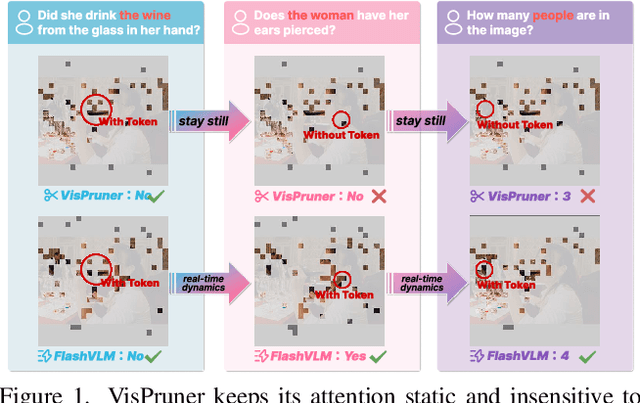
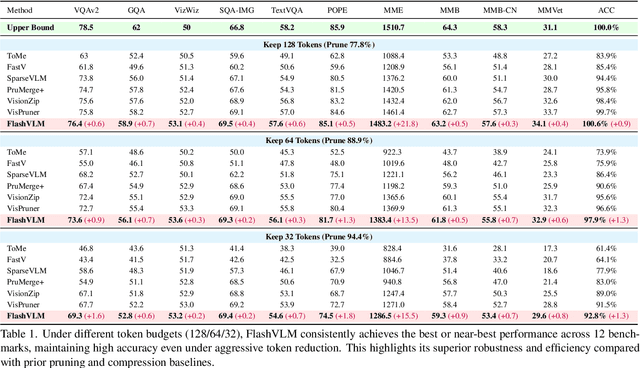
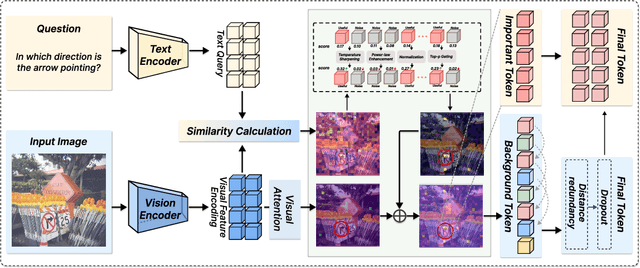
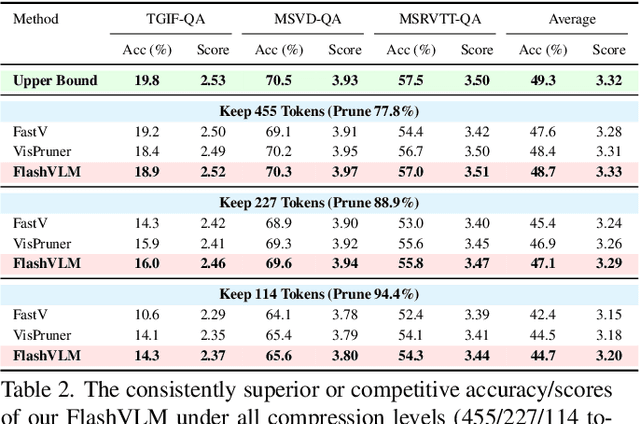
Large vision-language models (VLMs) typically process hundreds or thousands of visual tokens per image or video frame, incurring quadratic attention cost and substantial redundancy. Existing token reduction methods often ignore the textual query or rely on deep attention maps, whose instability under aggressive pruning leads to degraded semantic alignment. We propose FlashVLM, a text guided visual token selection framework that dynamically adapts visual inputs to the query. Instead of relying on noisy attention weights, FlashVLM computes an explicit cross modal similarity between projected image tokens and normalized text embeddings in the language model space. This extrinsic relevance is fused with intrinsic visual saliency using log domain weighting and temperature controlled sharpening. In addition, a diversity preserving partition retains a minimal yet representative set of background tokens to maintain global context. Under identical token budgets and evaluation protocols, FlashVLM achieves beyond lossless compression, slightly surpassing the unpruned baseline while pruning up to 77.8 percent of visual tokens on LLaVA 1.5, and maintaining 92.8 percent accuracy even under 94.4 percent compression. Extensive experiments on 14 image and video benchmarks demonstrate that FlashVLM delivers state of the art efficiency performance trade offs while maintaining strong robustness and generalization across mainstream VLMs.