 Add to Chrome
 Add to Firefox
 Add to Edge
Argus: A General-Purpose Agentic Reasoning Runtime for Long-Horizon Tasks
Aug 07, 2026
Long-horizon reasoning requires an agentic runtime that can persist when evidence supports its current approach and pivot when measurements reveal failure, hidden constraints, or a misspecified objective. We present Argus, a persistent, self-evolving runtime in which Manager, Planner, Engineer, and Reviewer execute bounded missions over durable project state. Argus separates stable user intent from operational objectives, constraints, and verification criteria, and admits memories, skills, procedures, verifiers, routing decisions, and rejected routes only after role-owned review and, when available, task-native verification. Model weights remain fixed; self-evolution occurs through persistent runtime state and control policy, with autonomous execution between operator-owned escalation points. Across seven GPT-5.5 benchmark arenas, Argus achieves about 78% on SWE-Bench Pro versus 59% for Direct Copilot while using 1.41 times the aggregate tokens. After verification-gated self-evolution, mature SWE-Bench waves use 21% fewer solve-input tokens and 15% less active workflow time per task than startup waves, while recording 34 verifier recoveries and 22 strict review-loop rescues. Argus also reaches 76.8% on AARRI-Bench and a 28.0-point gap on mathematical data synthesis, with competitive GPU-kernel and language-model-training results. Beyond benchmarks, an optimized RWKV6 kernel was merged upstream; a multi-day mathematics campaign retained falsified routes and proof-backed frontier updates; and six paper pipelines completed 254 missions with 16 stage rollbacks. These results show that a fixed-weight, self-evolving harness can revise, recover, and accumulate verified approaches while producing structured trajectories for future supervised and reinforcement learning.

Argus: A General-Purpose Agentic Runtime for Long-Horizon Reasoning
Aug 05, 2026Long-horizon reasoning requires an agentic runtime that can persist when evidence supports its current approach and pivot when measurements reveal failure, hidden constraints, or a misspecified objective. We present Argus, a persistent, self-evolving runtime in which Manager, Planner, Engineer, and Reviewer execute bounded missions over durable project state. Argus separates stable user intent from operational objectives, constraints, and verification criteria, and admits memories, skills, procedures, verifiers, routing decisions, and rejected routes only after role-owned review and, when available, task-native verification. Model weights remain fixed; self-evolution occurs through persistent runtime state and control policy, with autonomous execution between operator-owned escalation points. Across seven GPT-5.5 benchmark arenas, Argus achieves about 78% on SWE-Bench Pro versus 59% for Direct Copilot while using 1.41 times the aggregate tokens. After verification-gated self-evolution, mature SWE-Bench waves use 21% fewer solve-input tokens and 15% less active workflow time per task than startup waves, while recording 34 verifier recoveries and 22 strict review-loop rescues. Argus also reaches 76.8% on AARRI-Bench and a 28.0-point gap on mathematical data synthesis, with competitive GPU-kernel and language-model-training results. Beyond benchmarks, an optimized RWKV6 kernel was merged upstream; a multi-day mathematics campaign retained falsified routes and proof-backed frontier updates; and six paper pipelines completed 254 missions with 16 stage rollbacks. These results show that a fixed-weight, self-evolving harness can revise, recover, and accumulate verified approaches while producing structured trajectories for future supervised and reinforcement learning.
Towards Efficient LLMs Annealing with Principled Sample Selection
May 29, 2026The annealing phase is a pivotal convergence stage in LLM pre-training that ultimately determines final model quality. However, effectively selecting training data during this phase remains a key challenge. Current strategies rely on empirical heuristics, such as domain filtering or context extension, which lack a principled grounding in optimization theory. In this work, we characterize the annealing phase through the lens of the loss landscape's spectral geometry. We argue that optimal convergence requires gradient updates to satisfy heterogeneous constraints across different eigen-directions. Building on this insight, we formulate data selection as a problem of satisfying these directional constraints. To this end, we propose DiReCT (Directionally-Restrained Constrained Training), a novel framework that reformulates sample selection in the annealing stage as a constrained optimization problem. By imposing explicit directional constraints on per-sample gradients based on the spectral properties of the Hessian, DiReCT identifies samples that align with the optimal curvature-aware descent path. Extensive experiments across various model scales demonstrate that DiReCT consistently achieves state-of-the-art performance. For future research, code is available at https://github.com/xuyj233/Direct.
UniG2U-Bench: Do Unified Models Advance Multimodal Understanding?
Mar 03, 2026Unified multimodal models have recently demonstrated strong generative capabilities, yet whether and when generation improves understanding remains unclear. Existing benchmarks lack a systematic exploration of the specific tasks where generation facilitates understanding. To this end, we introduce UniG2U-Bench, a comprehensive benchmark categorizing generation-to-understanding (G2U) evaluation into 7 regimes and 30 subtasks, requiring varying degrees of implicit or explicit visual transformations. Extensive evaluation of over 30 models reveals three core findings: 1) Unified models generally underperform their base Vision-Language Models (VLMs), and Generate-then-Answer (GtA) inference typically degrades performance relative to direct inference. 2) Consistent enhancements emerge in spatial intelligence, visual illusions, or multi-round reasoning subtasks, where enhanced spatial and shape perception, as well as multi-step intermediate image states, prove beneficial. 3) Tasks with similar reasoning structures and models sharing architectures exhibit correlated behaviors, suggesting that generation-understanding coupling induces class-consistent inductive biases over tasks, pretraining data, and model architectures. These findings highlight the necessity for more diverse training data and novel paradigms to fully unlock the potential of unified multimodal modeling.
MILP-StuDio: MILP Instance Generation via Block Structure Decomposition
Oct 31, 2024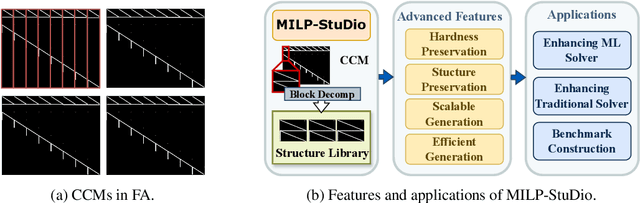
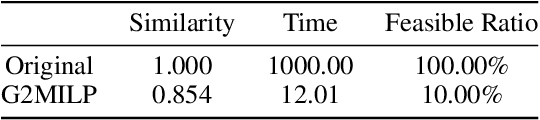
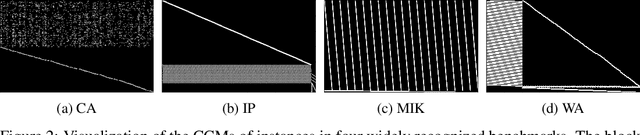

Mixed-integer linear programming (MILP) is one of the most popular mathematical formulations with numerous applications. In practice, improving the performance of MILP solvers often requires a large amount of high-quality data, which can be challenging to collect. Researchers thus turn to generation techniques to generate additional MILP instances. However, existing approaches do not take into account specific block structures -- which are closely related to the problem formulations -- in the constraint coefficient matrices (CCMs) of MILPs. Consequently, they are prone to generate computationally trivial or infeasible instances due to the disruptions of block structures and thus problem formulations. To address this challenge, we propose a novel MILP generation framework, called Block Structure Decomposition (MILP-StuDio), to generate high-quality instances by preserving the block structures. Specifically, MILP-StuDio begins by identifying the blocks in CCMs and decomposing the instances into block units, which serve as the building blocks of MILP instances. We then design three operators to construct new instances by removing, substituting, and appending block units in the original instances, enabling us to generate instances with flexible sizes. An appealing feature of MILP-StuDio is its strong ability to preserve the feasibility and computational hardness of the generated instances. Experiments on the commonly-used benchmarks demonstrate that using instances generated by MILP-StuDio is able to significantly reduce over 10% of the solving time for learning-based solvers.