 Add to Chrome
 Add to Firefox
 Add to Edge
Argus: A General-Purpose Agentic Reasoning Runtime for Long-Horizon Tasks
Aug 07, 2026
Long-horizon reasoning requires an agentic runtime that can persist when evidence supports its current approach and pivot when measurements reveal failure, hidden constraints, or a misspecified objective. We present Argus, a persistent, self-evolving runtime in which Manager, Planner, Engineer, and Reviewer execute bounded missions over durable project state. Argus separates stable user intent from operational objectives, constraints, and verification criteria, and admits memories, skills, procedures, verifiers, routing decisions, and rejected routes only after role-owned review and, when available, task-native verification. Model weights remain fixed; self-evolution occurs through persistent runtime state and control policy, with autonomous execution between operator-owned escalation points. Across seven GPT-5.5 benchmark arenas, Argus achieves about 78% on SWE-Bench Pro versus 59% for Direct Copilot while using 1.41 times the aggregate tokens. After verification-gated self-evolution, mature SWE-Bench waves use 21% fewer solve-input tokens and 15% less active workflow time per task than startup waves, while recording 34 verifier recoveries and 22 strict review-loop rescues. Argus also reaches 76.8% on AARRI-Bench and a 28.0-point gap on mathematical data synthesis, with competitive GPU-kernel and language-model-training results. Beyond benchmarks, an optimized RWKV6 kernel was merged upstream; a multi-day mathematics campaign retained falsified routes and proof-backed frontier updates; and six paper pipelines completed 254 missions with 16 stage rollbacks. These results show that a fixed-weight, self-evolving harness can revise, recover, and accumulate verified approaches while producing structured trajectories for future supervised and reinforcement learning.

Argus: A General-Purpose Agentic Runtime for Long-Horizon Reasoning
Aug 05, 2026Long-horizon reasoning requires an agentic runtime that can persist when evidence supports its current approach and pivot when measurements reveal failure, hidden constraints, or a misspecified objective. We present Argus, a persistent, self-evolving runtime in which Manager, Planner, Engineer, and Reviewer execute bounded missions over durable project state. Argus separates stable user intent from operational objectives, constraints, and verification criteria, and admits memories, skills, procedures, verifiers, routing decisions, and rejected routes only after role-owned review and, when available, task-native verification. Model weights remain fixed; self-evolution occurs through persistent runtime state and control policy, with autonomous execution between operator-owned escalation points. Across seven GPT-5.5 benchmark arenas, Argus achieves about 78% on SWE-Bench Pro versus 59% for Direct Copilot while using 1.41 times the aggregate tokens. After verification-gated self-evolution, mature SWE-Bench waves use 21% fewer solve-input tokens and 15% less active workflow time per task than startup waves, while recording 34 verifier recoveries and 22 strict review-loop rescues. Argus also reaches 76.8% on AARRI-Bench and a 28.0-point gap on mathematical data synthesis, with competitive GPU-kernel and language-model-training results. Beyond benchmarks, an optimized RWKV6 kernel was merged upstream; a multi-day mathematics campaign retained falsified routes and proof-backed frontier updates; and six paper pipelines completed 254 missions with 16 stage rollbacks. These results show that a fixed-weight, self-evolving harness can revise, recover, and accumulate verified approaches while producing structured trajectories for future supervised and reinforcement learning.
Mage-Flow: An Efficient Native-Resolution Foundation Model for Image Generation and Editing
Jul 21, 2026Large-scale visual generators are increasingly capable but costly to train, fine-tune, and deploy. We introduce Mage-Flow, a compact 4B-scale generative stack for efficient text-to-image generation and instruction-based image editing. The stack is built from two co-designed components: Mage-VAE, a lightweight high-fidelity latent tokenizer, and a Native-Resolution Multimodal Diffusion Transformer trained with rectified flow matching. Mage-VAE uses one-step diffusion-style encoding and decoding with anchor-latent regularization, preserving the reconstruction quality of strong public VAEs while reducing tokenization cost by more than an order of magnitude. Together with native-resolution packing and stack-level CUDA kernel fusion, the stack supports flexible-resolution training and improves end-to-end training throughput by about $2.5\times$. Built on this foundation, we develop a complete model family with Base, RL-aligned, and Turbo variants for both generation and editing. Diffusion-NFT improves prompt following, text rendering, aesthetic quality, and editing fidelity, while few-step distillation with adversarial perceptual guidance produces 4-step Turbo models for low-latency inference. Despite its compact scale, Mage-Flow and Mage-Flow-Edit achieves competitive performance across standard generation and editing benchmarks. More importantly, the Turbo variants make high-resolution generation and editing practical for interactive use: at $1024^2$ resolution on a single NVIDIA A100 GPU, Mage-Flow-Turbo generates an image in 0.59s, and Mage-Flow-Edit-Turbo edits an image in 1.02s, while maintaining a small memory footprint. These results show that careful tokenizer--backbone--system co-design can deliver strong high-resolution generation and editing within an efficient 4B model family.
Never Too Late for Force: Accelerating VLA Post-Training with Reactive Force Injection
Jul 15, 2026Pretrained vision-language-action (VLA) policies provide strong language-conditioned manipulation knowledge, but they remain largely vision-driven and can struggle once manipulation enters contact states where the scene is occluded, depth is ambiguous, or small force errors push execution off the offline demonstration distribution. We present LIFT (Late Reactive Injection of Force for VLA Post-Training), a force-aware post-training framework that adds contact reactivity to a pretrained VLA policy while preserving its general manipulation knowledge. LIFT grafts a reactive action expert beside the original action expert, initializes it from pretrained action weights, and injects recent 6D end-effector force through causal force memory and zero-initialized cross attention, enabling actions to be refreshed during execution. To address the policy-dependent distribution shift of contact feedback, LIFT further couples reactive force injection with an online DAgger loop that trains on a mixture of offline task-alignment data and human-corrected online rollouts. Across towel folding, book insertion, and Hanoi ring placement, LIFT learns faster and reaches higher performance than vision-only post-training, while ablations show that reactive force memory and online corrective data are both important for robust contact-rich manipulation. Our code and data will be publicly available.
RESOURCE2SKILL: Distilling Executable Agent Skills from Human-Created Multimodal Resources
Jun 28, 2026Skills are a useful abstraction for software agents, turning human and agent experience into reusable procedural knowledge. Yet existing skill libraries are mostly hand-written, text-centric, or derived from agent traces, leaving tutorial videos and other multimodal human resources largely underused. We present RESOURCE2SKILL, a framework that distills multimodal resources, including tutorial videos, repositories, articles, and reference artifacts, into executable skills for software agents. RESOURCE2SKILL organizes these skills as a hierarchical multimodal Skill Wiki, where each entry combines structured text, code, visual examples, metadata, and provenance. This design preserves complementary signals from different resources: videos capture temporal operations and visual effects, code captures executable tool patterns, and articles or artifacts provide conceptual and stylistic grounding. At inference time, agents retrieve and compose relevant skills from the wiki; when coverage is insufficient, the same construction operator can acquire new skills online. Across seven practical authoring domains, RESOURCE2SKILL improves average overall score by +11.9 percentage points over no-skill agents and outperforms strong harness baselines in 26 of 28 main-aggregate model-domain cells. Ablations confirm the value of multimodal skill format, hierarchical organization, source diversity, selection strategy, and online acquisition.
UniG2U-Bench: Do Unified Models Advance Multimodal Understanding?
Mar 03, 2026Unified multimodal models have recently demonstrated strong generative capabilities, yet whether and when generation improves understanding remains unclear. Existing benchmarks lack a systematic exploration of the specific tasks where generation facilitates understanding. To this end, we introduce UniG2U-Bench, a comprehensive benchmark categorizing generation-to-understanding (G2U) evaluation into 7 regimes and 30 subtasks, requiring varying degrees of implicit or explicit visual transformations. Extensive evaluation of over 30 models reveals three core findings: 1) Unified models generally underperform their base Vision-Language Models (VLMs), and Generate-then-Answer (GtA) inference typically degrades performance relative to direct inference. 2) Consistent enhancements emerge in spatial intelligence, visual illusions, or multi-round reasoning subtasks, where enhanced spatial and shape perception, as well as multi-step intermediate image states, prove beneficial. 3) Tasks with similar reasoning structures and models sharing architectures exhibit correlated behaviors, suggesting that generation-understanding coupling induces class-consistent inductive biases over tasks, pretraining data, and model architectures. These findings highlight the necessity for more diverse training data and novel paradigms to fully unlock the potential of unified multimodal modeling.
3D-Agent:Tri-Modal Multi-Agent Collaboration for Scalable 3D Object Annotation
Jan 07, 2026Driven by applications in autonomous driving robotics and augmented reality 3D object annotation presents challenges beyond 2D annotation including spatial complexity occlusion and viewpoint inconsistency Existing approaches based on single models often struggle to address these issues effectively We propose Tri MARF a novel framework that integrates tri modal inputs including 2D multi view images textual descriptions and 3D point clouds within a multi agent collaborative architecture to enhance large scale 3D annotation Tri MARF consists of three specialized agents a vision language model agent for generating multi view descriptions an information aggregation agent for selecting optimal descriptions and a gating agent that aligns textual semantics with 3D geometry for refined captioning Extensive experiments on Objaverse LVIS Objaverse XL and ABO demonstrate that Tri MARF substantially outperforms existing methods achieving a CLIPScore of 88 point 7 compared to prior state of the art methods retrieval accuracy of 45 point 2 and 43 point 8 on ViLT R at 5 and a throughput of up to 12000 objects per hour on a single NVIDIA A100 GPU
PAST: A Primary-Auxiliary Spatio-Temporal Network for Traffic Time Series Imputation
Nov 17, 2025
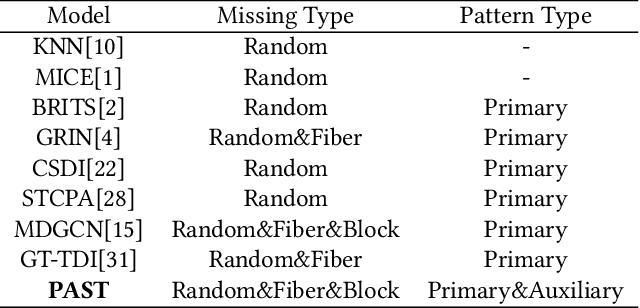
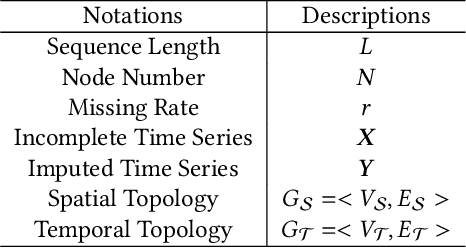
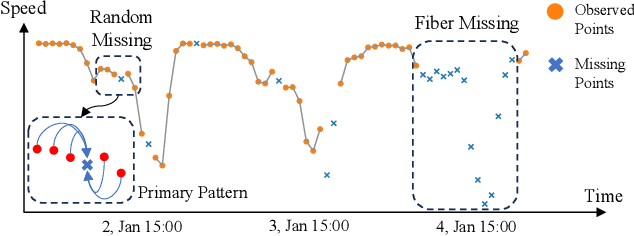
Traffic time series imputation is crucial for the safety and reliability of intelligent transportation systems, while diverse types of missing data, including random, fiber, and block missing make the imputation task challenging. Existing models often focus on disentangling and separately modeling spatial and temporal patterns based on relationships between data points. However, these approaches struggle to adapt to the random missing positions, and fail to learn long-term and large-scale dependencies, which are essential in extensive missing conditions. In this paper, patterns are categorized into two types to handle various missing data conditions: primary patterns, which originate from internal relationships between data points, and auxiliary patterns, influenced by external factors like timestamps and node attributes. Accordingly, we propose the Primary-Auxiliary Spatio-Temporal network (PAST). It comprises a graph-integrated module (GIM) and a cross-gated module (CGM). GIM captures primary patterns via dynamic graphs with interval-aware dropout and multi-order convolutions, and CGM extracts auxiliary patterns through bidirectional gating on embedded external features. The two modules interact via shared hidden vectors and are trained under an ensemble self-supervised framework. Experiments on three datasets under 27 missing data conditions demonstrate that the imputation accuracy of PAST outperforms seven state-of-the-art baselines by up to 26.2% in RMSE and 31.6% in MAE.