 Add to Chrome
 Add to Firefox
 Add to Edge
INSIDE: LLMs' Internal States Retain the Power of Hallucination Detection
Feb 06, 2024
Knowledge hallucination have raised widespread concerns for the security and reliability of deployed LLMs. Previous efforts in detecting hallucinations have been employed at logit-level uncertainty estimation or language-level self-consistency evaluation, where the semantic information is inevitably lost during the token-decoding procedure. Thus, we propose to explore the dense semantic information retained within LLMs' \textbf{IN}ternal \textbf{S}tates for halluc\textbf{I}nation \textbf{DE}tection (\textbf{INSIDE}). In particular, a simple yet effective \textbf{EigenScore} metric is proposed to better evaluate responses' self-consistency, which exploits the eigenvalues of responses' covariance matrix to measure the semantic consistency/diversity in the dense embedding space. Furthermore, from the perspective of self-consistent hallucination detection, a test time feature clipping approach is explored to truncate extreme activations in the internal states, which reduces overconfident generations and potentially benefits the detection of overconfident hallucinations. Extensive experiments and ablation studies are performed on several popular LLMs and question-answering (QA) benchmarks, showing the effectiveness of our proposal.

DoF Analysis for -Channels through a Number-Filling Puzzle
Feb 03, 2024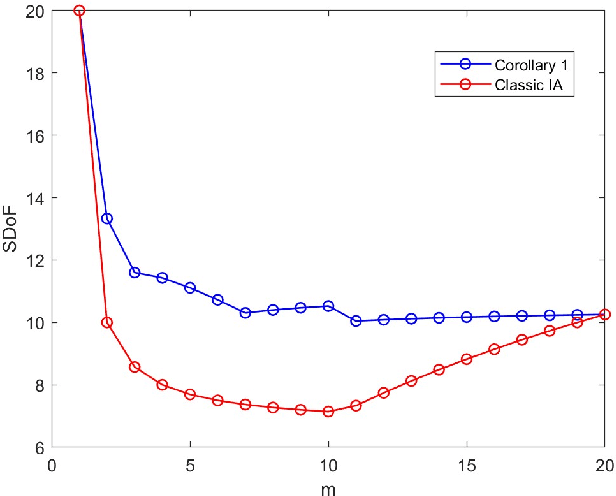
We consider a $\sf K$ user interference network with general connectivity, described by a matrix $\mat{N}$, and general message flows, described by a matrix $\mat{M}$. Previous studies have demonstrated that the standard interference scheme (IA) might not be optimal for networks with sparse connectivity. In this paper, we formalize a general IA coding scheme and an intuitive number-filling puzzle for given $\mat{M}$ and $\mat{N}$ in a way that the score of the solution to the puzzle determines the optimum sum degrees that can be achieved by the IA scheme. A solution to the puzzle is proposed for a general class of symmetric channels, and it is shown that this solution leads to significantly higher $\SDoF$ than the standard IA scheme.
TCI-Former: Thermal Conduction-Inspired Transformer for Infrared Small Target Detection
Feb 03, 2024


Infrared small target detection (ISTD) is critical to national security and has been extensively applied in military areas. ISTD aims to segment small target pixels from background. Most ISTD networks focus on designing feature extraction blocks or feature fusion modules, but rarely describe the ISTD process from the feature map evolution perspective. In the ISTD process, the network attention gradually shifts towards target areas. We abstract this process as the directional movement of feature map pixels to target areas through convolution, pooling and interactions with surrounding pixels, which can be analogous to the movement of thermal particles constrained by surrounding variables and particles. In light of this analogy, we propose Thermal Conduction-Inspired Transformer (TCI-Former) based on the theoretical principles of thermal conduction. According to thermal conduction differential equation in heat dynamics, we derive the pixel movement differential equation (PMDE) in the image domain and further develop two modules: Thermal Conduction-Inspired Attention (TCIA) and Thermal Conduction Boundary Module (TCBM). TCIA incorporates finite difference method with PMDE to reach a numerical approximation so that target body features can be extracted. To further remove errors in boundary areas, TCBM is designed and supervised by boundary masks to refine target body features with fine boundary details. Experiments on IRSTD-1k and NUAA-SIRST demonstrate the superiority of our method.
MoMA: Model-based Mirror Ascent for Offline Reinforcement Learning
Jan 21, 2024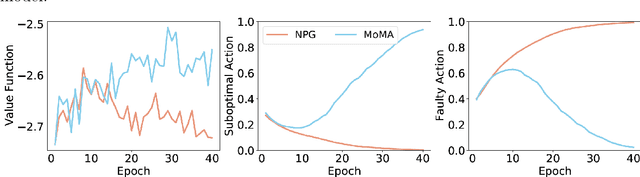
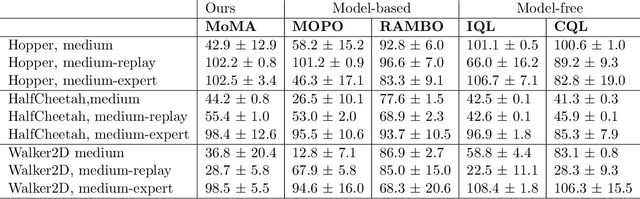
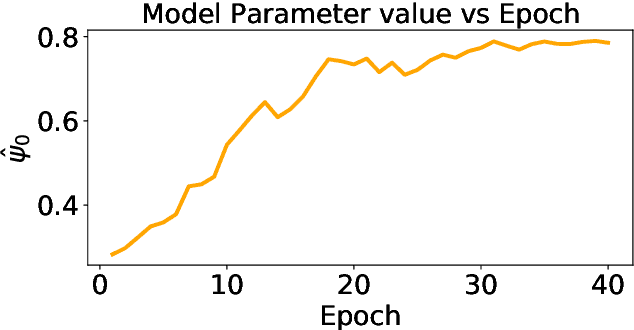
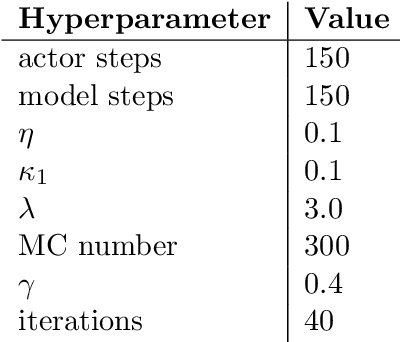
Model-based offline reinforcement learning methods (RL) have achieved state-of-the-art performance in many decision-making problems thanks to their sample efficiency and generalizability. Despite these advancements, existing model-based offline RL approaches either focus on theoretical studies without developing practical algorithms or rely on a restricted parametric policy space, thus not fully leveraging the advantages of an unrestricted policy space inherent to model-based methods. To address this limitation, we develop MoMA, a model-based mirror ascent algorithm with general function approximations under partial coverage of offline data. MoMA distinguishes itself from existing literature by employing an unrestricted policy class. In each iteration, MoMA conservatively estimates the value function by a minimization procedure within a confidence set of transition models in the policy evaluation step, then updates the policy with general function approximations instead of commonly-used parametric policy classes in the policy improvement step. Under some mild assumptions, we establish theoretical guarantees of MoMA by proving an upper bound on the suboptimality of the returned policy. We also provide a practically implementable, approximate version of the algorithm. The effectiveness of MoMA is demonstrated via numerical studies.
PIXART-δ: Fast and Controllable Image Generation with Latent Consistency Models
Jan 10, 2024This technical report introduces PIXART-{\delta}, a text-to-image synthesis framework that integrates the Latent Consistency Model (LCM) and ControlNet into the advanced PIXART-{\alpha} model. PIXART-{\alpha} is recognized for its ability to generate high-quality images of 1024px resolution through a remarkably efficient training process. The integration of LCM in PIXART-{\delta} significantly accelerates the inference speed, enabling the production of high-quality images in just 2-4 steps. Notably, PIXART-{\delta} achieves a breakthrough 0.5 seconds for generating 1024x1024 pixel images, marking a 7x improvement over the PIXART-{\alpha}. Additionally, PIXART-{\delta} is designed to be efficiently trainable on 32GB V100 GPUs within a single day. With its 8-bit inference capability (von Platen et al., 2023), PIXART-{\delta} can synthesize 1024px images within 8GB GPU memory constraints, greatly enhancing its usability and accessibility. Furthermore, incorporating a ControlNet-like module enables fine-grained control over text-to-image diffusion models. We introduce a novel ControlNet-Transformer architecture, specifically tailored for Transformers, achieving explicit controllability alongside high-quality image generation. As a state-of-the-art, open-source image generation model, PIXART-{\delta} offers a promising alternative to the Stable Diffusion family of models, contributing significantly to text-to-image synthesis.
A Survey of Reasoning with Foundation Models
Dec 26, 2023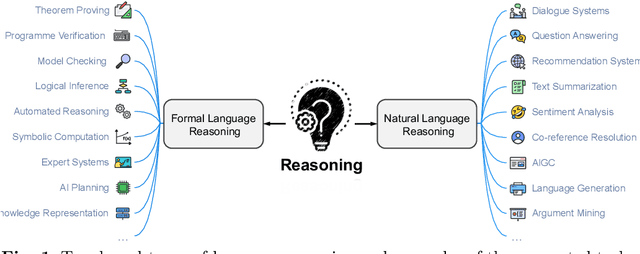


Reasoning, a crucial ability for complex problem-solving, plays a pivotal role in various real-world settings such as negotiation, medical diagnosis, and criminal investigation. It serves as a fundamental methodology in the field of Artificial General Intelligence (AGI). With the ongoing development of foundation models, there is a growing interest in exploring their abilities in reasoning tasks. In this paper, we introduce seminal foundation models proposed or adaptable for reasoning, highlighting the latest advancements in various reasoning tasks, methods, and benchmarks. We then delve into the potential future directions behind the emergence of reasoning abilities within foundation models. We also discuss the relevance of multimodal learning, autonomous agents, and super alignment in the context of reasoning. By discussing these future research directions, we hope to inspire researchers in their exploration of this field, stimulate further advancements in reasoning with foundation models, and contribute to the development of AGI.
Neural Gaussian Similarity Modeling for Differential Graph Structure Learning
Dec 15, 2023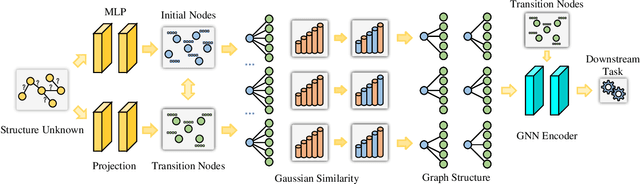
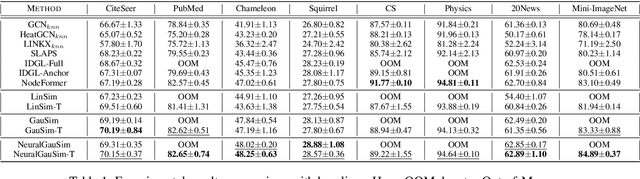
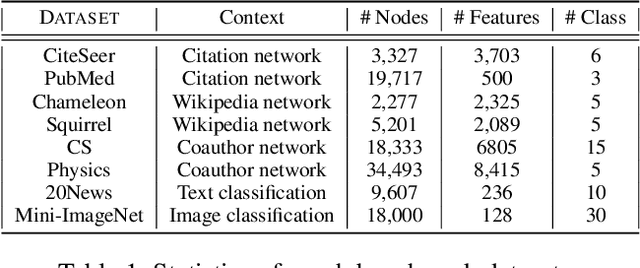
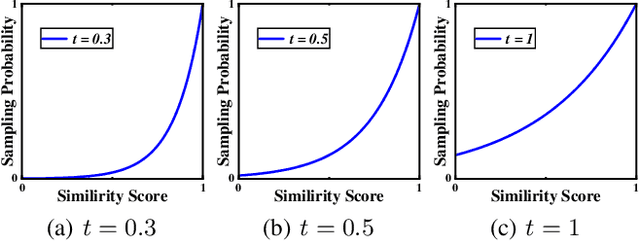
Graph Structure Learning (GSL) has demonstrated considerable potential in the analysis of graph-unknown non-Euclidean data across a wide range of domains. However, constructing an end-to-end graph structure learning model poses a challenge due to the impediment of gradient flow caused by the nearest neighbor sampling strategy. In this paper, we construct a differential graph structure learning model by replacing the non-differentiable nearest neighbor sampling with a differentiable sampling using the reparameterization trick. Under this framework, we argue that the act of sampling \mbox{nearest} neighbors may not invariably be essential, particularly in instances where node features exhibit a significant degree of similarity. To alleviate this issue, the bell-shaped Gaussian Similarity (GauSim) modeling is proposed to sample non-nearest neighbors. To adaptively model the similarity, we further propose Neural Gaussian Similarity (NeuralGauSim) with learnable parameters featuring flexible sampling behaviors. In addition, we develop a scalable method by transferring the large-scale graph to the transition graph to significantly reduce the complexity. Experimental results demonstrate the effectiveness of the proposed methods.
SimAC: A Simple Anti-Customization Method against Text-to-Image Synthesis of Diffusion Models
Dec 13, 2023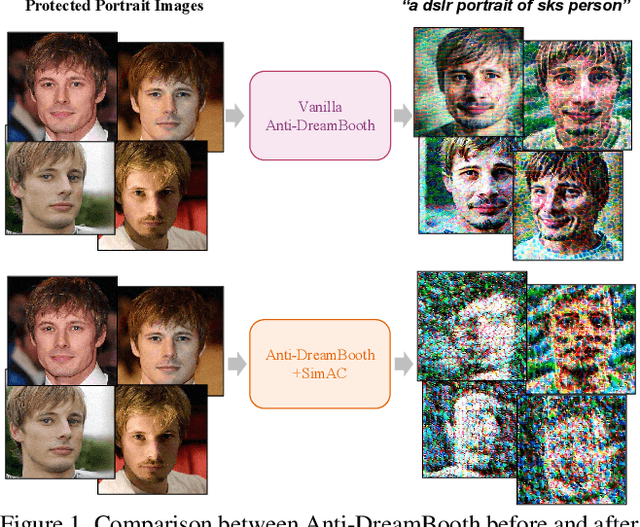
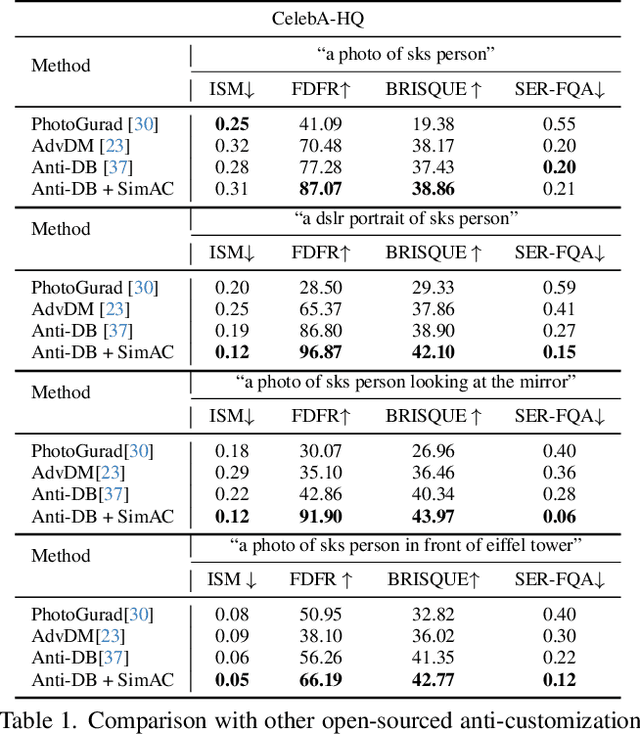
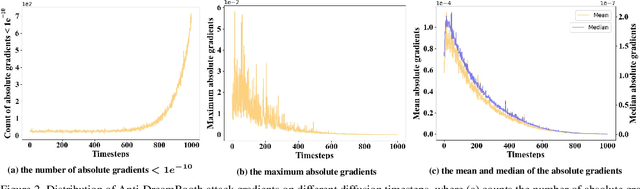
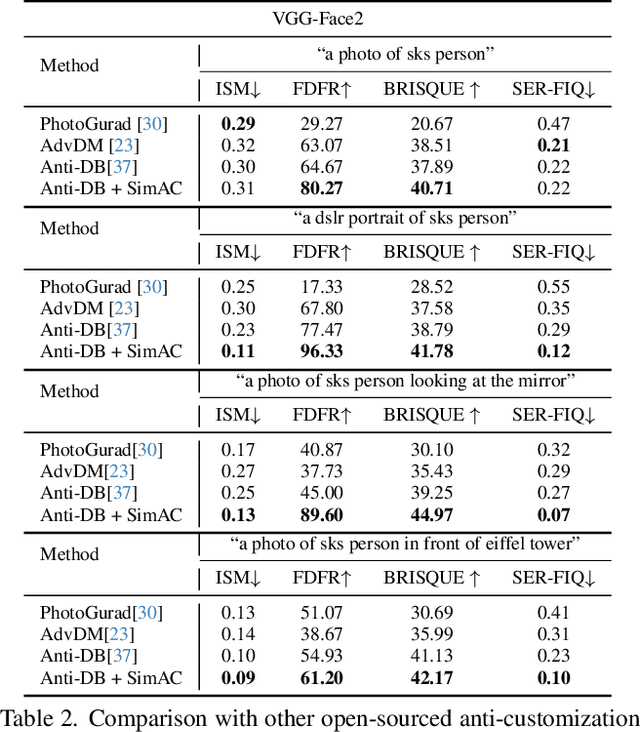
Despite the success of diffusion-based customization methods on visual content creation, increasing concerns have been raised about such techniques from both privacy and political perspectives. To tackle this issue, several anti-customization methods have been proposed in very recent months, predominantly grounded in adversarial attacks. Unfortunately, most of these methods adopt straightforward designs, such as end-to-end optimization with a focus on adversarially maximizing the original training loss, thereby neglecting nuanced internal properties intrinsic to the diffusion model, and even leading to ineffective optimization in some diffusion time steps. In this paper, we strive to bridge this gap by undertaking a comprehensive exploration of these inherent properties, to boost the performance of current anti-customization approaches. Two aspects of properties are investigated: 1) We examine the relationship between time step selection and the model's perception in the frequency domain of images and find that lower time steps can give much more contributions to adversarial noises. This inspires us to propose an adaptive greedy search for optimal time steps that seamlessly integrates with existing anti-customization methods. 2) We scrutinize the roles of features at different layers during denoising and devise a sophisticated feature-based optimization framework for anti-customization. Experiments on facial benchmarks demonstrate that our approach significantly increases identity disruption, thereby enhancing user privacy and security.
Fast Training of Diffusion Transformer with Extreme Masking for 3D Point Clouds Generation
Dec 12, 2023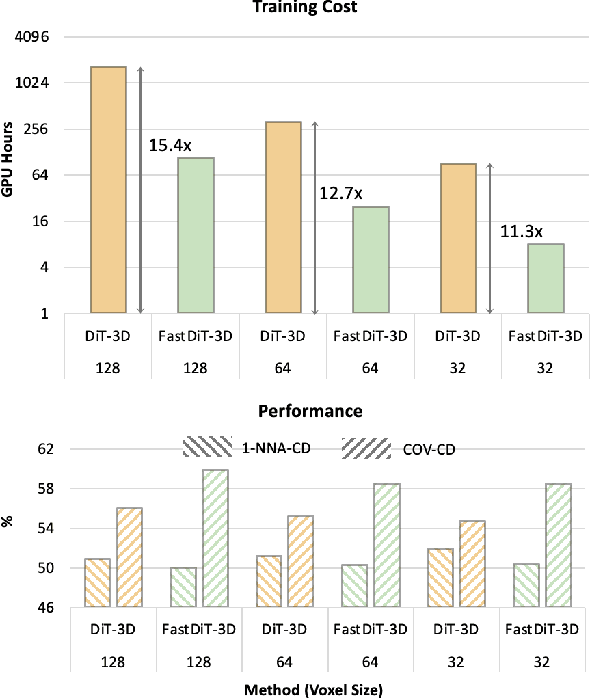
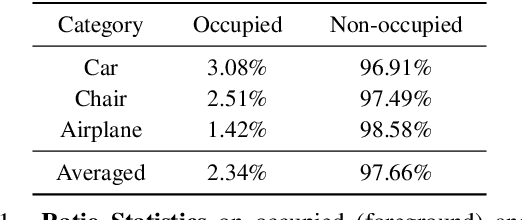
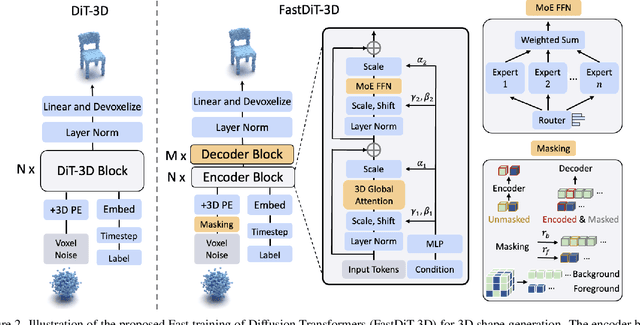
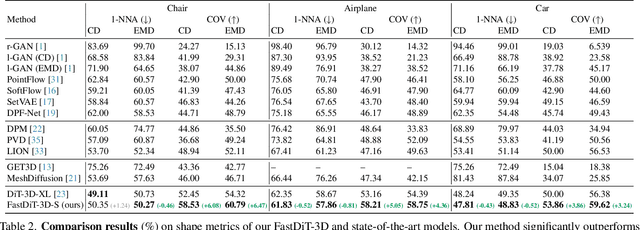
Diffusion Transformers have recently shown remarkable effectiveness in generating high-quality 3D point clouds. However, training voxel-based diffusion models for high-resolution 3D voxels remains prohibitively expensive due to the cubic complexity of attention operators, which arises from the additional dimension of voxels. Motivated by the inherent redundancy of 3D compared to 2D, we propose FastDiT-3D, a novel masked diffusion transformer tailored for efficient 3D point cloud generation, which greatly reduces training costs. Specifically, we draw inspiration from masked autoencoders to dynamically operate the denoising process on masked voxelized point clouds. We also propose a novel voxel-aware masking strategy to adaptively aggregate background/foreground information from voxelized point clouds. Our method achieves state-of-the-art performance with an extreme masking ratio of nearly 99%. Moreover, to improve multi-category 3D generation, we introduce Mixture-of-Expert (MoE) in 3D diffusion model. Each category can learn a distinct diffusion path with different experts, relieving gradient conflict. Experimental results on the ShapeNet dataset demonstrate that our method achieves state-of-the-art high-fidelity and diverse 3D point cloud generation performance. Our FastDiT-3D improves 1-Nearest Neighbor Accuracy and Coverage metrics when generating 128-resolution voxel point clouds, using only 6.5% of the original training cost.
PCRDiffusion: Diffusion Probabilistic Models for Point Cloud Registration
Dec 11, 2023We propose a new framework that formulates point cloud registration as a denoising diffusion process from noisy transformation to object transformation. During training stage, object transformation diffuses from ground-truth transformation to random distribution, and the model learns to reverse this noising process. In sampling stage, the model refines randomly generated transformation to the output result in a progressive way. We derive the variational bound in closed form for training and provide implementations of the model. Our work provides the following crucial findings: (i) In contrast to most existing methods, our framework, Diffusion Probabilistic Models for Point Cloud Registration (PCRDiffusion) does not require repeatedly update source point cloud to refine the predicted transformation. (ii) Point cloud registration, one of the representative discriminative tasks, can be solved by a generative way and the unified probabilistic formulation. Finally, we discuss and provide an outlook on the application of diffusion model in different scenarios for point cloud registration. Experimental results demonstrate that our model achieves competitive performance in point cloud registration. In correspondence-free and correspondence-based scenarios, PCRDifussion can both achieve exceeding 50\% performance improvements.