 Add to Chrome
 Add to Firefox
 Add to Edge
FoundationGeo: Learning Spatial Pixel-Wise Fields for Monocular Metric Geometry
Jul 14, 2026
We present FoundationGeo, a two-stage framework that explicitly bridges relative and metric prediction via spatial calibration and principled data design. Stage 1 learns a high-fidelity, affine-invariant geometry model by initializing with DINOv3 and training on a curated 10.2M-sample multi-domain corpus with complementary local-detail supervision, yielding sharp boundaries and strong cross-domain generalization. Stage 2 moves beyond global scaling by introducing lightweight pixel-wise calibration fields for metric estimation: a scale field for spatially varying metric alignment and a ray-direction correction field that mitigates directional bias in point-map geometry, together producing metrically consistent 3D point maps. Beyond model design, we identify camera intrinsic coverage, especially focal length distribution mismatch between training and test data, as a key bottleneck for zero-shot metric generalization: performance drops sharply when test intrinsics fall outside the training distribution. To address this, we synthesize additional training data across diverse focal lengths using a Blender-based data engine, repairing under-covered focal regimes and improving robustness under intrinsic shift. Extensive zero-shot evaluations across seven benchmarks show that FoundationGeo significantly strengthens cross-domain robustness, staying near the top across diverse domains while avoiding the sharp cross-domain performance drops observed in other methods. This consistency translates into the best overall performance, surpassing heavier baselines by over 5.2% on average.

Eligibility-Aware Evidence Synthesis: An Agentic Framework for Clinical Trial Meta-Analysis
Apr 03, 2026Clinical evidence synthesis requires identifying relevant trials from large registries and aggregating results that account for population differences. While recent LLM-based approaches have automated components of systematic review, they do not support end-to-end evidence synthesis. Moreover, conventional meta-analysis weights studies by statistical precision without considering clinical compatibility reflected in eligibility criteria. We propose EligMeta, an agentic framework that integrates automated trial discovery with eligibility-aware meta-analysis, translating natural-language queries into reproducible trial selection and incorporating eligibility alignment into study weighting to produce cohort-specific pooled estimates. EligMeta employs a hybrid architecture separating LLM-based reasoning from deterministic execution: LLMs generate interpretable rules from natural-language queries and perform schema-constrained parsing of trial metadata, while all logical operations, weight computations, and statistical pooling are executed deterministically to ensure reproducibility. The framework structures eligibility criteria and computes similarity-based study weights reflecting population alignment between target and comparator trials. In a gastric cancer landscape analysis, EligMeta reduced 4,044 candidate trials to 39 clinically relevant studies through rule-based filtering, recovering all 13 guideline-cited trials. In an olaparib adverse events meta-analysis across four trials, eligibility-aware weighting shifted the pooled risk ratio from 2.18 (95% CI: 1.71-2.79) under conventional Mantel-Haenszel estimation to 1.97 (95% CI: 1.76-2.20), demonstrating quantifiable impact of incorporating eligibility alignment. EligMeta bridges automated trial discovery with eligibility-aware meta-analysis, providing a scalable and reproducible framework for evidence synthesis in precision medicine.
TransformerLSR: Attentive Joint Model of Longitudinal Data, Survival, and Recurrent Events with Concurrent Latent Structure
Apr 04, 2024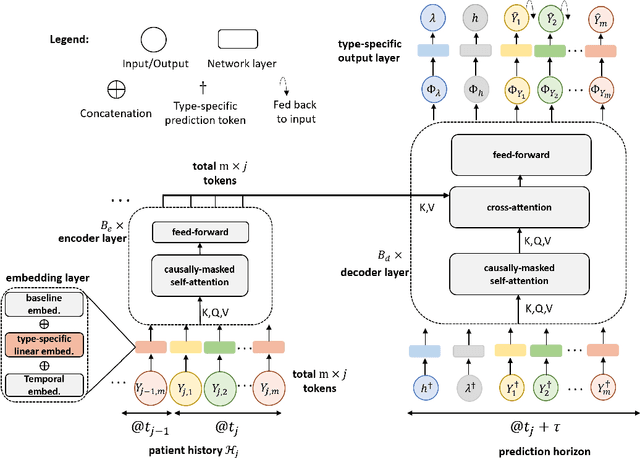
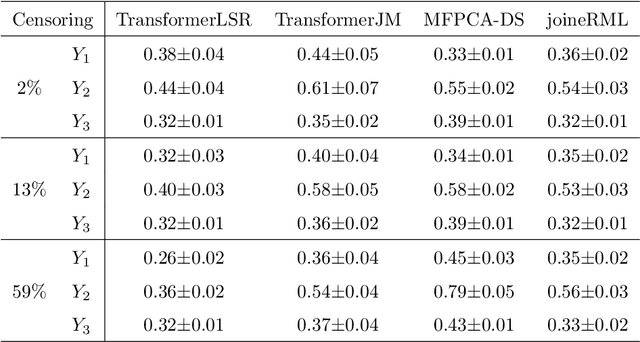

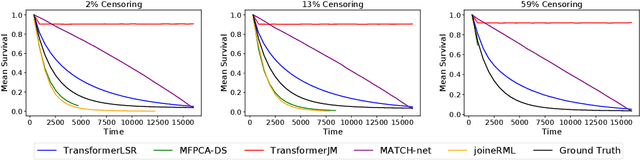
In applications such as biomedical studies, epidemiology, and social sciences, recurrent events often co-occur with longitudinal measurements and a terminal event, such as death. Therefore, jointly modeling longitudinal measurements, recurrent events, and survival data while accounting for their dependencies is critical. While joint models for the three components exist in statistical literature, many of these approaches are limited by heavy parametric assumptions and scalability issues. Recently, incorporating deep learning techniques into joint modeling has shown promising results. However, current methods only address joint modeling of longitudinal measurements at regularly-spaced observation times and survival events, neglecting recurrent events. In this paper, we develop TransformerLSR, a flexible transformer-based deep modeling and inference framework to jointly model all three components simultaneously. TransformerLSR integrates deep temporal point processes into the joint modeling framework, treating recurrent and terminal events as two competing processes dependent on past longitudinal measurements and recurrent event times. Additionally, TransformerLSR introduces a novel trajectory representation and model architecture to potentially incorporate a priori knowledge of known latent structures among concurrent longitudinal variables. We demonstrate the effectiveness and necessity of TransformerLSR through simulation studies and analyzing a real-world medical dataset on patients after kidney transplantation.
MoMA: Model-based Mirror Ascent for Offline Reinforcement Learning
Jan 21, 2024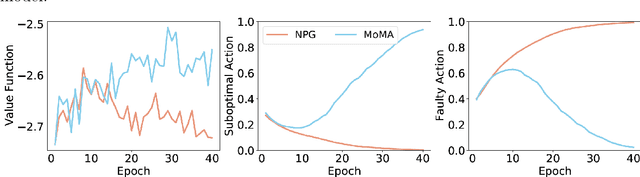
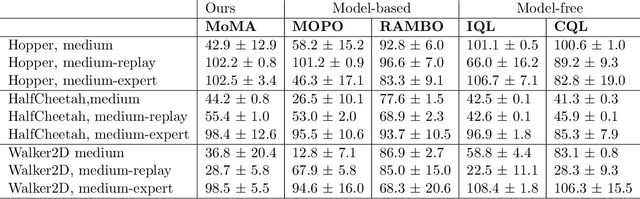
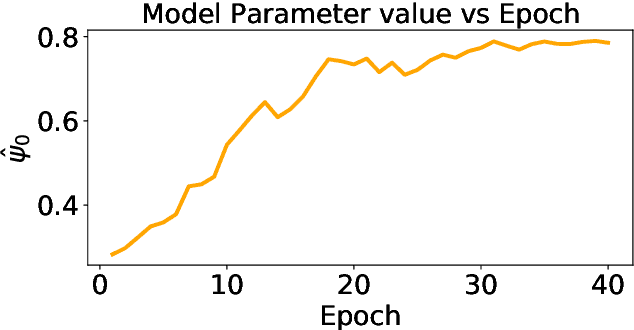
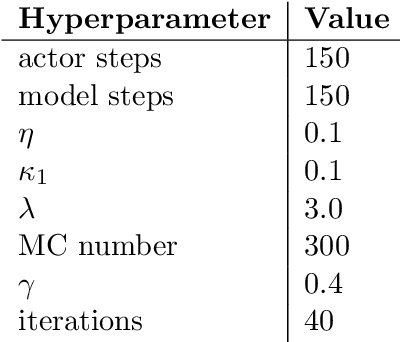
Model-based offline reinforcement learning methods (RL) have achieved state-of-the-art performance in many decision-making problems thanks to their sample efficiency and generalizability. Despite these advancements, existing model-based offline RL approaches either focus on theoretical studies without developing practical algorithms or rely on a restricted parametric policy space, thus not fully leveraging the advantages of an unrestricted policy space inherent to model-based methods. To address this limitation, we develop MoMA, a model-based mirror ascent algorithm with general function approximations under partial coverage of offline data. MoMA distinguishes itself from existing literature by employing an unrestricted policy class. In each iteration, MoMA conservatively estimates the value function by a minimization procedure within a confidence set of transition models in the policy evaluation step, then updates the policy with general function approximations instead of commonly-used parametric policy classes in the policy improvement step. Under some mild assumptions, we establish theoretical guarantees of MoMA by proving an upper bound on the suboptimality of the returned policy. We also provide a practically implementable, approximate version of the algorithm. The effectiveness of MoMA is demonstrated via numerical studies.
A Scalable Framework for Sparse Clustering Without Shrinkage
Feb 20, 2020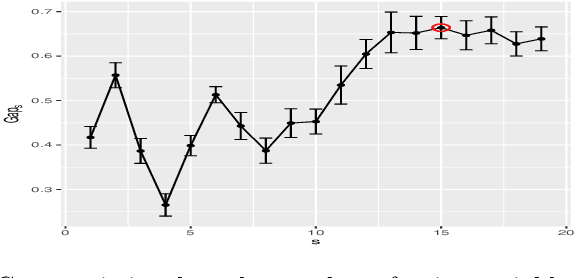
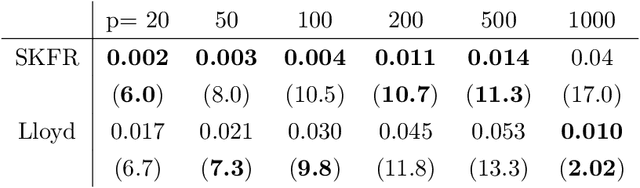
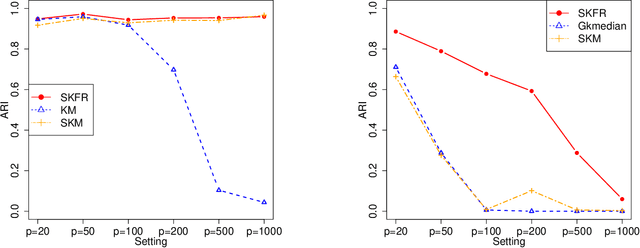
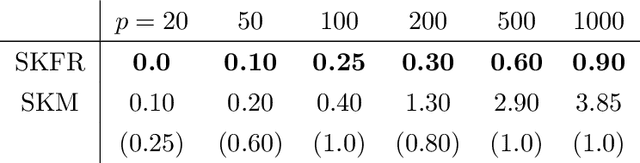
Clustering, a fundamental activity in unsupervised learning, is notoriously difficult when the feature space is high-dimensional. Fortunately, in many realistic scenarios, only a handful of features are relevant in distinguishing clusters. This has motivated the development of sparse clustering techniques that typically rely on k-means within outer algorithms of high computational complexity. Current techniques also require careful tuning of shrinkage parameters, further limiting their scalability. In this paper, we propose a novel framework for sparse k-means clustering that is intuitive, simple to implement, and competitive with state-of-the-art algorithms. We show that our algorithm enjoys consistency and convergence guarantees. Our core method readily generalizes to several task-specific algorithms such as clustering on subsets of attributes and in partially observed data settings. We showcase these contributions via simulated experiments and benchmark datasets, as well as a case study on mouse protein expression.