 Add to Chrome
 Add to Firefox
 Add to Edge
Driving Everywhere with Large Language Model Policy Adaptation
Feb 08, 2024
Adapting driving behavior to new environments, customs, and laws is a long-standing problem in autonomous driving, precluding the widespread deployment of autonomous vehicles (AVs). In this paper, we present LLaDA, a simple yet powerful tool that enables human drivers and autonomous vehicles alike to drive everywhere by adapting their tasks and motion plans to traffic rules in new locations. LLaDA achieves this by leveraging the impressive zero-shot generalizability of large language models (LLMs) in interpreting the traffic rules in the local driver handbook. Through an extensive user study, we show that LLaDA's instructions are useful in disambiguating in-the-wild unexpected situations. We also demonstrate LLaDA's ability to adapt AV motion planning policies in real-world datasets; LLaDA outperforms baseline planning approaches on all our metrics. Please check our website for more details: https://boyiliee.github.io/llada.

RA-Rec: An Efficient ID Representation Alignment Framework for LLM-based Recommendation
Feb 07, 2024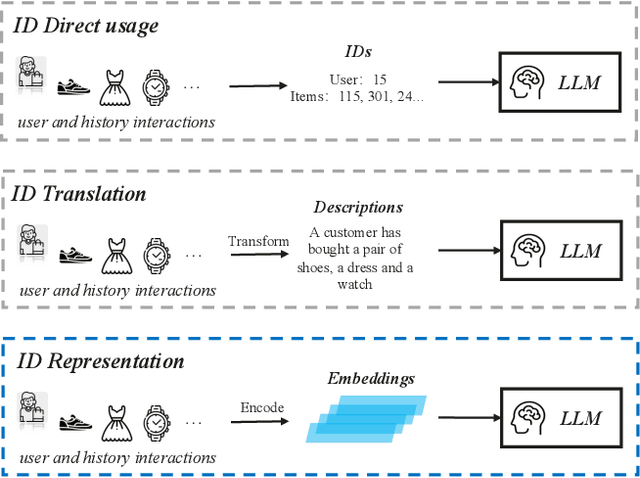
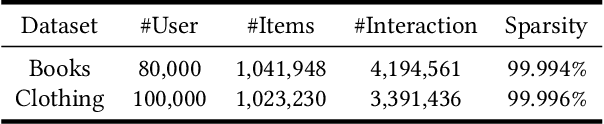
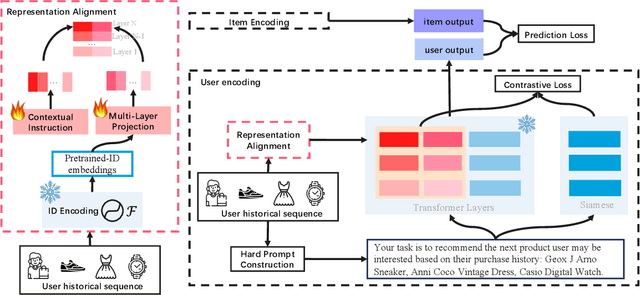
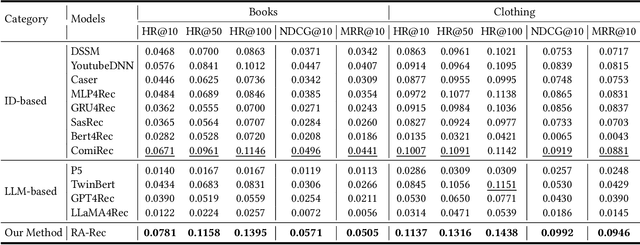
Large language models (LLM) have recently emerged as a powerful tool for a variety of natural language processing tasks, bringing a new surge of combining LLM with recommendation systems, termed as LLM-based RS. Current approaches generally fall into two main paradigms, the ID direct usage paradigm and the ID translation paradigm, noting their core weakness stems from lacking recommendation knowledge and uniqueness. To address this limitation, we propose a new paradigm, ID representation, which incorporates pre-trained ID embeddings into LLMs in a complementary manner. In this work, we present RA-Rec, an efficient ID representation alignment framework for LLM-based recommendation, which is compatible with multiple ID-based methods and LLM architectures. Specifically, we treat ID embeddings as soft prompts and design an innovative alignment module and an efficient tuning method with tailored data construction for alignment. Extensive experiments demonstrate RA-Rec substantially outperforms current state-of-the-art methods, achieving up to 3.0% absolute HitRate@100 improvements while utilizing less than 10x training data.
Denoising Vision Transformers
Jan 05, 2024


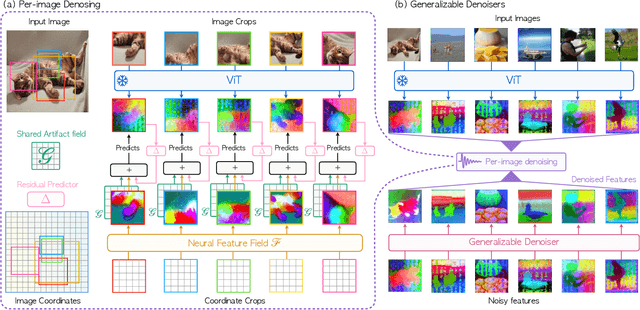
We delve into a nuanced but significant challenge inherent to Vision Transformers (ViTs): feature maps of these models exhibit grid-like artifacts, which detrimentally hurt the performance of ViTs in downstream tasks. Our investigations trace this fundamental issue down to the positional embeddings at the input stage. To address this, we propose a novel noise model, which is universally applicable to all ViTs. Specifically, the noise model dissects ViT outputs into three components: a semantics term free from noise artifacts and two artifact-related terms that are conditioned on pixel locations. Such a decomposition is achieved by enforcing cross-view feature consistency with neural fields in a per-image basis. This per-image optimization process extracts artifact-free features from raw ViT outputs, providing clean features for offline applications. Expanding the scope of our solution to support online functionality, we introduce a learnable denoiser to predict artifact-free features directly from unprocessed ViT outputs, which shows remarkable generalization capabilities to novel data without the need for per-image optimization. Our two-stage approach, termed Denoising Vision Transformers (DVT), does not require re-training existing pre-trained ViTs and is immediately applicable to any Transformer-based architecture. We evaluate our method on a variety of representative ViTs (DINO, MAE, DeiT-III, EVA02, CLIP, DINOv2, DINOv2-reg). Extensive evaluations demonstrate that our DVT consistently and significantly improves existing state-of-the-art general-purpose models in semantic and geometric tasks across multiple datasets (e.g., +3.84 mIoU). We hope our study will encourage a re-evaluation of ViT design, especially regarding the naive use of positional embeddings.
GenoCraft: A Comprehensive, User-Friendly Web-Based Platform for High-Throughput Omics Data Analysis and Visualization
Dec 21, 2023

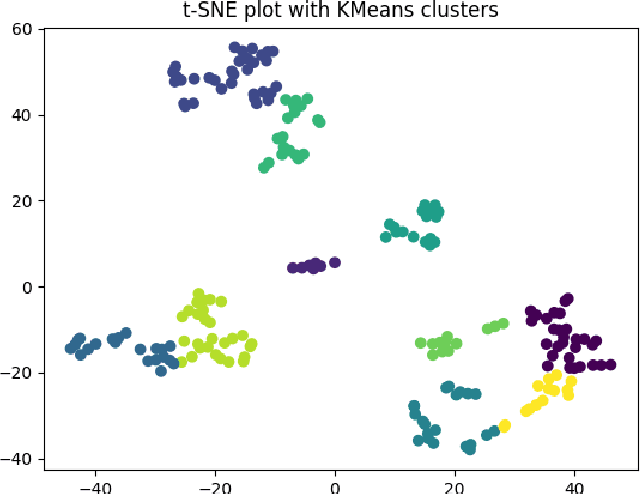

The surge in high-throughput omics data has reshaped the landscape of biological research, underlining the need for powerful, user-friendly data analysis and interpretation tools. This paper presents GenoCraft, a web-based comprehensive software solution designed to handle the entire pipeline of omics data processing. GenoCraft offers a unified platform featuring advanced bioinformatics tools, covering all aspects of omics data analysis. It encompasses a range of functionalities, such as normalization, quality control, differential analysis, network analysis, pathway analysis, and diverse visualization techniques. This software makes state-of-the-art omics data analysis more accessible to a wider range of users. With GenoCraft, researchers and data scientists have access to an array of cutting-edge bioinformatics tools under a user-friendly interface, making it a valuable resource for managing and analyzing large-scale omics data. The API with an interactive web interface is publicly available at https://genocraft.stanford. edu/. We also release all the codes in https://github.com/futianfan/GenoCraft.
EDA: Evolving and Distinct Anchors for Multimodal Motion Prediction
Dec 15, 2023
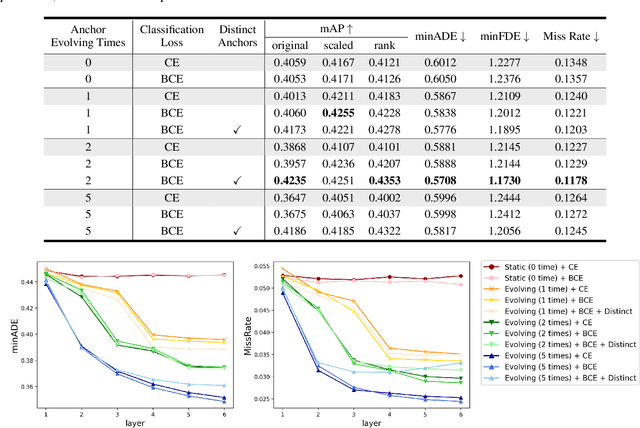
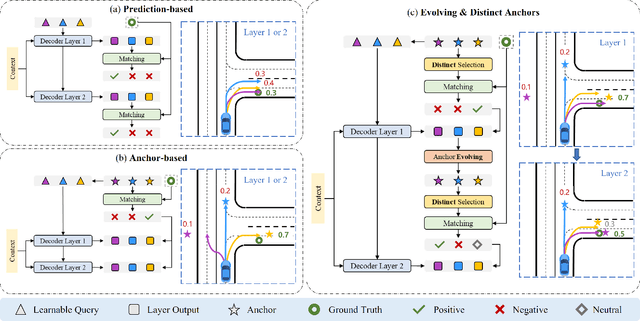
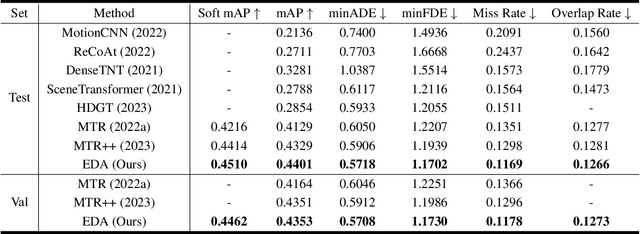
Motion prediction is a crucial task in autonomous driving, and one of its major challenges lands in the multimodality of future behaviors. Many successful works have utilized mixture models which require identification of positive mixture components, and correspondingly fall into two main lines: prediction-based and anchor-based matching. The prediction clustering phenomenon in prediction-based matching makes it difficult to pick representative trajectories for downstream tasks, while the anchor-based matching suffers from a limited regression capability. In this paper, we introduce a novel paradigm, named Evolving and Distinct Anchors (EDA), to define the positive and negative components for multimodal motion prediction based on mixture models. We enable anchors to evolve and redistribute themselves under specific scenes for an enlarged regression capacity. Furthermore, we select distinct anchors before matching them with the ground truth, which results in impressive scoring performance. Our approach enhances all metrics compared to the baseline MTR, particularly with a notable relative reduction of 13.5% in Miss Rate, resulting in state-of-the-art performance on the Waymo Open Motion Dataset. Code is available at https://github.com/Longzhong-Lin/EDA.
Better Neural PDE Solvers Through Data-Free Mesh Movers
Dec 09, 2023Recently, neural networks have been extensively employed to solve partial differential equations (PDEs) in physical system modeling. While major studies focus on learning system evolution on predefined static mesh discretizations, some methods utilize reinforcement learning or supervised learning techniques to create adaptive and dynamic meshes, due to the dynamic nature of these systems. However, these approaches face two primary challenges: (1) the need for expensive optimal mesh data, and (2) the change of the solution space's degree of freedom and topology during mesh refinement. To address these challenges, this paper proposes a neural PDE solver with a neural mesh adapter. To begin with, we introduce a novel data-free neural mesh adaptor, called Data-free Mesh Mover (DMM), with two main innovations. Firstly, it is an operator that maps the solution to adaptive meshes and is trained using the Monge-Ampere equation without optimal mesh data. Secondly, it dynamically changes the mesh by moving existing nodes rather than adding or deleting nodes and edges. Theoretical analysis shows that meshes generated by DMM have the lowest interpolation error bound. Based on DMM, to efficiently and accurately model dynamic systems, we develop a moving mesh based neural PDE solver (MM-PDE) that embeds the moving mesh with a two-branch architecture and a learnable interpolation framework to preserve information within the data. Empirical experiments demonstrate that our method generates suitable meshes and considerably enhances accuracy when modeling widely considered PDE systems.
Semantics-aware Motion Retargeting with Vision-Language Models
Dec 04, 2023


Capturing and preserving motion semantics is essential to motion retargeting between animation characters. However, most of the previous works neglect the semantic information or rely on human-designed joint-level representations. Here, we present a novel Semantics-aware Motion reTargeting (SMT) method with the advantage of vision-language models to extract and maintain meaningful motion semantics. We utilize a differentiable module to render 3D motions. Then the high-level motion semantics are incorporated into the motion retargeting process by feeding the vision-language model with the rendered images and aligning the extracted semantic embeddings. To ensure the preservation of fine-grained motion details and high-level semantics, we adopt a two-stage pipeline consisting of skeleton-aware pre-training and fine-tuning with semantics and geometry constraints. Experimental results show the effectiveness of the proposed method in producing high-quality motion retargeting results while accurately preserving motion semantics. Project page can be found at https://sites.google.com/view/smtnet.
Rethinking Directional Integration in Neural Radiance Fields
Nov 28, 2023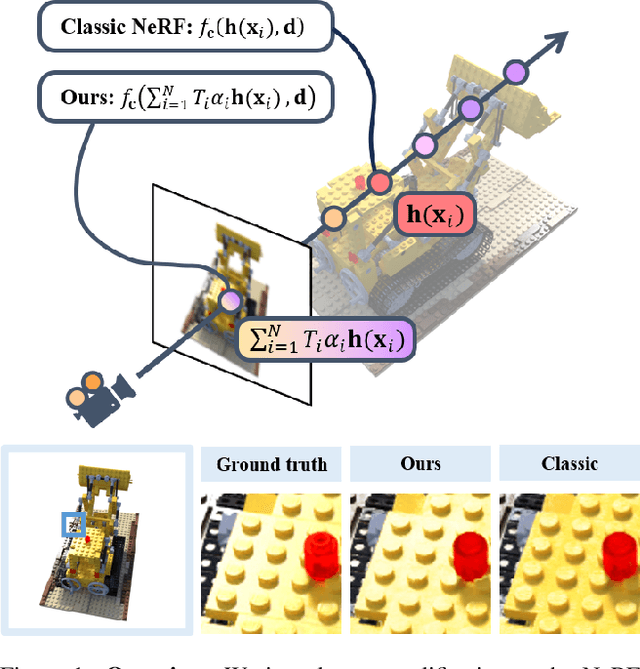
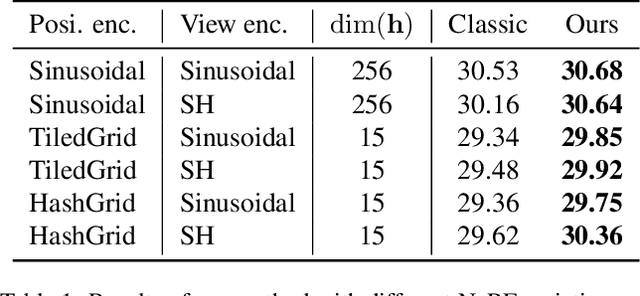
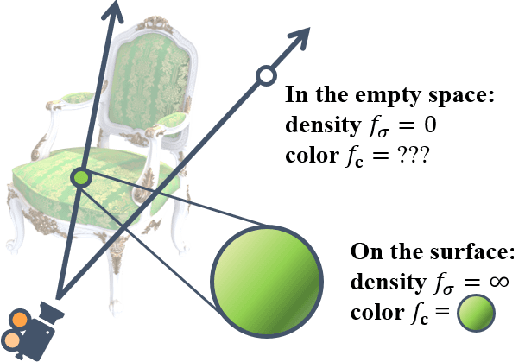
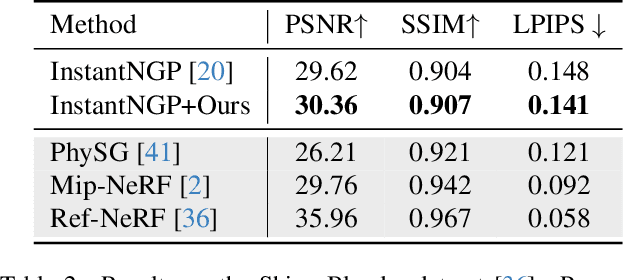
Recent works use the Neural radiance field (NeRF) to perform multi-view 3D reconstruction, providing a significant leap in rendering photorealistic scenes. However, despite its efficacy, NeRF exhibits limited capability of learning view-dependent effects compared to light field rendering or image-based view synthesis. To that end, we introduce a modification to the NeRF rendering equation which is as simple as a few lines of code change for any NeRF variations, while greatly improving the rendering quality of view-dependent effects. By swapping the integration operator and the direction decoder network, we only integrate the positional features along the ray and move the directional terms out of the integration, resulting in a disentanglement of the view-dependent and independent components. The modified equation is equivalent to the classical volumetric rendering in ideal cases on object surfaces with Dirac densities. Furthermore, we prove that with the errors caused by network approximation and numerical integration, our rendering equation exhibits better convergence properties with lower error accumulations compared to the classical NeRF. We also show that the modified equation can be interpreted as light field rendering with learned ray embeddings. Experiments on different NeRF variations show consistent improvements in the quality of view-dependent effects with our simple modification.
A Language Agent for Autonomous Driving
Nov 27, 2023Human-level driving is an ultimate goal of autonomous driving. Conventional approaches formulate autonomous driving as a perception-prediction-planning framework, yet their systems do not capitalize on the inherent reasoning ability and experiential knowledge of humans. In this paper, we propose a fundamental paradigm shift from current pipelines, exploiting Large Language Models (LLMs) as a cognitive agent to integrate human-like intelligence into autonomous driving systems. Our approach, termed Agent-Driver, transforms the traditional autonomous driving pipeline by introducing a versatile tool library accessible via function calls, a cognitive memory of common sense and experiential knowledge for decision-making, and a reasoning engine capable of chain-of-thought reasoning, task planning, motion planning, and self-reflection. Powered by LLMs, our Agent-Driver is endowed with intuitive common sense and robust reasoning capabilities, thus enabling a more nuanced, human-like approach to autonomous driving. We evaluate our approach on the large-scale nuScenes benchmark, and extensive experiments substantiate that our Agent-Driver significantly outperforms the state-of-the-art driving methods by a large margin. Our approach also demonstrates superior interpretability and few-shot learning ability to these methods. Code will be released.
NGEL-SLAM: Neural Implicit Representation-based Global Consistent Low-Latency SLAM System
Nov 16, 2023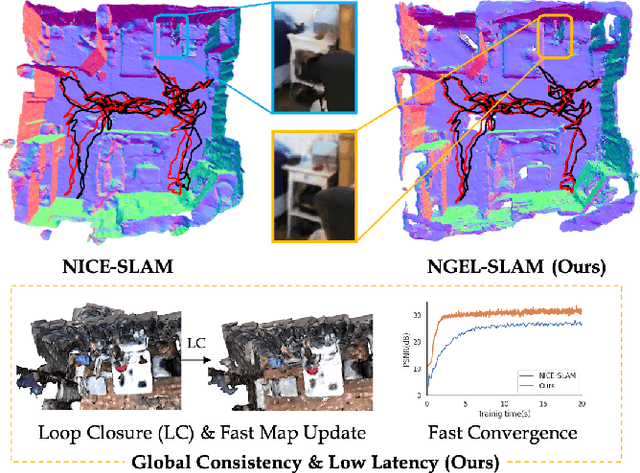
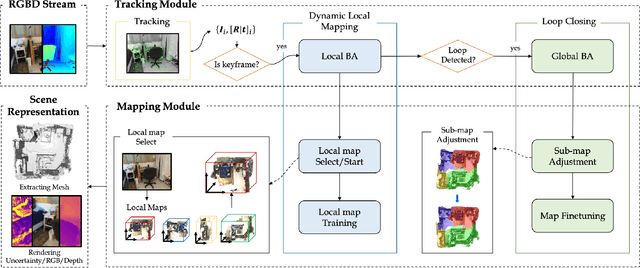
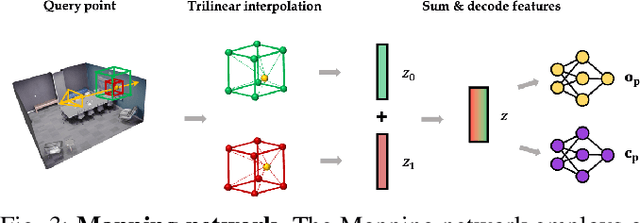
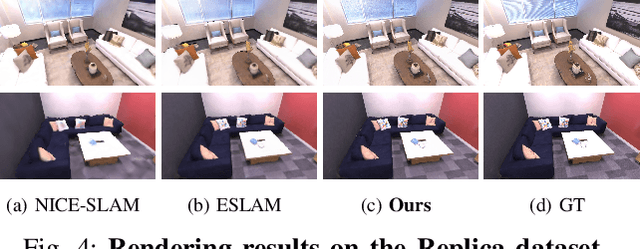
Neural implicit representations have emerged as a promising solution for providing dense geometry in Simultaneous Localization and Mapping (SLAM). However, existing methods in this direction fall short in terms of global consistency and low latency. This paper presents NGEL-SLAM to tackle the above challenges. To ensure global consistency, our system leverages a traditional feature-based tracking module that incorporates loop closure. Additionally, we maintain a global consistent map by representing the scene using multiple neural implicit fields, enabling quick adjustment to the loop closure. Moreover, our system allows for fast convergence through the use of octree-based implicit representations. The combination of rapid response to loop closure and fast convergence makes our system a truly low-latency system that achieves global consistency. Our system enables rendering high-fidelity RGB-D images, along with extracting dense and complete surfaces. Experiments on both synthetic and real-world datasets suggest that our system achieves state-of-the-art tracking and mapping accuracy while maintaining low latency.