 Add to Chrome
 Add to Firefox
 Add to Edge
Enhancing Sharpness-Aware Minimization by Learning Perturbation Radius
Aug 15, 2024
Sharpness-aware minimization (SAM) is to improve model generalization by searching for flat minima in the loss landscape. The SAM update consists of one step for computing the perturbation and the other for computing the update gradient. Within the two steps, the choice of the perturbation radius is crucial to the performance of SAM, but finding an appropriate perturbation radius is challenging. In this paper, we propose a bilevel optimization framework called LEarning the perTurbation radiuS (LETS) to learn the perturbation radius for sharpness-aware minimization algorithms. Specifically, in the proposed LETS method, the upper-level problem aims at seeking a good perturbation radius by minimizing the squared generalization gap between the training and validation losses, while the lower-level problem is the SAM optimization problem. Moreover, the LETS method can be combined with any variant of SAM. Experimental results on various architectures and benchmark datasets in computer vision and natural language processing demonstrate the effectiveness of the proposed LETS method in improving the performance of SAM.

Building Decision Making Models Through Language Model Regime
Aug 12, 2024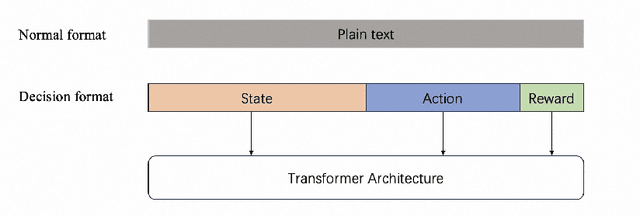
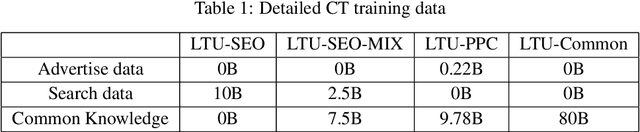
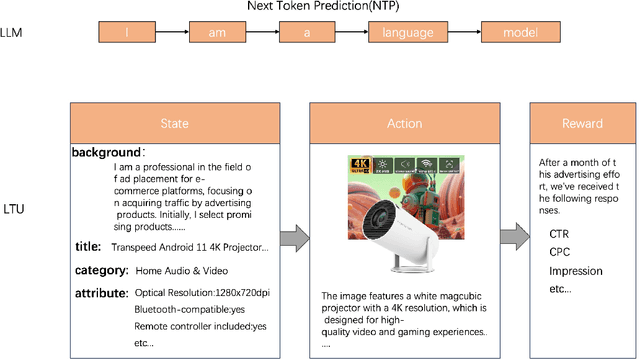

We propose a novel approach for decision making problems leveraging the generalization capabilities of large language models (LLMs). Traditional methods such as expert systems, planning algorithms, and reinforcement learning often exhibit limited generalization, typically requiring the training of new models for each unique task. In contrast, LLMs demonstrate remarkable success in generalizing across varied language tasks, inspiring a new strategy for training decision making models. Our approach, referred to as "Learning then Using" (LTU), entails a two-stage process. Initially, the \textit{learning} phase develops a robust foundational decision making model by integrating diverse knowledge from various domains and decision making contexts. The subsequent \textit{using} phase refines this foundation model for specific decision making scenarios. Distinct from other studies that employ LLMs for decision making through supervised learning, our LTU method embraces a versatile training methodology that combines broad pre-training with targeted fine-tuning. Experiments in e-commerce domains such as advertising and search optimization have shown that LTU approach outperforms traditional supervised learning regimes in decision making capabilities and generalization. The LTU approach is the first practical training architecture for both single-step and multi-step decision making tasks combined with LLMs, which can be applied beyond game and robot domains. It provides a robust and adaptable framework for decision making, enhances the effectiveness and flexibility of various systems in tackling various challenges.
E$^3$NeRF: Efficient Event-Enhanced Neural Radiance Fields from Blurry Images
Aug 03, 2024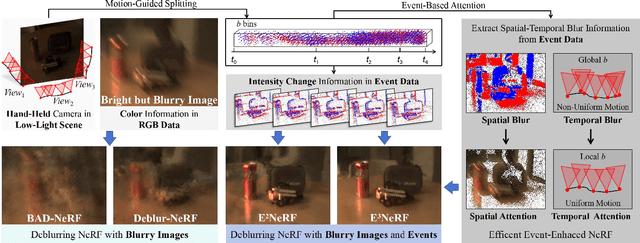
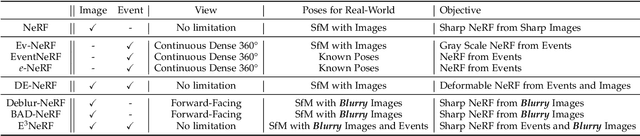
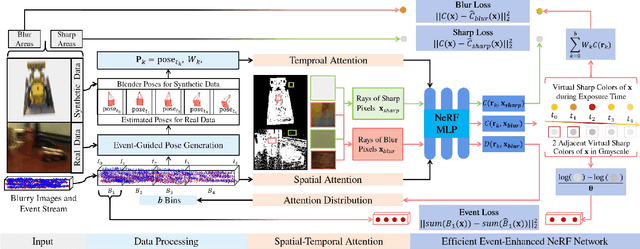

Neural Radiance Fields (NeRF) achieve impressive rendering performance by learning volumetric 3D representation from several images of different views. However, it is difficult to reconstruct a sharp NeRF from blurry input as it often occurs in the wild. To solve this problem, we propose a novel Efficient Event-Enhanced NeRF (E$^3$NeRF) by utilizing the combination of RGB images and event streams. To effectively introduce event streams into the neural volumetric representation learning process, we propose an event-enhanced blur rendering loss and an event rendering loss, which guide the network via modeling the real blur process and event generation process, respectively. Specifically, we leverage spatial-temporal information from the event stream to evenly distribute learning attention over temporal blur while simultaneously focusing on blurry texture through the spatial attention. Moreover, a camera pose estimation framework for real-world data is built with the guidance of the events to generalize the method to practical applications. Compared to previous image-based or event-based NeRF, our framework makes more profound use of the internal relationship between events and images. Extensive experiments on both synthetic data and real-world data demonstrate that E$^3$NeRF can effectively learn a sharp NeRF from blurry images, especially in non-uniform motion and low-light scenes.
High-Order Fusion Graph Contrastive Learning for Recommendation
Jul 29, 2024Self-supervised learning (SSL) has recently attracted significant attention in the field of recommender systems. Contrastive learning (CL) stands out as a major SSL paradigm due to its robust ability to generate self-supervised signals. Mainstream graph contrastive learning (GCL)-based methods typically implement CL by creating contrastive views through various data augmentation techniques. Despite these methods are effective, we argue that there still exist several challenges: i) Data augmentation (e.g., discarding edges or adding noise) necessitates additional graph convolution (GCN) or modeling operations, which are highly time-consuming and potentially harm the embedding quality. ii) Existing CL-based methods use traditional CL objectives to capture self-supervised signals. However, few studies have explored obtaining CL objectives from more perspectives and have attempted to fuse the varying signals from these CL objectives to enhance recommendation performance. To overcome these challenges, we propose a High-Order Fusion Graph Contrastive Learning (HFGCL) framework for recommendation. Specifically, we discards the data augmentations and instead high-order information from GCN process to create contrastive views. Additionally, to integrate self-supervised signals from various CL objectives, we propose an advanced CL objective. By ensuring that positive pairs are distanced from negative samples derived from both contrastive views, we effectively fuse self-supervised signals from distinct CL objectives, thereby enhancing the mutual information between positive pairs. Experimental results on three public datasets demonstrate the superior effectiveness of HFGCL compared to the state-of-the-art baselines.
Morphing median fin enhances untethered bionic robotic tuna's linear acceleration and turning maneuverability
Jul 26, 2024

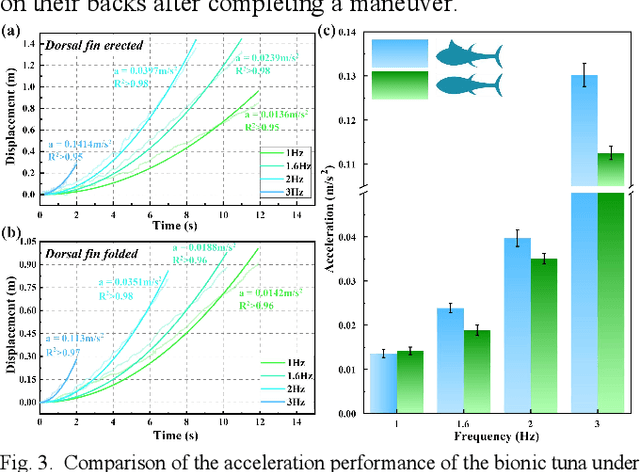
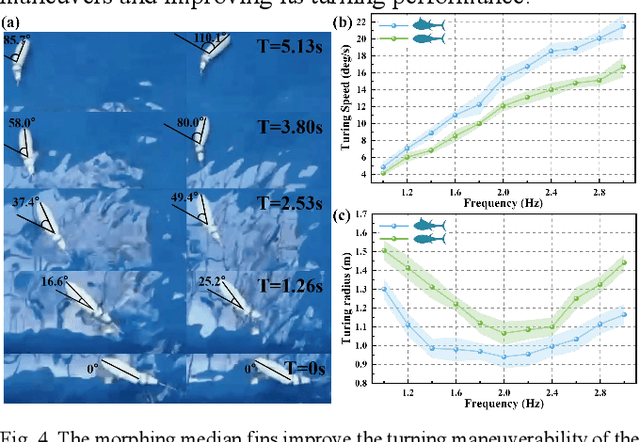
Median fins of fish-like swimmers play a crucial role in linear acceleration and maneuvering processes. However, few research focused on untethered robotic fish experiments. Imitating the behaviour of real tuna, we developed a free-swimming bionic tuna with a foldable dorsal fin. The erection of dorsal fin, at proper conditions, can reduce head heave by 50%, enhance linear acceleration by 15.7%, increase turning angular velocity by 32.78%, and turning radius decreasing by 33.13%. Conversely, erecting the dorsal fin increases the wetted surface area, resulting in decreased maximum speed and efficiency during steady swimming phase. This finding partially explains why tuna erect their median fins during maneuvers or acceleration and fold them afterward to reduce drag. In addition, we verified that folding the median fins after acceleration does not significantly affect locomotion efficiency. This study supports the application of morphing median fins in undulating underwater robots and helps to further understand the impact of median fins on fish locomotion.
Text-Augmented Multimodal LLMs for Chemical Reaction Condition Recommendation
Jul 21, 2024High-throughput reaction condition (RC) screening is fundamental to chemical synthesis. However, current RC screening suffers from laborious and costly trial-and-error workflows. Traditional computer-aided synthesis planning (CASP) tools fail to find suitable RCs due to data sparsity and inadequate reaction representations. Nowadays, large language models (LLMs) are capable of tackling chemistry-related problems, such as molecule design, and chemical logic Q\&A tasks. However, LLMs have not yet achieved accurate predictions of chemical reaction conditions. Here, we present MM-RCR, a text-augmented multimodal LLM that learns a unified reaction representation from SMILES, reaction graphs, and textual corpus for chemical reaction recommendation (RCR). To train MM-RCR, we construct 1.2 million pair-wised Q\&A instruction datasets. Our experimental results demonstrate that MM-RCR achieves state-of-the-art performance on two open benchmark datasets and exhibits strong generalization capabilities on out-of-domain (OOD) and High-Throughput Experimentation (HTE) datasets. MM-RCR has the potential to accelerate high-throughput condition screening in chemical synthesis.
SlingBAG: Sliding ball adaptive growth algorithm with differentiable radiation enables super-efficient iterative 3D photoacoustic image reconstruction
Jul 16, 2024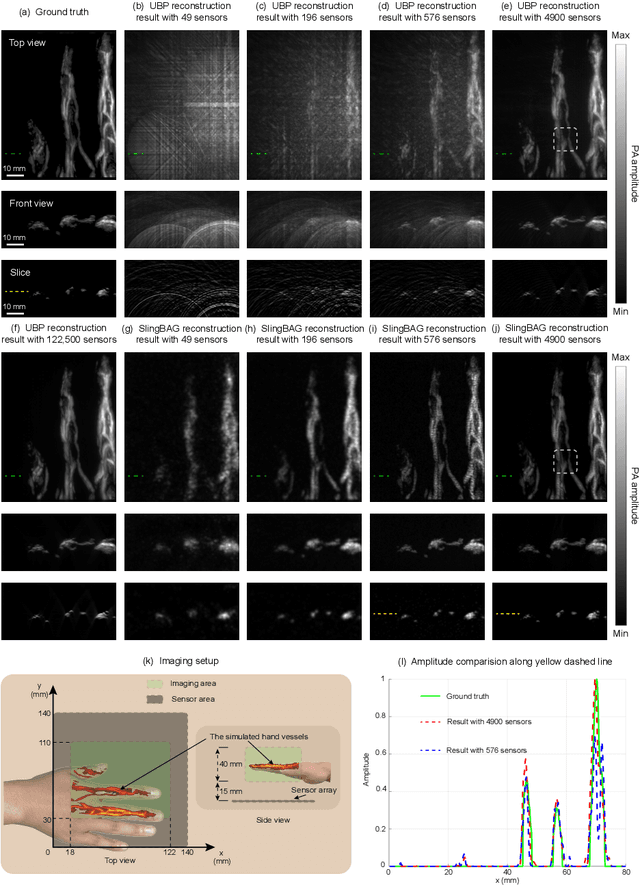

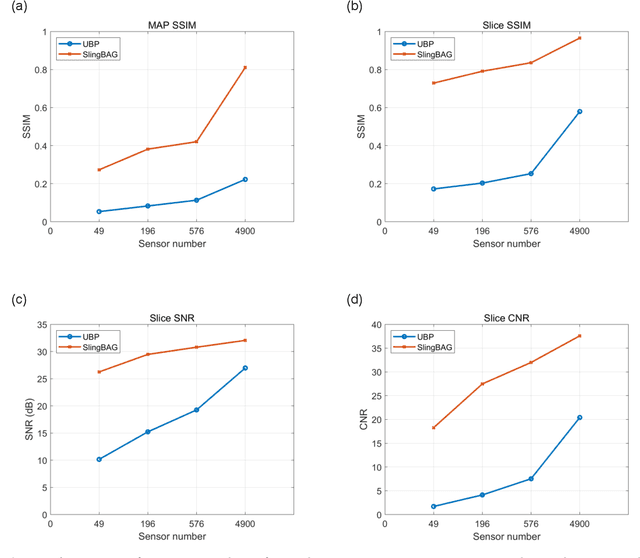
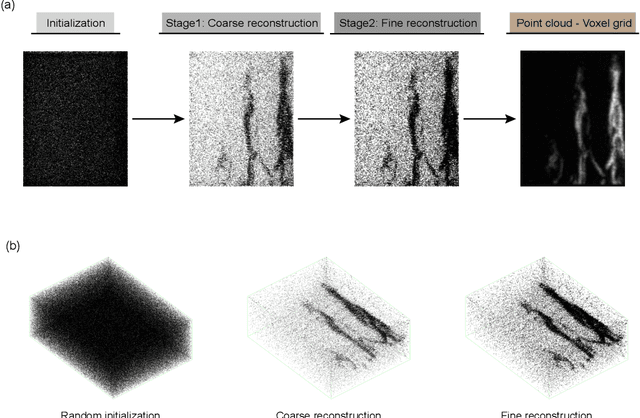
High-quality 3D photoacoustic imaging (PAI) reconstruction under sparse view or limited view has long been challenging. Traditional 3D iterative-based reconstruction methods suffer from both slow speed and high memory consumption. Recently, in computer graphics, the differentiable rendering has made significant progress, particularly with the rise of 3D Gaussian Splatting. Inspired by these, we introduce differentiable radiation into PAI, developing a novel reconstruction algorithm: the Sliding Ball Adaptive Growth algorithm (SlingBAG) for 3D PAI, which shows ability in high-quality 3D PAI reconstruction both under extremely sparse view and limited view. We established the point cloud dataset in PAI, and used unique differentiable rapid radiator based on the spherical decomposition strategy and the randomly initialized point cloud adaptively optimized according to sparse sensor data. Each point undergoes updates in 3D coordinates, initial pressure, and resolution (denoted by the radius of ball). Points undergo adaptive growth during iterative process, including point destroying, splitting and duplicating along the gradient of their positions, manifesting the sliding ball effect. Finally, our point cloud to voxel grid shader renders the final reconstruction results. Simulation and in vivo experiments demonstrate that our SlingBAG reconstruction result's SNR can be more than 40 dB under extremely sparse view, while the SNR of traditional back-projection algorithm's result is less than 20 dB. Moreover, the result of SlingBAG's structural similarity to the ground truth is significantly higher, with an SSIM value of 95.6%. Notably, our differentiable rapid radiator can conduct forward PA simulation in homogeneous, non-viscous media substantially faster than current methods that numerically simulate the wave propagation, such as k-Wave. The dataset and all code will be open source.
Stabilizing Dynamic Systems through Neural Network Learning: A Robust Approach
Jul 13, 2024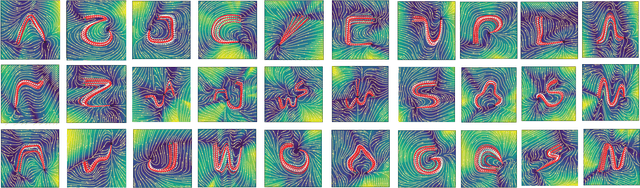
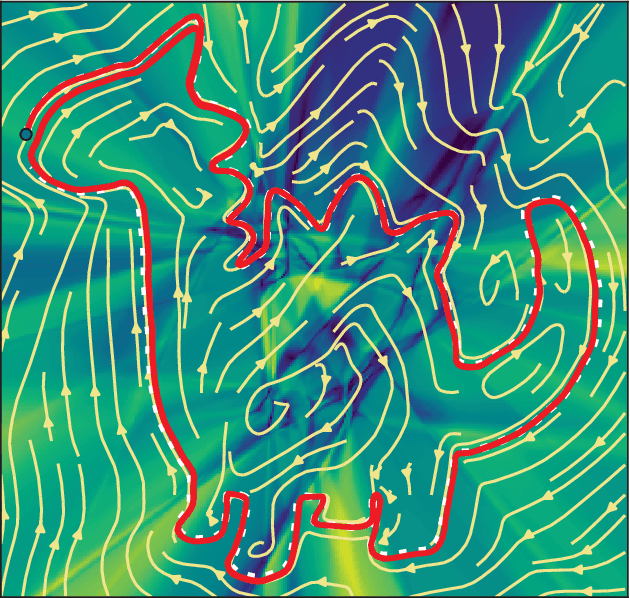
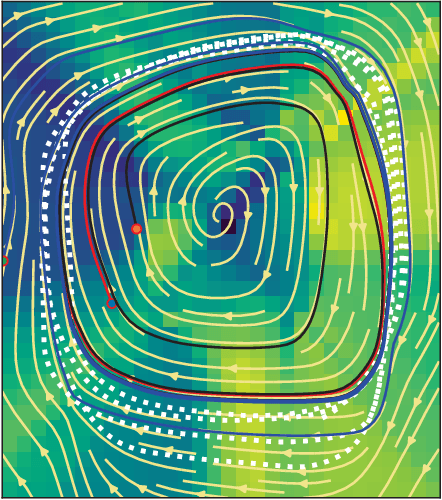
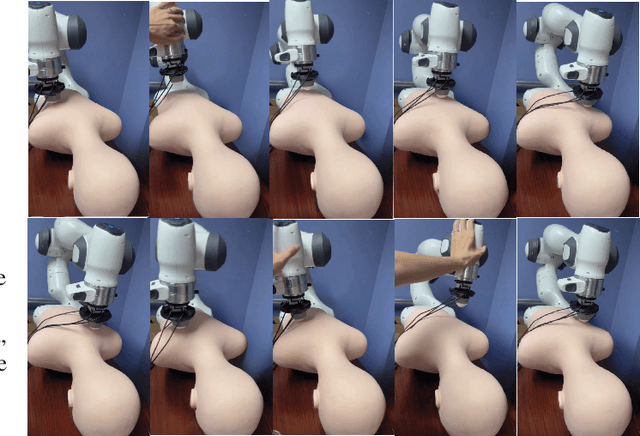
Point-to-point and periodic motions are ubiquitous in the world of robotics. To master these motions, Autonomous Dynamic System (DS) based algorithms are fundamental in the domain of Learning from Demonstration (LfD). However, these algorithms face the significant challenge of balancing precision in learning with the maintenance of system stability. This paper addresses this challenge by presenting a novel ADS algorithm that leverages neural network technology. The proposed algorithm is designed to distill essential knowledge from demonstration data, ensuring stability during the learning of both point-to-point and periodic motions. For point-to-point motions, a neural Lyapunov function is proposed to align with the provided demonstrations. In the case of periodic motions, the neural Lyapunov function is used with the transversal contraction to ensure that all generated motions converge to a stable limit cycle. The model utilizes a streamlined neural network architecture, adept at achieving dual objectives: optimizing learning accuracy while maintaining global stability. To thoroughly assess the efficacy of the proposed algorithm, rigorous evaluations are conducted using the LASA dataset and a manually designed dataset. These assessments were complemented by empirical validation through robotic experiments, providing robust evidence of the algorithm's performance
MTMamba: Enhancing Multi-Task Dense Scene Understanding by Mamba-Based Decoders
Jul 02, 2024Multi-task dense scene understanding, which learns a model for multiple dense prediction tasks, has a wide range of application scenarios. Modeling long-range dependency and enhancing cross-task interactions are crucial to multi-task dense prediction. In this paper, we propose MTMamba, a novel Mamba-based architecture for multi-task scene understanding. It contains two types of core blocks: self-task Mamba (STM) block and cross-task Mamba (CTM) block. STM handles long-range dependency by leveraging Mamba, while CTM explicitly models task interactions to facilitate information exchange across tasks. Experiments on NYUDv2 and PASCAL-Context datasets demonstrate the superior performance of MTMamba over Transformer-based and CNN-based methods. Notably, on the PASCAL-Context dataset, MTMamba achieves improvements of +2.08, +5.01, and +4.90 over the previous best method in the tasks of semantic segmentation, human parsing, and object boundary detection, respectively. The code is available at \url{https://github.com/EnVision-Research/MTMamba}.
Active Shadowing (ASD): Manipulating Visual Perception of Robotics Behaviors via Implicit Communication
Jul 01, 2024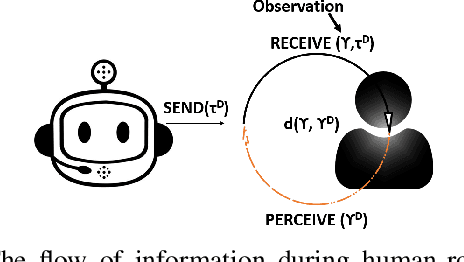
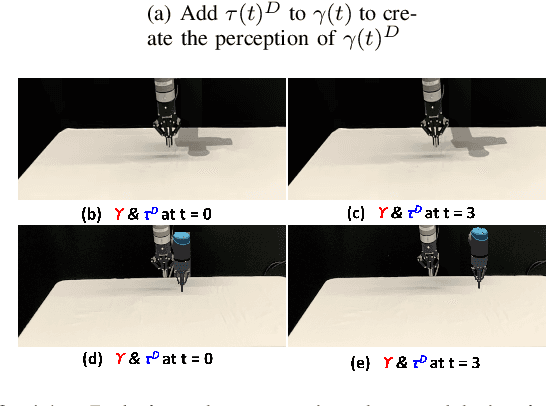


Explicit communication is often valued for its directness during interaction. Implicit communication, on the other hand, is indirect in that its communicative content must be inferred. Implicit communication is considered more desirable in teaming situations that requires reduced interruptions for improved fluency. In this paper, we investigate another unique advantage of implicit communication: its ability to manipulate the perception of object or behavior of interest. When communication results in the perception of an object or behavior to deviate from other information (about the object or behavior) available via observation, it introduces a discrepancy between perception and observation. We show that such a discrepancy in visual perception can benefit human-robot interaction in a controlled manner and introduce an approach referred to as active shadowing (ASD). Through user studies, we demonstrate the effectiveness of active shadowing in creating a misaligned perception of the robot's behavior and its execution in the real-world, resulting in more efficient task completion without sacrificing its understandability. We also analyze conditions under which such visual manipulation is effective.