 Add to Chrome
 Add to Firefox
 Add to Edge
CaptchaMind: Training CAPTCHA Solvers via Reinforcement Learning with Explicit Reasoning Supervision
May 19, 2026
CAPTCHAs are widely deployed as human verification mechanisms and frequently block intelligent agents from completing end-to-end automation in real-world web environments. Solving modern CAPTCHAs requires robust multi-step visual reasoning and interaction capabilities, yet training-based approaches have remained absent due to the lack of large-scale training data and process-level annotations. We introduce CaptchaBench, the first CAPTCHA benchmark designed to support large-scale training, comprising 16,000 programmatically generated samples across eight task categories with detailed region and process-level annotations. Systematic evaluation on CaptchaBench reveals that existing methods fail consistently on tasks requiring fine-grained visual detail capture and region-level comparison. We therefore present CaptchaMind, an RL-based solver trained with explicit reasoning process supervision, achieving 82.9% average success rate across eight tasks and 71.0% on real-world instances, substantially outperforming all existing methods without closed-source APIs.

DV-World: Benchmarking Data Visualization Agents in Real-World Scenarios
Apr 28, 2026Real-world data visualization (DV) requires native environmental grounding, cross-platform evolution, and proactive intent alignment. Yet, existing benchmarks often suffer from code-sandbox confinement, single-language creation-only tasks, and assumption of perfect intent. To bridge these gaps, we introduce DV-World, a benchmark of 260 tasks designed to evaluate DV agents across real-world professional lifecycles. DV-World spans three domains: DV-Sheet for native spreadsheet manipulation including chart and dashboard creation as well as diagnostic repair; DV-Evolution for adapting and restructuring reference visual artifacts to fit new data across diverse programming paradigms and DV-Interact for proactive intent alignment with a user simulator that mimics real-world ambiguous requirements. Our hybrid evaluation framework integrates Table-value Alignment for numerical precision and MLLM-as-a-Judge with rubrics for semantic-visual assessment. Experiments reveal that state-of-the-art models achieve less than 50% overall performance, exposing critical deficits in handling the complex challenges of real-world data visualization. DV-World provides a realistic testbed to steer development toward the versatile expertise required in enterprise workflows. Our data and code are available at \href{https://github.com/DA-Open/DV-World}{this project page}.
Building Decision Making Models Through Language Model Regime
Aug 12, 2024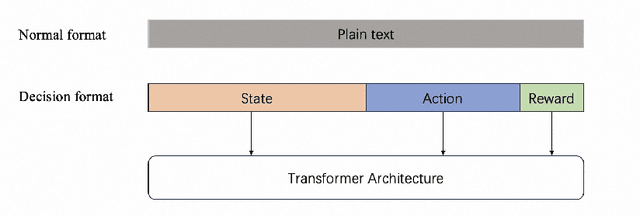
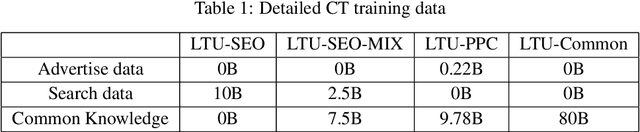
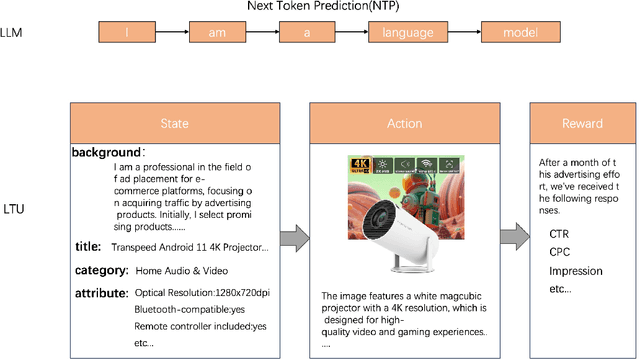

We propose a novel approach for decision making problems leveraging the generalization capabilities of large language models (LLMs). Traditional methods such as expert systems, planning algorithms, and reinforcement learning often exhibit limited generalization, typically requiring the training of new models for each unique task. In contrast, LLMs demonstrate remarkable success in generalizing across varied language tasks, inspiring a new strategy for training decision making models. Our approach, referred to as "Learning then Using" (LTU), entails a two-stage process. Initially, the \textit{learning} phase develops a robust foundational decision making model by integrating diverse knowledge from various domains and decision making contexts. The subsequent \textit{using} phase refines this foundation model for specific decision making scenarios. Distinct from other studies that employ LLMs for decision making through supervised learning, our LTU method embraces a versatile training methodology that combines broad pre-training with targeted fine-tuning. Experiments in e-commerce domains such as advertising and search optimization have shown that LTU approach outperforms traditional supervised learning regimes in decision making capabilities and generalization. The LTU approach is the first practical training architecture for both single-step and multi-step decision making tasks combined with LLMs, which can be applied beyond game and robot domains. It provides a robust and adaptable framework for decision making, enhances the effectiveness and flexibility of various systems in tackling various challenges.