 Add to Chrome
 Add to Firefox
 Add to Edge
CheX-DS: Improving Chest X-ray Image Classification with Ensemble Learning Based on DenseNet and Swin Transformer
May 16, 2025
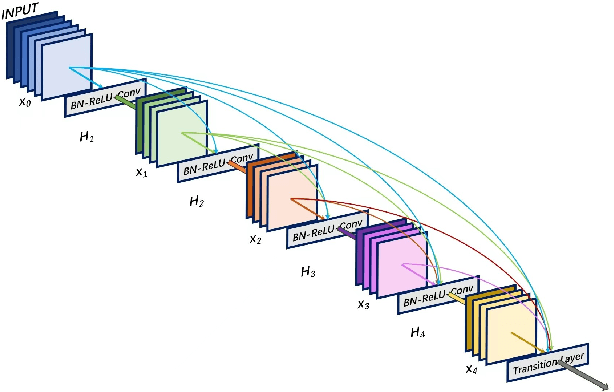
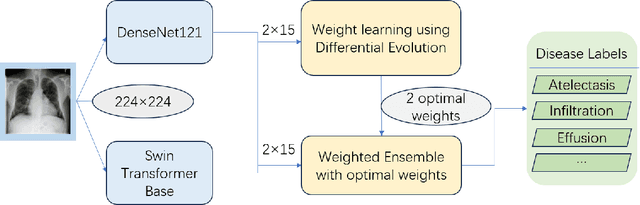
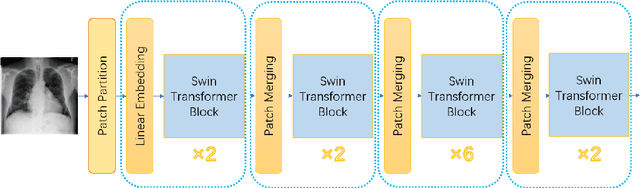
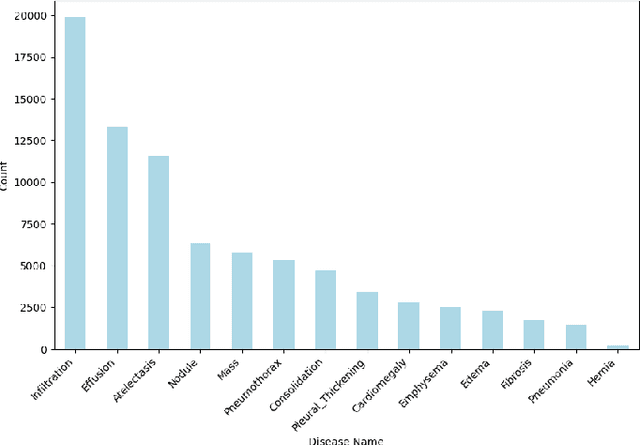
The automatic diagnosis of chest diseases is a popular and challenging task. Most current methods are based on convolutional neural networks (CNNs), which focus on local features while neglecting global features. Recently, self-attention mechanisms have been introduced into the field of computer vision, demonstrating superior performance. Therefore, this paper proposes an effective model, CheX-DS, for classifying long-tail multi-label data in the medical field of chest X-rays. The model is based on the excellent CNN model DenseNet for medical imaging and the newly popular Swin Transformer model, utilizing ensemble deep learning techniques to combine the two models and leverage the advantages of both CNNs and Transformers. The loss function of CheX-DS combines weighted binary cross-entropy loss with asymmetric loss, effectively addressing the issue of data imbalance. The NIH ChestX-ray14 dataset is selected to evaluate the model's effectiveness. The model outperforms previous studies with an excellent average AUC score of 83.76\%, demonstrating its superior performance.
* BIBM

Seed1.5-VL Technical Report
May 11, 2025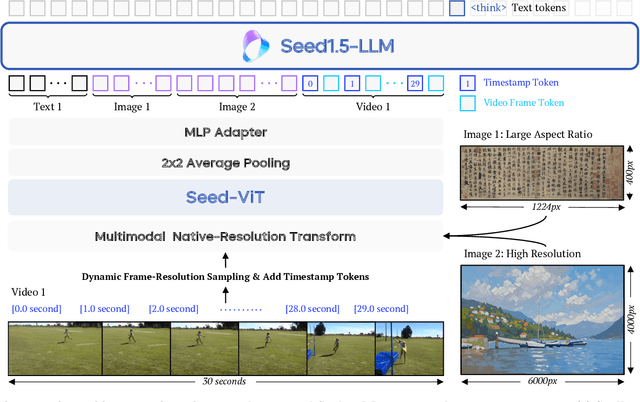

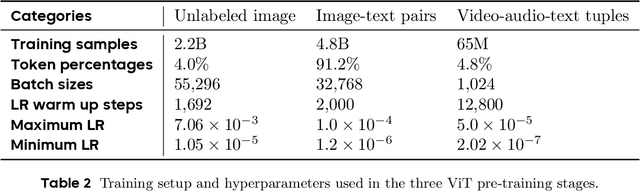
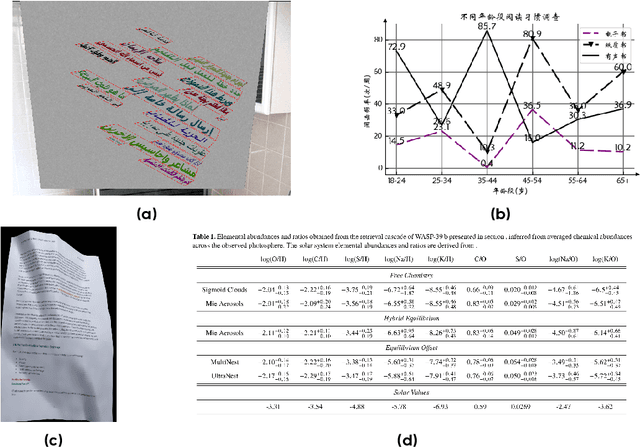
We present Seed1.5-VL, a vision-language foundation model designed to advance general-purpose multimodal understanding and reasoning. Seed1.5-VL is composed with a 532M-parameter vision encoder and a Mixture-of-Experts (MoE) LLM of 20B active parameters. Despite its relatively compact architecture, it delivers strong performance across a wide spectrum of public VLM benchmarks and internal evaluation suites, achieving the state-of-the-art performance on 38 out of 60 public benchmarks. Moreover, in agent-centric tasks such as GUI control and gameplay, Seed1.5-VL outperforms leading multimodal systems, including OpenAI CUA and Claude 3.7. Beyond visual and video understanding, it also demonstrates strong reasoning abilities, making it particularly effective for multimodal reasoning challenges such as visual puzzles. We believe these capabilities will empower broader applications across diverse tasks. In this report, we mainly provide a comprehensive review of our experiences in building Seed1.5-VL across model design, data construction, and training at various stages, hoping that this report can inspire further research. Seed1.5-VL is now accessible at https://www.volcengine.com/ (Volcano Engine Model ID: doubao-1-5-thinking-vision-pro-250428)
ICNN-enhanced 2SP: Leveraging input convex neural networks for solving two-stage stochastic programming
May 08, 2025Two-stage stochastic programming (2SP) offers a basic framework for modelling decision-making under uncertainty, yet scalability remains a challenge due to the computational complexity of recourse function evaluation. Existing learning-based methods like Neural Two-Stage Stochastic Programming (Neur2SP) employ neural networks (NNs) as recourse function surrogates but rely on computationally intensive mixed-integer programming (MIP) formulations. We propose ICNN-enhanced 2SP, a method that leverages Input Convex Neural Networks (ICNNs) to exploit linear programming (LP) representability in convex 2SP problems. By architecturally enforcing convexity and enabling exact inference through LP, our approach eliminates the need for integer variables inherent to the conventional MIP-based formulation while retaining an exact embedding of the ICNN surrogate within the 2SP framework. This results in a more computationally efficient alternative that maintains solution quality. Comprehensive experiments reveal that ICNNs incur only marginally longer training times while achieving validation accuracy on par with their MIP-based counterparts. Across benchmark problems, ICNN-enhanced 2SP often exhibits considerably faster solution times than the MIP-based formulations while preserving solution quality, with these advantages becoming significantly more pronounced as problem scale increases. For the most challenging instances, the method achieves speedups of up to 100$\times$ and solution quality superior to MIP-based formulations.
From Word to Sentence: A Large-Scale Multi-Instance Dataset for Open-Set Aerial Detection
May 06, 2025In recent years, language-guided open-world aerial object detection has gained significant attention due to its better alignment with real-world application needs. However, due to limited datasets, most existing language-guided methods primarily focus on vocabulary, which fails to meet the demands of more fine-grained open-world detection. To address this limitation, we propose constructing a large-scale language-guided open-set aerial detection dataset, encompassing three levels of language guidance: from words to phrases, and ultimately to sentences. Centered around an open-source large vision-language model and integrating image-operation-based preprocessing with BERT-based postprocessing, we present the OS-W2S Label Engine, an automatic annotation pipeline capable of handling diverse scene annotations for aerial images. Using this label engine, we expand existing aerial detection datasets with rich textual annotations and construct a novel benchmark dataset, called Multi-instance Open-set Aerial Dataset (MI-OAD), addressing the limitations of current remote sensing grounding data and enabling effective open-set aerial detection. Specifically, MI-OAD contains 163,023 images and 2 million image-caption pairs, approximately 40 times larger than comparable datasets. We also employ state-of-the-art open-set methods from the natural image domain, trained on our proposed dataset, to validate the model's open-set detection capabilities. For instance, when trained on our dataset, Grounding DINO achieves improvements of 29.5 AP_{50} and 33.7 Recall@10 for sentence inputs under zero-shot transfer conditions. Both the dataset and the label engine will be released publicly.
PhysioSync: Temporal and Cross-Modal Contrastive Learning Inspired by Physiological Synchronization for EEG-Based Emotion Recognition
Apr 24, 2025Electroencephalography (EEG) signals provide a promising and involuntary reflection of brain activity related to emotional states, offering significant advantages over behavioral cues like facial expressions. However, EEG signals are often noisy, affected by artifacts, and vary across individuals, complicating emotion recognition. While multimodal approaches have used Peripheral Physiological Signals (PPS) like GSR to complement EEG, they often overlook the dynamic synchronization and consistent semantics between the modalities. Additionally, the temporal dynamics of emotional fluctuations across different time resolutions in PPS remain underexplored. To address these challenges, we propose PhysioSync, a novel pre-training framework leveraging temporal and cross-modal contrastive learning, inspired by physiological synchronization phenomena. PhysioSync incorporates Cross-Modal Consistency Alignment (CM-CA) to model dynamic relationships between EEG and complementary PPS, enabling emotion-related synchronizations across modalities. Besides, it introduces Long- and Short-Term Temporal Contrastive Learning (LS-TCL) to capture emotional synchronization at different temporal resolutions within modalities. After pre-training, cross-resolution and cross-modal features are hierarchically fused and fine-tuned to enhance emotion recognition. Experiments on DEAP and DREAMER datasets demonstrate PhysioSync's advanced performance under uni-modal and cross-modal conditions, highlighting its effectiveness for EEG-centered emotion recognition.
ADT: Tuning Diffusion Models with Adversarial Supervision
Apr 15, 2025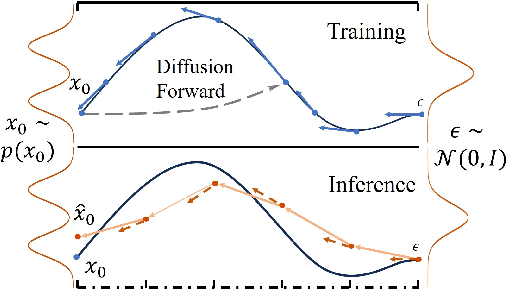
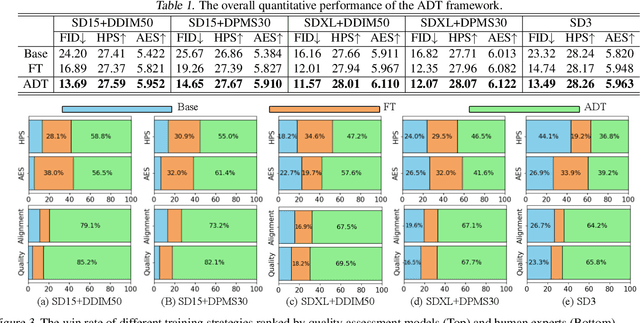
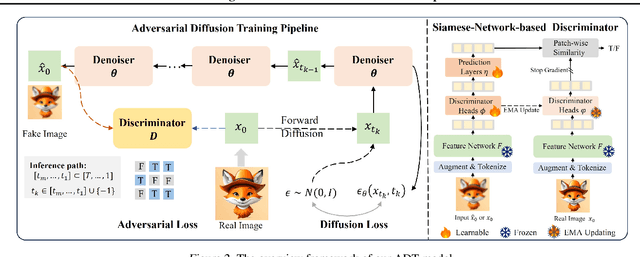
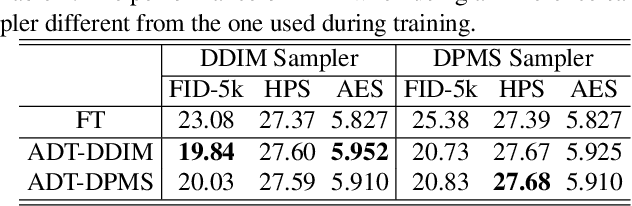
Diffusion models have achieved outstanding image generation by reversing a forward noising process to approximate true data distributions. During training, these models predict diffusion scores from noised versions of true samples in a single forward pass, while inference requires iterative denoising starting from white noise. This training-inference divergences hinder the alignment between inference and training data distributions, due to potential prediction biases and cumulative error accumulation. To address this problem, we propose an intuitive but effective fine-tuning framework, called Adversarial Diffusion Tuning (ADT), by stimulating the inference process during optimization and aligning the final outputs with training data by adversarial supervision. Specifically, to achieve robust adversarial training, ADT features a siamese-network discriminator with a fixed pre-trained backbone and lightweight trainable parameters, incorporates an image-to-image sampling strategy to smooth discriminative difficulties, and preserves the original diffusion loss to prevent discriminator hacking. In addition, we carefully constrain the backward-flowing path for back-propagating gradients along the inference path without incurring memory overload or gradient explosion. Finally, extensive experiments on Stable Diffusion models (v1.5, XL, and v3), demonstrate that ADT significantly improves both distribution alignment and image quality.
The Power of the Pareto Front: Balancing Uncertain Rewards for Adaptive Experimentation in scanning probe microscopy
Apr 09, 2025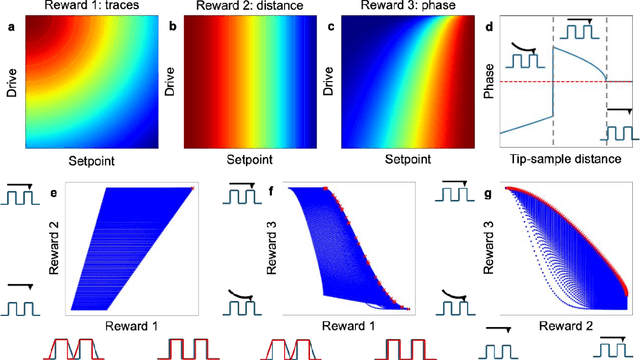
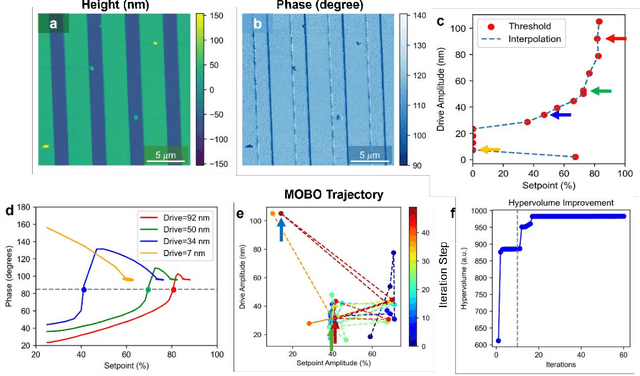
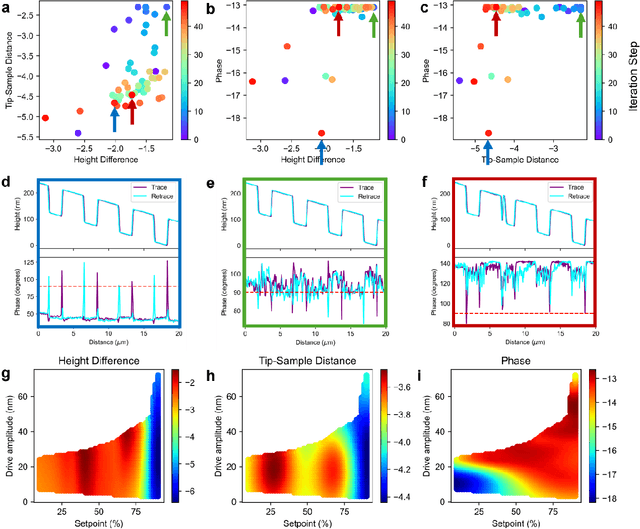
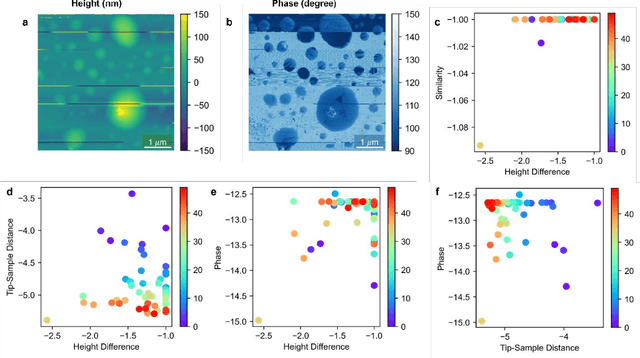
Automated experimentation has the potential to revolutionize scientific discovery, but its effectiveness depends on well-defined optimization targets, which are often uncertain or probabilistic in real-world settings. In this work, we demonstrate the application of Multi-Objective Bayesian Optimization (MOBO) to balance multiple, competing rewards in autonomous experimentation. Using scanning probe microscopy (SPM) imaging, one of the most widely used and foundational SPM modes, we show that MOBO can optimize imaging parameters to enhance measurement quality, reproducibility, and efficiency. A key advantage of this approach is the ability to compute and analyze the Pareto front, which not only guides optimization but also provides physical insights into the trade-offs between different objectives. Additionally, MOBO offers a natural framework for human-in-the-loop decision-making, enabling researchers to fine-tune experimental trade-offs based on domain expertise. By standardizing high-quality, reproducible measurements and integrating human input into AI-driven optimization, this work highlights MOBO as a powerful tool for advancing autonomous scientific discovery.
QEMesh: Employing A Quadric Error Metrics-Based Representation for Mesh Generation
Apr 08, 2025Mesh generation plays a crucial role in 3D content creation, as mesh is widely used in various industrial applications. Recent works have achieved impressive results but still face several issues, such as unrealistic patterns or pits on surfaces, thin parts missing, and incomplete structures. Most of these problems stem from the choice of shape representation or the capabilities of the generative network. To alleviate these, we extend PoNQ, a Quadric Error Metrics (QEM)-based representation, and propose a novel model, QEMesh, for high-quality mesh generation. PoNQ divides the shape surface into tiny patches, each represented by a point with its normal and QEM matrix, which preserves fine local geometry information. In our QEMesh, we regard these elements as generable parameters and design a unique latent diffusion model containing a novel multi-decoder VAE for PoNQ parameters generation. Given the latent code generated by the diffusion model, three parameter decoders produce several PoNQ parameters within each voxel cell, and an occupancy decoder predicts which voxel cells containing parameters to form the final shape. Extensive evaluations demonstrate that our method generates results with watertight surfaces and is comparable to state-of-the-art methods in several main metrics.
AdPO: Enhancing the Adversarial Robustness of Large Vision-Language Models with Preference Optimization
Apr 02, 2025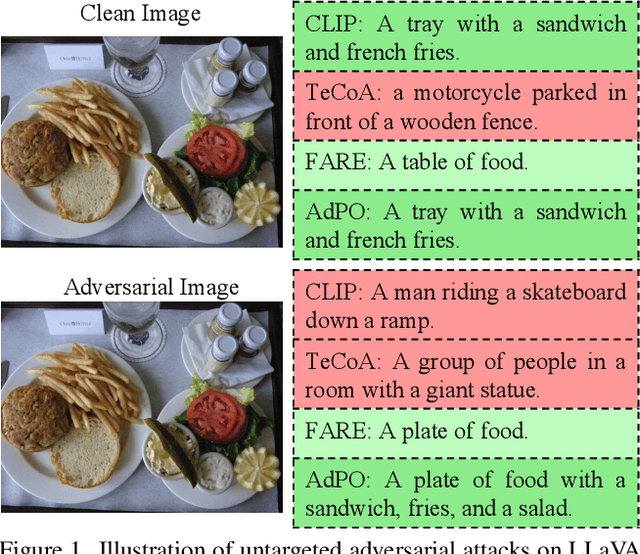
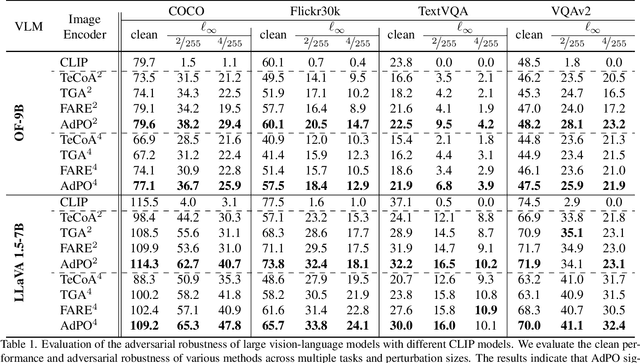
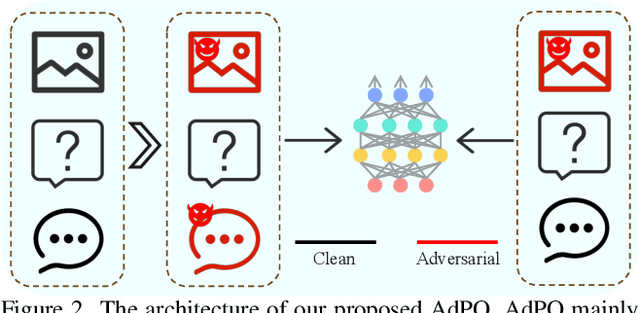
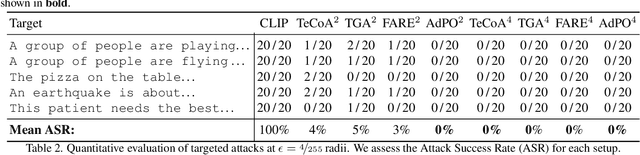
Large Vision-Language Models (LVLMs), such as GPT-4o and LLaVA, have recently witnessed remarkable advancements and are increasingly being deployed in real-world applications. However, inheriting the sensitivity of visual neural networks, LVLMs remain vulnerable to adversarial attacks, which can result in erroneous or malicious outputs. While existing efforts utilize adversarial fine-tuning to enhance robustness, they often suffer from performance degradation on clean inputs. In this paper, we proposes AdPO, a novel adversarial defense strategy for LVLMs based on preference optimization. For the first time, we reframe adversarial training as a preference optimization problem, aiming to enhance the model's preference for generating normal outputs on clean inputs while rejecting the potential misleading outputs for adversarial examples. Notably, AdPO achieves this by solely modifying the image encoder, e.g., CLIP ViT, resulting in superior clean and adversarial performance in a variety of downsream tasks. Considering that training involves large language models (LLMs), the computational cost increases significantly. We validate that training on smaller LVLMs and subsequently transferring to larger models can achieve competitive performance while maintaining efficiency comparable to baseline methods. Our comprehensive experiments confirm the effectiveness of the proposed AdPO, which provides a novel perspective for future adversarial defense research.
High-Fidelity Diffusion Face Swapping with ID-Constrained Facial Conditioning
Mar 28, 2025Face swapping aims to seamlessly transfer a source facial identity onto a target while preserving target attributes such as pose and expression. Diffusion models, known for their superior generative capabilities, have recently shown promise in advancing face-swapping quality. This paper addresses two key challenges in diffusion-based face swapping: the prioritized preservation of identity over target attributes and the inherent conflict between identity and attribute conditioning. To tackle these issues, we introduce an identity-constrained attribute-tuning framework for face swapping that first ensures identity preservation and then fine-tunes for attribute alignment, achieved through a decoupled condition injection. We further enhance fidelity by incorporating identity and adversarial losses in a post-training refinement stage. Our proposed identity-constrained diffusion-based face-swapping model outperforms existing methods in both qualitative and quantitative evaluations, demonstrating superior identity similarity and attribute consistency, achieving a new state-of-the-art performance in high-fidelity face swapping.