 Add to Chrome
 Add to Firefox
 Add to Edge
GD$^2$PO: Mitigating Multi-Reward Conflicts via Group-Dynamic reward-Decoupled Policy Optimization
Jun 15, 2026
As LLMs advance, post-training reinforcement learning (RL) increasingly relies on multi-dimensional rewards to cultivate comprehensive capabilities. This shift demands new algorithms capable of optimizing diverse and potentially competing objectives simultaneously. To address this, existing methods such as Group reward-Decoupled Policy Optimization (GDPO) decompose the overall score into independent reward groups, then compute the RL loss separately within each group. However, this strategy still encounters multi-reward conflicts: a single rollout can yield positive advantages on certain reward dimensions but negative ones on others, causing opposing signals to cancel each other out during aggregation, further hindering RL training efficiency. Inspired by Dynamic sAmpling Policy Optimization (DAPO), which improves RL training efficiency by filtering out ineffective rollouts with near-zero advantages, we propose Group-Dynamic reward-Decoupled Policy Optimization (GD$^2$PO). Specifically, GD$^2$PO employs a conflict-aware filtering mechanism to mask out rollouts suffering from severe reward-wise disagreement. By preventing conflicting signals from canceling each other out, this masking strategy preserves and enhances the magnitude of effective RL advantages, thereby significantly accelerating learning efficiency. Furthermore, we introduce query-level reweighting to dynamically adjust the update intensity of each query based on its overall reward consensus. Experiments on various multi-reward scenarios, including tool calling and human preference alignment, demonstrate that GD$^2$PO consistently and significantly outperforms existing baselines. The code is available at https://github.com/Qwen-Applications/GD2PO.

PerspectiveGap: A Benchmark for Multi-Agent Orchestration Prompting
Jun 07, 2026Real-world LLM applications are moving beyond single-agent workflows toward orchestrated multi-agent systems, yet current models still struggle to determine what each sub-agent needs to know. To measure this, we introduce PerspectiveGap, a benchmark for evaluating LLMs' ability to compose orchestration prompts for multi-agent systems. PerspectiveGap contains 110 scenarios, each evaluated through two distractor-mixed task formats: role-fragment assignment and free-form prompt writing. These scenarios are organized into 10 topologies, which are distilled from the authors' real-world engineering practice and framed by the Prompt Economy principle: building loop-centered orchestrations that maximize utility with minimal role and engineering overhead. In experiments with 27 commercial models from 10 companies, GPT-5.5 substantially outperforms all competitors, whereas Opus 4.7 shows a notable weakness in orchestration prompting despite its strong coding performance. Nevertheless, PerspectiveGap remains challenging: the evaluated models achieve an average combined pass rate of only 14.9\% (GPT-5.5 62.0\%) and an average overall leakage rate of 246.5\% (a per-scenario information leak-event count, not a proportion; GPT-5.5 49.1\%). These findings suggest that multi-agent orchestration prompting is a distinct and under-evaluated capability, and PerspectiveGap provides a foundation for measuring and improving it systematically.
NRGS: Neural Regularization for Robust 3D Semantic Gaussian Splatting
Apr 24, 2026We propose a neural regularization method that refines the noisy 3D semantic field produced by lifting multi-view inconsistent 2D features, in order to obtain an accurate and robust 3D semantic Gaussian Splatting. The 2D features extracted from vision foundation models suffer from multi-view inconsistency due to a lack of cross-view constraints. Lifting these inconsistent features directly into 3D Gaussians results in a noisy semantic field, which degrades the performance of downstream tasks. Previous methods either focus on obtaining consistent multi-view features in the preprocessing stage or aim to mitigate noise through improved optimization strategies, often at the cost of increased preprocessing time or expensive computational overhead. In contrast, we introduce a variance-aware conditional MLP that operates directly on the 3D Gaussians, leveraging their geometric and appearance attributes to correct semantic errors in 3D space. Experiments on different datasets show that our method enhances the accuracy of lifted semantics, providing an efficient and effective approach to robust 3D semantic Gaussian Splatting.
Trace2Skill: Distill Trajectory-Local Lessons into Transferable Agent Skills
Mar 26, 2026Equipping Large Language Model (LLM) agents with domain-specific skills is critical for tackling complex tasks. Yet, manual authoring creates a severe scalability bottleneck. Conversely, automated skill generation often yields fragile or fragmented results because it either relies on shallow parametric knowledge or sequentially overfits to non-generalizable trajectory-local lessons. To overcome this, we introduce Trace2Skill, a framework that mirrors how human experts author skills: by holistically analyzing broad execution experience before distilling it into a single, comprehensive guide. Instead of reacting sequentially to individual trajectories, Trace2Skill dispatches a parallel fleet of sub-agents to analyze a diverse pool of executions. It extracts trajectory-specific lessons and hierarchically consolidates them into a unified, conflict-free skill directory via inductive reasoning. Trace2Skill supports both deepening existing human-written skills and creating new ones from scratch. Experiments in challenging domains, such as spreadsheet, VisionQA and math reasoning, show that Trace2Skill significantly improves upon strong baselines, including Anthropic's official xlsx skills. Crucially, this trajectory-grounded evolution does not merely memorize task instances or model-specific quirks: evolved skills transfer across LLM scales and generalize to OOD settings. For example, skills evolved by Qwen3.5-35B on its own trajectories improved a Qwen3.5-122B agent by up to 57.65 absolute percentage points on WikiTableQuestions. Ultimately, our results demonstrate that complex agent experience can be packaged into highly transferable, declarative skills -- requiring no parameter updates, no external retrieval modules, and utilizing open-source models as small as 35B parameters.
Search More, Think Less: Rethinking Long-Horizon Agentic Search for Efficiency and Generalization
Feb 26, 2026Recent deep research agents primarily improve performance by scaling reasoning depth, but this leads to high inference cost and latency in search-intensive scenarios. Moreover, generalization across heterogeneous research settings remains challenging. In this work, we propose \emph{Search More, Think Less} (SMTL), a framework for long-horizon agentic search that targets both efficiency and generalization. SMTL replaces sequential reasoning with parallel evidence acquisition, enabling efficient context management under constrained context budgets. To support generalization across task types, we further introduce a unified data synthesis pipeline that constructs search tasks spanning both deterministic question answering and open-ended research scenarios with task appropriate evaluation metrics. We train an end-to-end agent using supervised fine-tuning and reinforcement learning, achieving strong and often state of the art performance across benchmarks including BrowseComp (48.6\%), GAIA (75.7\%), Xbench (82.0\%), and DeepResearch Bench (45.9\%). Compared to Mirothinker-v1.0, SMTL with maximum 100 interaction steps reduces the average number of reasoning steps on BrowseComp by 70.7\%, while improving accuracy.
Gaussian Mesh Renderer for Lightweight Differentiable Rendering
Feb 16, 20263D Gaussian Splatting (3DGS) has enabled high-fidelity virtualization with fast rendering and optimization for novel view synthesis. On the other hand, triangle mesh models still remain a popular choice for surface reconstruction but suffer from slow or heavy optimization in traditional mesh-based differentiable renderers. To address this problem, we propose a new lightweight differentiable mesh renderer leveraging the efficient rasterization process of 3DGS, named Gaussian Mesh Renderer (GMR), which tightly integrates the Gaussian and mesh representations. Each Gaussian primitive is analytically derived from the corresponding mesh triangle, preserving structural fidelity and enabling the gradient flow. Compared to the traditional mesh renderers, our method achieves smoother gradients, which especially contributes to better optimization using smaller batch sizes with limited memory. Our implementation is available in the public GitHub repository at https://github.com/huntorochi/Gaussian-Mesh-Renderer.
O-Researcher: An Open Ended Deep Research Model via Multi-Agent Distillation and Agentic RL
Jan 07, 2026The performance gap between closed-source and open-source large language models (LLMs) is largely attributed to disparities in access to high-quality training data. To bridge this gap, we introduce a novel framework for the automated synthesis of sophisticated, research-grade instructional data. Our approach centers on a multi-agent workflow where collaborative AI agents simulate complex tool-integrated reasoning to generate diverse and high-fidelity data end-to-end. Leveraging this synthesized data, we develop a two-stage training strategy that integrates supervised fine-tuning with a novel reinforcement learning method, designed to maximize model alignment and capability. Extensive experiments demonstrate that our framework empowers open-source models across multiple scales, enabling them to achieve new state-of-the-art performance on the major deep research benchmark. This work provides a scalable and effective pathway for advancing open-source LLMs without relying on proprietary data or models.
Polysemous Language Gaussian Splatting via Matching-based Mask Lifting
Sep 26, 2025Lifting 2D open-vocabulary understanding into 3D Gaussian Splatting (3DGS) scenes is a critical challenge. However, mainstream methods suffer from three key flaws: (i) their reliance on costly per-scene retraining prevents plug-and-play application; (ii) their restrictive monosemous design fails to represent complex, multi-concept semantics; and (iii) their vulnerability to cross-view semantic inconsistencies corrupts the final semantic representation. To overcome these limitations, we introduce MUSplat, a training-free framework that abandons feature optimization entirely. Leveraging a pre-trained 2D segmentation model, our pipeline generates and lifts multi-granularity 2D masks into 3D, where we estimate a foreground probability for each Gaussian point to form initial object groups. We then optimize the ambiguous boundaries of these initial groups using semantic entropy and geometric opacity. Subsequently, by interpreting the object's appearance across its most representative viewpoints, a Vision-Language Model (VLM) distills robust textual features that reconciles visual inconsistencies, enabling open-vocabulary querying via semantic matching. By eliminating the costly per-scene training process, MUSplat reduces scene adaptation time from hours to mere minutes. On benchmark tasks for open-vocabulary 3D object selection and semantic segmentation, MUSplat outperforms established training-based frameworks while simultaneously addressing their monosemous limitations.
Zero-shot Hierarchical Plant Segmentation via Foundation Segmentation Models and Text-to-image Attention
Sep 11, 2025Foundation segmentation models achieve reasonable leaf instance extraction from top-view crop images without training (i.e., zero-shot). However, segmenting entire plant individuals with each consisting of multiple overlapping leaves remains challenging. This problem is referred to as a hierarchical segmentation task, typically requiring annotated training datasets, which are often species-specific and require notable human labor. To address this, we introduce ZeroPlantSeg, a zero-shot segmentation for rosette-shaped plant individuals from top-view images. We integrate a foundation segmentation model, extracting leaf instances, and a vision-language model, reasoning about plants' structures to extract plant individuals without additional training. Evaluations on datasets with multiple plant species, growth stages, and shooting environments demonstrate that our method surpasses existing zero-shot methods and achieves better cross-domain performance than supervised methods. Implementations are available at https://github.com/JunhaoXing/ZeroPlantSeg.
HoGS: Unified Near and Far Object Reconstruction via Homogeneous Gaussian Splatting
Mar 25, 2025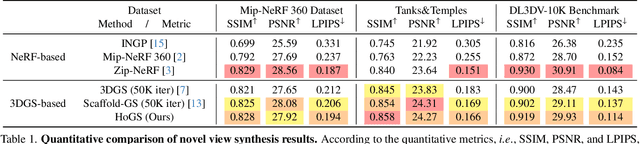
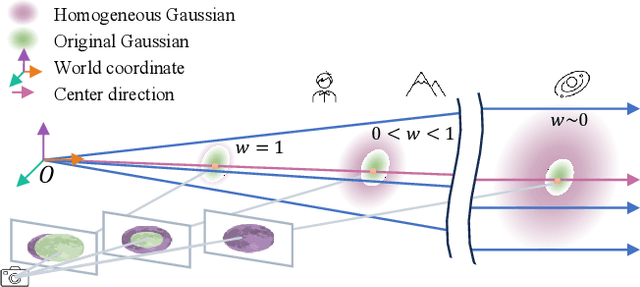
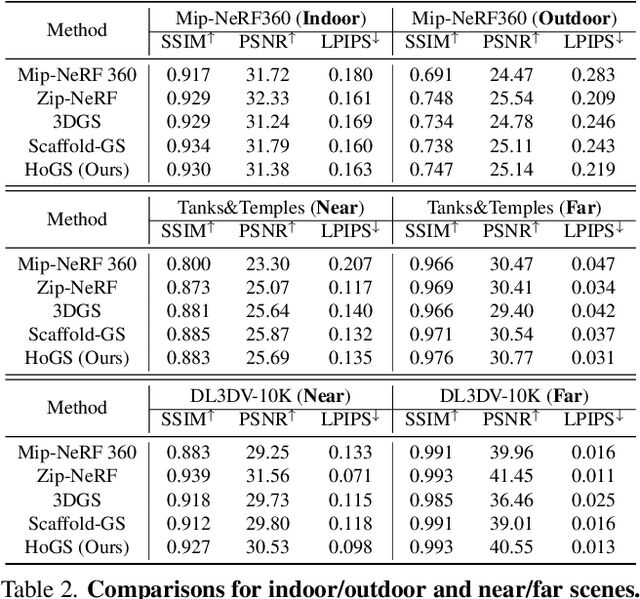
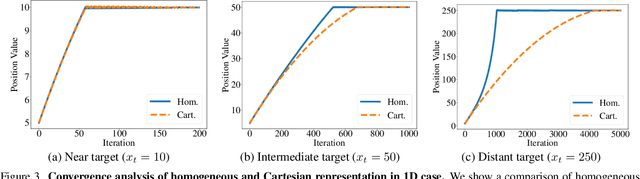
Novel view synthesis has demonstrated impressive progress recently, with 3D Gaussian splatting (3DGS) offering efficient training time and photorealistic real-time rendering. However, reliance on Cartesian coordinates limits 3DGS's performance on distant objects, which is important for reconstructing unbounded outdoor environments. We found that, despite its ultimate simplicity, using homogeneous coordinates, a concept on the projective geometry, for the 3DGS pipeline remarkably improves the rendering accuracies of distant objects. We therefore propose Homogeneous Gaussian Splatting (HoGS) incorporating homogeneous coordinates into the 3DGS framework, providing a unified representation for enhancing near and distant objects. HoGS effectively manages both expansive spatial positions and scales particularly in outdoor unbounded environments by adopting projective geometry principles. Experiments show that HoGS significantly enhances accuracy in reconstructing distant objects while maintaining high-quality rendering of nearby objects, along with fast training speed and real-time rendering capability. Our implementations are available on our project page https://kh129.github.io/hogs/.