 Add to Chrome
 Add to Firefox
 Add to Edge
Omni-Supervised Motion Editing: Balancing Change and Invariance through Positive-Negative Learning
May 29, 2026
Text-based human motion editing aims to modify existing motion sequences according to natural language instructions while maintaining the consistency of the original motion. Existing diffusion-based approaches often rely on heuristic similarity cues or coarse global conditioning, leading to motion distortion and suboptimal semantic alignment. The key challenge lies in balancing change (i.e. precisely editing target regions) and invariance (i.e. preserving unedited parts). To handle such challenge, we propose an Omni-Supervised Positive-Negative Learning framework, named OmniME. Our method integrates three complementary components: (1) retrospective feature supervision that enforces coarse-to-fine consistency across transformer layers,(2) motion preservation mechanism that focuses on subtle variations according to the source-target similarity, and (3) triplet-based semantic alignment that strengthens text-motion correspondence. Together, these components form a unified supervision paradigm that balances change and invariance. Extensive experiments on the MotionFix and STANCE Adjustment datasets demonstrate that OmniME achieves state-of-the-art performance in editing alignment, validating the effectiveness of our unified learning framework. Our source codes and models have been released at: https://github.com/rocket-ycyer/OmniME.git

GSCompleter: A Distillation-Free Plugin for Metric-Aware 3D Gaussian Splatting Completion in Seconds
Apr 22, 2026While 3D Gaussian Splatting (3DGS) has revolutionized real-time rendering, its performance degrades significantly under sparse-view extrapolation, manifesting as severe geometric voids and artifacts. Existing solutions primarily rely on an iterative "Repair-then-Distill" paradigm, which is inherently unstable and prone to overfitting. In this work, we propose GSCompleter, a distillation-free plugin that shifts scene completion to a stable "Generate-then-Register" workflow. Our approach first synthesizes plausible 2D reference images and explicitly lifts them into metric-scale 3D primitives via a robust Stereo-Anchor mechanism. These primitives are then seamlessly integrated into the global context through a novel Ray-Constrained Registration strategy. This shift to a rapid registration paradigm delivers superior 3DGS completion performance across three distinct benchmarks, enhancing the quality and efficiency of various baselines and achieving new SOTA results.
DailyArt: Discovering Articulation from Single Static Images via Latent Dynamics
Apr 09, 2026Articulated objects are essential for embodied AI and world models, yet inferring their kinematics from a single closed-state image remains challenging because crucial motion cues are often occluded. Existing methods either require multi-state observations or rely on explicit part priors, retrieval, or other auxiliary inputs that partially expose the structure to be inferred. In this work, we present DailyArt, which formulates articulated joint estimation from a single static image as a synthesis-mediated reasoning problem. Instead of directly regressing joints from a heavily occluded observation, DailyArt first synthesizes a maximally articulated opened state under the same camera view to expose articulation cues, and then estimates the full set of joint parameters from the discrepancy between the observed and synthesized states. Using a set-prediction formulation, DailyArt recovers all joints simultaneously without requiring object-specific templates, multi-view inputs, or explicit part annotations at test time. Taking estimated joints as conditions, the framework further supports part-level novel state synthesis as a downstream capability. Extensive experiments show that DailyArt achieves strong performance in articulated joint estimation and supports part-level novel state synthesis conditioned on joints. Project page is available at https://rangooo123.github.io/DaliyArt.github.io/.
Memory Intelligence Agent
Apr 07, 2026Deep research agents (DRAs) integrate LLM reasoning with external tools. Memory systems enable DRAs to leverage historical experiences, which are essential for efficient reasoning and autonomous evolution. Existing methods rely on retrieving similar trajectories from memory to aid reasoning, while suffering from key limitations of ineffective memory evolution and increasing storage and retrieval costs. To address these problems, we propose a novel Memory Intelligence Agent (MIA) framework, consisting of a Manager-Planner-Executor architecture. Memory Manager is a non-parametric memory system that can store compressed historical search trajectories. Planner is a parametric memory agent that can produce search plans for questions. Executor is another agent that can search and analyze information guided by the search plan. To build the MIA framework, we first adopt an alternating reinforcement learning paradigm to enhance cooperation between the Planner and the Executor. Furthermore, we enable the Planner to continuously evolve during test-time learning, with updates performed on-the-fly alongside inference without interrupting the reasoning process. Additionally, we establish a bidirectional conversion loop between parametric and non-parametric memories to achieve efficient memory evolution. Finally, we incorporate a reflection and an unsupervised judgment mechanisms to boost reasoning and self-evolution in the open world. Extensive experiments across eleven benchmarks demonstrate the superiority of MIA.
S2GS: Streaming Semantic Gaussian Splatting for Online Scene Understanding and Reconstruction
Mar 15, 2026Existing offline feed-forward methods for joint scene understanding and reconstruction on long image streams often repeatedly perform global computation over an ever-growing set of past observations, causing runtime and GPU memory to increase rapidly with sequence length and limiting scalability. We propose Streaming Semantic Gaussian Splatting (S2GS), a strictly causal, incremental 3D Gaussian semantic field framework: it does not leverage future frames and continuously updates scene geometry, appearance, and instance-level semantics without reprocessing historical frames, enabling scalable online joint reconstruction and understanding. S2GS adopts a geometry-semantic decoupled dual-backbone design: the geometry branch performs causal modeling to drive incremental Gaussian updates, while the semantic branch leverages a 2D foundation vision model and a query-driven decoder to predict segmentation masks and identity embeddings, further stabilized by query-level contrastive alignment and lightweight online association with an instance memory. Experiments show that S2GS matches or outperforms strong offline baselines on joint reconstruction-and-understanding benchmarks, while significantly improving long-horizon scalability: it processes 1,000+ frames with much slower growth in runtime and GPU memory, whereas offline global-processing baselines typically run out of memory at around 80 frames under the same setting.
Zero-Shot Robotic Manipulation via 3D Gaussian Splatting-Enhanced Multimodal Retrieval-Augmented Generation
Feb 28, 2026Existing end-to-end approaches of robotic manipulation often lack generalization to unseen objects or tasks due to limited data and poor interpretability. While recent Multimodal Large Language Models (MLLMs) demonstrate strong commonsense reasoning, they struggle with geometric and spatial understanding required for pose prediction. In this paper, we propose RobMRAG, a 3D Gaussian Splatting-Enhanced Multimodal Retrieval-Augmented Generation (MRAG) framework for zero-shot robotic manipulation. Specifically, we construct a multi-source manipulation knowledge base containing object contact frames, task completion frames, and pose parameters. During inference, a Hierarchical Multimodal Retrieval module first employs a three-priority hybrid retrieval strategy to find task-relevant object prototypes, then selects the geometrically closest reference example based on pixel-level similarity and Instance Matching Distance (IMD). We further introduce a 3D-Aware Pose Refinement module based on 3D Gaussian Splatting into the MRAG framework, which aligns the pose of the reference object to the target object in 3D space. The aligned results are reprojected onto the image plane and used as input to the MLLM to enhance the generation of the final pose parameters. Extensive experiments show that on a test set containing 30 categories of household objects, our method improves the success rate by 7.76% compared to the best-performing zero-shot baseline under the same setting, and by 6.54% compared to the state-of-the-art supervised baseline. Our results validate that RobMRAG effectively bridges the gap between high-level semantic reasoning and low-level geometric execution, enabling robotic systems that generalize to unseen objects while remaining inherently interpretable.
EscherVerse: An Open World Benchmark and Dataset for Teleo-Spatial Intelligence with Physical-Dynamic and Intent-Driven Understanding
Jan 04, 2026The ability to reason about spatial dynamics is a cornerstone of intelligence, yet current research overlooks the human intent behind spatial changes. To address these limitations, we introduce Teleo-Spatial Intelligence (TSI), a new paradigm that unifies two critical pillars: Physical-Dynamic Reasoning--understanding the physical principles of object interactions--and Intent-Driven Reasoning--inferring the human goals behind these actions. To catalyze research in TSI, we present EscherVerse, consisting of a large-scale, open-world benchmark (Escher-Bench), a dataset (Escher-35k), and models (Escher series). Derived from real-world videos, EscherVerse moves beyond constrained settings to explicitly evaluate an agent's ability to reason about object permanence, state transitions, and trajectory prediction in dynamic, human-centric scenarios. Crucially, it is the first benchmark to systematically assess Intent-Driven Reasoning, challenging models to connect physical events to their underlying human purposes. Our work, including a novel data curation pipeline, provides a foundational resource to advance spatial intelligence from passive scene description toward a holistic, purpose-driven understanding of the world.
UniForward: Unified 3D Scene and Semantic Field Reconstruction via Feed-Forward Gaussian Splatting from Only Sparse-View Images
Jun 11, 2025We propose a feed-forward Gaussian Splatting model that unifies 3D scene and semantic field reconstruction. Combining 3D scenes with semantic fields facilitates the perception and understanding of the surrounding environment. However, key challenges include embedding semantics into 3D representations, achieving generalizable real-time reconstruction, and ensuring practical applicability by using only images as input without camera parameters or ground truth depth. To this end, we propose UniForward, a feed-forward model to predict 3D Gaussians with anisotropic semantic features from only uncalibrated and unposed sparse-view images. To enable the unified representation of the 3D scene and semantic field, we embed semantic features into 3D Gaussians and predict them through a dual-branch decoupled decoder. During training, we propose a loss-guided view sampler to sample views from easy to hard, eliminating the need for ground truth depth or masks required by previous methods and stabilizing the training process. The whole model can be trained end-to-end using a photometric loss and a distillation loss that leverages semantic features from a pre-trained 2D semantic model. At the inference stage, our UniForward can reconstruct 3D scenes and the corresponding semantic fields in real time from only sparse-view images. The reconstructed 3D scenes achieve high-quality rendering, and the reconstructed 3D semantic field enables the rendering of view-consistent semantic features from arbitrary views, which can be further decoded into dense segmentation masks in an open-vocabulary manner. Experiments on novel view synthesis and novel view segmentation demonstrate that our method achieves state-of-the-art performances for unifying 3D scene and semantic field reconstruction.
DORAEMON: Decentralized Ontology-aware Reliable Agent with Enhanced Memory Oriented Navigation
May 29, 2025Adaptive navigation in unfamiliar environments is crucial for household service robots but remains challenging due to the need for both low-level path planning and high-level scene understanding. While recent vision-language model (VLM) based zero-shot approaches reduce dependence on prior maps and scene-specific training data, they face significant limitations: spatiotemporal discontinuity from discrete observations, unstructured memory representations, and insufficient task understanding leading to navigation failures. We propose DORAEMON (Decentralized Ontology-aware Reliable Agent with Enhanced Memory Oriented Navigation), a novel cognitive-inspired framework consisting of Ventral and Dorsal Streams that mimics human navigation capabilities. The Dorsal Stream implements the Hierarchical Semantic-Spatial Fusion and Topology Map to handle spatiotemporal discontinuities, while the Ventral Stream combines RAG-VLM and Policy-VLM to improve decision-making. Our approach also develops Nav-Ensurance to ensure navigation safety and efficiency. We evaluate DORAEMON on the HM3D, MP3D, and GOAT datasets, where it achieves state-of-the-art performance on both success rate (SR) and success weighted by path length (SPL) metrics, significantly outperforming existing methods. We also introduce a new evaluation metric (AORI) to assess navigation intelligence better. Comprehensive experiments demonstrate DORAEMON's effectiveness in zero-shot autonomous navigation without requiring prior map building or pre-training.
Reconstructing In-the-Wild Open-Vocabulary Human-Object Interactions
Mar 20, 2025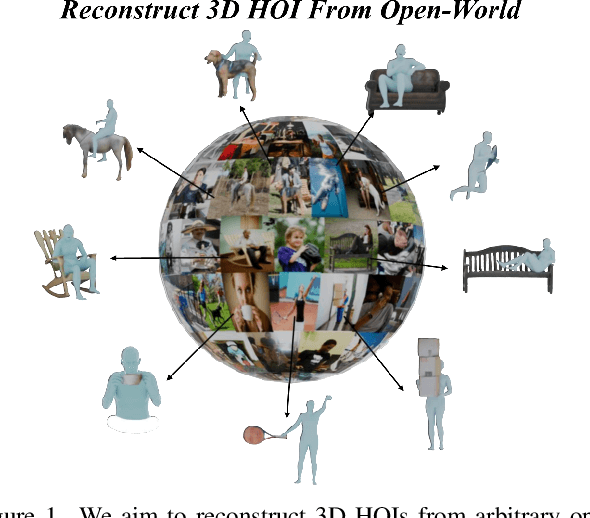
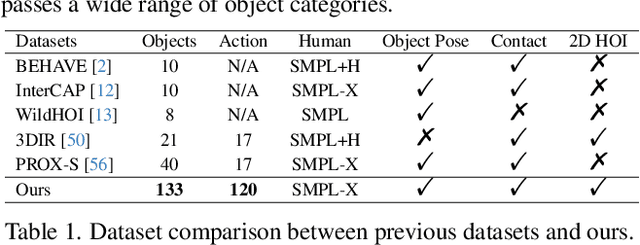
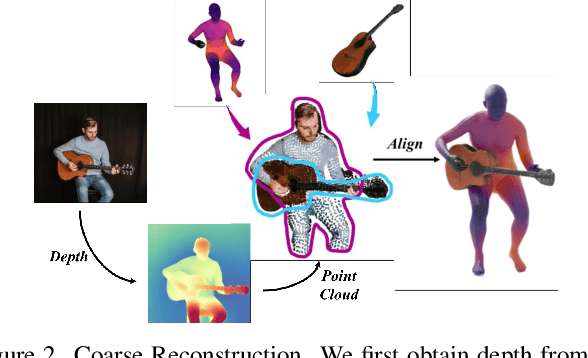
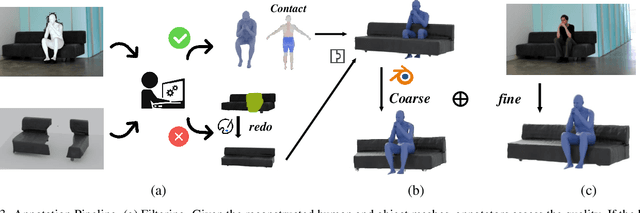
Reconstructing human-object interactions (HOI) from single images is fundamental in computer vision. Existing methods are primarily trained and tested on indoor scenes due to the lack of 3D data, particularly constrained by the object variety, making it challenging to generalize to real-world scenes with a wide range of objects. The limitations of previous 3D HOI datasets were primarily due to the difficulty in acquiring 3D object assets. However, with the development of 3D reconstruction from single images, recently it has become possible to reconstruct various objects from 2D HOI images. We therefore propose a pipeline for annotating fine-grained 3D humans, objects, and their interactions from single images. We annotated 2.5k+ 3D HOI assets from existing 2D HOI datasets and built the first open-vocabulary in-the-wild 3D HOI dataset Open3DHOI, to serve as a future test set. Moreover, we design a novel Gaussian-HOI optimizer, which efficiently reconstructs the spatial interactions between humans and objects while learning the contact regions. Besides the 3D HOI reconstruction, we also propose several new tasks for 3D HOI understanding to pave the way for future work. Data and code will be publicly available at https://wenboran2002.github.io/3dhoi.