 Add to Chrome
 Add to Firefox
 Add to Edge
LAMBDA: A Low-Altitude Multimodal Base Dataset for UAV Sensing and Communication
Jul 04, 2026
Research on low-altitude integrated sensing and communication (ISAC) requires aligned multimodal data that jointly describe wireless propagation, visual appearance, unmanned aerial vehicle (UAV) motion, light detection and ranging (LiDAR) perception, and radar sensing under common trajectories and timestamps. To address this need, a low-altitude multimodal base dataset, named LAMBDA, is introduced. LAMBDA is characterized by high fidelity, modality diversity, scenario richness, and configuration flexibility. It is generated through a high-fidelity digital-twin pipeline with detailed scene geometry, refined material assignment, and electromagnetic modeling of UAVs. LAMBDA provides synchronized RGB images, depth maps, LiDAR point clouds, inertial measurement unit states, UAV poses, channel state information (CSI), and radar-synthesis resources across matched low-altitude operating conditions, shared coordinate systems, and synchronized frame indices. The dataset covers urban, suburban, and campus scenes, multi-UAV/multi-base-station settings, nighttime conditions, and sunny, rainy, snowy, and foggy weather variations. Its CSI and radar resources support user-defined antenna-array sizes, bandwidths, subcarrier spacings, chirp parameters, and plane-wave or spherical-wavefront channel synthesis. The reliability and usability of LAMBDA are assessed through quality control, weather and multimodal visualization, and two UAV ISAC-related use cases: RGB-aided beam prediction and RGB-LiDAR-based UAV localization.

Homogeneous Dynamics Space for Heterogeneous Humans
Dec 09, 2024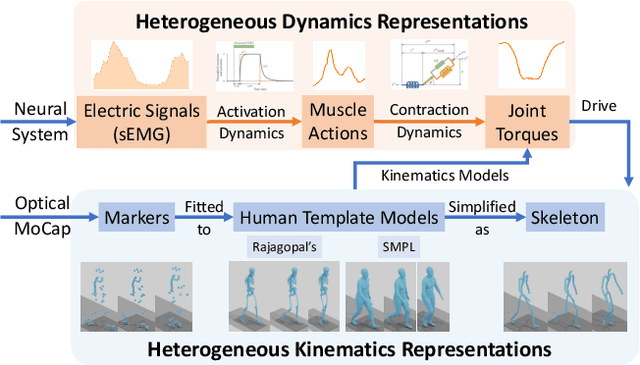
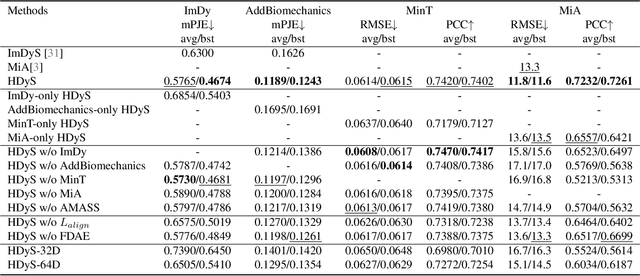
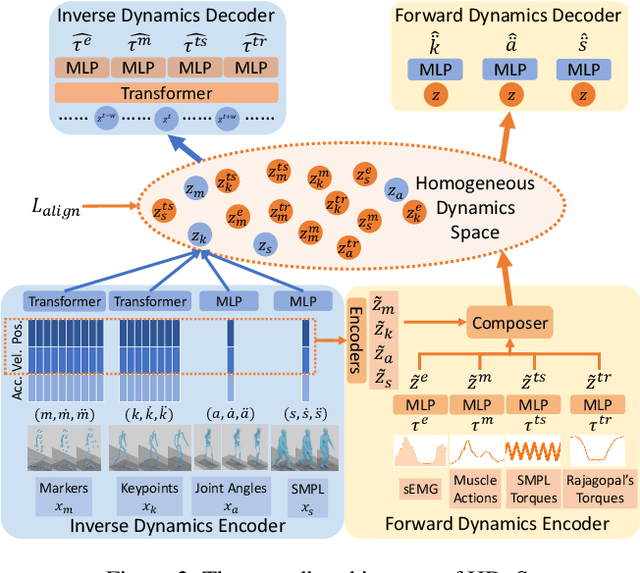

Analyses of human motion kinematics have achieved tremendous advances. However, the production mechanism, known as human dynamics, is still undercovered. In this paper, we aim to push data-driven human dynamics understanding forward. We identify a major obstacle to this as the heterogeneity of existing human motion understanding efforts. Specifically, heterogeneity exists in not only the diverse kinematics representations and hierarchical dynamics representations but also in the data from different domains, namely biomechanics and reinforcement learning. With an in-depth analysis of the existing heterogeneity, we propose to emphasize the beneath homogeneity: all of them represent the homogeneous fact of human motion, though from different perspectives. Given this, we propose Homogeneous Dynamics Space (HDyS) as a fundamental space for human dynamics by aggregating heterogeneous data and training a homogeneous latent space with inspiration from the inverse-forward dynamics procedure. Leveraging the heterogeneous representations and datasets, HDyS achieves decent mapping between human kinematics and dynamics. We demonstrate the feasibility of HDyS with extensive experiments and applications. The project page is https://foruck.github.io/HDyS.