 Add to Chrome
 Add to Firefox
 Add to Edge
AcademiClaw: When Students Set Challenges for AI Agents
May 04, 2026
Benchmarks within the OpenClaw ecosystem have thus far evaluated exclusively assistant-level tasks, leaving the academic-level capabilities of OpenClaw largely unexamined. We introduce AcademiClaw, a bilingual benchmark of 80 complex, long-horizon tasks sourced directly from university students' real academic workflows -- homework, research projects, competitions, and personal projects -- that they found current AI agents unable to solve effectively. Curated from 230 student-submitted candidates through rigorous expert review, the final task set spans 25+ professional domains, ranging from olympiad-level mathematics and linguistics problems to GPU-intensive reinforcement learning and full-stack system debugging, with 16 tasks requiring CUDA GPU execution. Each task executes in an isolated Docker sandbox and is scored on task completion by multi-dimensional rubrics combining six complementary techniques, with an independent five-category safety audit providing additional behavioral analysis. Experiments on six frontier models show that even the best achieves only a 55\% pass rate. Further analysis uncovers sharp capability boundaries across task domains, divergent behavioral strategies among models, and a disconnect between token consumption and output quality, providing fine-grained diagnostic signals beyond what aggregate metrics reveal. We hope that AcademiClaw and its open-sourced data and code can serve as a useful resource for the OpenClaw community, driving progress toward agents that are more capable and versatile across the full breadth of real-world academic demands. All data and code are available at https://github.com/GAIR-NLP/AcademiClaw.

Reconstructing In-the-Wild Open-Vocabulary Human-Object Interactions
Mar 20, 2025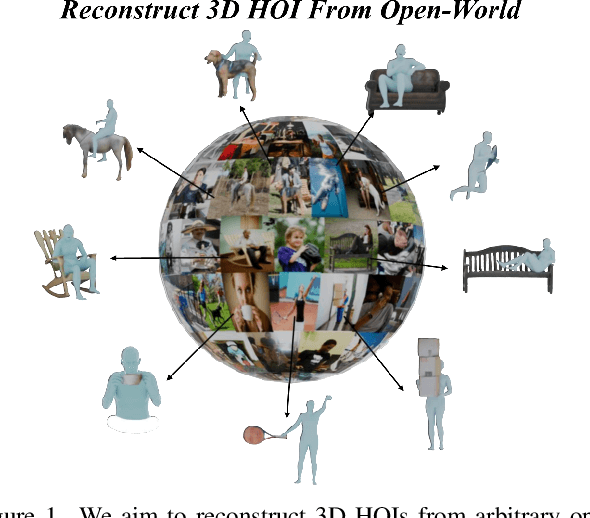
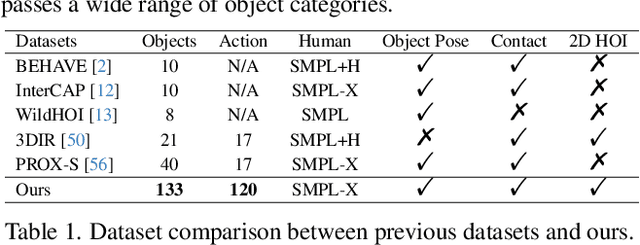
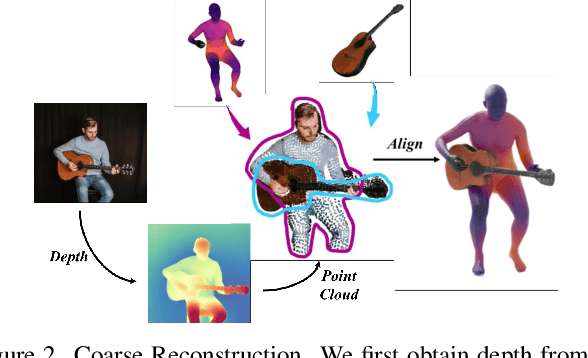
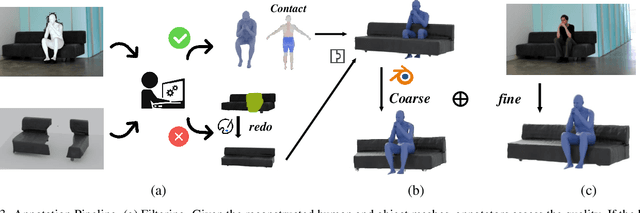
Reconstructing human-object interactions (HOI) from single images is fundamental in computer vision. Existing methods are primarily trained and tested on indoor scenes due to the lack of 3D data, particularly constrained by the object variety, making it challenging to generalize to real-world scenes with a wide range of objects. The limitations of previous 3D HOI datasets were primarily due to the difficulty in acquiring 3D object assets. However, with the development of 3D reconstruction from single images, recently it has become possible to reconstruct various objects from 2D HOI images. We therefore propose a pipeline for annotating fine-grained 3D humans, objects, and their interactions from single images. We annotated 2.5k+ 3D HOI assets from existing 2D HOI datasets and built the first open-vocabulary in-the-wild 3D HOI dataset Open3DHOI, to serve as a future test set. Moreover, we design a novel Gaussian-HOI optimizer, which efficiently reconstructs the spatial interactions between humans and objects while learning the contact regions. Besides the 3D HOI reconstruction, we also propose several new tasks for 3D HOI understanding to pave the way for future work. Data and code will be publicly available at https://wenboran2002.github.io/3dhoi.