 Add to Chrome
 Add to Firefox
 Add to Edge
UniMoCa: Unifying Motion and Camera Controls as Visual Proxies for Faithful Human Video Generation
Aug 03, 2026
Controlling human motion and camera movement is essential for faithful human-oriented video generation, yet remains challenging in multi-person scenes with large body motions, occlusions, and dynamic cameras. Existing pipelines typically rely on visual motion sequences, such as skeleton maps, pose maps, or rendered body representations, for motion control, while using camera embeddings for camera control. Such heterogeneous control interfaces force video generation models to reconcile pixel-aligned visual cues with non-visual geometric embeddings, making motion-camera attribution difficult and sensitive to camera estimation errors. We propose \textbf{UniMoCa}, a representation-driven framework that unifies motion and camera controls in visual space. At the core of UniMoCa is \textbf{Motion-Camera Visual Proxy} (\textbf{MCVP}), a mutually-sharable novel representation that converts 3D human motion and camera trajectories extracted from driving videos into an identity-neutral visual proxy. MCVP renders temporally aligned human geometry under the recovered camera trajectory and augments it with explicit camera trajectory markers, replacing heterogeneous visual-parametric controls with distinguishable visual cues. As both control factors are represented in the same visual space, they become mutually compatible rather than heterogeneous, enabling consistent joint reasoning and editing during video generation. We further curate a \textbf{MCVP-Video} dataset covering complex actions, multi-person interactions, and diverse camera trajectories. Experiments based on the Wan2.2 I2V show that UniMoCa achieves substantial gains in human motion control, camera control, temporal consistency, and camera-aware robustness with minimal additional complexity. More details are shown in our Project page: https://tanliming-daniel.github.io/UniMoCa/.

World Narrative Model for Highly Controllable Video Generation: A Paradigm Shift from Pixel Sampling to Physical World Orchestration
Jun 30, 2026The fundamental obstacle to industrial grade video generation is the lack of controllability: existing models treat video as a pixel distribution sampling problem, bypassing the explicit, instance level $4D$ $(3D + T)$ physical world. Consequently, content creators cannot specify geometry, motion, camera parameters, or lighting in a deterministic, quantitative way, leading to the infamous ''gacha'' loop that makes professional content creation prohibitively inefficient and expensive. To address this, we introduce the World Narrative Model (WNM), a paradigm that decouples what to render -- the structured physical narrative -- from how to render -- the pixel generation process. WNM replaces end-to-end black-box sampling with orchestrated $4D$ pre-visualization for media generation. Collaborative agents translate sparse multimodal inputs, including text, reference videos, and sketches, into a fully editable world representation with scene geometry, object layouts, character/animal skeleton motion, trajectories, camera motion, and lighting at quantitative, physically meaningful granularity. This representation acts as a deterministic structural blueprint that drives existing video foundation models, either frozen or lightly adapted, to render final footage, turning the base model into a faithful neural shader. Built on this engine, our human-AI platform supports automatic world generation and pre-visualization aligned with professional filmmaking pipelines, while director consoles enable seamless human refinement. Experiments show that WNM greatly reduces probabilistic ``gacha'' calls and produces videos whose layout, motion, and cinematography closely follow creator intent. The framework is open and modular, allowing each component, such as world representation, control agents, and adapters, to be independently improved. Project website: https://glassroom.sjtu.edu.cn/WNM/.
M$^3$-VOS: Multi-Phase, Multi-Transition, and Multi-Scenery Video Object Segmentation
Dec 19, 2024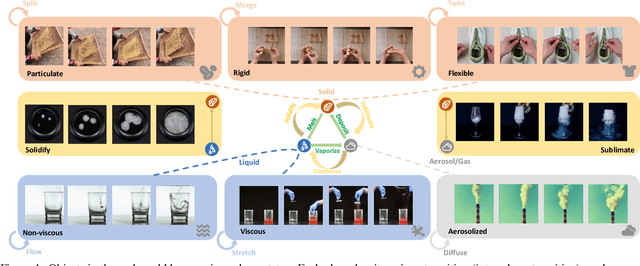
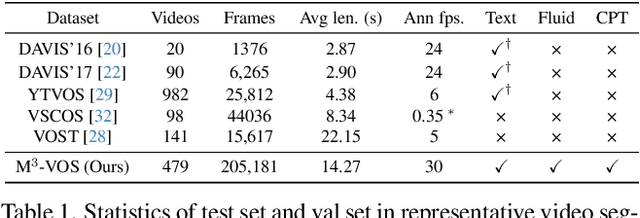

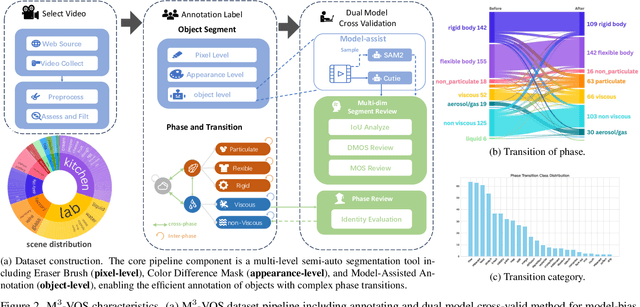
Intelligent robots need to interact with diverse objects across various environments. The appearance and state of objects frequently undergo complex transformations depending on the object properties, e.g., phase transitions. However, in the vision community, segmenting dynamic objects with phase transitions is overlooked. In light of this, we introduce the concept of phase in segmentation, which categorizes real-world objects based on their visual characteristics and potential morphological and appearance changes. Then, we present a new benchmark, Multi-Phase, Multi-Transition, and Multi-Scenery Video Object Segmentation (M$^3$-VOS), to verify the ability of models to understand object phases, which consists of 479 high-resolution videos spanning over 10 distinct everyday scenarios. It provides dense instance mask annotations that capture both object phases and their transitions. We evaluate state-of-the-art methods on M$^3$-VOS, yielding several key insights. Notably, current appearancebased approaches show significant room for improvement when handling objects with phase transitions. The inherent changes in disorder suggest that the predictive performance of the forward entropy-increasing process can be improved through a reverse entropy-reducing process. These findings lead us to propose ReVOS, a new plug-andplay model that improves its performance by reversal refinement. Our data and code will be publicly available at https://zixuan-chen.github.io/M-cubeVOS.github.io/.