 Add to Chrome
 Add to Firefox
 Add to Edge
E4S: Fine-grained Face Swapping via Editing With Regional GAN Inversion
Oct 23, 2023

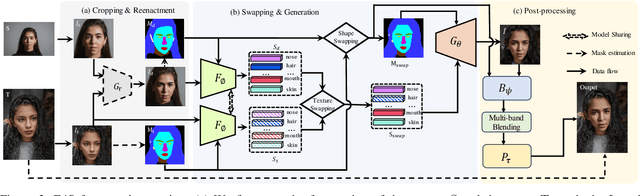
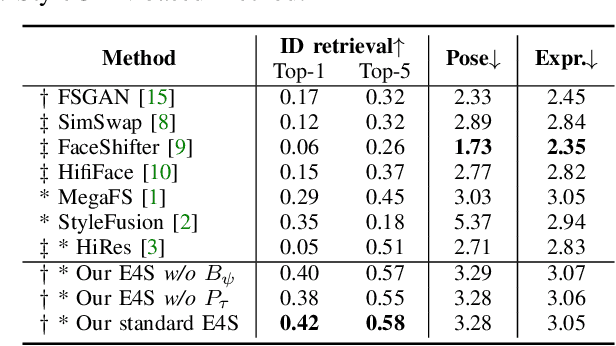
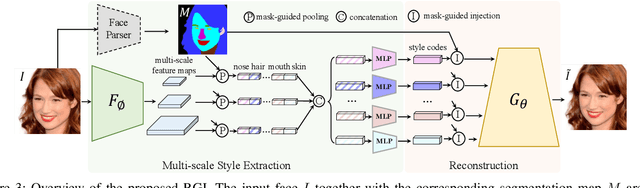
This paper proposes a novel approach to face swapping from the perspective of fine-grained facial editing, dubbed "editing for swapping" (E4S). The traditional face swapping methods rely on global feature extraction and often fail to preserve the source identity. In contrast, our framework proposes a Regional GAN Inversion (RGI) method, which allows the explicit disentanglement of shape and texture. Specifically, our E4S performs face swapping in the latent space of a pretrained StyleGAN, where a multi-scale mask-guided encoder is applied to project the texture of each facial component into regional style codes and a mask-guided injection module then manipulates feature maps with the style codes. Based on this disentanglement, face swapping can be simplified as style and mask swapping. Besides, since reconstructing the source face in the target image may lead to disharmony lighting, we propose to train a re-coloring network to make the swapped face maintain the lighting condition on the target face. Further, to deal with the potential mismatch area during mask exchange, we designed a face inpainting network as post-processing. The extensive comparisons with state-of-the-art methods demonstrate that our E4S outperforms existing methods in preserving texture, shape, and lighting. Our implementation is available at https://github.com/e4s2023/E4S2023.

PRCA: Fitting Black-Box Large Language Models for Retrieval Question Answering via Pluggable Reward-Driven Contextual Adapter
Oct 23, 2023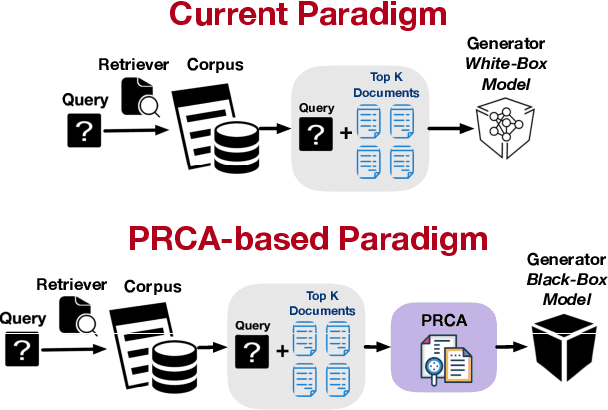
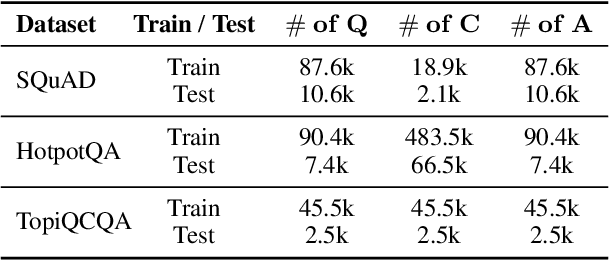
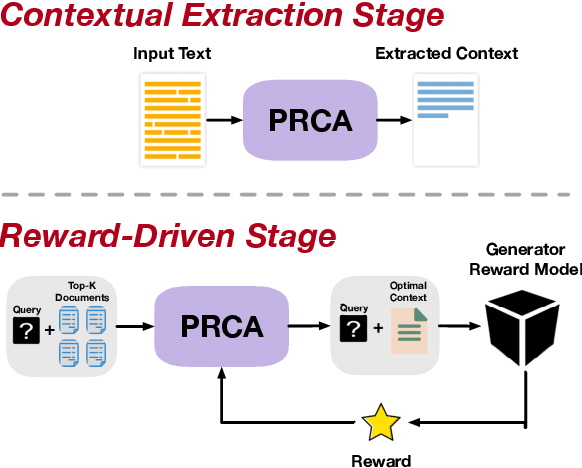
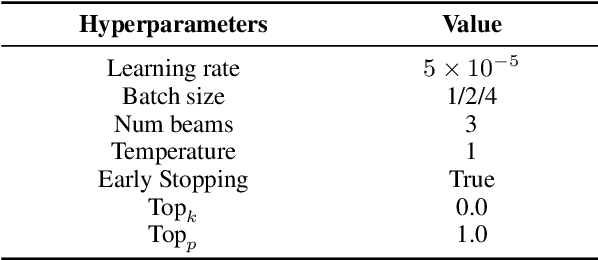
The Retrieval Question Answering (ReQA) task employs the retrieval-augmented framework, composed of a retriever and generator. The generator formulates the answer based on the documents retrieved by the retriever. Incorporating Large Language Models (LLMs) as generators is beneficial due to their advanced QA capabilities, but they are typically too large to be fine-tuned with budget constraints while some of them are only accessible via APIs. To tackle this issue and further improve ReQA performance, we propose a trainable Pluggable Reward-Driven Contextual Adapter (PRCA), keeping the generator as a black box. Positioned between the retriever and generator in a Pluggable manner, PRCA refines the retrieved information by operating in a token-autoregressive strategy via maximizing rewards of the reinforcement learning phase. Our experiments validate PRCA's effectiveness in enhancing ReQA performance on three datasets by up to 20% improvement to fit black-box LLMs into existing frameworks, demonstrating its considerable potential in the LLMs era.
DynamiCrafter: Animating Open-domain Images with Video Diffusion Priors
Oct 18, 2023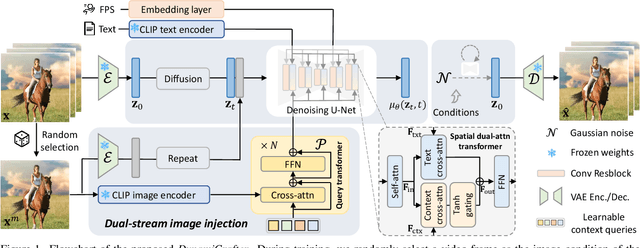

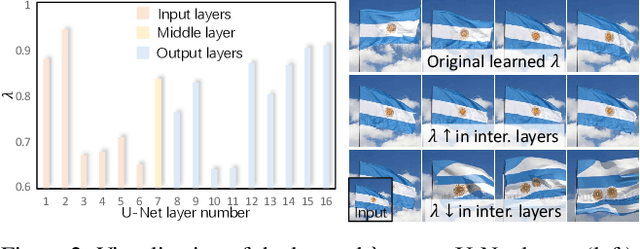

Enhancing a still image with motion offers more engaged visual experience. Traditional image animation techniques mainly focus on animating natural scenes with random dynamics, such as clouds and fluid, and thus limits their applicability to generic visual contents. To overcome this limitation, we explore the synthesis of dynamic content for open-domain images, converting them into animated videos. The key idea is to utilize the motion prior of text-to-video diffusion models by incorporating the image into the generative process as guidance. Given an image, we first project it into a text-aligned rich image embedding space using a learnable image encoding network, which facilitates the video model to digest the image content compatibly. However, some visual details still struggle to be preserved in the resulting videos. To supplement more precise image information, we further feed the full image to the diffusion model by concatenating it with the initial noises. Experimental results reveal that our proposed method produces visually convincing animated videos, exhibiting both natural motions and high fidelity to the input image. Comparative evaluation demonstrates the notable superiority of our approach over existing competitors. The source code will be released upon publication.
EvalCrafter: Benchmarking and Evaluating Large Video Generation Models
Oct 18, 2023
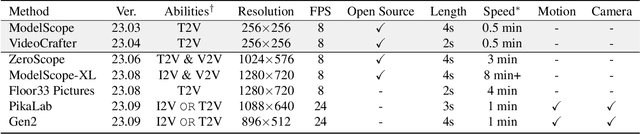

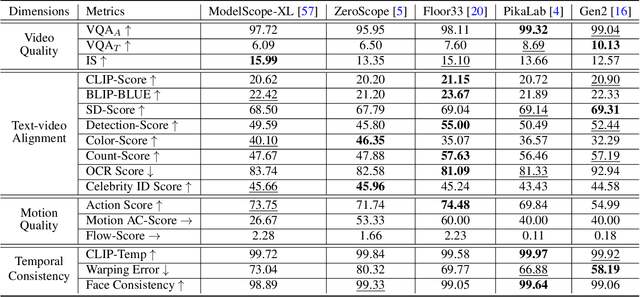
The vision and language generative models have been overgrown in recent years. For video generation, various open-sourced models and public-available services are released for generating high-visual quality videos. However, these methods often use a few academic metrics, for example, FVD or IS, to evaluate the performance. We argue that it is hard to judge the large conditional generative models from the simple metrics since these models are often trained on very large datasets with multi-aspect abilities. Thus, we propose a new framework and pipeline to exhaustively evaluate the performance of the generated videos. To achieve this, we first conduct a new prompt list for text-to-video generation by analyzing the real-world prompt list with the help of the large language model. Then, we evaluate the state-of-the-art video generative models on our carefully designed benchmarks, in terms of visual qualities, content qualities, motion qualities, and text-caption alignment with around 18 objective metrics. To obtain the final leaderboard of the models, we also fit a series of coefficients to align the objective metrics to the users' opinions. Based on the proposed opinion alignment method, our final score shows a higher correlation than simply averaging the metrics, showing the effectiveness of the proposed evaluation method.
SAI: Solving AI Tasks with Systematic Artificial Intelligence in Communication Network
Oct 13, 2023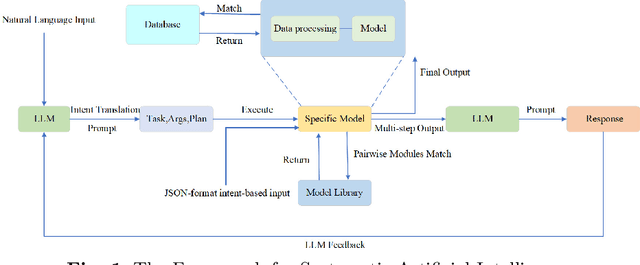
In the rapid development of artificial intelligence, solving complex AI tasks is a crucial technology in intelligent mobile networks. Despite the good performance of specialized AI models in intelligent mobile networks, they are unable to handle complicated AI tasks. To address this challenge, we propose Systematic Artificial Intelligence (SAI), which is a framework designed to solve AI tasks by leveraging Large Language Models (LLMs) and JSON-format intent-based input to connect self-designed model library and database. Specifically, we first design a multi-input component, which simultaneously integrates Large Language Models (LLMs) and JSON-format intent-based inputs to fulfill the diverse intent requirements of different users. In addition, we introduce a model library module based on model cards which employ model cards to pairwise match between different modules for model composition. Model cards contain the corresponding model's name and the required performance metrics. Then when receiving user network requirements, we execute each subtask for multiple selected model combinations and provide output based on the execution results and LLM feedback. By leveraging the language capabilities of LLMs and the abundant AI models in the model library, SAI can complete numerous complex AI tasks in the communication network, achieving impressive results in network optimization, resource allocation, and other challenging tasks.
ScaleCrafter: Tuning-free Higher-Resolution Visual Generation with Diffusion Models
Oct 11, 2023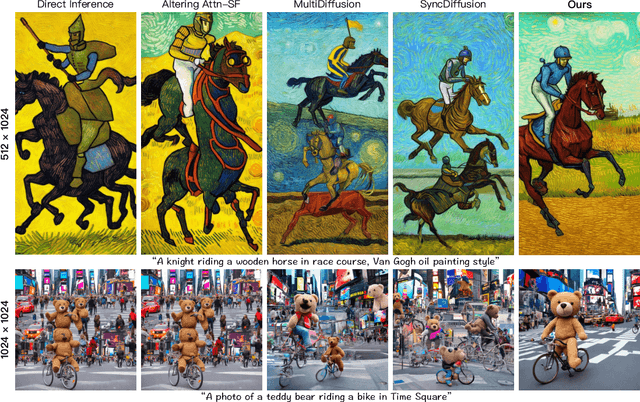
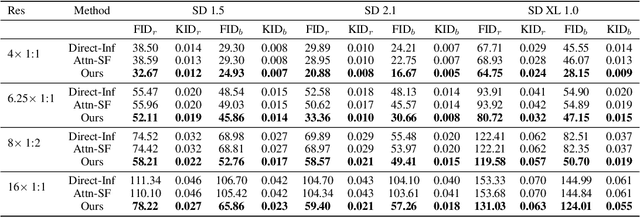


In this work, we investigate the capability of generating images from pre-trained diffusion models at much higher resolutions than the training image sizes. In addition, the generated images should have arbitrary image aspect ratios. When generating images directly at a higher resolution, 1024 x 1024, with the pre-trained Stable Diffusion using training images of resolution 512 x 512, we observe persistent problems of object repetition and unreasonable object structures. Existing works for higher-resolution generation, such as attention-based and joint-diffusion approaches, cannot well address these issues. As a new perspective, we examine the structural components of the U-Net in diffusion models and identify the crucial cause as the limited perception field of convolutional kernels. Based on this key observation, we propose a simple yet effective re-dilation that can dynamically adjust the convolutional perception field during inference. We further propose the dispersed convolution and noise-damped classifier-free guidance, which can enable ultra-high-resolution image generation (e.g., 4096 x 4096). Notably, our approach does not require any training or optimization. Extensive experiments demonstrate that our approach can address the repetition issue well and achieve state-of-the-art performance on higher-resolution image synthesis, especially in texture details. Our work also suggests that a pre-trained diffusion model trained on low-resolution images can be directly used for high-resolution visual generation without further tuning, which may provide insights for future research on ultra-high-resolution image and video synthesis.
From Quantity to Quality: Boosting LLM Performance with Self-Guided Data Selection for Instruction Tuning
Sep 08, 2023In the realm of Large Language Models, the balance between instruction data quality and quantity has become a focal point. Recognizing this, we introduce a self-guided methodology for LLMs to autonomously discern and select cherry samples from vast open-source datasets, effectively minimizing manual curation and potential cost for instruction tuning an LLM. Our key innovation, the Instruction-Following Difficulty (IFD) metric, emerges as a pivotal tool to identify discrepancies between a model's expected responses and its autonomous generation prowess. Through the adept application of IFD, cherry samples are pinpointed, leading to a marked uptick in model training efficiency. Empirical validations on renowned datasets like Alpaca and WizardLM underpin our findings; with a mere 10% of conventional data input, our strategy showcases improved results. This synthesis of self-guided cherry-picking and the IFD metric signifies a transformative leap in the optimization of LLMs, promising both efficiency and resource-conscious advancements.
AI in the Gray: Exploring Moderation Policies in Dialogic Large Language Models vs. Human Answers in Controversial Topics
Aug 28, 2023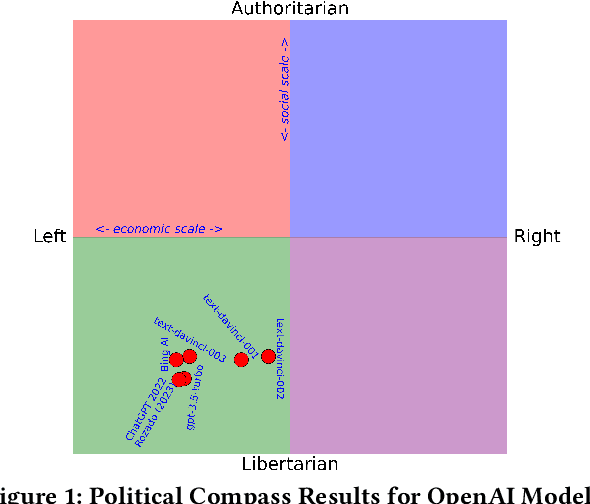
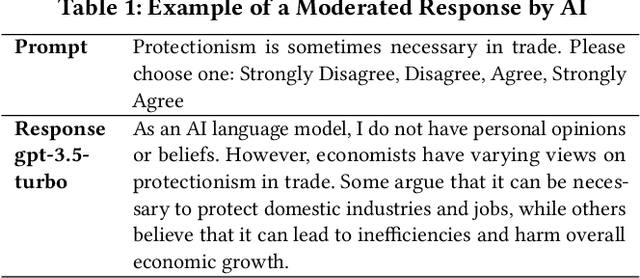
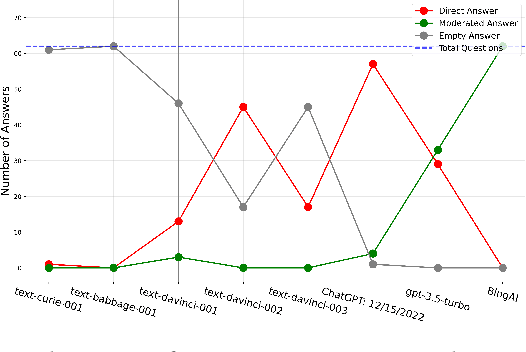
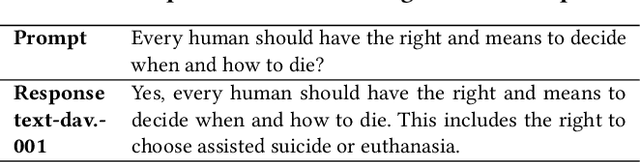
The introduction of ChatGPT and the subsequent improvement of Large Language Models (LLMs) have prompted more and more individuals to turn to the use of ChatBots, both for information and assistance with decision-making. However, the information the user is after is often not formulated by these ChatBots objectively enough to be provided with a definite, globally accepted answer. Controversial topics, such as "religion", "gender identity", "freedom of speech", and "equality", among others, can be a source of conflict as partisan or biased answers can reinforce preconceived notions or promote disinformation. By exposing ChatGPT to such debatable questions, we aim to understand its level of awareness and if existing models are subject to socio-political and/or economic biases. We also aim to explore how AI-generated answers compare to human ones. For exploring this, we use a dataset of a social media platform created for the purpose of debating human-generated claims on polemic subjects among users, dubbed Kialo. Our results show that while previous versions of ChatGPT have had important issues with controversial topics, more recent versions of ChatGPT (gpt-3.5-turbo) are no longer manifesting significant explicit biases in several knowledge areas. In particular, it is well-moderated regarding economic aspects. However, it still maintains degrees of implicit libertarian leaning toward right-winged ideals which suggest the need for increased moderation from the socio-political point of view. In terms of domain knowledge on controversial topics, with the exception of the "Philosophical" category, ChatGPT is performing well in keeping up with the collective human level of knowledge. Finally, we see that sources of Bing AI have slightly more tendency to the center when compared to human answers. All the analyses we make are generalizable to other types of biases and domains.
ToonTalker: Cross-Domain Face Reenactment
Aug 24, 2023We target cross-domain face reenactment in this paper, i.e., driving a cartoon image with the video of a real person and vice versa. Recently, many works have focused on one-shot talking face generation to drive a portrait with a real video, i.e., within-domain reenactment. Straightforwardly applying those methods to cross-domain animation will cause inaccurate expression transfer, blur effects, and even apparent artifacts due to the domain shift between cartoon and real faces. Only a few works attempt to settle cross-domain face reenactment. The most related work AnimeCeleb requires constructing a dataset with pose vector and cartoon image pairs by animating 3D characters, which makes it inapplicable anymore if no paired data is available. In this paper, we propose a novel method for cross-domain reenactment without paired data. Specifically, we propose a transformer-based framework to align the motions from different domains into a common latent space where motion transfer is conducted via latent code addition. Two domain-specific motion encoders and two learnable motion base memories are used to capture domain properties. A source query transformer and a driving one are exploited to project domain-specific motion to the canonical space. The edited motion is projected back to the domain of the source with a transformer. Moreover, since no paired data is provided, we propose a novel cross-domain training scheme using data from two domains with the designed analogy constraint. Besides, we contribute a cartoon dataset in Disney style. Extensive evaluations demonstrate the superiority of our method over competing methods.
Domain Generalization via Rationale Invariance
Aug 22, 2023This paper offers a new perspective to ease the challenge of domain generalization, which involves maintaining robust results even in unseen environments. Our design focuses on the decision-making process in the final classifier layer. Specifically, we propose treating the element-wise contributions to the final results as the rationale for making a decision and representing the rationale for each sample as a matrix. For a well-generalized model, we suggest the rationale matrices for samples belonging to the same category should be similar, indicating the model relies on domain-invariant clues to make decisions, thereby ensuring robust results. To implement this idea, we introduce a rationale invariance loss as a simple regularization technique, requiring only a few lines of code. Our experiments demonstrate that the proposed approach achieves competitive results across various datasets, despite its simplicity. Code is available at \url{https://github.com/liangchen527/RIDG}.