 Add to Chrome
 Add to Firefox
 Add to Edge
STAGE: Controlled Objective Admission for Multi-Preference LLM Alignment
Aug 17, 2026
Multi-preference alignment is often framed as scalarization: combine reward dimensions, then optimize. This leaves a temporal decision underspecified: when should each preference dimension enter policy optimization? We propose \methodname, a stability-guided active-set controller for controlled objective admission. \methodname starts from a small active set, retains admitted objectives, and expands when reward-deviation gates indicate low recent deviation or a patience budget is exhausted. A probing phase estimates a hard-to-easy order, and adaptive weighting emphasizes underperforming active dimensions. Automatic evaluations with 15 training preferences and 16 held-out benchmark columns show that \methodname obtains higher averages than simultaneous scalarization and shared-budget adapted baselines. Component ablations and expansion dynamics further support cumulative retention, gated admission, and probing-derived ordering as useful design choices in this setting. These results position objective-entry timing as a concrete control variable in reward-vector RLHF.

Ask, Condition or Abstain: Reinforcement Learning for Missing-Premise Reasoning
Aug 17, 2026Answer-only reinforcement learning (RL) trains reasoning models to solve fully specified problems, but many realistic queries omit a premise needed for a unique answer. In this setting, the useful response is not always refusal: the model should ask for the missing premise, condition its answer on the unknown quantity, or abstain when no informative conditional response is available. We present \emph{Ask-Condition-Abstain Reinforcement Learning} (ACA-RL), a data-augmented RL framework for this setting. Its reasoning-graph-guided pipeline converts well-posed problems into missing-premise training instances with localized gap annotations; ACA-RL then trains on these instances with a structured reward over five observable response behaviors. We also introduce the \emph{Missing-Premise Benchmark} (MPB), a 274-instance human-verified benchmark spanning mathematical, logical, and real-world word problems. Across Qwen3 and Llama models, ACA-RL consistently improves on MPB while preserving competitive performance on well-posed reasoning tasks. Together with the released code, MPB, and training data, this work supports a new mission for NLP evaluation: measuring whether models can recognize when a task is underdetermined and handle uncertainty, not only whether they can answer fully specified questions.
ARC: Fair Relative Advantage Comparison in Open-Ended Real-World Interaction
Aug 13, 2026Open-ended real-world interaction admits multiple valid behaviors: an agent may answer directly, ask for clarification, provide progress updates, or confirm before acting. This flexibility breaks a core assumption behind group-based RL: rollouts compared within a group are no longer guaranteed to be behaviorally comparable. As a result, reward-model preferences over interaction style can distort relative advantages and steer optimization toward reward-preferred behaviors rather than context-appropriate ones. We formalize this as a \textit{reward fairness problem} and propose \textbf{ARC} (Advantage Regularization via Conditioning), a training recipe that restores fairer relative comparison through strategy-conditioned rollout grouping, together with hybrid rewards and entropy regularization. We study ARC in our proposed \inter, a novel paradigm for responsive, steerable, and execution-aware user-agent interaction that decouples user-visible communication from latent reasoning and tool use. \inter\ also provides the annotation and distillation pipeline for constructing \inter-86K, our strategy-annotated training corpus for supervised and RL training. Empirically, ARC substantially strengthens the core $τ/τ^2$ tool-use benchmarks, while \inter\ reduces time-to-first-token from 4.91s to 1.27s relative to a think-style baseline. Together, these results suggest that a central bottleneck in open-ended interactive learning is not only how agents are rewarded, but whether their behaviors are compared fairly in the first place. The ARC implementation and \inter-86K training data will be released.
Diagnosis Before Recovery: Turning Agent Failures into Selective Self-Correction
Aug 12, 2026Self-correction is particularly useful when a failure constrains the next repair. Coding agents benefit from this property because compilers, tests, and execution traces turn many failures into typed recovery signals, but broad language-agent tasks often expose only a coarse task failure. This creates a tension for generic recovery playbooks: they broaden the agent's context precisely when the system needs a narrower repair interface, mixing incompatible signals for invalid actions, missing procedures, and strict-format errors. Our insight is that development-set failures can recover part of the missing diagnostic substrate by deciding which recovery interventions are admissible before test-time correction. We propose DARC, a diagnosis-guided recovery harness that profiles task-family failure modes, prunes mismatched interventions from a shared recovery library, and freezes a verifier-selected success-cost policy for deployment. This causal order makes correction selective: the harness first determines what kind of failure can be repaired, then decides how much recovery evidence to spend. In ALFWorld, AppWorld, and XBRL Finance, the same protocol yields an action-validity harness, a procedural-recovery fallback, and a format-precision retrieval policy; in each evaluated setting it improves average task performance over base agents and broad playbooks while reducing environment steps or retrieval budget. Our experiments show that failures need not trigger uniformly more context: DARC turns self-correction from prompt expansion into recovery-interface design. DARC provides a practical route toward more reliable agents in domains where compiler-like feedback is absent: making failures actionable before making contexts larger.
Optimal Transport for LLM Reward Modeling from Noisy Preference
May 07, 2026Reward models are fundamental to Reinforcement Learning from Human Feedback (RLHF), yet real-world datasets are inevitably corrupted by noisy preference. Conventional training objectives tend to overfit these errors, while existing denoising approaches often rely on homogeneous noise assumptions that fail to capture the complexity of linguistic preferences. To handle these challenges, we propose SelectiveRM, a framework grounded in optimal transport. We first devise a Joint Consistency Discrepancy to align the distribution of model predictions with preference data. Furthermore, to address the limitation of strict mass conservation which compels the model to fit outliers, we incorporate a Mass Relaxation mechanism via partial transport. This enables the autonomous exclusion of samples with noisy preference that contradict semantic consistency. Theoretically, we demonstrate that SelectiveRM optimizes a tighter upper bound on the unobserved clean risk. Extensive experiments validate that our approach significantly outperforms state-of-the-art baselines across diverse benchmarks.
Understanding and Mitigating Overrefusal in LLMs from an Unveiling Perspective of Safety Decision Boundary
May 23, 2025Large language models (LLMs) have demonstrated remarkable capabilities across a wide range of tasks, yet they often refuse to answer legitimate queries-a phenomenon known as overrefusal. Overrefusal typically stems from over-conservative safety alignment, causing models to treat many reasonable prompts as potentially risky. To systematically understand this issue, we probe and leverage the models'safety decision boundaries to analyze and mitigate overrefusal. Our findings reveal that overrefusal is closely tied to misalignment at these boundary regions, where models struggle to distinguish subtle differences between benign and harmful content. Building on these insights, we present RASS, an automated framework for prompt generation and selection that strategically targets overrefusal prompts near the safety boundary. By harnessing steering vectors in the representation space, RASS efficiently identifies and curates boundary-aligned prompts, enabling more effective and targeted mitigation of overrefusal. This approach not only provides a more precise and interpretable view of model safety decisions but also seamlessly extends to multilingual scenarios.We have explored the safety decision boundaries of various LLMs and construct the MORBench evaluation set to facilitate robust assessment of model safety and helpfulness across multiple languages. Code and datasets will be released at https://anonymous.4open.science/r/RASS-80D3.
REWARD CONSISTENCY: Improving Multi-Objective Alignment from a Data-Centric Perspective
Apr 15, 2025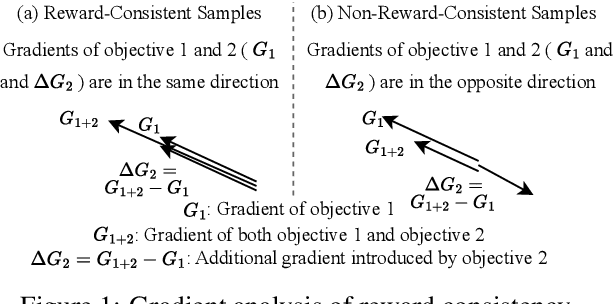
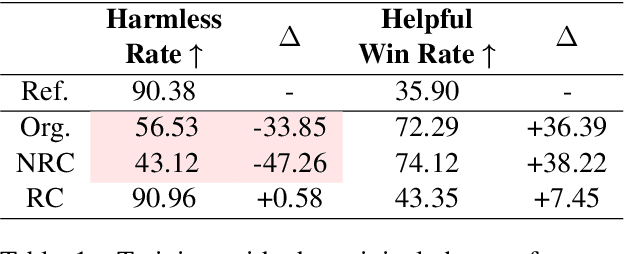

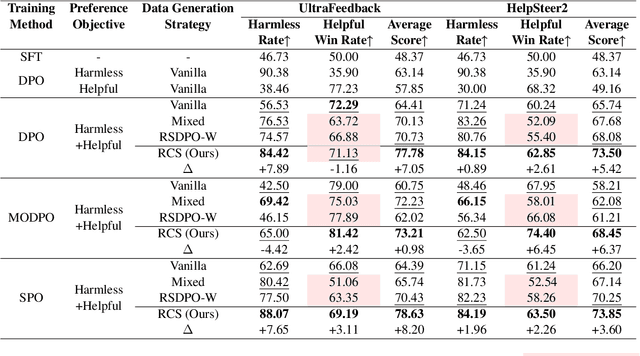
Multi-objective preference alignment in language models often encounters a challenging trade-off: optimizing for one human preference (e.g., helpfulness) frequently compromises others (e.g., harmlessness) due to the inherent conflicts between competing objectives. While prior work mainly focuses on algorithmic solutions, we explore a novel data-driven approach to uncover the types of data that can effectively mitigate these conflicts. Specifically, we propose the concept of Reward Consistency (RC), which identifies samples that align with multiple preference objectives, thereby reducing conflicts during training. Through gradient-based analysis, we demonstrate that RC-compliant samples inherently constrain performance degradation during multi-objective optimization. Building on these insights, we further develop Reward Consistency Sampling, a framework that automatically constructs preference datasets that effectively mitigate conflicts during multi-objective alignment. Our generated data achieves an average improvement of 13.37% in both the harmless rate and helpfulness win rate when optimizing harmlessness and helpfulness, and can consistently resolve conflicts in varying multi-objective scenarios.
BPO: Towards Balanced Preference Optimization between Knowledge Breadth and Depth in Alignment
Nov 16, 2024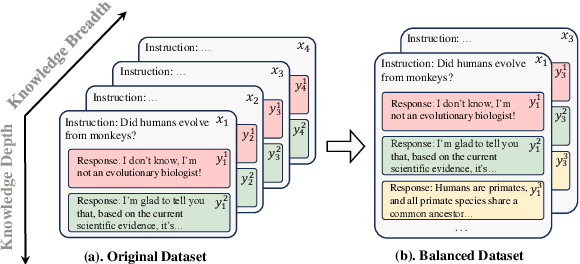
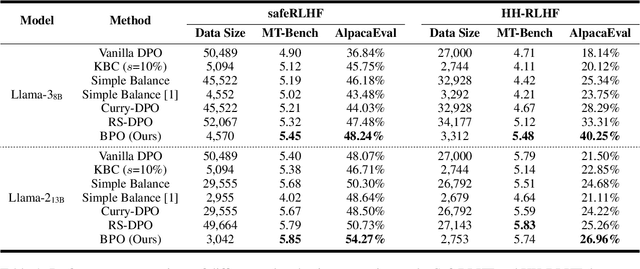
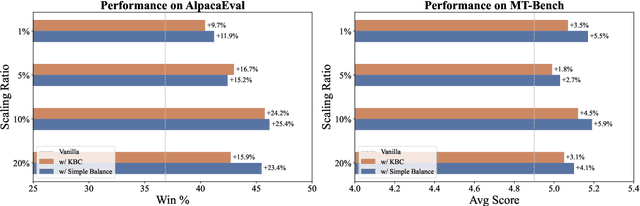
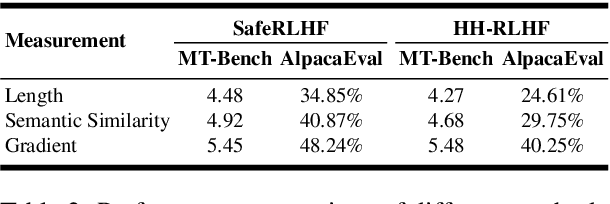
Reinforcement Learning with Human Feedback (RLHF) is the key to the success of large language models (LLMs) in recent years. In this work, we first introduce the concepts of knowledge breadth and knowledge depth, which measure the comprehensiveness and depth of an LLM or knowledge source respectively. We reveal that the imbalance in the number of prompts and responses can lead to a potential disparity in breadth and depth learning within alignment tuning datasets by showing that even a simple uniform method for balancing the number of instructions and responses can lead to significant improvements. Building on this, we further propose Balanced Preference Optimization (BPO), designed to dynamically augment the knowledge depth of each sample. BPO is motivated by the observation that the usefulness of knowledge varies across samples, necessitating tailored learning of knowledge depth. To achieve this, we introduce gradient-based clustering, estimating the knowledge informativeness and usefulness of each augmented sample based on the model's optimization direction. Our experimental results across various benchmarks demonstrate that BPO outperforms other baseline methods in alignment tuning while maintaining training efficiency. Furthermore, we conduct a detailed analysis of each component of BPO, providing guidelines for future research in preference data optimization.
Optimizing Language Model's Reasoning Abilities with Weak Supervision
May 07, 2024


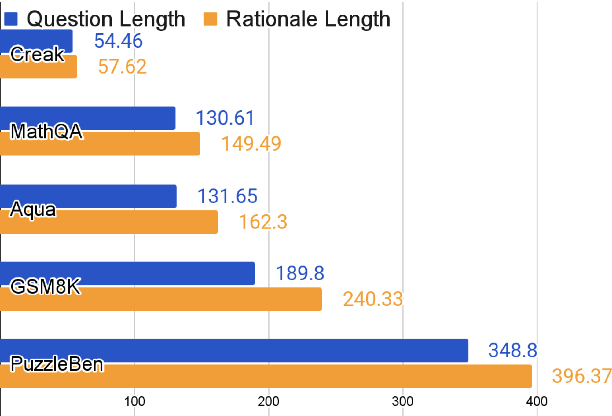
While Large Language Models (LLMs) have demonstrated proficiency in handling complex queries, much of the past work has depended on extensively annotated datasets by human experts. However, this reliance on fully-supervised annotations poses scalability challenges, particularly as models and data requirements grow. To mitigate this, we explore the potential of enhancing LLMs' reasoning abilities with minimal human supervision. In this work, we introduce self-reinforcement, which begins with Supervised Fine-Tuning (SFT) of the model using a small collection of annotated questions. Then it iteratively improves LLMs by learning from the differences in responses from the SFT and unfinetuned models on unlabeled questions. Our approach provides an efficient approach without relying heavily on extensive human-annotated explanations. However, current reasoning benchmarks typically only include golden-reference answers or rationales. Therefore, we present \textsc{PuzzleBen}, a weakly supervised benchmark that comprises 25,147 complex questions, answers, and human-generated rationales across various domains, such as brainteasers, puzzles, riddles, parajumbles, and critical reasoning tasks. A unique aspect of our dataset is the inclusion of 10,000 unannotated questions, enabling us to explore utilizing fewer supersized data to boost LLMs' inference capabilities. Our experiments underscore the significance of \textsc{PuzzleBen}, as well as the effectiveness of our methodology as a promising direction in future endeavors. Our dataset and code will be published soon on \texttt{Anonymity Link}.
Can LLMs Learn from Previous Mistakes? Investigating LLMs' Errors to Boost for Reasoning
Mar 29, 2024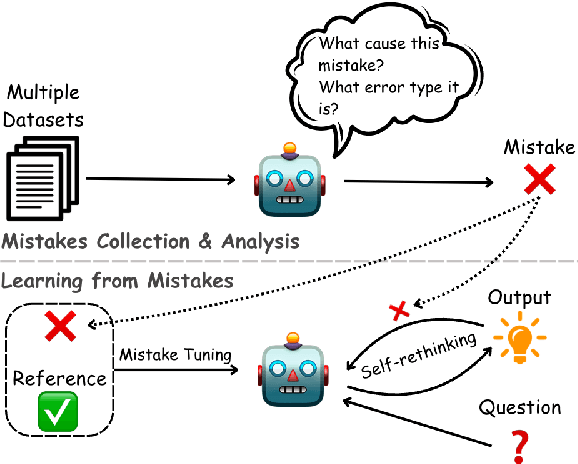
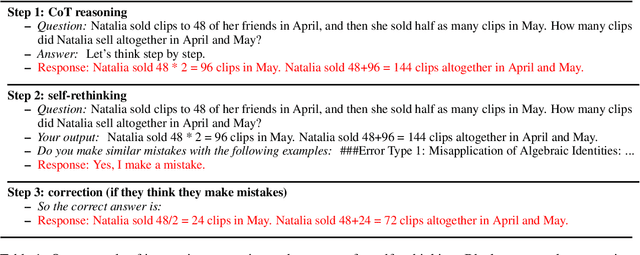
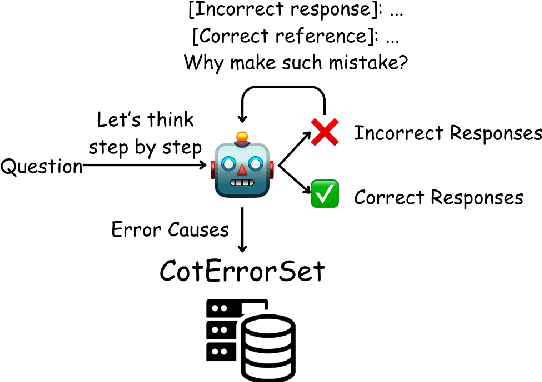

Recent works have shown the benefits to LLMs from fine-tuning golden-standard Chain-of-Thought (CoT) rationales or using them as correct examples in few-shot prompting. While humans can indeed imitate correct examples, learning from our mistakes is another vital aspect of human cognition. Hence, a question naturally arises: \textit{can LLMs learn and benefit from their mistakes, especially for their reasoning? } This study investigates this problem from both the prompting and model-tuning perspectives. We begin by introducing \textsc{CoTErrorSet}, a new benchmark with 609,432 questions, each designed with both correct and error references, and demonstrating the types and reasons for making such mistakes. To explore the effectiveness of those mistakes, we design two methods: (1) \textbf{Self-rethinking} prompting guides LLMs to rethink whether they have made similar previous mistakes; and (2) \textbf{Mistake tuning} involves finetuning models in both correct and incorrect reasoning domains, rather than only tuning models to learn ground truth in traditional methodology. We conduct a series of experiments to prove LLMs can obtain benefits from mistakes in both directions. Our two methods offer potentially cost-effective strategies by leveraging errors to enhance reasoning capabilities, which costs significantly less than creating meticulously hand-crafted golden references. We ultimately make a thorough analysis of the reasons behind LLMs' errors, which provides directions that future research needs to overcome. \textsc{CoTErrorSet} will be published soon on \texttt{Anonymity Link}.