 Add to Chrome
 Add to Firefox
 Add to Edge
Pelican-VLA 0.5: Attending Before Acting Benefits Generalization
Jul 09, 2026
In this report, we present Pelican-VLA 0.5, a unified VLA model that integrates vision-language understanding, future-frame generation, and action prediction within a single architecture. Pelican-VLA 0.5 achieves attention-level generalization: without object annotations, segmentation masks, attention supervision, or task-specific fine-tuning, its action pathway already focuses on the manipulation-relevant object and contact region. This behavior persists across unseen scenes and unseen robot embodiments, and is substantially stronger than in other open-source VLA baselines. We verify that this ability originates from the learnable Bottleneck Token inserted between perception and action: by routing task-relevant visual information through a compact bottleneck, the tokens interface induces manipulation-centric attention during pre-training and remains effective across different policy structures, including a MoT-style architecture.

Current World Models Lack a Persistent State Core
Jun 18, 2026World models are increasingly regarded as a decisive step toward artificial general intelligence, yet modeling the physical world demands more than rendering convincing frames on demand: it requires an internal world state that keeps evolving over time, decoupled from observation, so that objects endure and events run to their conclusions whether or not a camera is watching, much as the moon holds to its orbit when no one is looking. This requirement is a blind spot of existing benchmarks, which reward surface properties such as fidelity, motion, and camera controllability while never asking whether a generated world keeps evolving once it is unobserved. We introduce \textbf{WRBench}, the first systematic diagnostic benchmark that treats camera motion as an intervention on observability and resolves evaluation into a human-calibrated chain that asks whether the camera executes the requested interaction, whether the scene stays continuous and identifiable while in view, and whether a returning target remains consistent with the event that was set in motion. Across 9{,}600 videos from 23 models spanning four control paradigms, one finding proves stubborn: current systems maintain the observed world as a tracking shot, resuming a returning target in the state at which it was abandoned rather than advancing the event while it went unseen. Because this failure recurs across control paradigms, model families, and increments of scale, robust world-state evolution does not follow from cleaner imagery, tighter control, richer geometric priors, or sheer parameter count We therefore argue that the stability of the physical state kernel and the consistency of worldlines under viewpoint intervention should become first-class objectives of world-model design, so that a world model captures how the world will unfold rather than how the next frame appears.
Holo-World: Unified Camera, Object and Weather Control for Video World Model
Jun 18, 2026Video world models are moving toward preserving an observed world under controllable camera and object motion while allowing its environmental state to change. Yet these controls remain isolated, and weather generation typically relies on a source video or reconstructed scene that already specifies future structure. We study a first-frame-anchored source-to-state setting, where the model starts from a single image and follows explicit camera and object controls and an optional weather instruction, then generates a video that either preserves the source world or transfers it to a target weather state. To address these challenges, we first build HoloStateData, a state video dataset that turns diverse videos into unified control samples for camera, object, and weather supervision. Second, we introduce Holo-World, a unified controllable video world model that jointly controls scene from a single image. Its Unified Scene Adapter factorizes world preservation and weather transfer into distinct parameter subspaces, using rendered background, geometry buffers, and object controls to maintain controlled scene structure while modeling weather-dependent appearance and particle effects. Additionally, Scene-Weather Decomposed CFG guides scene and weather residuals separately, strengthening target weather effects without over-amplifying the full condition. Quantitative and qualitative experiments demonstrate that Holo-World maintains precise camera and object control with consistent scene structure while transferring scenes into diverse target weather state, outperforming video-to-video weather editing baselines on weather-state generation. Our project page is available at \url{https://xiangchenyin.github.io/Holo-World/}.
What Should a Skill Remember? Quality--Cost Trade-offs in Cost-Aware Skill Rewriting for Language Model Agents
Jun 09, 2026Large language model agents increasingly rely on skills: reusable procedural documents encoding workflows, tool use, implementation patterns, validation checks, and domain rules. Skill rewriting is often treated as prompt compression, but shorter skills can make agents more expensive by removing sparse operational anchors that prevent exploration, debugging, and recovery. We study skill rewriting through this economic lens. Our controlled framework profiles skill structure, rewrites skills using information-preservation strategies, and evaluates the rewrites under fixed task instructions, environments, and verifiers. Experiments on SkillsBench reveal distinct quality--cost trade-offs across strategies: API/code anchoring, workflow guarding, and rule/formula anchoring benefit different task families, with no universally dominant template. In the main held-out evaluation, the learned policy reduces total cost by 7.0% and downstream agent-token cost by 6.0%; in frozen cross-model transfer, the corresponding reductions average 14.7% and 13.7%, while verifier quality is preserved. These results position skill design as cost-aware operational knowledge engineering rather than prompt compression. Resources: https://github.com/1Reminding/Skill_EE.
VLA-Trace: Diagnosing Vision-Language-Action Models through Representation and Behavior Tracing
May 28, 2026Understanding how Vision-Language-Action (VLA) models transform multimodal knowledge into embodied control remains an open challenge. We present VLA-Trace, a progressive diagnostic framework that analyzes VLA models through a unified evidence chain from representation dynamics to causal control attribution and behavioral manifestation. It specifically combines cross-modal and checkpoint-drift centered kernel alignment (CKA) to trace representation evolution, attention knockout interventions to identify modality-specific control pathways, and rollout-level behavioral probes to examine grounding, shortcut dependence, and semantic following. Experiments on $π_{0.5}$ and OpenVLA reveal three key findings. First, the two models exhibit distinct modality-specific adaptation dynamics during VLA finetuning. Second, they rely on different multimodal routing strategies and layer-wise dependencies during action decoding. Third, although VLA policies excel at visually grounded trajectory generation, they remain limited in fine-grained semantic following. These findings highlight future directions for representation-preserving adaptation, causal VLA circuits, and compositional semantic control.
Pelican-Unified 1.0: A Unified Embodied Intelligence Model for Understanding, Reasoning, Imagination and Action
May 14, 2026We present Pelican-Unified 1.0, the first embodied foundation model trained according to the principle of unification. Pelican-Unified 1.0 uses a single VLM as a unified understanding module, mapping scenes, instructions, visual contexts, and action histories into a shared semantic space. The same VLM also serves as a unified reasoning module, autoregressively producing task-, action-, and future-oriented chains of thought in a single forward pass and projecting the final hidden state into a dense latent variable. A Unified Future Generator (UFG) then conditions on this latent variable and jointly generates future videos and future actions through two modality-specific output heads within the same denoising process. The language, video, and action losses are all backpropagated into the shared representation, enabling the model to jointly optimize understanding, reasoning, imagination, and action during training, rather than training three isolated expert systems. Experiments demonstrate that unification does not imply compromise. With a single checkpoint, Pelican-Unified 1.0 achieves strong performance across all three capabilities: 64.7 on eight VLM benchmarks, the best among comparable-scale models; 66.03 on WorldArena, ranking first; and 93.5 on RoboTwin, the second-best average among compared action methods. These results show that the unified paradigm succeeds in preserving specialist strength while bringing understanding, reasoning, imagination, and action into one model.
MAIN-VLA: Modeling Abstraction of Intention and eNvironment for Vision-Language-Action Models
Feb 02, 2026Despite significant progress in Visual-Language-Action (VLA), in highly complex and dynamic environments that involve real-time unpredictable interactions (such as 3D open worlds and large-scale PvP games), existing approaches remain inefficient at extracting action-critical signals from redundant sensor streams. To tackle this, we introduce MAIN-VLA, a framework that explicitly Models the Abstraction of Intention and eNvironment to ground decision-making in deep semantic alignment rather than superficial pattern matching. Specifically, our Intention Abstraction (IA) extracts verbose linguistic instructions and their associated reasoning into compact, explicit semantic primitives, while the Environment Semantics Abstraction (ESA) projects overwhelming visual streams into a structured, topological affordance representation. Furthermore, aligning these two abstract modalities induces an emergent attention-concentration effect, enabling a parameter-free token-pruning strategy that filters out perceptual redundancy without degrading performance. Extensive experiments in open-world Minecraft and large-scale PvP environments (Game for Peace and Valorant) demonstrate that MAIN-VLA sets a new state-of-the-art, which achieves superior decision quality, stronger generalization, and cutting-edge inference efficiency.
Johnson-Lindenstrauss Lemma Guided Network for Efficient 3D Medical Segmentation
Sep 26, 2025Lightweight 3D medical image segmentation remains constrained by a fundamental "efficiency / robustness conflict", particularly when processing complex anatomical structures and heterogeneous modalities. In this paper, we study how to redesign the framework based on the characteristics of high-dimensional 3D images, and explore data synergy to overcome the fragile representation of lightweight methods. Our approach, VeloxSeg, begins with a deployable and extensible dual-stream CNN-Transformer architecture composed of Paired Window Attention (PWA) and Johnson-Lindenstrauss lemma-guided convolution (JLC). For each 3D image, we invoke a "glance-and-focus" principle, where PWA rapidly retrieves multi-scale information, and JLC ensures robust local feature extraction with minimal parameters, significantly enhancing the model's ability to operate with low computational budget. Followed by an extension of the dual-stream architecture that incorporates modal interaction into the multi-scale image-retrieval process, VeloxSeg efficiently models heterogeneous modalities. Finally, Spatially Decoupled Knowledge Transfer (SDKT) via Gram matrices injects the texture prior extracted by a self-supervised network into the segmentation network, yielding stronger representations than baselines at no extra inference cost. Experimental results on multimodal benchmarks show that VeloxSeg achieves a 26% Dice improvement, alongside increasing GPU throughput by 11x and CPU by 48x. Codes are available at https://github.com/JinPLu/VeloxSeg.
FURINA: Free from Unmergeable Router via LINear Aggregation of mixed experts
Sep 18, 2025
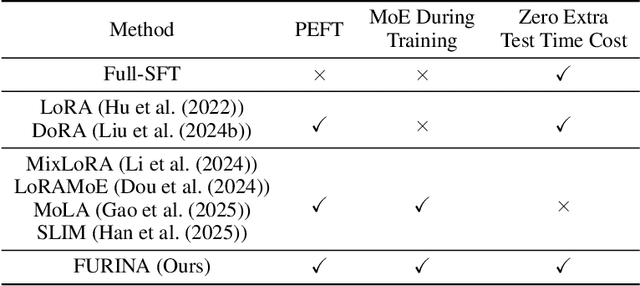
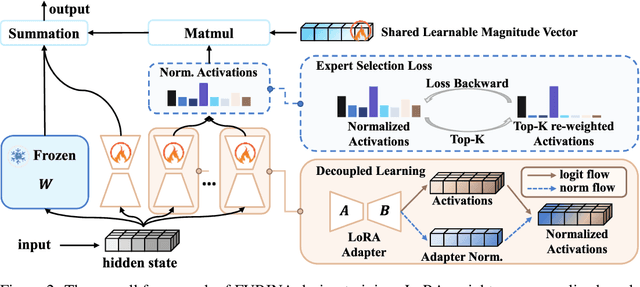
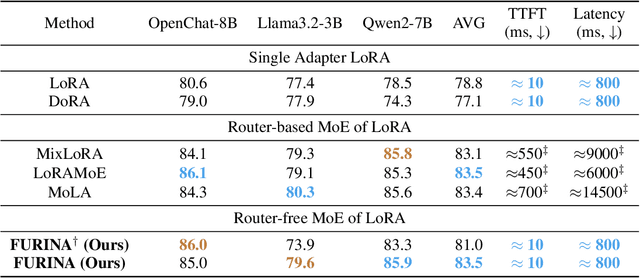
The Mixture of Experts (MoE) paradigm has been successfully integrated into Low-Rank Adaptation (LoRA) for parameter-efficient fine-tuning (PEFT), delivering performance gains with minimal parameter overhead. However, a key limitation of existing MoE-LoRA methods is their reliance on a discrete router, which prevents the integration of the MoE components into the backbone model. To overcome this, we propose FURINA, a novel Free from Unmergeable Router framework based on the LINear Aggregation of experts. FURINA eliminates the router by introducing a Self-Routing mechanism. This is achieved through three core innovations: (1) decoupled learning of the direction and magnitude for LoRA adapters, (2) a shared learnable magnitude vector for consistent activation scaling, and (3) expert selection loss that encourages divergent expert activation. The proposed mechanism leverages the angular similarity between the input and each adapter's directional component to activate experts, which are then scaled by the shared magnitude vector. This design allows the output norm to naturally reflect the importance of each expert, thereby enabling dynamic, router-free routing. The expert selection loss further sharpens this behavior by encouraging sparsity and aligning it with standard MoE activation patterns. We also introduce a shared expert within the MoE-LoRA block that provides stable, foundational knowledge. To the best of our knowledge, FURINA is the first router-free, MoE-enhanced LoRA method that can be fully merged into the backbone model, introducing zero additional inference-time cost or complexity. Extensive experiments demonstrate that FURINA not only significantly outperforms standard LoRA but also matches or surpasses the performance of existing MoE-LoRA methods, while eliminating the extra inference-time overhead of MoE.
EMPOWER: Evolutionary Medical Prompt Optimization With Reinforcement Learning
Aug 25, 2025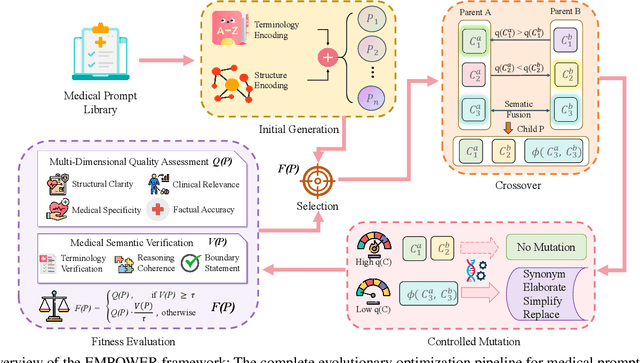
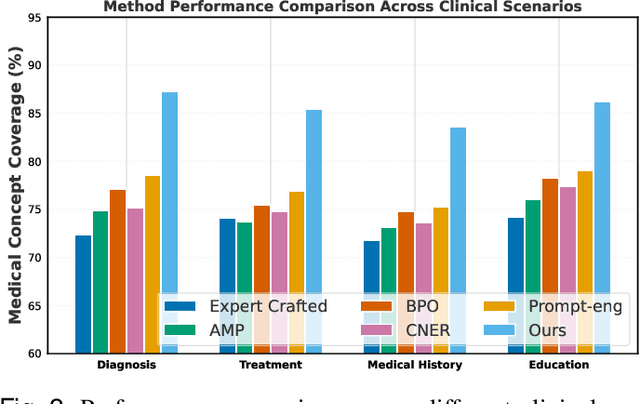
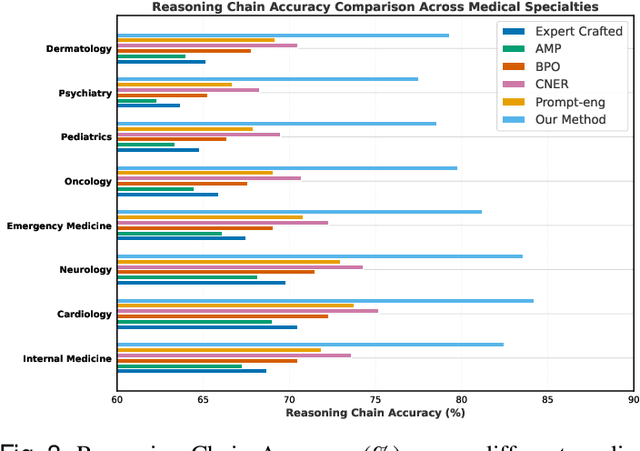
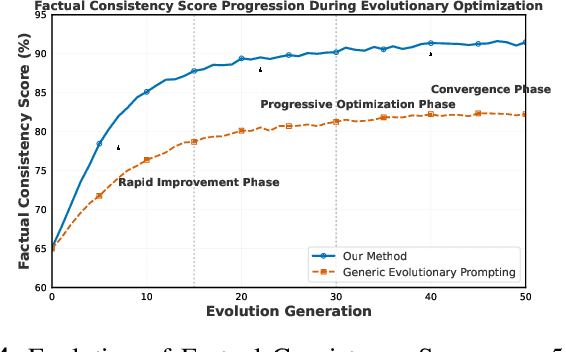
Prompt engineering significantly influences the reliability and clinical utility of Large Language Models (LLMs) in medical applications. Current optimization approaches inadequately address domain-specific medical knowledge and safety requirements. This paper introduces EMPOWER, a novel evolutionary framework that enhances medical prompt quality through specialized representation learning, multi-dimensional evaluation, and structure-preserving algorithms. Our methodology incorporates: (1) a medical terminology attention mechanism, (2) a comprehensive assessment architecture evaluating clarity, specificity, clinical relevance, and factual accuracy, (3) a component-level evolutionary algorithm preserving clinical reasoning integrity, and (4) a semantic verification module ensuring adherence to medical knowledge. Evaluation across diagnostic, therapeutic, and educational tasks demonstrates significant improvements: 24.7% reduction in factually incorrect content, 19.6% enhancement in domain specificity, and 15.3% higher clinician preference in blinded evaluations. The framework addresses critical challenges in developing clinically appropriate prompts, facilitating more responsible integration of LLMs into healthcare settings.