 Add to Chrome
 Add to Firefox
 Add to Edge
Conflict-Aware Federated Fine-Tuning of Large Language Models with Mixture-of-Experts
Jun 14, 2026
The continuous scaling of large language models (LLMs) incurs prohibitive computational costs, making Mixture-of-Experts (MoE) a scalable alternative for efficient fine-tuning via sparse activation. While federated learning (FL) emerges as the paradigm for privacy-preserving collaborative optimization, integrating MoE into FL under data heterogeneity may trigger conflicting expert optimizations. Client-specific data distributions force same-indexed experts to optimize under inconsistent or even conflicting feature-label correlations. This mismatch induces destructive interference during aggregation, thus destabilizing the optimization trajectory and degrading model performance. To address this issue, we propose FC-MoE, a federated conflict-aware framework for MoE fine-tuning. It employs an importance aware weighting scheme to prioritize reliable local updates and utilizes gradient consensus projection to suppress conflicting updates, ensuring a stable global optimization path. Moreover, a local knowledge retention mechanism further preserves specialized client expertise by re-anchoring domain-specific residuals. Extensive experiments demonstrate that FC-MoE accelerates convergence and enhances both global and local model performance in non-IID federated environments.

EMPOWER: Evolutionary Medical Prompt Optimization With Reinforcement Learning
Aug 25, 2025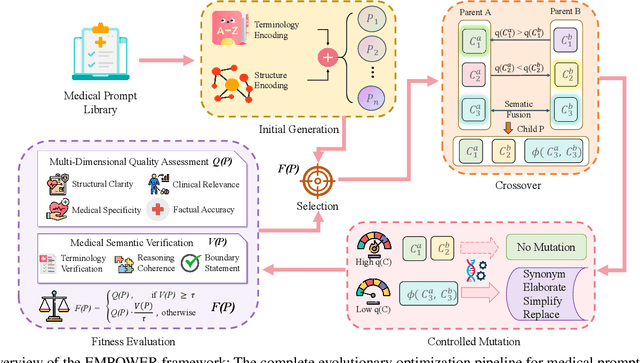
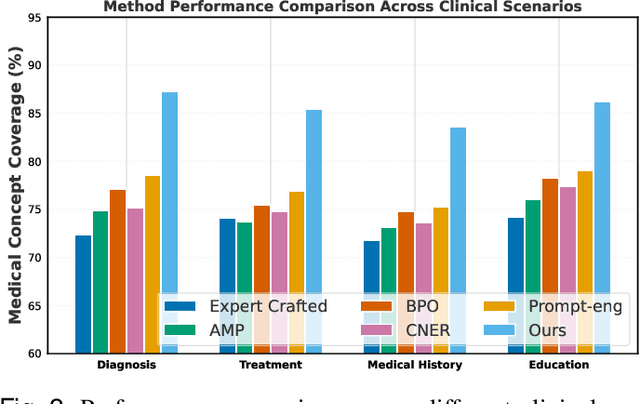
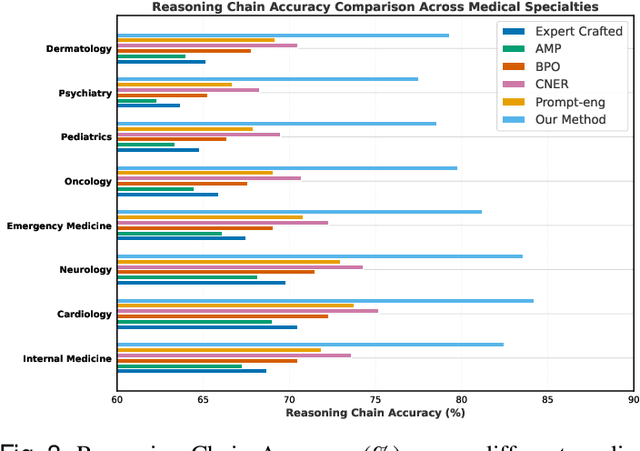
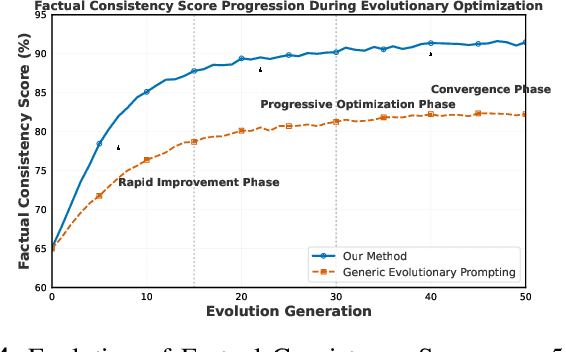
Prompt engineering significantly influences the reliability and clinical utility of Large Language Models (LLMs) in medical applications. Current optimization approaches inadequately address domain-specific medical knowledge and safety requirements. This paper introduces EMPOWER, a novel evolutionary framework that enhances medical prompt quality through specialized representation learning, multi-dimensional evaluation, and structure-preserving algorithms. Our methodology incorporates: (1) a medical terminology attention mechanism, (2) a comprehensive assessment architecture evaluating clarity, specificity, clinical relevance, and factual accuracy, (3) a component-level evolutionary algorithm preserving clinical reasoning integrity, and (4) a semantic verification module ensuring adherence to medical knowledge. Evaluation across diagnostic, therapeutic, and educational tasks demonstrates significant improvements: 24.7% reduction in factually incorrect content, 19.6% enhancement in domain specificity, and 15.3% higher clinician preference in blinded evaluations. The framework addresses critical challenges in developing clinically appropriate prompts, facilitating more responsible integration of LLMs into healthcare settings.