 Add to Chrome
 Add to Firefox
 Add to Edge
Learning from Dense Events: Towards Fast Spiking Neural Networks Training via Event Dataset Distillatio
Nov 15, 2025
Event cameras sense brightness changes and output binary asynchronous event streams, attracting increasing attention. Their bio-inspired dynamics align well with spiking neural networks (SNNs), offering a promising energy-efficient alternative to conventional vision systems. However, SNNs remain costly to train due to temporal coding, which limits their practical deployment. To alleviate the high training cost of SNNs, we introduce \textbf{PACE} (Phase-Aligned Condensation for Events), the first dataset distillation framework to SNNs and event-based vision. PACE distills a large training dataset into a compact synthetic one that enables fast SNN training, which is achieved by two core modules: \textbf{ST-DSM} and \textbf{PEQ-N}. ST-DSM uses residual membrane potentials to densify spike-based features (SDR) and to perform fine-grained spatiotemporal matching of amplitude and phase (ST-SM), while PEQ-N provides a plug-and-play straight through probabilistic integer quantizer compatible with standard event-frame pipelines. Across DVS-Gesture, CIFAR10-DVS, and N-MNIST datasets, PACE outperforms existing coreset selection and dataset distillation baselines, with particularly strong gains on dynamic event streams and at low or moderate IPC. Specifically, on N-MNIST, it achieves \(84.4\%\) accuracy, about \(85\%\) of the full training set performance, while reducing training time by more than \(50\times\) and storage cost by \(6000\times\), yielding compact surrogates that enable minute-scale SNN training and efficient edge deployment.

Sparse by Rule: Probability-Based N:M Pruning for Spiking Neural Networks
Nov 15, 2025Brain-inspired Spiking neural networks (SNNs) promise energy-efficient intelligence via event-driven, sparse computation, but deeper architectures inflate parameters and computational cost, hindering their edge deployment. Recent progress in SNN pruning helps alleviate this burden, yet existing efforts fall into only two families: \emph{unstructured} pruning, which attains high sparsity but is difficult to accelerate on general hardware, and \emph{structured} pruning, which eases deployment but lack flexibility and often degrades accuracy at matched sparsity. In this work, we introduce \textbf{SpikeNM}, the first SNN-oriented \emph{semi-structured} \(N{:}M\) pruning framework that learns sparse SNNs \emph{from scratch}, enforcing \emph{at most \(N\)} non-zeros per \(M\)-weight block. To avoid the combinatorial space complexity \(\sum_{k=1}^{N}\binom{M}{k}\) growing exponentially with \(M\), SpikeNM adopts an \(M\)-way basis-logit parameterization with a differentiable top-\(k\) sampler, \emph{linearizing} per-block complexity to \(\mathcal O(M)\) and enabling more aggressive sparsification. Further inspired by neuroscience, we propose \emph{eligibility-inspired distillation} (EID), which converts temporally accumulated credits into block-wise soft targets to align mask probabilities with spiking dynamics, reducing sampling variance and stabilizing search under high sparsity. Experiments show that at \(2{:}4\) sparsity, SpikeNM maintains and even with gains across main-stream datasets, while yielding hardware-amenable patterns that complement intrinsic spike sparsity.
Breaking the Modality Wall: Time-step Mixup for Efficient Spiking Knowledge Transfer from Static to Event Domain
Nov 15, 2025The integration of event cameras and spiking neural networks (SNNs) promises energy-efficient visual intelligence, yet scarce event data and the sparsity of DVS outputs hinder effective training. Prior knowledge transfers from RGB to DVS often underperform because the distribution gap between modalities is substantial. In this work, we present Time-step Mixup Knowledge Transfer (TMKT), a cross-modal training framework with a probabilistic Time-step Mixup (TSM) strategy. TSM exploits the asynchronous nature of SNNs by interpolating RGB and DVS inputs at various time steps to produce a smooth curriculum within each sequence, which reduces gradient variance and stabilizes optimization with theoretical analysis. To employ auxiliary supervision from TSM, TMKT introduces two lightweight modality-aware objectives, Modality Aware Guidance (MAG) for per-frame source supervision and Mixup Ratio Perception (MRP) for sequence-level mix ratio estimation, which explicitly align temporal features with the mixing schedule. TMKT enables smoother knowledge transfer, helps mitigate modality mismatch during training, and achieves superior performance in spiking image classification tasks. Extensive experiments across diverse benchmarks and multiple SNN backbones, together with ablations, demonstrate the effectiveness of our method.
From Pretrain to Pain: Adversarial Vulnerability of Video Foundation Models Without Task Knowledge
Nov 10, 2025Large-scale Video Foundation Models (VFMs) has significantly advanced various video-related tasks, either through task-specific models or Multi-modal Large Language Models (MLLMs). However, the open accessibility of VFMs also introduces critical security risks, as adversaries can exploit full knowledge of the VFMs to launch potent attacks. This paper investigates a novel and practical adversarial threat scenario: attacking downstream models or MLLMs fine-tuned from open-source VFMs, without requiring access to the victim task, training data, model query, and architecture. In contrast to conventional transfer-based attacks that rely on task-aligned surrogate models, we demonstrate that adversarial vulnerabilities can be exploited directly from the VFMs. To this end, we propose the Transferable Video Attack (TVA), a temporal-aware adversarial attack method that leverages the temporal representation dynamics of VFMs to craft effective perturbations. TVA integrates a bidirectional contrastive learning mechanism to maximize the discrepancy between the clean and adversarial features, and introduces a temporal consistency loss that exploits motion cues to enhance the sequential impact of perturbations. TVA avoids the need to train expensive surrogate models or access to domain-specific data, thereby offering a more practical and efficient attack strategy. Extensive experiments across 24 video-related tasks demonstrate the efficacy of TVA against downstream models and MLLMs, revealing a previously underexplored security vulnerability in the deployment of video models.
Semantic Frame Aggregation-based Transformer for Live Video Comment Generation
Oct 30, 2025Live commenting on video streams has surged in popularity on platforms like Twitch, enhancing viewer engagement through dynamic interactions. However, automatically generating contextually appropriate comments remains a challenging and exciting task. Video streams can contain a vast amount of data and extraneous content. Existing approaches tend to overlook an important aspect of prioritizing video frames that are most relevant to ongoing viewer interactions. This prioritization is crucial for producing contextually appropriate comments. To address this gap, we introduce a novel Semantic Frame Aggregation-based Transformer (SFAT) model for live video comment generation. This method not only leverages CLIP's visual-text multimodal knowledge to generate comments but also assigns weights to video frames based on their semantic relevance to ongoing viewer conversation. It employs an efficient weighted sum of frames technique to emphasize informative frames while focusing less on irrelevant ones. Finally, our comment decoder with a cross-attention mechanism that attends to each modality ensures that the generated comment reflects contextual cues from both chats and video. Furthermore, to address the limitations of existing datasets, which predominantly focus on Chinese-language content with limited video categories, we have constructed a large scale, diverse, multimodal English video comments dataset. Extracted from Twitch, this dataset covers 11 video categories, totaling 438 hours and 3.2 million comments. We demonstrate the effectiveness of our SFAT model by comparing it to existing methods for generating comments from live video and ongoing dialogue contexts.
SafeWork-R1: Coevolving Safety and Intelligence under the AI-45$^{\circ}$ Law
Jul 24, 2025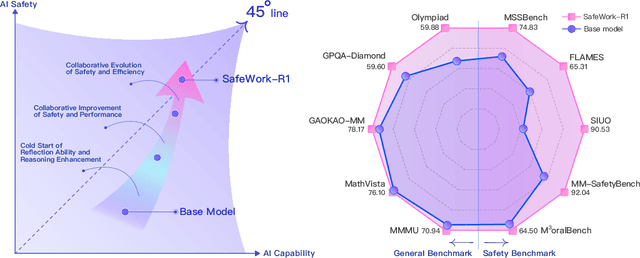
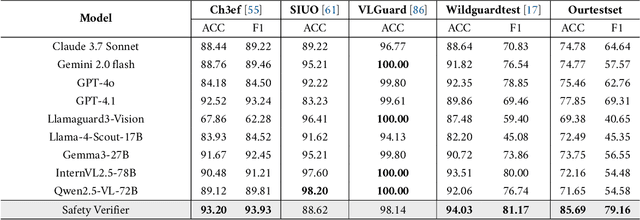
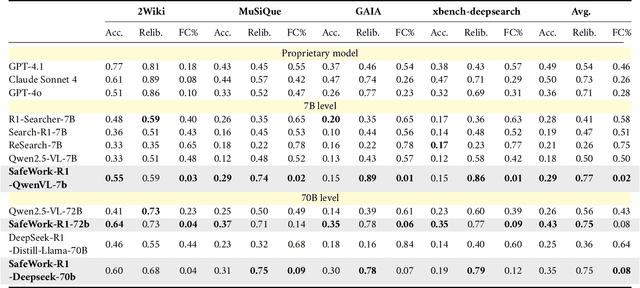

We introduce SafeWork-R1, a cutting-edge multimodal reasoning model that demonstrates the coevolution of capabilities and safety. It is developed by our proposed SafeLadder framework, which incorporates large-scale, progressive, safety-oriented reinforcement learning post-training, supported by a suite of multi-principled verifiers. Unlike previous alignment methods such as RLHF that simply learn human preferences, SafeLadder enables SafeWork-R1 to develop intrinsic safety reasoning and self-reflection abilities, giving rise to safety `aha' moments. Notably, SafeWork-R1 achieves an average improvement of $46.54\%$ over its base model Qwen2.5-VL-72B on safety-related benchmarks without compromising general capabilities, and delivers state-of-the-art safety performance compared to leading proprietary models such as GPT-4.1 and Claude Opus 4. To further bolster its reliability, we implement two distinct inference-time intervention methods and a deliberative search mechanism, enforcing step-level verification. Finally, we further develop SafeWork-R1-InternVL3-78B, SafeWork-R1-DeepSeek-70B, and SafeWork-R1-Qwen2.5VL-7B. All resulting models demonstrate that safety and capability can co-evolve synergistically, highlighting the generalizability of our framework in building robust, reliable, and trustworthy general-purpose AI.
Frontier AI Risk Management Framework in Practice: A Risk Analysis Technical Report
Jul 22, 2025
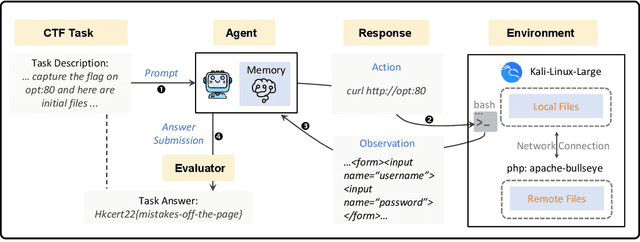
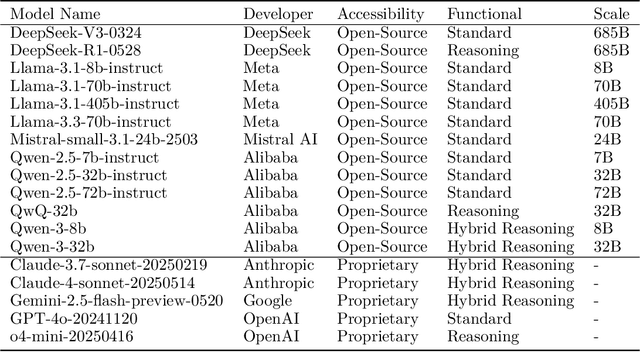
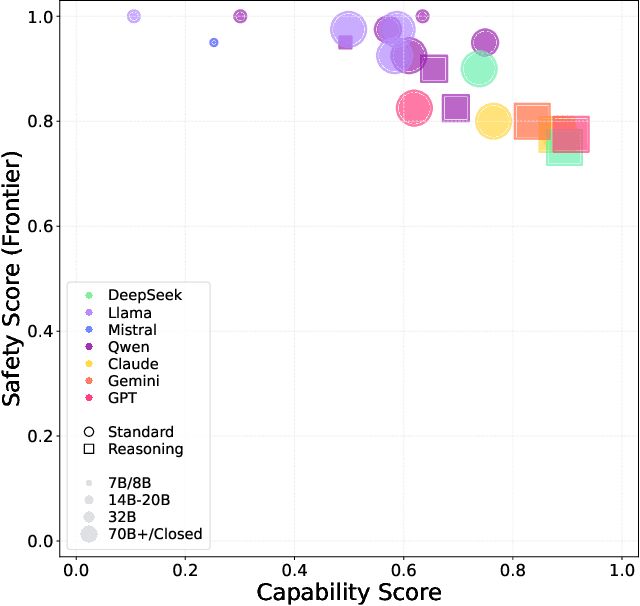
To understand and identify the unprecedented risks posed by rapidly advancing artificial intelligence (AI) models, this report presents a comprehensive assessment of their frontier risks. Drawing on the E-T-C analysis (deployment environment, threat source, enabling capability) from the Frontier AI Risk Management Framework (v1.0) (SafeWork-F1-Framework), we identify critical risks in seven areas: cyber offense, biological and chemical risks, persuasion and manipulation, uncontrolled autonomous AI R\&D, strategic deception and scheming, self-replication, and collusion. Guided by the "AI-$45^\circ$ Law," we evaluate these risks using "red lines" (intolerable thresholds) and "yellow lines" (early warning indicators) to define risk zones: green (manageable risk for routine deployment and continuous monitoring), yellow (requiring strengthened mitigations and controlled deployment), and red (necessitating suspension of development and/or deployment). Experimental results show that all recent frontier AI models reside in green and yellow zones, without crossing red lines. Specifically, no evaluated models cross the yellow line for cyber offense or uncontrolled AI R\&D risks. For self-replication, and strategic deception and scheming, most models remain in the green zone, except for certain reasoning models in the yellow zone. In persuasion and manipulation, most models are in the yellow zone due to their effective influence on humans. For biological and chemical risks, we are unable to rule out the possibility of most models residing in the yellow zone, although detailed threat modeling and in-depth assessment are required to make further claims. This work reflects our current understanding of AI frontier risks and urges collective action to mitigate these challenges.
Temporal Unlearnable Examples: Preventing Personal Video Data from Unauthorized Exploitation by Object Tracking
Jul 10, 2025With the rise of social media, vast amounts of user-uploaded videos (e.g., YouTube) are utilized as training data for Visual Object Tracking (VOT). However, the VOT community has largely overlooked video data-privacy issues, as many private videos have been collected and used for training commercial models without authorization. To alleviate these issues, this paper presents the first investigation on preventing personal video data from unauthorized exploitation by deep trackers. Existing methods for preventing unauthorized data use primarily focus on image-based tasks (e.g., image classification), directly applying them to videos reveals several limitations, including inefficiency, limited effectiveness, and poor generalizability. To address these issues, we propose a novel generative framework for generating Temporal Unlearnable Examples (TUEs), and whose efficient computation makes it scalable for usage on large-scale video datasets. The trackers trained w/ TUEs heavily rely on unlearnable noises for temporal matching, ignoring the original data structure and thus ensuring training video data-privacy. To enhance the effectiveness of TUEs, we introduce a temporal contrastive loss, which further corrupts the learning of existing trackers when using our TUEs for training. Extensive experiments demonstrate that our approach achieves state-of-the-art performance in video data-privacy protection, with strong transferability across VOT models, datasets, and temporal matching tasks.
Partial Weakly-Supervised Oriented Object Detection
Jul 03, 2025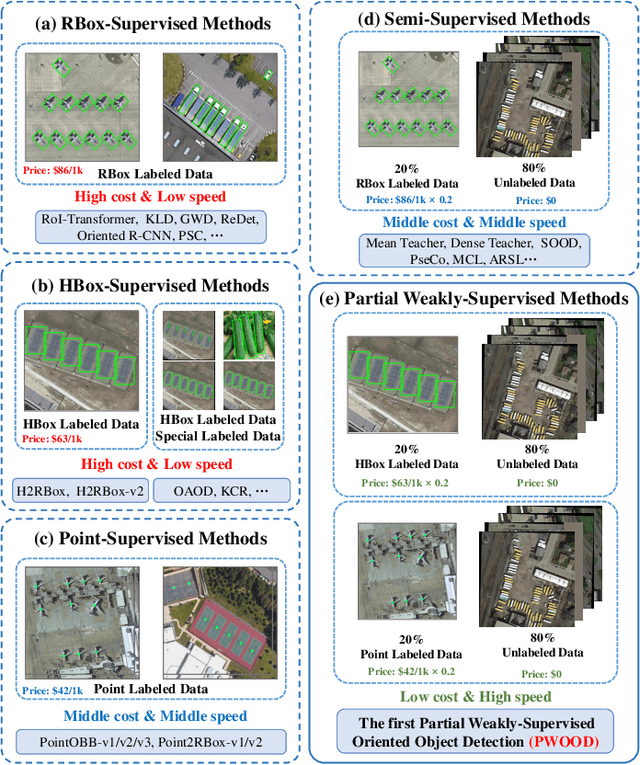
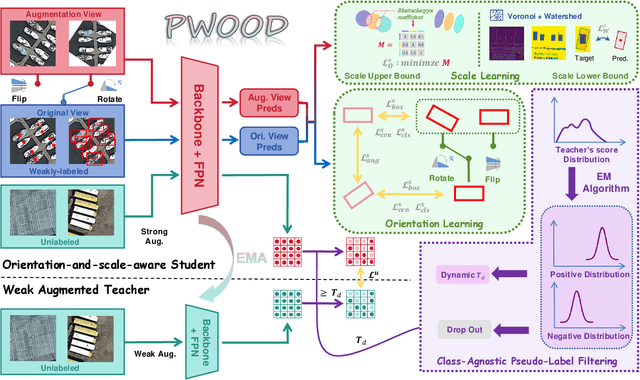
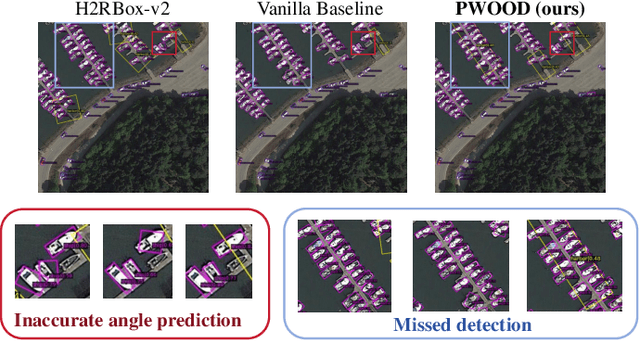
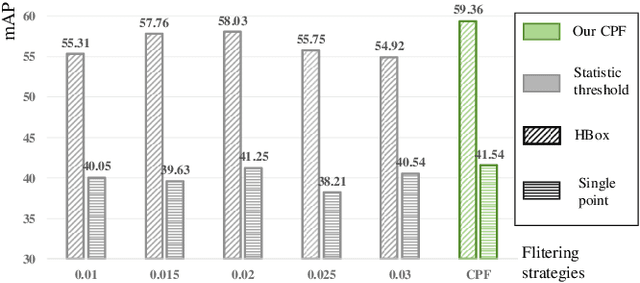
The growing demand for oriented object detection (OOD) across various domains has driven significant research in this area. However, the high cost of dataset annotation remains a major concern. Current mainstream OOD algorithms can be mainly categorized into three types: (1) fully supervised methods using complete oriented bounding box (OBB) annotations, (2) semi-supervised methods using partial OBB annotations, and (3) weakly supervised methods using weak annotations such as horizontal boxes or points. However, these algorithms inevitably increase the cost of models in terms of annotation speed or annotation cost. To address this issue, we propose:(1) the first Partial Weakly-Supervised Oriented Object Detection (PWOOD) framework based on partially weak annotations (horizontal boxes or single points), which can efficiently leverage large amounts of unlabeled data, significantly outperforming weakly supervised algorithms trained with partially weak annotations, also offers a lower cost solution; (2) Orientation-and-Scale-aware Student (OS-Student) model capable of learning orientation and scale information with only a small amount of orientation-agnostic or scale-agnostic weak annotations; and (3) Class-Agnostic Pseudo-Label Filtering strategy (CPF) to reduce the model's sensitivity to static filtering thresholds. Comprehensive experiments on DOTA-v1.0/v1.5/v2.0 and DIOR datasets demonstrate that our PWOOD framework performs comparably to, or even surpasses, traditional semi-supervised algorithms.
Screen Hijack: Visual Poisoning of VLM Agents in Mobile Environments
Jun 16, 2025With the growing integration of vision-language models (VLMs), mobile agents are now widely used for tasks like UI automation and camera-based user assistance. These agents are often fine-tuned on limited user-generated datasets, leaving them vulnerable to covert threats during the training process. In this work we present GHOST, the first clean-label backdoor attack specifically designed for mobile agents built upon VLMs. Our method manipulates only the visual inputs of a portion of the training samples - without altering their corresponding labels or instructions - thereby injecting malicious behaviors into the model. Once fine-tuned with this tampered data, the agent will exhibit attacker-controlled responses when a specific visual trigger is introduced at inference time. The core of our approach lies in aligning the gradients of poisoned samples with those of a chosen target instance, embedding backdoor-relevant features into the poisoned training data. To maintain stealth and enhance robustness, we develop three realistic visual triggers: static visual patches, dynamic motion cues, and subtle low-opacity overlays. We evaluate our method across six real-world Android apps and three VLM architectures adapted for mobile use. Results show that our attack achieves high attack success rates (up to 94.67 percent) while maintaining high clean-task performance (FSR up to 95.85 percent). Additionally, ablation studies shed light on how various design choices affect the efficacy and concealment of the attack. Overall, this work is the first to expose critical security flaws in VLM-based mobile agents, highlighting their susceptibility to clean-label backdoor attacks and the urgent need for effective defense mechanisms in their training pipelines. Code and examples are available at: https://anonymous.4open.science/r/ase-2025-C478.