 Add to Chrome
 Add to Firefox
 Add to Edge
Fire on Motion: Optimizing Video Pass-bands for Efficient Spiking Action Recognition
Jan 30, 2026
Spiking neural networks (SNNs) have gained traction in vision due to their energy efficiency, bio-plausibility, and inherent temporal processing. Yet, despite this temporal capacity, most progress concentrates on static image benchmarks, and SNNs still underperform on dynamic video tasks compared to artificial neural networks (ANNs). In this work, we diagnose a fundamental pass-band mismatch: Standard spiking dynamics behave as a temporal low pass that emphasizes static content while attenuating motion bearing bands, where task relevant information concentrates in dynamic tasks. This phenomenon explains why SNNs can approach ANNs on static tasks yet fall behind on tasks that demand richer temporal understanding.To remedy this, we propose the Pass-Bands Optimizer (PBO), a plug-and-play module that optimizes the temporal pass-band toward task-relevant motion bands. PBO introduces only two learnable parameters, and a lightweight consistency constraint that preserves semantics and boundaries, incurring negligible computational overhead and requires no architectural changes. PBO deliberately suppresses static components that contribute little to discrimination, effectively high passing the stream so that spiking activity concentrates on motion bearing content. On UCF101, PBO yields over ten percentage points improvement. On more complex multi-modal action recognition and weakly supervised video anomaly detection, PBO delivers consistent and significant gains, offering a new perspective for SNN based video processing and understanding.

Breaking the Modality Wall: Time-step Mixup for Efficient Spiking Knowledge Transfer from Static to Event Domain
Nov 15, 2025The integration of event cameras and spiking neural networks (SNNs) promises energy-efficient visual intelligence, yet scarce event data and the sparsity of DVS outputs hinder effective training. Prior knowledge transfers from RGB to DVS often underperform because the distribution gap between modalities is substantial. In this work, we present Time-step Mixup Knowledge Transfer (TMKT), a cross-modal training framework with a probabilistic Time-step Mixup (TSM) strategy. TSM exploits the asynchronous nature of SNNs by interpolating RGB and DVS inputs at various time steps to produce a smooth curriculum within each sequence, which reduces gradient variance and stabilizes optimization with theoretical analysis. To employ auxiliary supervision from TSM, TMKT introduces two lightweight modality-aware objectives, Modality Aware Guidance (MAG) for per-frame source supervision and Mixup Ratio Perception (MRP) for sequence-level mix ratio estimation, which explicitly align temporal features with the mixing schedule. TMKT enables smoother knowledge transfer, helps mitigate modality mismatch during training, and achieves superior performance in spiking image classification tasks. Extensive experiments across diverse benchmarks and multiple SNN backbones, together with ablations, demonstrate the effectiveness of our method.
Time-step Mixup for Efficient Spiking Knowledge Transfer from Appearance to Event Domain
Sep 16, 2025The integration of event cameras and spiking neural networks holds great promise for energy-efficient visual processing. However, the limited availability of event data and the sparse nature of DVS outputs pose challenges for effective training. Although some prior work has attempted to transfer semantic knowledge from RGB datasets to DVS, they often overlook the significant distribution gap between the two modalities. In this paper, we propose Time-step Mixup knowledge transfer (TMKT), a novel fine-grained mixing strategy that exploits the asynchronous nature of SNNs by interpolating RGB and DVS inputs at various time-steps. To enable label mixing in cross-modal scenarios, we further introduce modality-aware auxiliary learning objectives. These objectives support the time-step mixup process and enhance the model's ability to discriminate effectively across different modalities. Our approach enables smoother knowledge transfer, alleviates modality shift during training, and achieves superior performance in spiking image classification tasks. Extensive experiments demonstrate the effectiveness of our method across multiple datasets. The code will be released after the double-blind review process.
Real-time Vehicle-to-Vehicle Communication Based Network Cooperative Control System through Distributed Database and Multimodal Perception: Demonstrated in Crossroads
Oct 23, 2024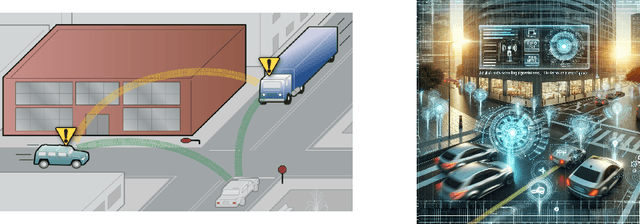
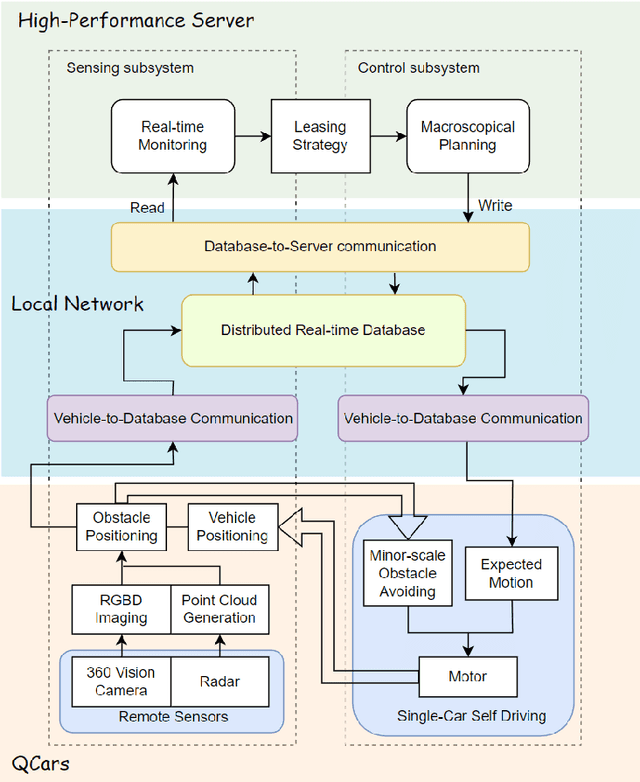
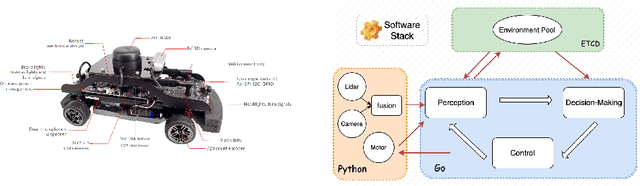
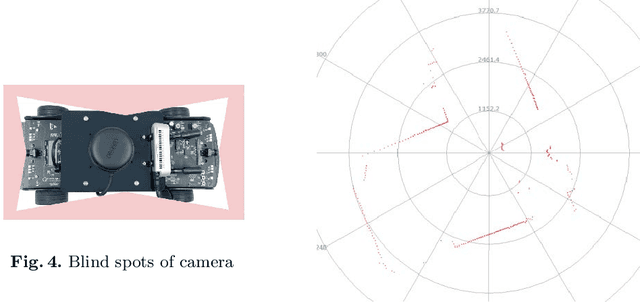
The autonomous driving industry is rapidly advancing, with Vehicle-to-Vehicle (V2V) communication systems highlighting as a key component of enhanced road safety and traffic efficiency. This paper introduces a novel Real-time Vehicle-to-Vehicle Communication Based Network Cooperative Control System (VVCCS), designed to revolutionize macro-scope traffic planning and collision avoidance in autonomous driving. Implemented on Quanser Car (Qcar) hardware platform, our system integrates the distributed databases into individual autonomous vehicles and an optional central server. We also developed a comprehensive multi-modal perception system with multi-objective tracking and radar sensing. Through a demonstration within a physical crossroad environment, our system showcases its potential to be applied in congested and complex urban environments.