 Add to Chrome
 Add to Firefox
 Add to Edge
From Pretrain to Pain: Adversarial Vulnerability of Video Foundation Models Without Task Knowledge
Nov 10, 2025
Large-scale Video Foundation Models (VFMs) has significantly advanced various video-related tasks, either through task-specific models or Multi-modal Large Language Models (MLLMs). However, the open accessibility of VFMs also introduces critical security risks, as adversaries can exploit full knowledge of the VFMs to launch potent attacks. This paper investigates a novel and practical adversarial threat scenario: attacking downstream models or MLLMs fine-tuned from open-source VFMs, without requiring access to the victim task, training data, model query, and architecture. In contrast to conventional transfer-based attacks that rely on task-aligned surrogate models, we demonstrate that adversarial vulnerabilities can be exploited directly from the VFMs. To this end, we propose the Transferable Video Attack (TVA), a temporal-aware adversarial attack method that leverages the temporal representation dynamics of VFMs to craft effective perturbations. TVA integrates a bidirectional contrastive learning mechanism to maximize the discrepancy between the clean and adversarial features, and introduces a temporal consistency loss that exploits motion cues to enhance the sequential impact of perturbations. TVA avoids the need to train expensive surrogate models or access to domain-specific data, thereby offering a more practical and efficient attack strategy. Extensive experiments across 24 video-related tasks demonstrate the efficacy of TVA against downstream models and MLLMs, revealing a previously underexplored security vulnerability in the deployment of video models.

Vid-Morp: Video Moment Retrieval Pretraining from Unlabeled Videos in the Wild
Dec 01, 2024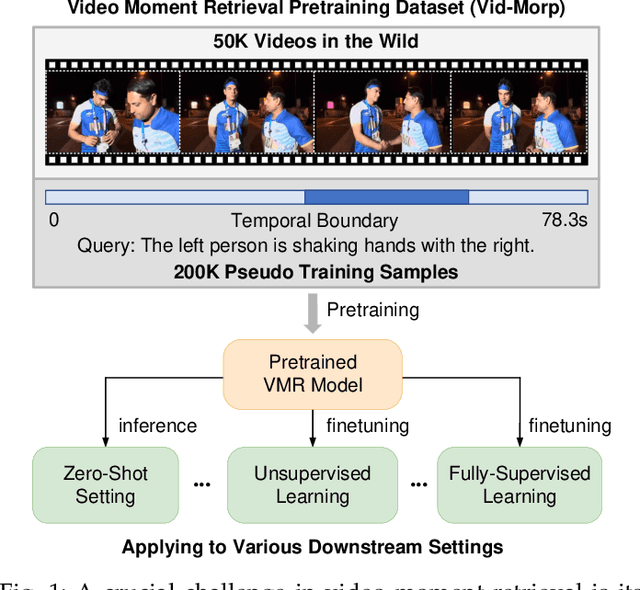
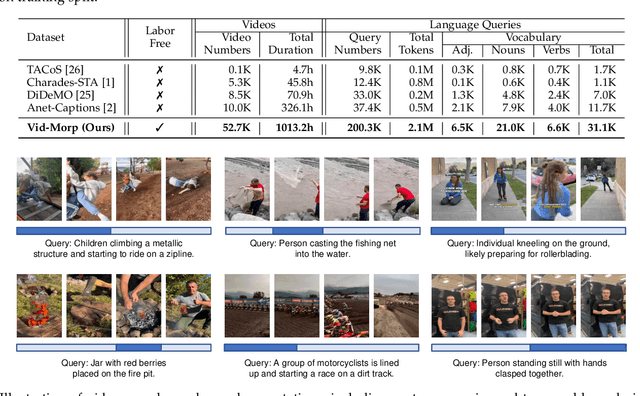
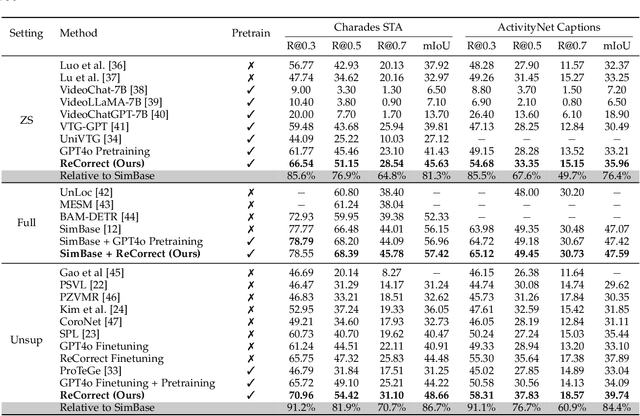
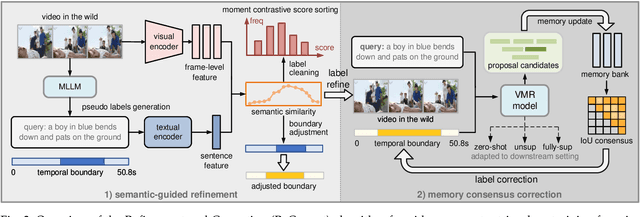
Given a natural language query, video moment retrieval aims to localize the described temporal moment in an untrimmed video. A major challenge of this task is its heavy dependence on labor-intensive annotations for training. Unlike existing works that directly train models on manually curated data, we propose a novel paradigm to reduce annotation costs: pretraining the model on unlabeled, real-world videos. To support this, we introduce Video Moment Retrieval Pretraining (Vid-Morp), a large-scale dataset collected with minimal human intervention, consisting of over 50K videos captured in the wild and 200K pseudo annotations. Direct pretraining on these imperfect pseudo annotations, however, presents significant challenges, including mismatched sentence-video pairs and imprecise temporal boundaries. To address these issues, we propose the ReCorrect algorithm, which comprises two main phases: semantics-guided refinement and memory-consensus correction. The semantics-guided refinement enhances the pseudo labels by leveraging semantic similarity with video frames to clean out unpaired data and make initial adjustments to temporal boundaries. In the following memory-consensus correction phase, a memory bank tracks the model predictions, progressively correcting the temporal boundaries based on consensus within the memory. Comprehensive experiments demonstrate ReCorrect's strong generalization abilities across multiple downstream settings. Zero-shot ReCorrect achieves over 75% and 80% of the best fully-supervised performance on two benchmarks, while unsupervised ReCorrect reaches about 85% on both. The code, dataset, and pretrained models are available at https://github.com/baopj/Vid-Morp.