 Add to Chrome
 Add to Firefox
 Add to Edge
Video Object Segmentation in Panoptic Wild Scenes
May 08, 2023
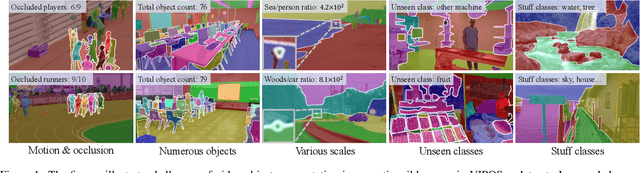
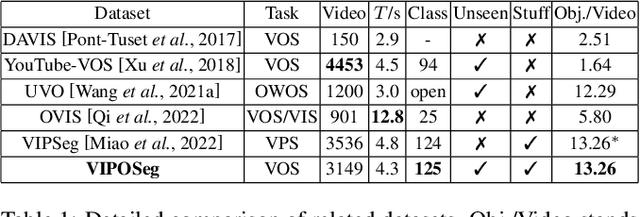
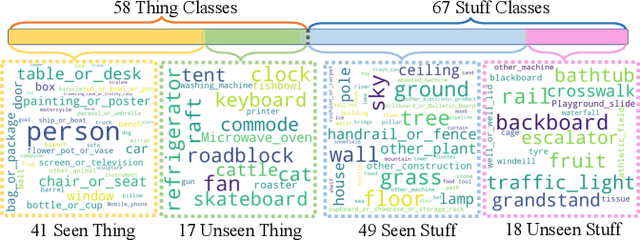
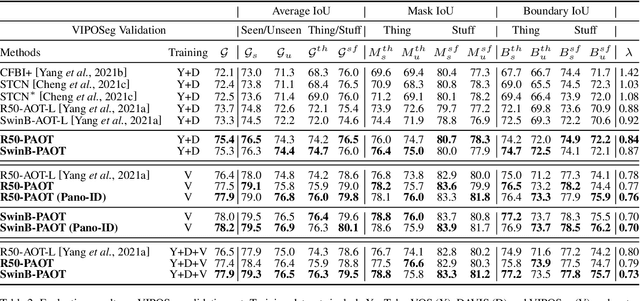
In this paper, we introduce semi-supervised video object segmentation (VOS) to panoptic wild scenes and present a large-scale benchmark as well as a baseline method for it. Previous benchmarks for VOS with sparse annotations are not sufficient to train or evaluate a model that needs to process all possible objects in real-world scenarios. Our new benchmark (VIPOSeg) contains exhaustive object annotations and covers various real-world object categories which are carefully divided into subsets of thing/stuff and seen/unseen classes for comprehensive evaluation. Considering the challenges in panoptic VOS, we propose a strong baseline method named panoptic object association with transformers (PAOT), which uses panoptic identification to associate objects with a pyramid architecture on multiple scales. Experimental results show that VIPOSeg can not only boost the performance of VOS models by panoptic training but also evaluate them comprehensively in panoptic scenes. Previous methods for classic VOS still need to improve in performance and efficiency when dealing with panoptic scenes, while our PAOT achieves SOTA performance with good efficiency on VIPOSeg and previous VOS benchmarks. PAOT also ranks 1st in the VOT2022 challenge. Our dataset is available at https://github.com/yoxu515/VIPOSeg-Benchmark.

Towards Medical Artificial General Intelligence via Knowledge-Enhanced Multimodal Pretraining
Apr 26, 2023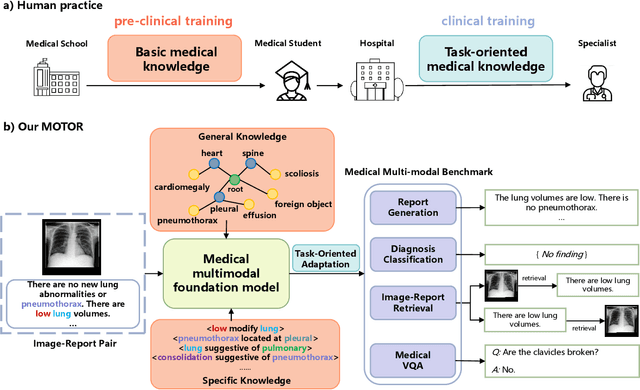

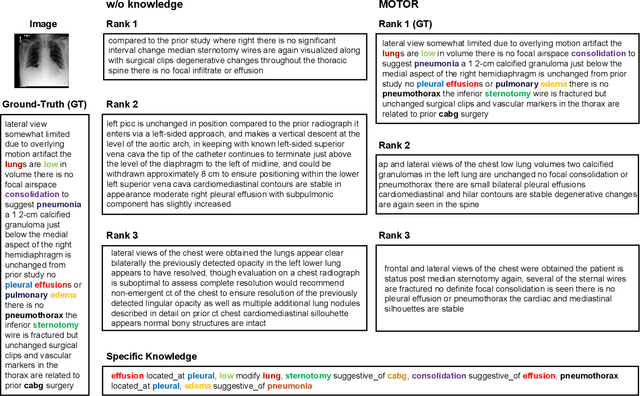
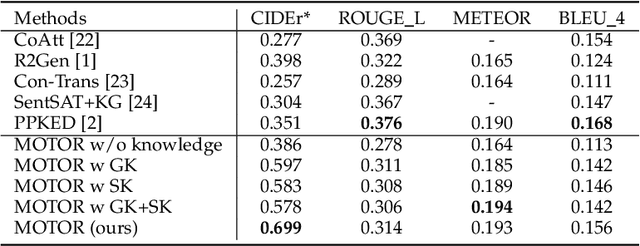
Medical artificial general intelligence (MAGI) enables one foundation model to solve different medical tasks, which is very practical in the medical domain. It can significantly reduce the requirement of large amounts of task-specific data by sufficiently sharing medical knowledge among different tasks. However, due to the challenges of designing strongly generalizable models with limited and complex medical data, most existing approaches tend to develop task-specific models. To take a step towards MAGI, we propose a new paradigm called Medical-knOwledge-enhanced mulTimOdal pretRaining (MOTOR). In MOTOR, we combine two kinds of basic medical knowledge, i.e., general and specific knowledge, in a complementary manner to boost the general pretraining process. As a result, the foundation model with comprehensive basic knowledge can learn compact representations from pretraining radiographic data for better cross-modal alignment. MOTOR unifies the understanding and generation, which are two kinds of core intelligence of an AI system, into a single medical foundation model, to flexibly handle more diverse medical tasks. To enable a comprehensive evaluation and facilitate further research, we construct a medical multimodal benchmark including a wide range of downstream tasks, such as chest x-ray report generation and medical visual question answering. Extensive experiments on our benchmark show that MOTOR obtains promising results through simple task-oriented adaptation. The visualization shows that the injected knowledge successfully highlights key information in the medical data, demonstrating the excellent interpretability of MOTOR. Our MOTOR successfully mimics the human practice of fulfilling a "medical student" to accelerate the process of becoming a "specialist". We believe that our work makes a significant stride in realizing MAGI.
Feature-compatible Progressive Learning for Video Copy Detection
Apr 20, 2023Video Copy Detection (VCD) has been developed to identify instances of unauthorized or duplicated video content. This paper presents our first and second solutions to the Meta AI Video Similarity Challenge (VSC22), CVPR 2023. In order to compete in this challenge, we propose Feature-Compatible Progressive Learning (FCPL) for VCD. FCPL trains various models that produce mutually-compatible features, meaning that the features derived from multiple distinct models can be directly compared with one another. We find this mutual compatibility enables feature ensemble. By implementing progressive learning and utilizing labeled ground truth pairs, we effectively gradually enhance performance. Experimental results demonstrate the superiority of the proposed FCPL over other competitors. Our code is available at https://github.com/WangWenhao0716/VSC-DescriptorTrack-Submission and https://github.com/WangWenhao0716/VSC-MatchingTrack-Submission.
DETR with Additional Global Aggregation for Cross-domain Weakly Supervised Object Detection
Apr 14, 2023This paper presents a DETR-based method for cross-domain weakly supervised object detection (CDWSOD), aiming at adapting the detector from source to target domain through weak supervision. We think DETR has strong potential for CDWSOD due to an insight: the encoder and the decoder in DETR are both based on the attention mechanism and are thus capable of aggregating semantics across the entire image. The aggregation results, i.e., image-level predictions, can naturally exploit the weak supervision for domain alignment. Such motivated, we propose DETR with additional Global Aggregation (DETR-GA), a CDWSOD detector that simultaneously makes "instance-level + image-level" predictions and utilizes "strong + weak" supervisions. The key point of DETR-GA is very simple: for the encoder / decoder, we respectively add multiple class queries / a foreground query to aggregate the semantics into image-level predictions. Our query-based aggregation has two advantages. First, in the encoder, the weakly-supervised class queries are capable of roughly locating the corresponding positions and excluding the distraction from non-relevant regions. Second, through our design, the object queries and the foreground query in the decoder share consensus on the class semantics, therefore making the strong and weak supervision mutually benefit each other for domain alignment. Extensive experiments on four popular cross-domain benchmarks show that DETR-GA significantly improves CSWSOD and advances the states of the art (e.g., 29.0% --> 79.4% mAP on PASCAL VOC --> Clipart_all dataset).
TransHP: Image Classification with Hierarchical Prompting
Apr 13, 2023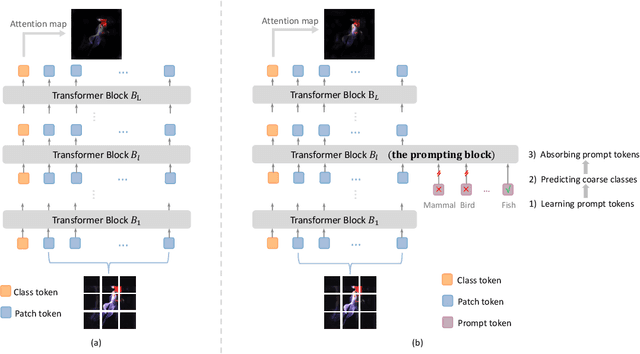

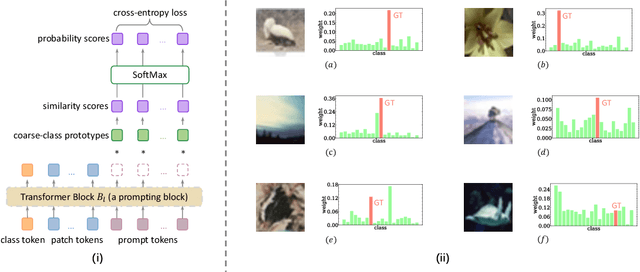

This paper explores a hierarchical prompting mechanism for the hierarchical image classification (HIC) task. Different from prior HIC methods, our hierarchical prompting is the first to explicitly inject ancestor-class information as a tokenized hint that benefits the descendant-class discrimination. We think it well imitates human visual recognition, i.e., humans may use the ancestor class as a prompt to draw focus on the subtle differences among descendant classes. We model this prompting mechanism into a Transformer with Hierarchical Prompting (TransHP). TransHP consists of three steps: 1) learning a set of prompt tokens to represent the coarse (ancestor) classes, 2) on-the-fly predicting the coarse class of the input image at an intermediate block, and 3) injecting the prompt token of the predicted coarse class into the intermediate feature. Though the parameters of TransHP maintain the same for all input images, the injected coarse-class prompt conditions (modifies) the subsequent feature extraction and encourages a dynamic focus on relatively subtle differences among the descendant classes. Extensive experiments show that TransHP improves image classification on accuracy (e.g., improving ViT-B/16 by +2.83% ImageNet classification accuracy), training data efficiency (e.g., +12.69% improvement under 10% ImageNet training data), and model explainability. Moreover, TransHP also performs favorably against prior HIC methods, showing that TransHP well exploits the hierarchical information.
Efficient Multimodal Fusion via Interactive Prompting
Apr 13, 2023Large-scale pre-training has brought unimodal fields such as computer vision and natural language processing to a new era. Following this trend, the size of multi-modal learning models constantly increases, leading to an urgent need to reduce the massive computational cost of finetuning these models for downstream tasks. In this paper, we propose an efficient and flexible multimodal fusion method, namely PMF, tailored for fusing unimodally pre-trained transformers. Specifically, we first present a modular multimodal fusion framework that exhibits high flexibility and facilitates mutual interactions among different modalities. In addition, we disentangle vanilla prompts into three types in order to learn different optimizing objectives for multimodal learning. It is also worth noting that we propose to add prompt vectors only on the deep layers of the unimodal transformers, thus significantly reducing the training memory usage. Experiment results show that our proposed method achieves comparable performance to several other multimodal finetuning methods with less than 3% trainable parameters and up to 66% saving of training memory usage.
PVD-AL: Progressive Volume Distillation with Active Learning for Efficient Conversion Between Different NeRF Architectures
Apr 08, 2023Neural Radiance Fields (NeRF) have been widely adopted as practical and versatile representations for 3D scenes, facilitating various downstream tasks. However, different architectures, including plain Multi-Layer Perceptron (MLP), Tensors, low-rank Tensors, Hashtables, and their compositions, have their trade-offs. For instance, Hashtables-based representations allow for faster rendering but lack clear geometric meaning, making spatial-relation-aware editing challenging. To address this limitation and maximize the potential of each architecture, we propose Progressive Volume Distillation with Active Learning (PVD-AL), a systematic distillation method that enables any-to-any conversions between different architectures. PVD-AL decomposes each structure into two parts and progressively performs distillation from shallower to deeper volume representation, leveraging effective information retrieved from the rendering process. Additionally, a Three-Levels of active learning technique provides continuous feedback during the distillation process, resulting in high-performance results. Empirical evidence is presented to validate our method on multiple benchmark datasets. For example, PVD-AL can distill an MLP-based model from a Hashtables-based model at a 10~20X faster speed and 0.8dB~2dB higher PSNR than training the NeRF model from scratch. Moreover, PVD-AL permits the fusion of diverse features among distinct structures, enabling models with multiple editing properties and providing a more efficient model to meet real-time requirements. Project website:http://sk-fun.fun/PVD-AL.
GIF: A General Graph Unlearning Strategy via Influence Function
Apr 06, 2023With the greater emphasis on privacy and security in our society, the problem of graph unlearning -- revoking the influence of specific data on the trained GNN model, is drawing increasing attention. However, ranging from machine unlearning to recently emerged graph unlearning methods, existing efforts either resort to retraining paradigm, or perform approximate erasure that fails to consider the inter-dependency between connected neighbors or imposes constraints on GNN structure, therefore hard to achieve satisfying performance-complexity trade-offs. In this work, we explore the influence function tailored for graph unlearning, so as to improve the unlearning efficacy and efficiency for graph unlearning. We first present a unified problem formulation of diverse graph unlearning tasks \wrt node, edge, and feature. Then, we recognize the crux to the inability of traditional influence function for graph unlearning, and devise Graph Influence Function (GIF), a model-agnostic unlearning method that can efficiently and accurately estimate parameter changes in response to a $\epsilon$-mass perturbation in deleted data. The idea is to supplement the objective of the traditional influence function with an additional loss term of the influenced neighbors due to the structural dependency. Further deductions on the closed-form solution of parameter changes provide a better understanding of the unlearning mechanism. We conduct extensive experiments on four representative GNN models and three benchmark datasets to justify the superiority of GIF for diverse graph unlearning tasks in terms of unlearning efficacy, model utility, and unlearning efficiency. Our implementations are available at \url{https://github.com/wujcan/GIF-torch/}.
Joint Video Multi-Frame Interpolation and Deblurring under Unknown Exposure Time
Mar 27, 2023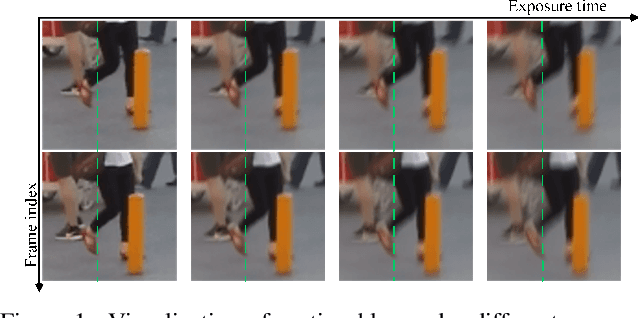
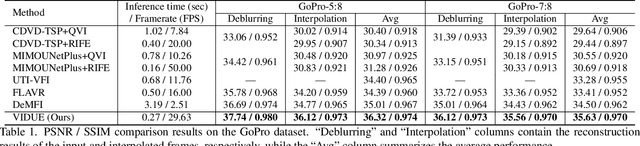
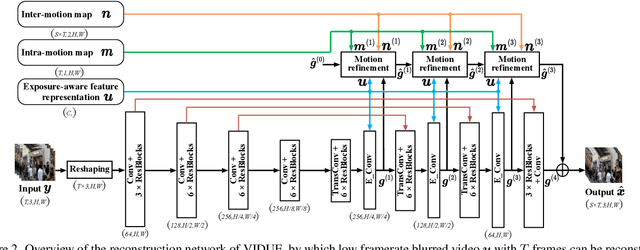
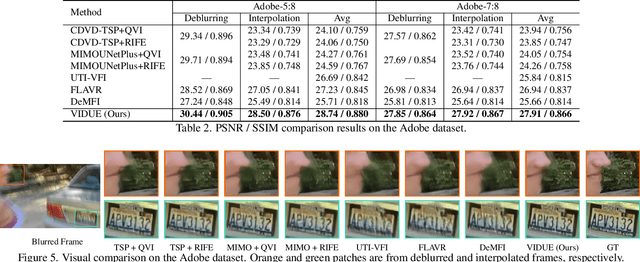
Natural videos captured by consumer cameras often suffer from low framerate and motion blur due to the combination of dynamic scene complexity, lens and sensor imperfection, and less than ideal exposure setting. As a result, computational methods that jointly perform video frame interpolation and deblurring begin to emerge with the unrealistic assumption that the exposure time is known and fixed. In this work, we aim ambitiously for a more realistic and challenging task - joint video multi-frame interpolation and deblurring under unknown exposure time. Toward this goal, we first adopt a variant of supervised contrastive learning to construct an exposure-aware representation from input blurred frames. We then train two U-Nets for intra-motion and inter-motion analysis, respectively, adapting to the learned exposure representation via gain tuning. We finally build our video reconstruction network upon the exposure and motion representation by progressive exposure-adaptive convolution and motion refinement. Extensive experiments on both simulated and real-world datasets show that our optimized method achieves notable performance gains over the state-of-the-art on the joint video x8 interpolation and deblurring task. Moreover, on the seemingly implausible x16 interpolation task, our method outperforms existing methods by more than 1.5 dB in terms of PSNR.
Sector Patch Embedding: An Embedding Module Conforming to The Distortion Pattern of Fisheye Image
Mar 26, 2023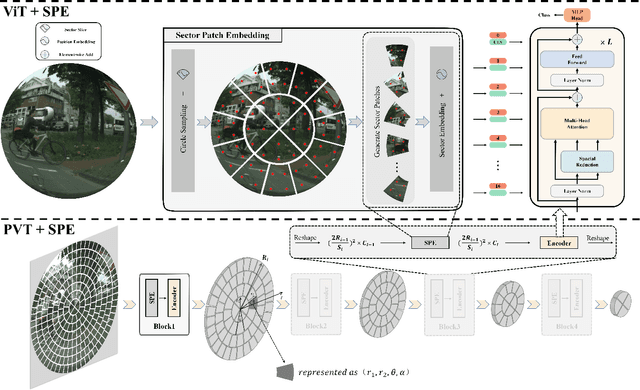
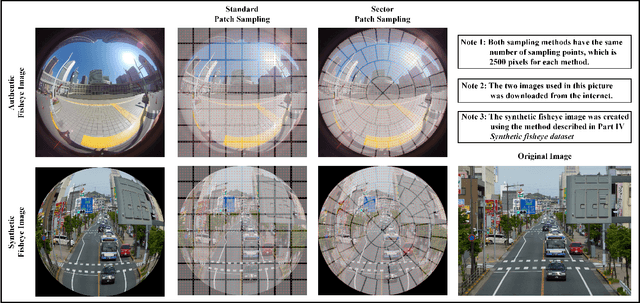
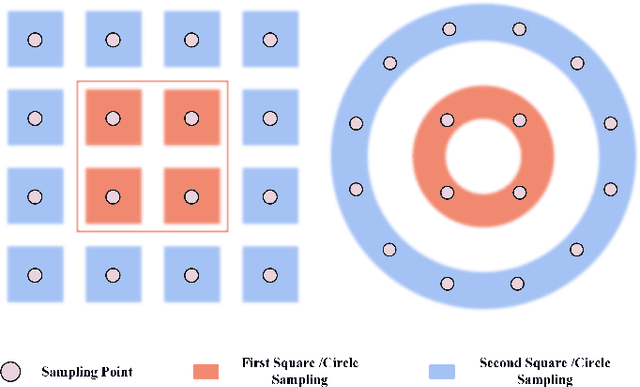
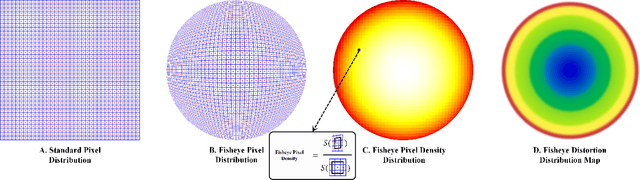
Fisheye cameras suffer from image distortion while having a large field of view(LFOV). And this fact leads to poor performance on some fisheye vision tasks. One of the solutions is to optimize the current vision algorithm for fisheye images. However, most of the CNN-based methods and the Transformer-based methods lack the capability of leveraging distortion information efficiently. In this work, we propose a novel patch embedding method called Sector Patch Embedding(SPE), conforming to the distortion pattern of the fisheye image. Furthermore, we put forward a synthetic fisheye dataset based on the ImageNet-1K and explore the performance of several Transformer models on the dataset. The classification top-1 accuracy of ViT and PVT is improved by 0.75% and 2.8% with SPE respectively. The experiments show that the proposed sector patch embedding method can better perceive distortion and extract features on the fisheye images. Our method can be easily adopted to other Transformer-based models. Source code is at https://github.com/IN2-ViAUn/Sector-Patch-Embedding.