 Add to Chrome
 Add to Firefox
 Add to Edge
Benchmarking and Reasoning Distillation of Large Language Models for Feedback Controller Design in Complex Dynamical Systems
Aug 07, 2026
Although remarkable capabilities have been demonstrated by Large Language Models (LLMs) across scientific domains, feedback controller design remains underexplored. Existing benchmarks focus mainly on linear single-Degree-of-Freedom (DoF) systems and large API-hosted models, leaving performance on complex controller-design tasks and feasibility for edge deployment unclear. To address these limitations, we introduce the Complex Dynamics-to-Control Benchmark for Large Language Models (CoDyControlBench), comprising 132 system configurations across five evaluation dimensions: number of DoF, system type, coupling level, damping regime, and controller type. Six state-of-the-art LLMs were evaluated over three independent runs, including three commercial models (GPT, Gemini, and Claude) and three open-source models (GLM, DeepSeek, and Qwen). GPT achieved the highest design success rate at 94.8\%, whereas Qwen showed the lowest rate at 50.0\%. Across the benchmark dimensions, DoF and controller type exhibited the largest model-averaged variations in design success, with success-rate ranges of 36.3\% and 17.6\%, respectively, exceeding those associated with system type, coupling level, and damping regime. Comparison of GPT and Qwen showed that their performance gap arose mainly from the control-design knowledge, particularly gain selection and the use of transient-limiting mechanisms. For edge deployment, a specialized 1.5B-parameter model was developed through reasoning distillation. The reasoning-distilled model outperformed the answer-distilled and base model on CoDyControlBench, maintained stable performance across 1-6 DoFs, and achieved successful traget tracking in all three physical trials on a pneumatic-artificial-muscle-driven robotic arm. These results establish a benchmark baseline and highlight the potential of lightweight, edge-deployable controller-design models.

Temporally Centered SIGReg Improves Multi-Task LeWorldModel Learning: From Analysis to Method
Jul 29, 2026Recent work on LeWorldModel (LeWM) has shown that the Sketched Isotropic Gaussian Regularizer (SIGReg) enables stable end-to-end world-model learning from pixels by regularizing the latent marginal distribution toward an isotropic Gaussian, thereby preventing representation collapse. While effective and elegant in single-task settings, this recipe does not extend reliably to multi-task training, leading to substantially worse downstream behavior-cloning performance. In this paper, we show that marginal Gaussianization compresses the separation between task-dependent latent clusters relative to within-cluster variation. This compression introduces representation aliasing across tasks and states, and makes the learned representations highly sensitive to small visual perturbations. To address this problem, we apply SIGReg to temporally centered residuals rather than to the latent marginal distribution. This surrogate target places no direct regularization pressure on the separation among cluster centers, removes the requirement that the full latent follow a single isotropic Gaussian, and retains the anti-collapse effect of SIGReg. On the LIBERO benchmark, our method improves downstream success on the long-horizon suite by 1.7x and raises the average success rate across four suites from 53.2% to 73.6%. Without external pretraining, it slightly outperforms Diffusion Policy trained from scratch and approaches the performance of large-scale pretrained policy baselines. These results reveal a structural incompatibility between marginal Gaussian priors and multi-task latent structure, and provide a simple route toward stable and scalable end-to-end multi-task world-model learning.
NavWAM: A Navigation World Action Model for Goal-Conditioned Visual Navigation
Jun 11, 2026Goal-conditioned visual navigation requires a robot to act under partial observability by anticipating how its motion will change the future egocentric view and whether that change brings it closer to the goal. Navigation world models provide such visual foresight, but they remain prediction modules that require an external planner to convert predicted futures into closed-loop control. We propose Navigation World Action Model (NavWAM), a diffusion-transformer policy that turns navigation world-model prediction into executable action by representing future observations, goal-progress values, and action chunks in a shared latent sequence. By learning future prediction jointly with the action and value targets that determine closed-loop behavior, NavWAM makes visual foresight directly usable for robot control. We build NavWAM through simulation pretraining and real-robot adaptation, and evaluate it on image-goal navigation against planning-based world models and a representative direct navigation policy. Across offline benchmarks and closed-loop real-robot deployment, NavWAM improves over planning-based world-model baselines in our evaluations while using the default policy mode without CEM-style action search. Project page: https://dachii-azm.github.io/navwam/
Development of a Compliant Gripper for Safe Robot-Assisted Trouser Dressing-Undressing
Dec 10, 2025In recent years, many countries, including Japan, have rapidly aging populations, making the preservation of seniors' quality of life a significant concern. For elderly people with impaired physical abilities, support for toileting is one of the most important issues. This paper details the design, development, experimental assessment, and potential application of the gripper system, with a focus on the unique requirements and obstacles involved in aiding elderly or hemiplegic individuals in dressing and undressing trousers. The gripper we propose seeks to find the right balance between compliance and grasping forces, ensuring precise manipulation while maintaining a safe and compliant interaction with the users. The gripper's integration into a custom--built robotic manipulator system provides a comprehensive solution for assisting hemiplegic individuals in their dressing and undressing tasks. Experimental evaluations and comparisons with existing studies demonstrate the gripper's ability to successfully assist in both dressing and dressing of trousers in confined spaces with a high success rate. This research contributes to the advancement of assistive robotics, empowering elderly, and physically impaired individuals to maintain their independence and improve their quality of life.
LLMs-guided adaptive compensator: Bringing Adaptivity to Automatic Control Systems with Large Language Models
Jul 28, 2025With rapid advances in code generation, reasoning, and problem-solving, Large Language Models (LLMs) are increasingly applied in robotics. Most existing work focuses on high-level tasks such as task decomposition. A few studies have explored the use of LLMs in feedback controller design; however, these efforts are restricted to overly simplified systems, fixed-structure gain tuning, and lack real-world validation. To further investigate LLMs in automatic control, this work targets a key subfield: adaptive control. Inspired by the framework of model reference adaptive control (MRAC), we propose an LLM-guided adaptive compensator framework that avoids designing controllers from scratch. Instead, the LLMs are prompted using the discrepancies between an unknown system and a reference system to design a compensator that aligns the response of the unknown system with that of the reference, thereby achieving adaptivity. Experiments evaluate five methods: LLM-guided adaptive compensator, LLM-guided adaptive controller, indirect adaptive control, learning-based adaptive control, and MRAC, on soft and humanoid robots in both simulated and real-world environments. Results show that the LLM-guided adaptive compensator outperforms traditional adaptive controllers and significantly reduces reasoning complexity compared to the LLM-guided adaptive controller. The Lyapunov-based analysis and reasoning-path inspection demonstrate that the LLM-guided adaptive compensator enables a more structured design process by transforming mathematical derivation into a reasoning task, while exhibiting strong generalizability, adaptability, and robustness. This study opens a new direction for applying LLMs in the field of automatic control, offering greater deployability and practicality compared to vision-language models.
A Comprehensive Survey on Physical Risk Control in the Era of Foundation Model-enabled Robotics
May 19, 2025Recent Foundation Model-enabled robotics (FMRs) display greatly improved general-purpose skills, enabling more adaptable automation than conventional robotics. Their ability to handle diverse tasks thus creates new opportunities to replace human labor. However, unlike general foundation models, FMRs interact with the physical world, where their actions directly affect the safety of humans and surrounding objects, requiring careful deployment and control. Based on this proposition, our survey comprehensively summarizes robot control approaches to mitigate physical risks by covering all the lifespan of FMRs ranging from pre-deployment to post-accident stage. Specifically, we broadly divide the timeline into the following three phases: (1) pre-deployment phase, (2) pre-incident phase, and (3) post-incident phase. Throughout this survey, we find that there is much room to study (i) pre-incident risk mitigation strategies, (ii) research that assumes physical interaction with humans, and (iii) essential issues of foundation models themselves. We hope that this survey will be a milestone in providing a high-resolution analysis of the physical risks of FMRs and their control, contributing to the realization of a good human-robot relationship.
Enhancing the LLM-Based Robot Manipulation Through Human-Robot Collaboration
Jun 20, 2024Large Language Models (LLMs) are gaining popularity in the field of robotics. However, LLM-based robots are limited to simple, repetitive motions due to the poor integration between language models, robots, and the environment. This paper proposes a novel approach to enhance the performance of LLM-based autonomous manipulation through Human-Robot Collaboration (HRC). The approach involves using a prompted GPT-4 language model to decompose high-level language commands into sequences of motions that can be executed by the robot. The system also employs a YOLO-based perception algorithm, providing visual cues to the LLM, which aids in planning feasible motions within the specific environment. Additionally, an HRC method is proposed by combining teleoperation and Dynamic Movement Primitives (DMP), allowing the LLM-based robot to learn from human guidance. Real-world experiments have been conducted using the Toyota Human Support Robot for manipulation tasks. The outcomes indicate that tasks requiring complex trajectory planning and reasoning over environments can be efficiently accomplished through the incorporation of human demonstrations.
Integrating Visuo-tactile Sensing with Haptic Feedback for Teleoperated Robot Manipulation
Apr 30, 2024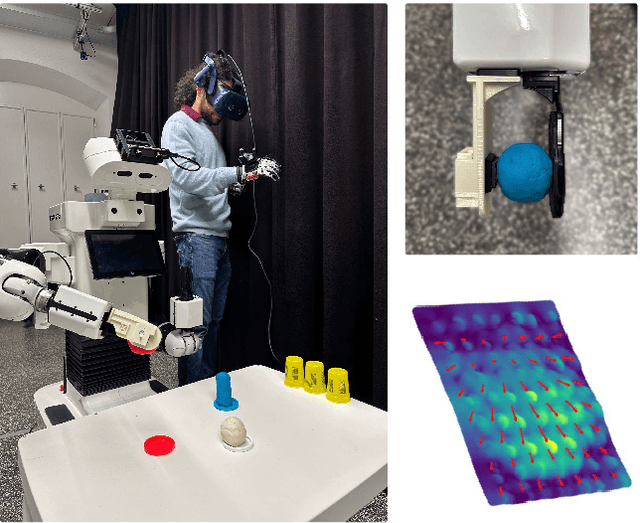
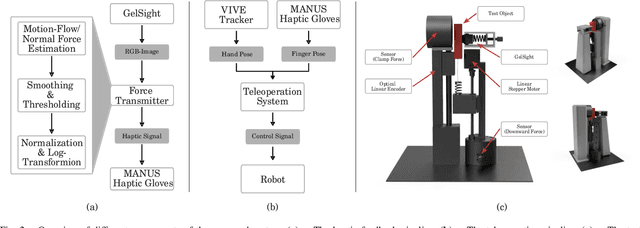
Telerobotics enables humans to overcome spatial constraints and allows them to physically interact with the environment in remote locations. However, the sensory feedback provided by the system to the operator is often purely visual, limiting the operator's dexterity in manipulation tasks. In this work, we address this issue by equipping the robot's end-effector with high-resolution visuotactile GelSight sensors. Using low-cost MANUS-Gloves, we provide the operator with haptic feedback about forces acting at the points of contact in the form of vibration signals. We propose two different methods for estimating these forces; one based on estimating the movement of markers on the sensor surface and one deep-learning approach. Additionally, we integrate our system into a virtual-reality teleoperation pipeline in which a human operator controls both arms of a Tiago robot while receiving visual and haptic feedback. We believe that integrating haptic feedback is a crucial step for dexterous manipulation in teleoperated robotic systems.
LLM-Based Human-Robot Collaboration Framework for Manipulation Tasks
Aug 29, 2023This paper presents a novel approach to enhance autonomous robotic manipulation using the Large Language Model (LLM) for logical inference, converting high-level language commands into sequences of executable motion functions. The proposed system combines the advantage of LLM with YOLO-based environmental perception to enable robots to autonomously make reasonable decisions and task planning based on the given commands. Additionally, to address the potential inaccuracies or illogical actions arising from LLM, a combination of teleoperation and Dynamic Movement Primitives (DMP) is employed for action correction. This integration aims to improve the practicality and generalizability of the LLM-based human-robot collaboration system.
Human Preferences and Robot Constraints Aware Shared Control for Smooth Follower Motion Execution
Jul 31, 2023With the continuous advancement of robot teleoperation technology, shared control is used to reduce the physical and mental load of the operator in teleoperation system. This paper proposes an alternating shared control framework for object grasping that considers both operator's preferences through their manual manipulation and the constraints of the follower robot. The switching between manual mode and automatic mode enables the operator to intervene the task according to their wishes. The generation of the grasping pose takes into account the current state of the operator's hand pose, as well as the manipulability of the robot. The object grasping experiment indicates that the use of the proposed grasping pose selection strategy leads to smoother follower movements when switching from manual mode to automatic mode.