 Add to Chrome
 Add to Firefox
 Add to Edge
Automatic Field-of-View Adjustment for a View-Expansive Microscope via LSTM-Based Gaze and Pipette Motion Interpretation
Aug 11, 2026
Intracytoplasmic sperm injection (ICSI) operators frequently adjust the field-of-view (FOV) during procedures, which interrupts workflow and increases procedure time. Conventional microscopes require manual objective lens switching and illumination adjustments to achieve different FOV sizes. We propose an AI-based automatic FOV adjustment method integrated with a view-expansive microscope. This microscope enables the simultaneous acquisition of a large FOV and high-resolution images using a single objective lens through multiview imaging with galvanometer mirrors and high-speed vision, thereby eliminating the need for physical lens exchanges. Our method utilizes a long short-term memory (LSTM) model to predict the appropriate FOV size based on real-time analysis of the pipette's position and velocity, combined with the operator's gaze position. The AI model is trained using ICSI procedure data from an expert with over five years of micromanipulation experience. Experimental evaluation with novice operators reveals that the proposed automatic FOV adjustment system significantly improves the ICSI procedure speed, reducing the average task completion time from 60.5 to 48.0 s (p < 0.001). The experiments also demonstrate that this improvement enables novice operators to achieve ICSI working speeds equivalent to those of expert operators.
* This is the accepted version of an article published in IEEE Access 13, 182915-182923 (2025). DOI: 10.1109/ACCESS.2025.3624246. Open Access under CC BY 4.0

Elbow Angle Guidance System Based on Surface Haptic Sensations Elicited by Lightweight Wearable Fabric Actuator
Aug 11, 2026The demand for wearable haptic devices has rapidly increased for various applications. However, many haptic devices interfere with the wearer's activities and movements. In addition, several haptic devices fail to elicit intuitive haptic sensations by adjusting to the natural posture of the wearer. To address these issues, we propose an elbow angle guidance system using a lightweight wearable fabric actuator. The proposed actuator is made of fabric and has two McKibben-type artificial muscles attached to it, rendering it extremely lightweight and facilitating the delivery of surface haptic sensations to intuitively induce elbow extension and flexion. The surface haptic sensation elicited by the fabric actuator is adjusted to natural body movements without interfering with the wearer's movements. Moreover, the proposed system measures and guides the elbow angle by changing the intensity of the surface haptic sensation delivered to users in real time. The accuracy of the proposed system is demonstrated through experiments involving human participants.
* This is the accepted version of the paper published in Proc. 2024 IEEE International Conference on Advanced Intelligent Mechatronics (AIM), 1447-1454 (2024)
Intuitive Hand Positional Guidance Using McKibben-Based Surface Tactile Sensations to Shoulder and Elbow
Aug 10, 2026Hand positional guidance with intuitive perception is crucial for enhancing user interaction and task performance in immersive environments. However, conventional hand positional guidance methods, relying on tactile sensations, lack intuitiveness. Consequently, users require instruction on the relationship between the tactile sensation and target position of the guidance before using these methods. Additionally, the user needs training to become familiar with tactile sensations. This study presents a hand positional guidance system with intuitive perception that leverages McKibben-based surface tactile sensations directed to the shoulder and elbow. We developed a wearable fabric actuator that provides McKibben-based surface tactile sensations to induce six specific movements: elbow flexion, extension, shoulder abduction, adduction, horizontal abduction, and horizontal adduction. The effectiveness of the actuator was experimentally validated, demonstrating its high accuracy in intuitively inducing six movements. An algorithm based on the equilibrium point hypothesis and Weber-Fechner law was implemented to regulate the intensity of the tactile sensations for hand positional guidance. Furthermore, the accuracy and speed of the proposed system were compared with that of conventional guidance methods utilizing synthesized speech and vibrotactile guidance.
* This is the accepted version of an article published in IEEE Robotics and Automation Letters 10(4), 3254-3261 (2025). DOI: 10.1109/LRA.2025.3540579. Open Access under CC BY-NC-ND 4.0
Immersive Micromanipulation Integrating Pipette and Injector Operations with McKibben-Based Haptic Sensations for Workload Reduction
Aug 10, 2026Intracytoplasmic sperm injection (ICSI) requires advanced micromanipulation techniques but relies solely on visual feedback and involves frequent interface switching between pipette movement and injector operations. Existing haptic feedback systems primarily focus on pipette puncture forces and do not provide feedback on injector states. We developed an immersive micromanipulation system that unifies operational interfaces and provides McKibben-based haptic sensations to represent aspiration, discharge, and contact between the oocyte and pipette. Users operated both the pipette and injector with a single hand while receiving haptic sensations. A human-participant experiment revealed that the immersive operation interface improved micromanipulation speed and reduced cognitive workload of the micromanipulation compared with conventional methods. Additionally, McKibben-based haptic sensations improved overall system usability. The immersive micromanipulation system with McKibben-based haptic sensations successfully unified operational interfaces and reduced operator workload.
* This is the accepted version of an article published in IEEE Access 14, 116393-116404 (2026). DOI: 10.1109/ACCESS.2026.3717843. Open Access under CC BY 4.0
Intuitive Directional Sense Presentation to the Torso Using McKibben-Based Surface Haptic Sensation in Immersive Space
Aug 10, 2026In recent years, systems that utilize immersive space have been developed in various fields. Immersive spaces often contain considerable amounts of visual information; therefore, users often fail to obtain their desired information. Therefore, various methods have been developed to guide users toward haptic sensations. However, many of these methods have limitations in terms of the intuitive perception of haptic sensation and require practice for familiarization with haptic sensation. Fabric actuators are wearable haptic devices that combine fabric and McKibben artificial muscles to provide wearers with surface haptic sensation. These sensations can be provided to a wide area of the body with intuitive perception, instead of only to a part of the body. This paper presents a novel air pressure adjustment method for whole-body motion guidance using surface haptic sensations provided by a wearable fabric actuator. The proposed system can provide users with a directional sense without visual information in an immersive space. The effectiveness of the proposed system was evaluated through subject experiments and statistical data analysis. Finally, a directional sense presentation was conducted for users performing micromanipulations in a mixed-reality space to demonstrate the applicability of the proposed system for teleoperation.
* This is the accepted version of an article published in IEEE Transactions on Haptics 18(1), 244-254 (2025). DOI: 10.1109/TOH.2024.3522897. Open Access under CC BY-NC-ND 4.0
Development of a Compliant Gripper for Safe Robot-Assisted Trouser Dressing-Undressing
Dec 10, 2025In recent years, many countries, including Japan, have rapidly aging populations, making the preservation of seniors' quality of life a significant concern. For elderly people with impaired physical abilities, support for toileting is one of the most important issues. This paper details the design, development, experimental assessment, and potential application of the gripper system, with a focus on the unique requirements and obstacles involved in aiding elderly or hemiplegic individuals in dressing and undressing trousers. The gripper we propose seeks to find the right balance between compliance and grasping forces, ensuring precise manipulation while maintaining a safe and compliant interaction with the users. The gripper's integration into a custom--built robotic manipulator system provides a comprehensive solution for assisting hemiplegic individuals in their dressing and undressing tasks. Experimental evaluations and comparisons with existing studies demonstrate the gripper's ability to successfully assist in both dressing and dressing of trousers in confined spaces with a high success rate. This research contributes to the advancement of assistive robotics, empowering elderly, and physically impaired individuals to maintain their independence and improve their quality of life.
Enhancing the LLM-Based Robot Manipulation Through Human-Robot Collaboration
Jun 20, 2024Large Language Models (LLMs) are gaining popularity in the field of robotics. However, LLM-based robots are limited to simple, repetitive motions due to the poor integration between language models, robots, and the environment. This paper proposes a novel approach to enhance the performance of LLM-based autonomous manipulation through Human-Robot Collaboration (HRC). The approach involves using a prompted GPT-4 language model to decompose high-level language commands into sequences of motions that can be executed by the robot. The system also employs a YOLO-based perception algorithm, providing visual cues to the LLM, which aids in planning feasible motions within the specific environment. Additionally, an HRC method is proposed by combining teleoperation and Dynamic Movement Primitives (DMP), allowing the LLM-based robot to learn from human guidance. Real-world experiments have been conducted using the Toyota Human Support Robot for manipulation tasks. The outcomes indicate that tasks requiring complex trajectory planning and reasoning over environments can be efficiently accomplished through the incorporation of human demonstrations.
LLM-Based Human-Robot Collaboration Framework for Manipulation Tasks
Aug 29, 2023This paper presents a novel approach to enhance autonomous robotic manipulation using the Large Language Model (LLM) for logical inference, converting high-level language commands into sequences of executable motion functions. The proposed system combines the advantage of LLM with YOLO-based environmental perception to enable robots to autonomously make reasonable decisions and task planning based on the given commands. Additionally, to address the potential inaccuracies or illogical actions arising from LLM, a combination of teleoperation and Dynamic Movement Primitives (DMP) is employed for action correction. This integration aims to improve the practicality and generalizability of the LLM-based human-robot collaboration system.
Human Preferences and Robot Constraints Aware Shared Control for Smooth Follower Motion Execution
Jul 31, 2023With the continuous advancement of robot teleoperation technology, shared control is used to reduce the physical and mental load of the operator in teleoperation system. This paper proposes an alternating shared control framework for object grasping that considers both operator's preferences through their manual manipulation and the constraints of the follower robot. The switching between manual mode and automatic mode enables the operator to intervene the task according to their wishes. The generation of the grasping pose takes into account the current state of the operator's hand pose, as well as the manipulability of the robot. The object grasping experiment indicates that the use of the proposed grasping pose selection strategy leads to smoother follower movements when switching from manual mode to automatic mode.
Cutaneous Feedback Interface for Teleoperated In-Hand Manipulation
Mar 06, 2023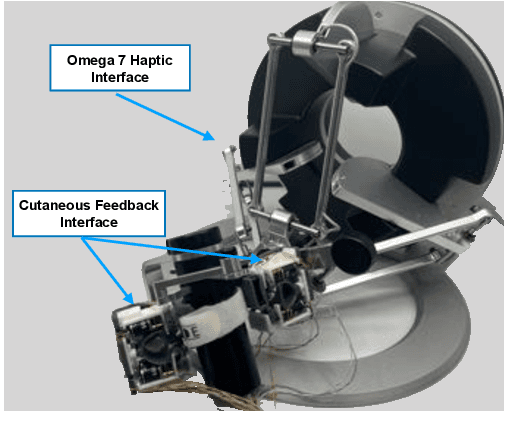
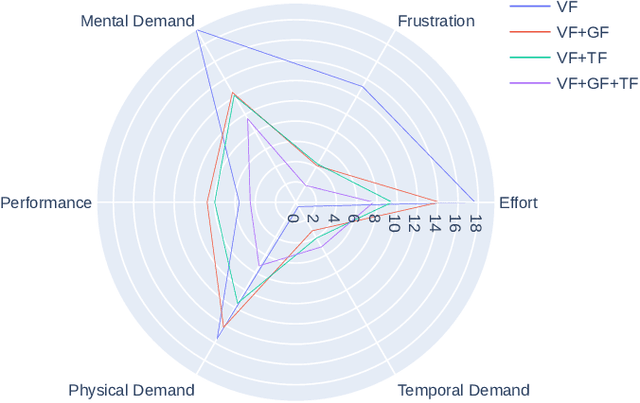
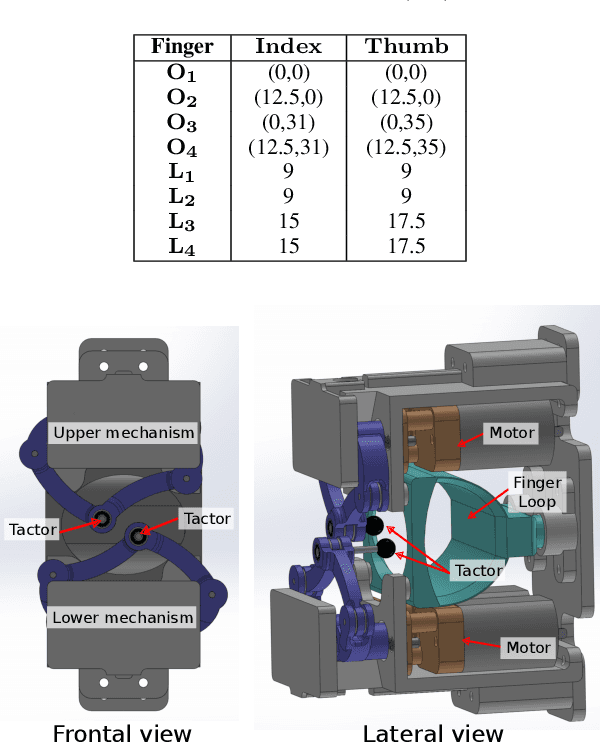
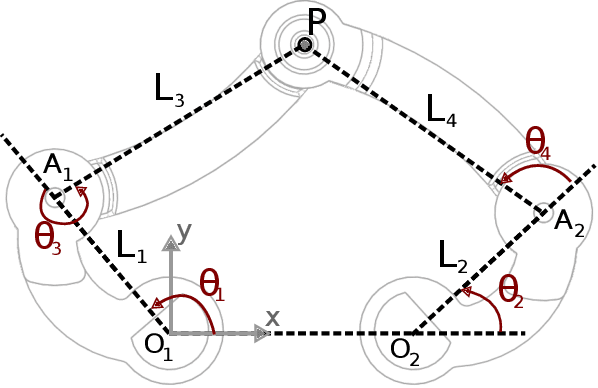
In-hand pivoting is one of the important manipulation skills that leverage robot grippers' extrinsic dexterity to perform repositioning tasks to compensate for environmental uncertainties and imprecise motion execution. Although many researchers have been trying to solve pivoting problems using mathematical modeling or learning-based approaches, the problems remain as open challenges. On the other hand, humans perform in-hand manipulation with remarkable precision and speed. Hence, the solution could be provided by making full use of this intrinsic human skill through dexterous teleoperation. For dexterous teleoperation to be successful, interfaces that enhance and complement haptic feedback are of great necessity. In this paper, we propose a cutaneous feedback interface that complements the somatosensory information humans rely on when performing dexterous skills. The interface is designed based on five-bar link mechanisms and provides two contact points in the index finger and thumb for cutaneous feedback. By integrating the interface with a commercially available haptic device, the system can display information such as grasping force, shear force, friction, and grasped object's pose. Passive pivoting tasks inside a numerical simulator Isaac Sim is conducted to evaluate the effect of the proposed cutaneous feedback interface.
* 7 pages, 10 figures, Accepted at 2022 IEEE/RSJ International Conference on Intelligent Robots and Systems (IROS)