 Add to Chrome
 Add to Firefox
 Add to Edge
LongEgoRefer: A Benchmark for Long-Form Egocentric Video Referring Expression Comprehension
Jul 02, 2026
Egocentric videos capture rich and diverse human-object interactions and have emerged as a fundamental resource for understanding human activities related to objects. In this context, Video Referring Expression Comprehension (Video REC), the task of localizing the temporal and spatial extent of a referred object in video frames given a natural language query, plays a key role in linking textual descriptions to observed objects in untrimmed egocentric recordings. However, existing egocentric Video REC benchmarks primarily focus on short video clips, where some target object appears densely within frames. Such settings do not reflect real-world egocentric recordings, which are long-form, untrimmed, and characterized by sparse object occurrences and complex activity transitions. To address this limitation, we introduce LongEgoRefer, a novel and challenging benchmark constructed from long-form videos in the Ego4D dataset. LongEgoRefer contains 1,498 referring expressions with an average video duration of 45 minutes. The benchmark exhibits extreme target sparsity, detailed linguistic descriptions, and complex human-object interactions embedded in long, dynamic egocentric narratives. Consequently, it defines a demanding spatio-temporal grounding problem that requires models to identify both when an event occurs and where the referred object appears within extended video sequences. We evaluate existing Video REC approaches, including training-free baselines based on vision-language models combined with Grounded SAM2. Extensive experiments show that even advanced baselines and current state-of-the-art models struggle significantly on LongEgoRefer. These results highlight the intrinsic difficulty of long-form egocentric spatio-temporal grounding and emphasize the need for more robust video understanding models.

NavWAM: A Navigation World Action Model for Goal-Conditioned Visual Navigation
Jun 11, 2026Goal-conditioned visual navigation requires a robot to act under partial observability by anticipating how its motion will change the future egocentric view and whether that change brings it closer to the goal. Navigation world models provide such visual foresight, but they remain prediction modules that require an external planner to convert predicted futures into closed-loop control. We propose Navigation World Action Model (NavWAM), a diffusion-transformer policy that turns navigation world-model prediction into executable action by representing future observations, goal-progress values, and action chunks in a shared latent sequence. By learning future prediction jointly with the action and value targets that determine closed-loop behavior, NavWAM makes visual foresight directly usable for robot control. We build NavWAM through simulation pretraining and real-robot adaptation, and evaluate it on image-goal navigation against planning-based world models and a representative direct navigation policy. Across offline benchmarks and closed-loop real-robot deployment, NavWAM improves over planning-based world-model baselines in our evaluations while using the default policy mode without CEM-style action search. Project page: https://dachii-azm.github.io/navwam/
E3VS-Bench: A Benchmark for Viewpoint-Dependent Active Perception in 3D Gaussian Splatting Scenes
Apr 20, 2026Visual search in 3D environments requires embodied agents to actively explore their surroundings and acquire task-relevant evidence. However, existing visual search and embodied AI benchmarks, including EQA, typically rely on static observations or constrained egocentric motion, and thus do not explicitly evaluate fine-grained viewpoint-dependent phenomena that arise under unrestricted 5-DoF viewpoint control in real-world 3D environments, such as visibility changes caused by vertical viewpoint shifts, revealing contents inside containers, and disambiguating object attributes that are only observable from specific angles. To address this limitation, we introduce {E3VS-Bench}, a benchmark for embodied 3D visual search where agents must control their viewpoints in 5-DoF to gather viewpoint-dependent evidence for question answering. E3VS-Bench consists of 99 high-fidelity 3D scenes reconstructed using 3D Gaussian Splatting and 2,014 question-driven episodes. 3D Gaussian Splatting enables photorealistic free-viewpoint rendering that preserves fine-grained visual details (e.g., small text and subtle attributes) often degraded in mesh-based simulators, thereby allowing the construction of questions that cannot be answered from a single view and instead require active inspection across viewpoints in 5-DoF. We evaluate multiple state-of-the-art VLMs and compare their performance with humans. Despite strong 2D reasoning ability, all models exhibit a substantial gap from humans, highlighting limitations in active perception and coherent viewpoint planning specifically under full 5-DoF viewpoint changes.
Stitch4D: Sparse Multi-Location 4D Urban Reconstruction via Spatio-Temporal Interpolation
Apr 09, 2026Dynamic urban environments are often captured by cameras placed at spatially separated locations with little or no view overlap. However, most existing 4D reconstruction methods assume densely overlapping views. When applied to such sparse observations, these methods fail to reconstruct intermediate regions and often introduce temporal artifacts. To address this practical yet underexplored sparse multi-location setting, we propose Stitch4D, a unified 4D reconstruction framework that explicitly compensates for missing spatial coverage in sparse observations. Stitch4D (i) synthesizes intermediate bridge views to densify spatial constraints and improve spatial coverage, and (ii) jointly optimizes real and synthesized observations within a unified coordinate frame under explicit inter-location consistency constraints. By restoring intermediate coverage before optimization, Stitch4D prevents geometric collapse and reconstructs coherent geometry and smooth scene dynamics even in sparsely observed environments. To evaluate this setting, we introduce Urban Sparse 4D (U-S4D), a CARLA-based benchmark designed to assess spatiotemporal alignment under sparse multi-location configurations. Experimental results on U-S4D show that Stitch4D surpasses representative 4D reconstruction baselines and achieves superior visual quality. These results indicate that recovering intermediate spatial coverage is essential for stable 4D reconstruction in sparse urban environments.
EC-Bench: Enumeration and Counting Benchmark for Ultra-Long Videos
Mar 31, 2026Counting in long videos remains a fundamental yet underexplored challenge in computer vision. Real-world recordings often span tens of minutes or longer and contain sparse, diverse events, making long-range temporal reasoning particularly difficult. However, most existing video counting benchmarks focus on short clips and evaluate only the final numerical answer, providing little insight into what should be counted or whether models consistently identify relevant instances across time. We introduce EC-Bench, a benchmark that jointly evaluates enumeration, counting, and temporal evidence grounding in long-form videos. EC-Bench contains 152 videos longer than 30 minutes and 1,699 queries paired with explicit evidence spans. Across 22 multimodal large language models (MLLMs), the best model achieves only 29.98% accuracy on Enumeration and 23.74% on Counting, while human performance reaches 78.57% and 82.97%, respectively. Our analysis reveals strong relationships between enumeration accuracy, temporal grounding, and counting performance. These results highlight fundamental limitations of current MLLMs and establish EC-Bench as a challenging benchmark for long-form quantitative video reasoning.
PhysQuantAgent: An Inference Pipeline of Mass Estimation for Vision-Language Models
Mar 17, 2026Vision-Language Models (VLMs) are increasingly applied to robotic perception and manipulation, yet their ability to infer physical properties required for manipulation remains limited. In particular, estimating the mass of real-world objects is essential for determining appropriate grasp force and ensuring safe interaction. However, current VLMs lack reliable mass reasoning capabilities, and most existing benchmarks do not explicitly evaluate physical quantity estimation under realistic sensing conditions. In this work, we propose PhysQuantAgent, a framework for real-world object mass estimation using VLMs, together with VisPhysQuant, a new benchmark dataset for evaluation. VisPhysQuant consists of RGB-D videos of real objects captured from multiple viewpoints, annotated with precise mass measurements. To improve estimation accuracy, we introduce three visual prompting methods that enhance the input image with object detection, scale estimation, and cross-sectional image generation to help the model comprehend the size and internal structure of the target object. Experiments show that visual prompting significantly improves mass estimation accuracy on real-world data, suggesting the efficacy of integrating spatial reasoning with VLM knowledge for physical inference.
LegalViz: Legal Text Visualization by Text To Diagram Generation
Feb 10, 2025Legal documents including judgments and court orders require highly sophisticated legal knowledge for understanding. To disclose expert knowledge for non-experts, we explore the problem of visualizing legal texts with easy-to-understand diagrams and propose a novel dataset of LegalViz with 23 languages and 7,010 cases of legal document and visualization pairs, using the DOT graph description language of Graphviz. LegalViz provides a simple diagram from a complicated legal corpus identifying legal entities, transactions, legal sources, and statements at a glance, that are essential in each judgment. In addition, we provide new evaluation metrics for the legal diagram visualization by considering graph structures, textual similarities, and legal contents. We conducted empirical studies on few-shot and finetuning large language models for generating legal diagrams and evaluated them with these metrics, including legal content-based evaluation within 23 languages. Models trained with LegalViz outperform existing models including GPTs, confirming the effectiveness of our dataset.
Answerability Fields: Answerable Location Estimation via Diffusion Models
Jul 26, 2024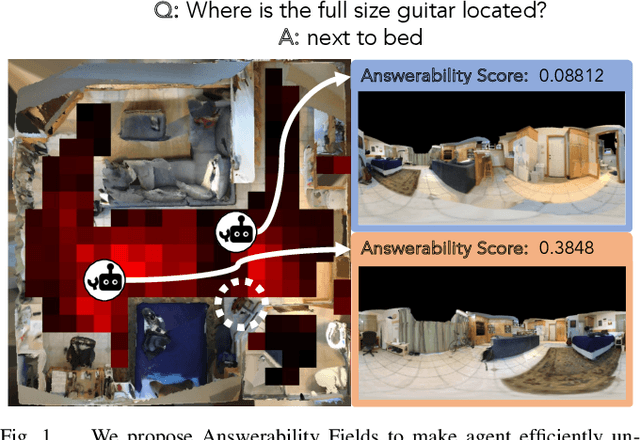
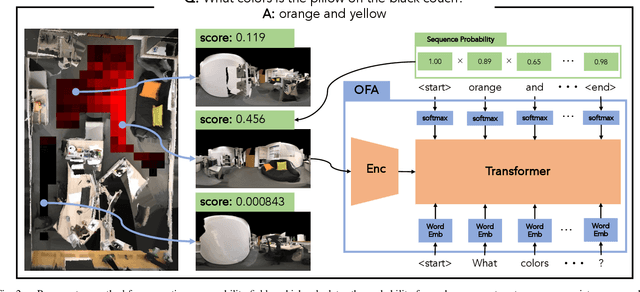
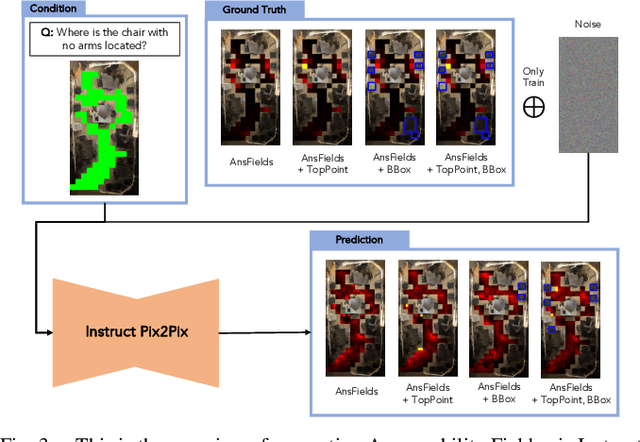
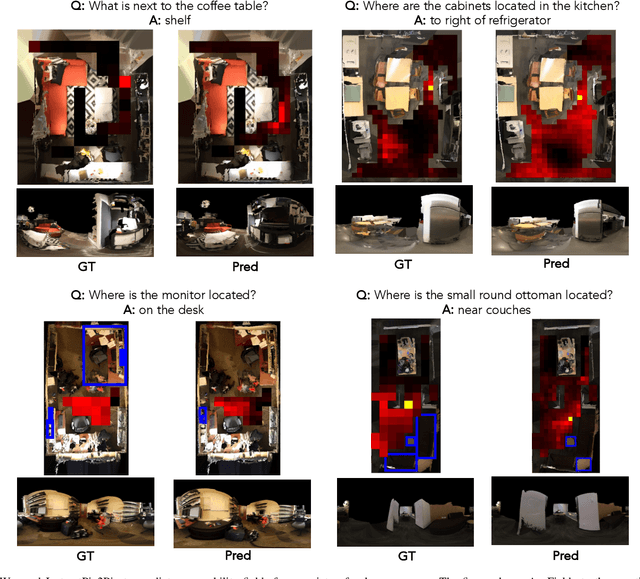
In an era characterized by advancements in artificial intelligence and robotics, enabling machines to interact with and understand their environment is a critical research endeavor. In this paper, we propose Answerability Fields, a novel approach to predicting answerability within complex indoor environments. Leveraging a 3D question answering dataset, we construct a comprehensive Answerability Fields dataset, encompassing diverse scenes and questions from ScanNet. Using a diffusion model, we successfully infer and evaluate these Answerability Fields, demonstrating the importance of objects and their locations in answering questions within a scene. Our results showcase the efficacy of Answerability Fields in guiding scene-understanding tasks, laying the foundation for their application in enhancing interactions between intelligent agents and their environments.
CityNav: Language-Goal Aerial Navigation Dataset with Geographic Information
Jun 20, 2024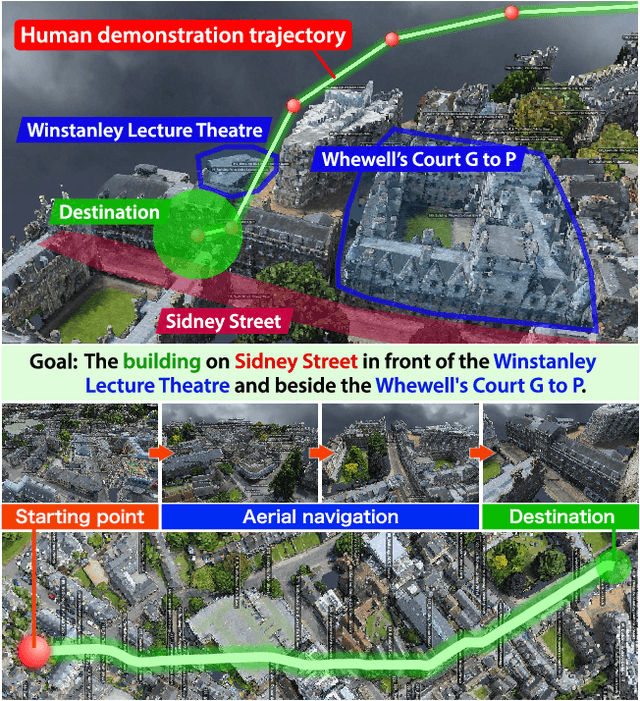
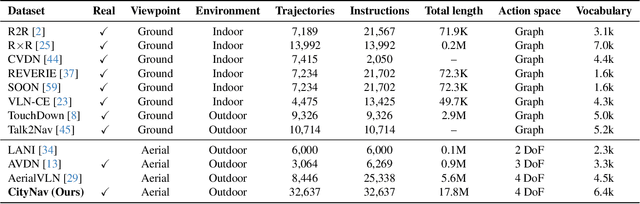
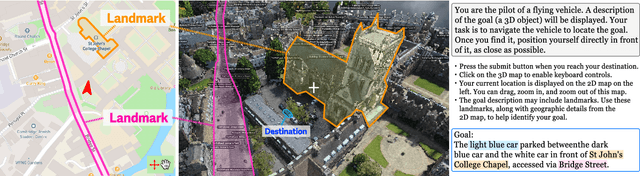
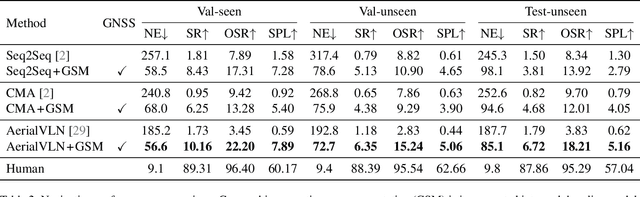
Vision-and-language navigation (VLN) aims to guide autonomous agents through real-world environments by integrating visual and linguistic cues. While substantial progress has been made in understanding these interactive modalities in ground-level navigation, aerial navigation remains largely underexplored. This is primarily due to the scarcity of resources suitable for real-world, city-scale aerial navigation studies. To bridge this gap, we introduce CityNav, a new dataset for language-goal aerial navigation using a 3D point cloud representation from real-world cities. CityNav includes 32,637 natural language descriptions paired with human demonstration trajectories, collected from participants via a new web-based 3D simulator developed for this research. Each description specifies a navigation goal, leveraging the names and locations of landmarks within real-world cities. We also provide baseline models of navigation agents that incorporate an internal 2D spatial map representing landmarks referenced in the descriptions. We benchmark the latest aerial navigation baselines and our proposed model on the CityNav dataset. The results using this dataset reveal the following key findings: (i) Our aerial agent models trained on human demonstration trajectories outperform those trained on shortest path trajectories, highlighting the importance of human-driven navigation strategies; (ii) The integration of a 2D spatial map significantly enhances navigation efficiency at city scale. Our dataset and code are available at https://water-cookie.github.io/city-nav-proj/
Map-based Modular Approach for Zero-shot Embodied Question Answering
May 26, 2024Building robots capable of interacting with humans through natural language in the visual world presents a significant challenge in the field of robotics. To overcome this challenge, Embodied Question Answering (EQA) has been proposed as a benchmark task to measure the ability to identify an object navigating through a previously unseen environment in response to human-posed questions. Although some methods have been proposed, their evaluations have been limited to simulations, without experiments in real-world scenarios. Furthermore, all of these methods are constrained by a limited vocabulary for question-and-answer interactions, making them unsuitable for practical applications. In this work, we propose a map-based modular EQA method that enables real robots to navigate unknown environments through frontier-based map creation and address unknown QA pairs using foundation models that support open vocabulary. Unlike the questions of the previous EQA dataset on Matterport 3D (MP3D), questions in our real-world experiments contain various question formats and vocabularies not included in the training data. We conduct comprehensive experiments on virtual environments (MP3D-EQA) and two real-world house environments and demonstrate that our method can perform EQA even in the real world.