 Add to Chrome
 Add to Firefox
 Add to Edge
Benchmarking and Reasoning Distillation of Large Language Models for Feedback Controller Design in Complex Dynamical Systems
Aug 07, 2026
Although remarkable capabilities have been demonstrated by Large Language Models (LLMs) across scientific domains, feedback controller design remains underexplored. Existing benchmarks focus mainly on linear single-Degree-of-Freedom (DoF) systems and large API-hosted models, leaving performance on complex controller-design tasks and feasibility for edge deployment unclear. To address these limitations, we introduce the Complex Dynamics-to-Control Benchmark for Large Language Models (CoDyControlBench), comprising 132 system configurations across five evaluation dimensions: number of DoF, system type, coupling level, damping regime, and controller type. Six state-of-the-art LLMs were evaluated over three independent runs, including three commercial models (GPT, Gemini, and Claude) and three open-source models (GLM, DeepSeek, and Qwen). GPT achieved the highest design success rate at 94.8\%, whereas Qwen showed the lowest rate at 50.0\%. Across the benchmark dimensions, DoF and controller type exhibited the largest model-averaged variations in design success, with success-rate ranges of 36.3\% and 17.6\%, respectively, exceeding those associated with system type, coupling level, and damping regime. Comparison of GPT and Qwen showed that their performance gap arose mainly from the control-design knowledge, particularly gain selection and the use of transient-limiting mechanisms. For edge deployment, a specialized 1.5B-parameter model was developed through reasoning distillation. The reasoning-distilled model outperformed the answer-distilled and base model on CoDyControlBench, maintained stable performance across 1-6 DoFs, and achieved successful traget tracking in all three physical trials on a pneumatic-artificial-muscle-driven robotic arm. These results establish a benchmark baseline and highlight the potential of lightweight, edge-deployable controller-design models.

High-Q non-invasive Glucose Sensor using MicrostripLine Main Field and Split Ring Resonator
Mar 02, 2025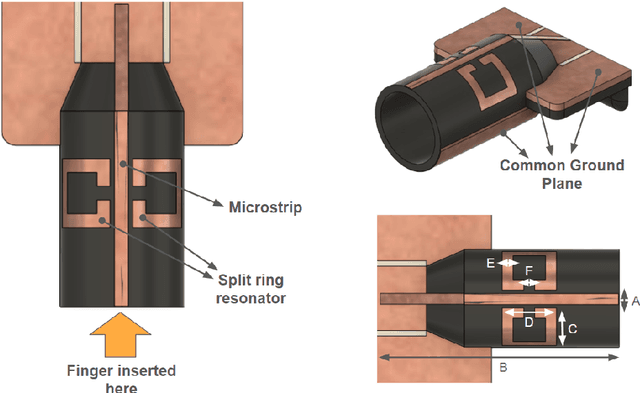
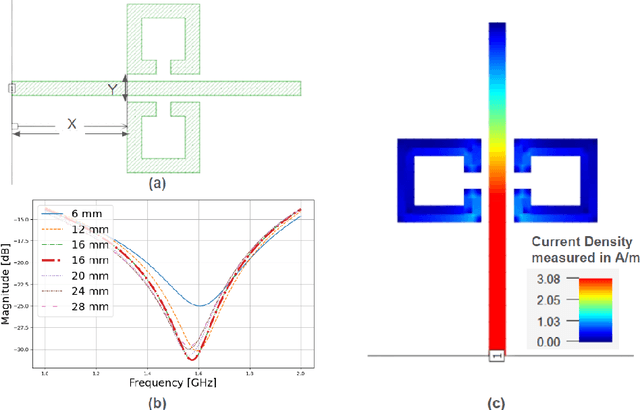
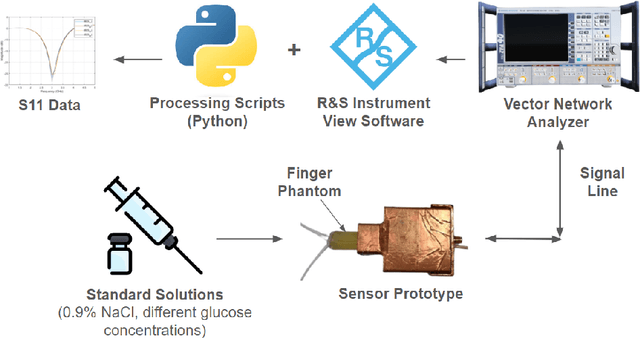
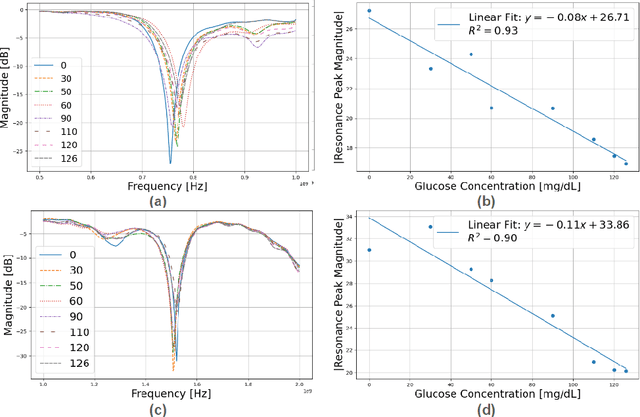
A high-Q sensor integrating microstrip line (MLIN) main field and split ring resonators is presented for non-invasive glucose sensing. The proposed sensor combines the field-focusing effects of split ring resonators with the enhanced field substrate interaction properties of the MLIN main field, using the reflection coefficient (S11) of an open-ended MLIN with the finger as the substrate and operating at 750 MHz and 1.5 GHz. The permittivity of blood inside the finger depends on the glucose concentration, which in turn affects the S11 of the system. Sensor geometry was optimized using Method-of-Moments simulation before the sensor was fabricated and validated on standard solutions of glucose concentrations between 0 to 126 mg/dL within the physiological range, and a human test subject. In both experiments, a near inverse-linear relationship between the S11 peak magnitude and the glucose concentration was observed, demonstrating the sensitivity of the proposed sensor for detecting changes in blood glucose concentration at physiological conditions.
Physics-Coupled Neural Network Magnetic Resonance Electrical Property Tomography (MREPT) for Conductivity Reconstruction
Sep 27, 2021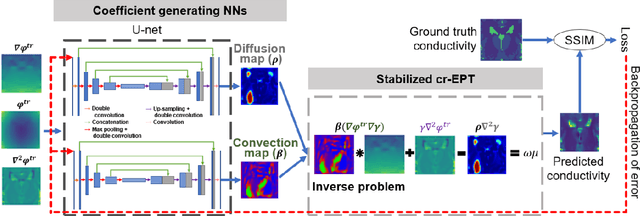
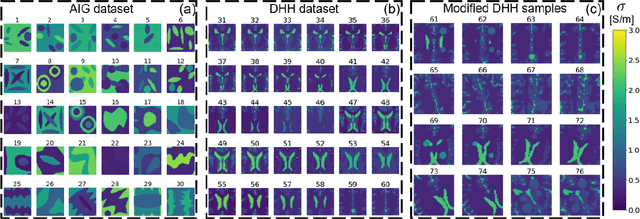
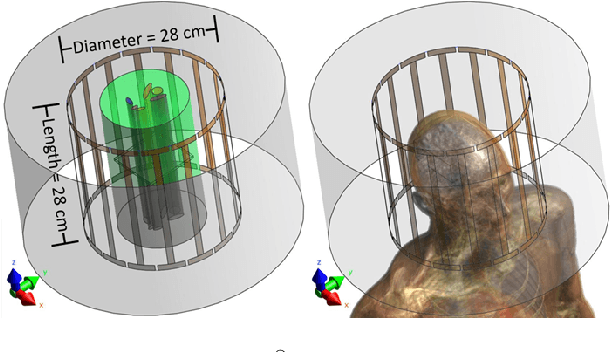
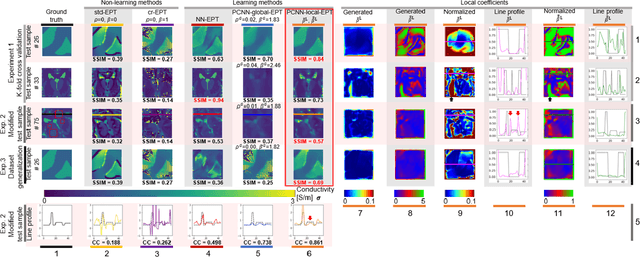
The electrical property (EP) of human tissues is a quantitative biomarker that facilitates early diagnosis of cancerous tissues. Magnetic resonance electrical properties tomography (MREPT) is an imaging modality that reconstructs EPs by the radio-frequency field in an MRI system. MREPT reconstructs EPs by solving analytic models numerically based on Maxwell's equations. Most MREPT methods suffer from artifacts caused by inaccuracy of the hypotheses behind the models, and/or numerical errors. These artifacts can be mitigated by adding coefficients to stabilize the models, however, the selection of such coefficient has been empirical, which limit its medical application. Alternatively, end-to-end Neural networks-based MREPT (NN-MREPT) learns to reconstruct the EPs from training samples, circumventing Maxwell's equations. However, due to its pattern-matching nature, it is difficult for NN-MREPT to produce accurate reconstructions for new samples. In this work, we proposed a physics-coupled NN for MREPT (PCNN-MREPT), in which an analytic model, cr-MREPT, works with diffusion and convection coefficients, learned by NNs from the difference between the reconstructed and ground-truth EPs to reduce artifacts. With two simulated datasets, three generalization experiments in which test samples deviate gradually from the training samples, and one noise-robustness experiment were conducted. The results show that the proposed PCNN-MREPT achieves higher accuracy than two representative analytic methods. Moreover, compared with an end-to-end NN-MREPT, the proposed method attained higher accuracy in two critical generalization tests. This is an important step to practical MREPT medical diagnoses.
Saliency Fusion in Eigenvector Space with Multi-Channel Pulse Coupled Neural Network
Mar 01, 2017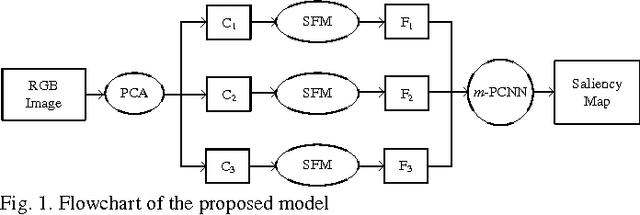
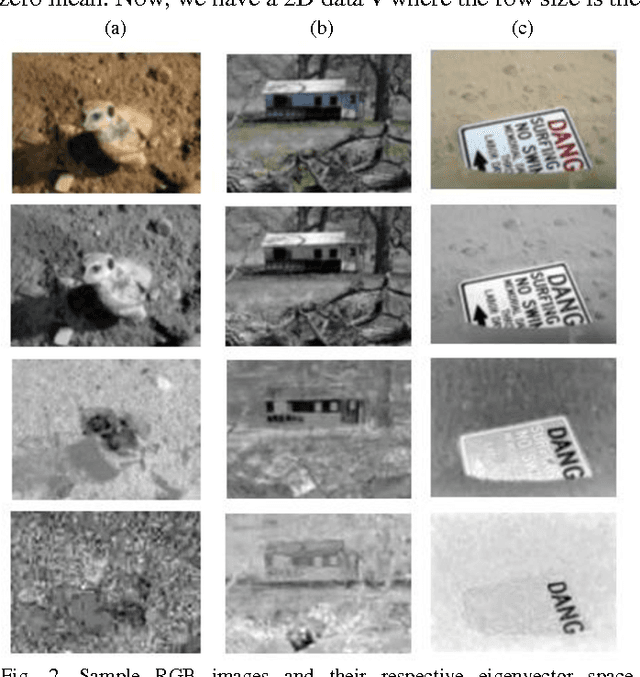
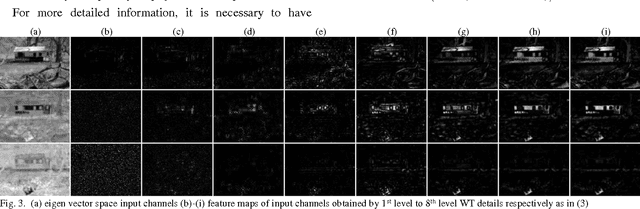
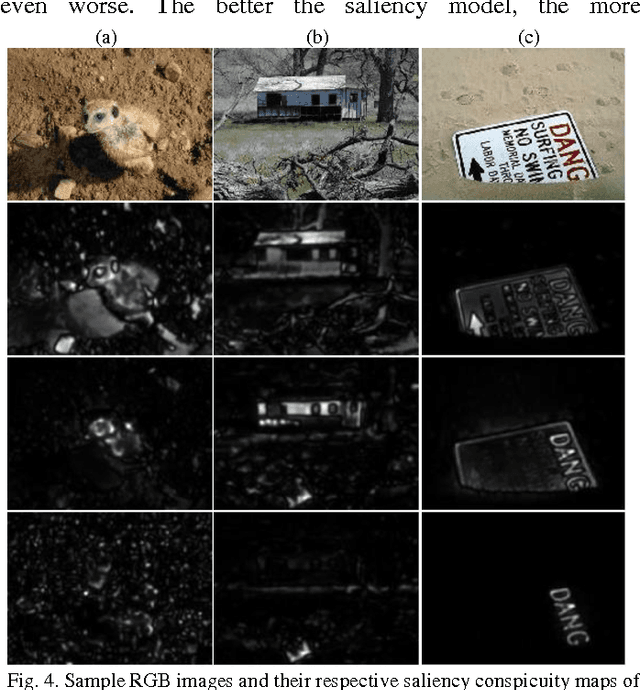
Saliency computation has become a popular research field for many applications due to the useful information provided by saliency maps. For a saliency map, local relations around the salient regions in multi-channel perspective should be taken into consideration by aiming uniformity on the region of interest as an internal approach. And, irrelevant salient regions have to be avoided as much as possible. Most of the works achieve these criteria with external processing modules; however, these can be accomplished during the conspicuity map fusion process. Therefore, in this paper, a new model is proposed for saliency/conspicuity map fusion with two concepts: a) input image transformation relying on the principal component analysis (PCA), and b) saliency conspicuity map fusion with multi-channel pulsed coupled neural network (m-PCNN). Experimental results, which are evaluated by precision, recall, F-measure, and area under curve (AUC), support the reliability of the proposed method by enhancing the saliency computation.
* 8 pages, 9 figures, 1 table. This submission includes detailed explanation of partial section (saliency detection) of the work "An Improved Saliency for RGB-D Visual Tracking and Control Strategies for a Bio-monitoring Mobile Robot", Evaluating AAL Systems Through Competitive Benchmarking, Communications in Computer and Information Science, vol. 386, pp.1-12, 2013