 Add to Chrome
 Add to Firefox
 Add to Edge
Benchmarking and Reasoning Distillation of Large Language Models for Feedback Controller Design in Complex Dynamical Systems
Aug 07, 2026
Although remarkable capabilities have been demonstrated by Large Language Models (LLMs) across scientific domains, feedback controller design remains underexplored. Existing benchmarks focus mainly on linear single-Degree-of-Freedom (DoF) systems and large API-hosted models, leaving performance on complex controller-design tasks and feasibility for edge deployment unclear. To address these limitations, we introduce the Complex Dynamics-to-Control Benchmark for Large Language Models (CoDyControlBench), comprising 132 system configurations across five evaluation dimensions: number of DoF, system type, coupling level, damping regime, and controller type. Six state-of-the-art LLMs were evaluated over three independent runs, including three commercial models (GPT, Gemini, and Claude) and three open-source models (GLM, DeepSeek, and Qwen). GPT achieved the highest design success rate at 94.8\%, whereas Qwen showed the lowest rate at 50.0\%. Across the benchmark dimensions, DoF and controller type exhibited the largest model-averaged variations in design success, with success-rate ranges of 36.3\% and 17.6\%, respectively, exceeding those associated with system type, coupling level, and damping regime. Comparison of GPT and Qwen showed that their performance gap arose mainly from the control-design knowledge, particularly gain selection and the use of transient-limiting mechanisms. For edge deployment, a specialized 1.5B-parameter model was developed through reasoning distillation. The reasoning-distilled model outperformed the answer-distilled and base model on CoDyControlBench, maintained stable performance across 1-6 DoFs, and achieved successful traget tracking in all three physical trials on a pneumatic-artificial-muscle-driven robotic arm. These results establish a benchmark baseline and highlight the potential of lightweight, edge-deployable controller-design models.

Retrieval is Cheap, Show Me the Code: Executable Multi-Hop Reasoning for Retrieval-Augmented Generation
May 13, 2026Retrieval-Augmented Generation (RAG) has become a standard approach for knowledge-intensive question answering, but existing systems remain brittle on multi-hop questions, where solving the task requires chaining multiple retrieval and reasoning steps. Key challenges are that current methods represent reasoning through free-form natural language, where intermediate states are implicit, retrieval queries can drift from intended entities, and errors are detected by the same model that produces them making self-reflection an unreliable, ungrounded signal. We observe that multi-hop question answering is a typical form of step-by-step computation, and that this structured process aligns closely with how code-specialized language models are trained to operate. Motivated by this, we introduce \pyrag, a framework that reformulates multi-hop RAG as program synthesis and execution. Instead of free-form reasoning trajectories, \pyrag represents the reasoning process as an executable Python program over retrieval and QA tools, exposing intermediate states as variables, producing deterministic feedback through execution, and yielding an inspectable trace of the entire reasoning process. This formulation further enables compiler-grounded self-repair and execution-driven adaptive retrieval without any additional training. Experiments on five QA benchmarks (PopQA, HotpotQA, 2WikiMultihopQA, MuSiQue, and Bamboogle) show that \pyrag consistently outperforms strong baselines under both training-free and RL-trained settings, with especially large gains on compositional multi-hop datasets. Our code, data and models are publicly available at https://github.com/GasolSun36/PyRAG.
TaSR-RAG: Taxonomy-guided Structured Reasoning for Retrieval-Augmented Generation
Mar 10, 2026Retrieval-Augmented Generation (RAG) helps large language models (LLMs) answer knowledge-intensive and time-sensitive questions by conditioning generation on external evidence. However, most RAG systems still retrieve unstructured chunks and rely on one-shot generation, which often yields redundant context, low information density, and brittle multi-hop reasoning. While structured RAG pipelines can improve grounding, they typically require costly and error-prone graph construction or impose rigid entity-centric structures that do not align with the query's reasoning chain. We propose \textsc{TaSR-RAG}, a taxonomy-guided structured reasoning framework for evidence selection. We represent both queries and documents as relational triples, and constrain entity semantics with a lightweight two-level taxonomy to balance generalization and precision. Given a complex question, \textsc{TaSR-RAG} decomposes it into an ordered sequence of triple sub-queries with explicit latent variables, then performs step-wise evidence selection via hybrid triple matching that combines semantic similarity over raw triples with structural consistency over typed triples. By maintaining an explicit entity binding table across steps, \textsc{TaSR-RAG} resolves intermediate variables and reduces entity conflation without explicit graph construction or exhaustive search. Experiments on multiple multi-hop question answering benchmarks show that \textsc{TaSR-RAG} consistently outperforms strong RAG and structured-RAG baselines by up to 14\%, while producing clearer evidence attribution and more faithful reasoning traces.
Spectrum and Orthogonality of Orthogonal Delay-Doppler Division Multiplexing Modulation Waveforms
Nov 19, 2025Orthogonal delay-Doppler (DD) division multiplexing (ODDM) modulation has recently emerged as a promising paradigm for ensuring reliable communications in doubly-selective channels. This work investigates the spectra and orthogonality characteristics of analog (direct) and approximate digital implementations of ODDM systems. We first determine the time and frequency domain representations of the basis functions for waveform in analog and approximate digital ODDM systems. Thereafter, we derive their power spectral densities and show that while the spectrum of analog ODDM waveforms exhibits a step-wise behavior in its transition regions, the spectrum of approximate digital ODDM waveforms is confined to that of the ODDM sub-pulse. Next, we prove the orthogonality characteristics of approximate digital ODDM waveforms and show that, unlike analog ODDM waveforms, the approximate digital ODDM waveforms satisfy orthogonality without the need of additional time domain resources. Additionally, we examine the similarities and differences that implementations of approximate digital ODDM share with the other variants of DD modulations, focusing on the domain changes the symbols undergo, the type of pulse shaping and windowing used, and the domains and the sequence in which they are performed. Finally, we present numerical results to validate our findings and draw further insights.
Channel Coding Toward 6G: Technical Overview and Outlook
May 13, 2024
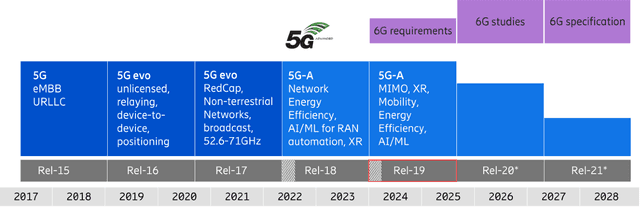
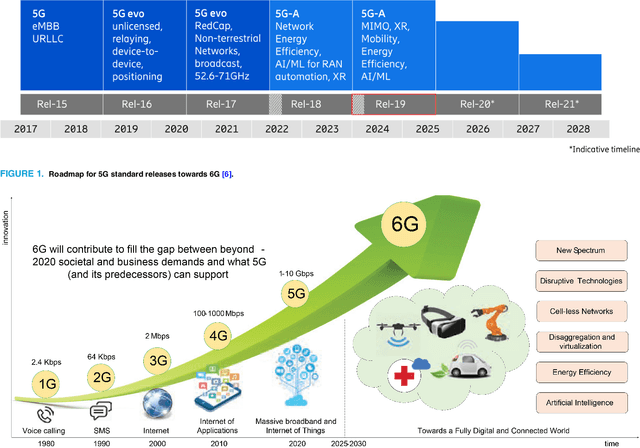
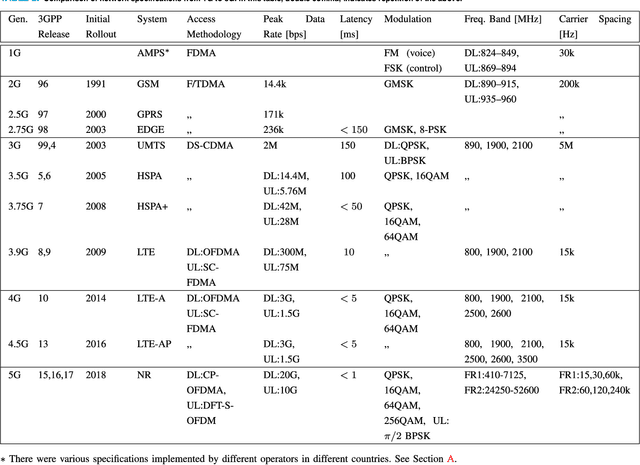
Channel coding plays a pivotal role in ensuring reliable communication over wireless channels. With the growing need for ultra-reliable communication in emerging wireless use cases, the significance of channel coding has amplified. Furthermore, minimizing decoding latency is crucial for critical-mission applications, while optimizing energy efficiency is paramount for mobile and the Internet of Things (IoT) communications. As the fifth generation (5G) of mobile communications is currently in operation and 5G-advanced is on the horizon, the objective of this paper is to assess prominent channel coding schemes in the context of recent advancements and the anticipated requirements for the sixth generation (6G). In this paper, after considering the potential impact of channel coding on key performance indicators (KPIs) of wireless networks, we review the evolution of mobile communication standards and the organizations involved in the standardization, from the first generation (1G) to the current 5G, highlighting the technologies integral to achieving targeted KPIs such as reliability, data rate, latency, energy efficiency, spectral efficiency, connection density, and traffic capacity. Following this, we delve into the anticipated requirements for potential use cases in 6G. The subsequent sections of the paper focus on a comprehensive review of three primary coding schemes utilized in past generations and their recent advancements: low-density parity-check (LDPC) codes, turbo codes (including convolutional codes), polar codes (alongside Reed-Muller codes). Additionally, we examine alternative coding schemes like Fountain codes and sparse regression codes. Our evaluation includes a comparative analysis of error correction performance and the performance of hardware implementation for these coding schemes, providing insights into their potential and suitability for the upcoming 6G era.
Low Complexity Turbo SIC-MMSE Detection for Orthogonal Time Frequency Space Modulation
Jan 19, 2024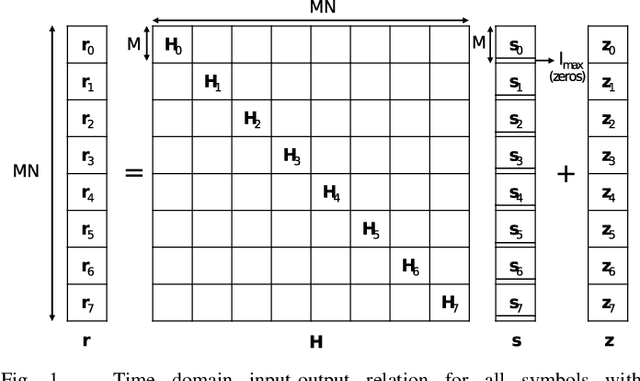
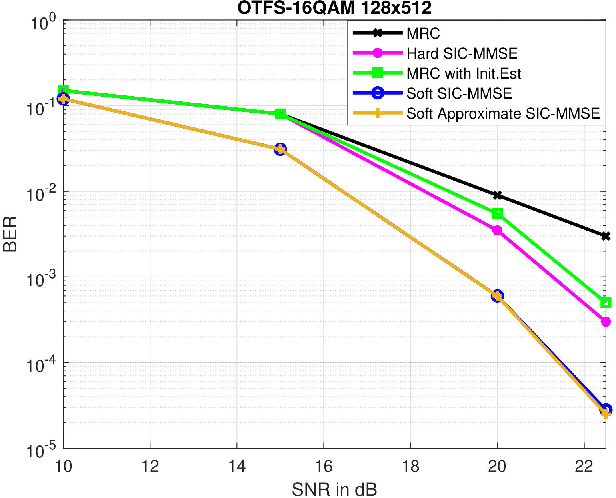
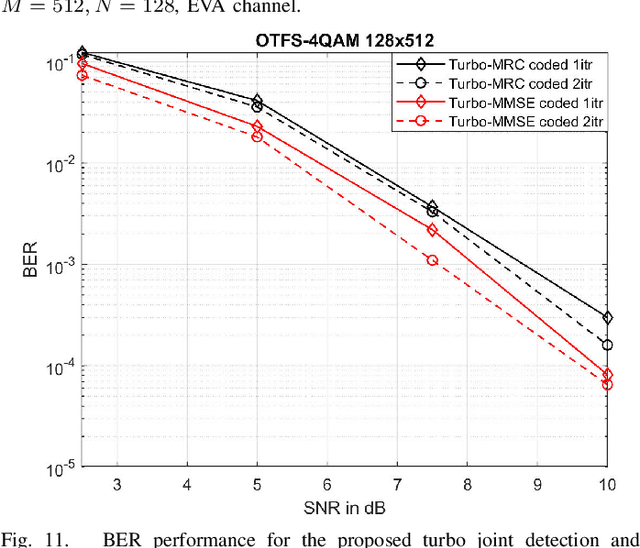
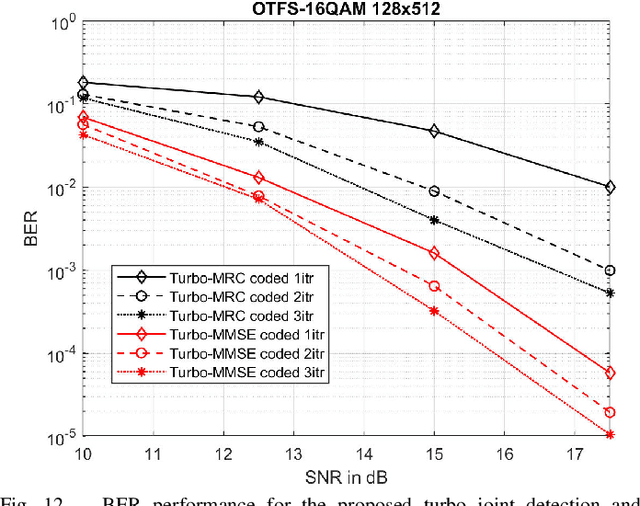
Recently, orthogonal time frequency space (OTFS) modulation has garnered considerable attention due to its robustness against doubly-selective wireless channels. In this paper, we propose a low-complexity iterative successive interference cancellation based minimum mean squared error (SIC-MMSE) detection algorithm for zero-padded OTFS (ZP-OTFS) modulation. In the proposed algorithm, signals are detected based on layers processed by multiple SIC-MMSE linear filters for each sub-channel, with interference on the targeted signal layer being successively canceled either by hard or soft information. To reduce the complexity of computing individual layer filter coefficients, we also propose a novel filter coefficients recycling approach in place of generating the exact form of MMSE filter weights. Moreover, we design a joint detection and decoding algorithm for ZP-OTFS to enhance error performance. Compared to the conventional SIC-MMSE detection, our proposed algorithms outperform other linear detectors, e.g., maximal ratio combining (MRC), for ZP-OTFS with up to 3 dB gain while maintaining comparable computation complexity.