 Add to Chrome
 Add to Firefox
 Add to Edge
VividPose: Advancing Stable Video Diffusion for Realistic Human Image Animation
May 28, 2024
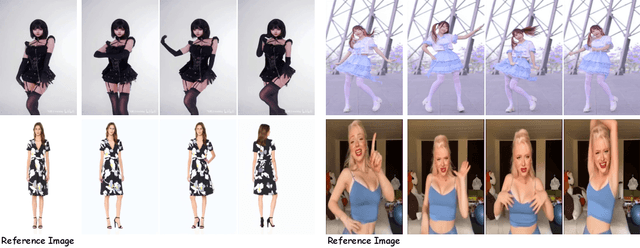
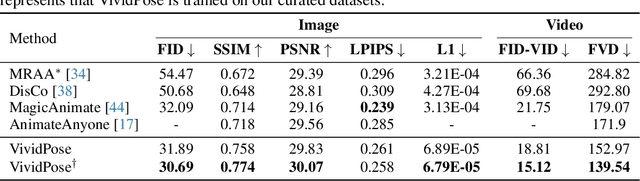
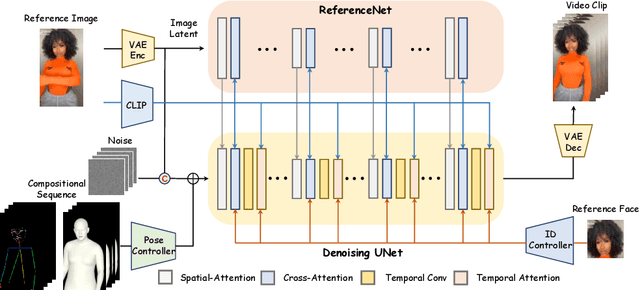

Human image animation involves generating a video from a static image by following a specified pose sequence. Current approaches typically adopt a multi-stage pipeline that separately learns appearance and motion, which often leads to appearance degradation and temporal inconsistencies. To address these issues, we propose VividPose, an innovative end-to-end pipeline based on Stable Video Diffusion (SVD) that ensures superior temporal stability. To enhance the retention of human identity, we propose an identity-aware appearance controller that integrates additional facial information without compromising other appearance details such as clothing texture and background. This approach ensures that the generated videos maintain high fidelity to the identity of human subject, preserving key facial features across various poses. To accommodate diverse human body shapes and hand movements, we introduce a geometry-aware pose controller that utilizes both dense rendering maps from SMPL-X and sparse skeleton maps. This enables accurate alignment of pose and shape in the generated videos, providing a robust framework capable of handling a wide range of body shapes and dynamic hand movements. Extensive qualitative and quantitative experiments on the UBCFashion and TikTok benchmarks demonstrate that our method achieves state-of-the-art performance. Furthermore, VividPose exhibits superior generalization capabilities on our proposed in-the-wild dataset. Codes and models will be available.

Image-Text-Image Knowledge Transferring for Lifelong Person Re-Identification with Hybrid Clothing States
May 26, 2024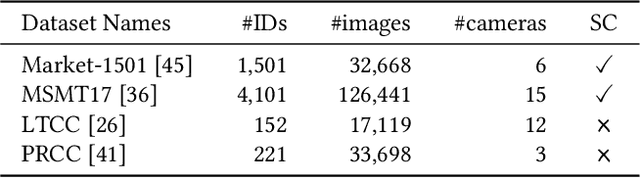
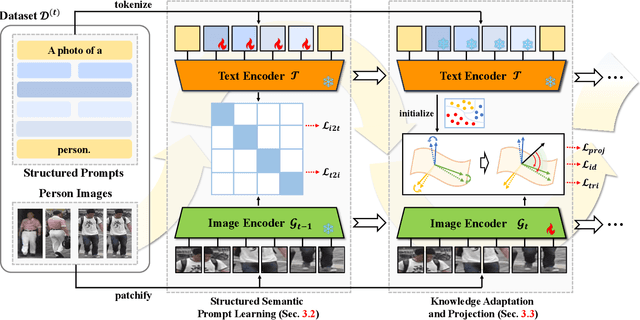
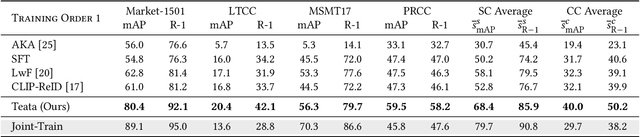
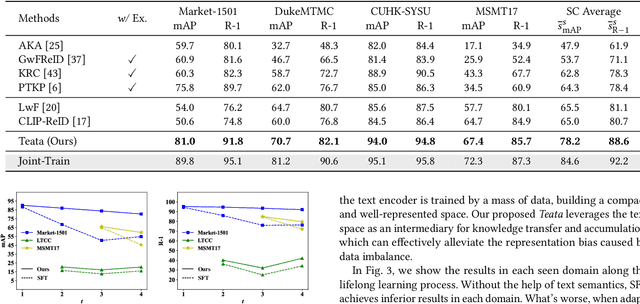
With the continuous expansion of intelligent surveillance networks, lifelong person re-identification (LReID) has received widespread attention, pursuing the need of self-evolution across different domains. However, existing LReID studies accumulate knowledge with the assumption that people would not change their clothes. In this paper, we propose a more practical task, namely lifelong person re-identification with hybrid clothing states (LReID-Hybrid), which takes a series of cloth-changing and cloth-consistent domains into account during lifelong learning. To tackle the challenges of knowledge granularity mismatch and knowledge presentation mismatch that occurred in LReID-Hybrid, we take advantage of the consistency and generalization of the text space, and propose a novel framework, dubbed $Teata$, to effectively align, transfer and accumulate knowledge in an "image-text-image" closed loop. Concretely, to achieve effective knowledge transfer, we design a Structured Semantic Prompt (SSP) learning to decompose the text prompt into several structured pairs to distill knowledge from the image space with a unified granularity of text description. Then, we introduce a Knowledge Adaptation and Projection strategy (KAP), which tunes text knowledge via a slow-paced learner to adapt to different tasks without catastrophic forgetting. Extensive experiments demonstrate the superiority of our proposed $Teata$ for LReID-Hybrid as well as on conventional LReID benchmarks over advanced methods.
Content and Salient Semantics Collaboration for Cloth-Changing Person Re-Identification
May 26, 2024
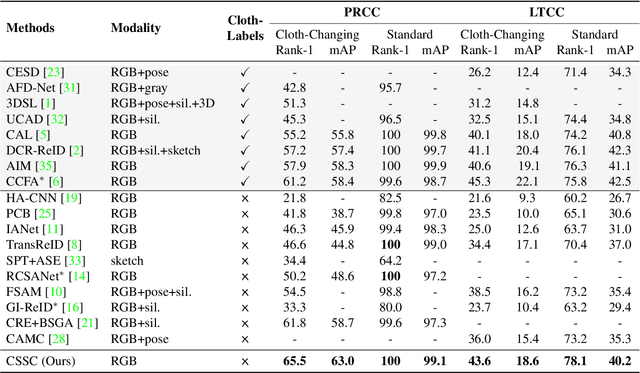

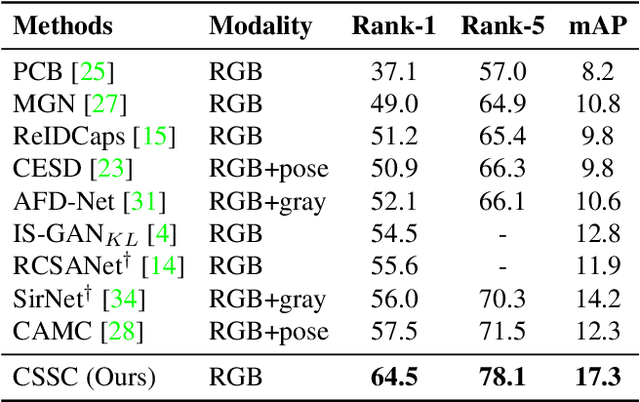
Cloth-changing person Re-IDentification (Re-ID) aims at recognizing the same person with clothing changes across non-overlapping cameras. Conventional person Re-ID methods usually bias the model's focus on cloth-related appearance features rather than identity-sensitive features associated with biological traits. Recently, advanced cloth-changing person Re-ID methods either resort to identity-related auxiliary modalities (e.g., sketches, silhouettes, keypoints and 3D shapes) or clothing labels to mitigate the impact of clothes. However, relying on unpractical and inflexible auxiliary modalities or annotations limits their real-world applicability. In this paper, we promote cloth-changing person Re-ID by effectively leveraging abundant semantics present within pedestrian images without the need for any auxiliaries. Specifically, we propose the Content and Salient Semantics Collaboration (CSSC) framework, facilitating cross-parallel semantics interaction and refinement. Our framework is simple yet effective, and the vital design is the Semantics Mining and Refinement (SMR) module. It extracts robust identity features about content and salient semantics, while mitigating interference from clothing appearances effectively. By capitalizing on the mined abundant semantic features, our proposed approach achieves state-of-the-art performance on three cloth-changing benchmarks as well as conventional benchmarks, demonstrating its superiority over advanced competitors.
Towards Global Optimal Visual In-Context Learning Prompt Selection
May 24, 2024Visual In-Context Learning (VICL) is a prevailing way to transfer visual foundation models to new tasks by leveraging contextual information contained in in-context examples to enhance learning and prediction of query sample. The fundamental problem in VICL is how to select the best prompt to activate its power as much as possible, which is equivalent to the ranking problem to test the in-context behavior of each candidate in the alternative set and select the best one. To utilize more appropriate ranking metric and leverage more comprehensive information among the alternative set, we propose a novel in-context example selection framework to approximately identify the global optimal prompt, i.e. choosing the best performing in-context examples from all alternatives for each query sample. Our method, dubbed Partial2Global, adopts a transformer-based list-wise ranker to provide a more comprehensive comparison within several alternatives, and a consistency-aware ranking aggregator to generate globally consistent ranking. The effectiveness of Partial2Global is validated through experiments on foreground segmentation, single object detection and image colorization, demonstrating that Partial2Global selects consistently better in-context examples compared with other methods, and thus establish the new state-of-the-arts.
On the Theory of Cross-Modality Distillation with Contrastive Learning
May 06, 2024Cross-modality distillation arises as an important topic for data modalities containing limited knowledge such as depth maps and high-quality sketches. Such techniques are of great importance, especially for memory and privacy-restricted scenarios where labeled training data is generally unavailable. To solve the problem, existing label-free methods leverage a few pairwise unlabeled data to distill the knowledge by aligning features or statistics between the source and target modalities. For instance, one typically aims to minimize the L2 distance or contrastive loss between the learned features of pairs of samples in the source (e.g. image) and the target (e.g. sketch) modalities. However, most algorithms in this domain only focus on the experimental results but lack theoretical insight. To bridge the gap between the theory and practical method of cross-modality distillation, we first formulate a general framework of cross-modality contrastive distillation (CMCD), built upon contrastive learning that leverages both positive and negative correspondence, towards a better distillation of generalizable features. Furthermore, we establish a thorough convergence analysis that reveals that the distance between source and target modalities significantly impacts the test error on downstream tasks within the target modality which is also validated by the empirical results. Extensive experimental results show that our algorithm outperforms existing algorithms consistently by a margin of 2-3\% across diverse modalities and tasks, covering modalities of image, sketch, depth map, and audio and tasks of recognition and segmentation.
MemFlow: Optical Flow Estimation and Prediction with Memory
Apr 07, 2024

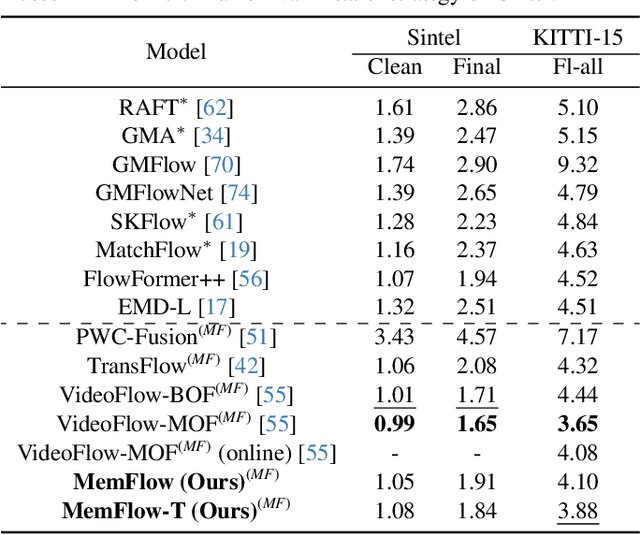

Optical flow is a classical task that is important to the vision community. Classical optical flow estimation uses two frames as input, whilst some recent methods consider multiple frames to explicitly model long-range information. The former ones limit their ability to fully leverage temporal coherence along the video sequence; and the latter ones incur heavy computational overhead, typically not possible for real-time flow estimation. Some multi-frame-based approaches even necessitate unseen future frames for current estimation, compromising real-time applicability in safety-critical scenarios. To this end, we present MemFlow, a real-time method for optical flow estimation and prediction with memory. Our method enables memory read-out and update modules for aggregating historical motion information in real-time. Furthermore, we integrate resolution-adaptive re-scaling to accommodate diverse video resolutions. Besides, our approach seamlessly extends to the future prediction of optical flow based on past observations. Leveraging effective historical motion aggregation, our method outperforms VideoFlow with fewer parameters and faster inference speed on Sintel and KITTI-15 datasets in terms of generalization performance. At the time of submission, MemFlow also leads in performance on the 1080p Spring dataset. Codes and models will be available at: https://dqiaole.github.io/MemFlow/.
NeuroPictor: Refining fMRI-to-Image Reconstruction via Multi-individual Pretraining and Multi-level Modulation
Mar 27, 2024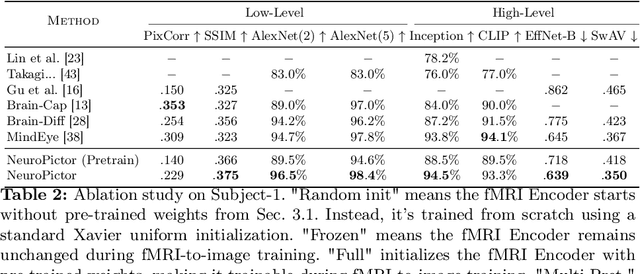
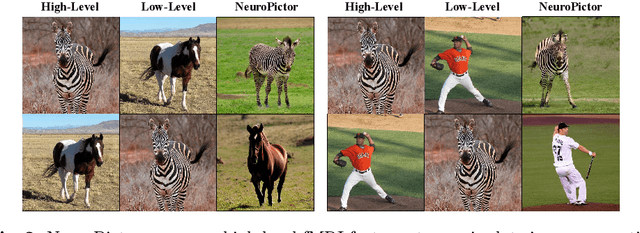
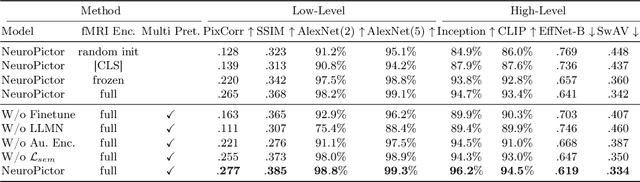
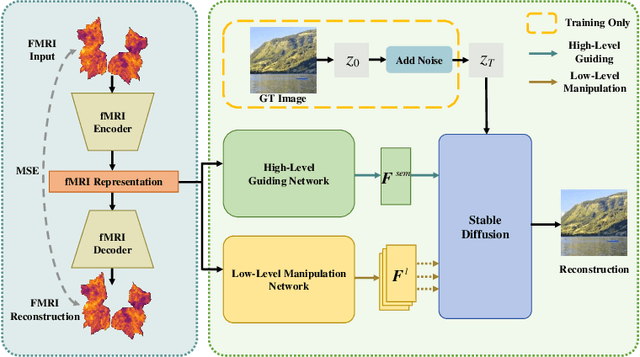
Recent fMRI-to-image approaches mainly focused on associating fMRI signals with specific conditions of pre-trained diffusion models. These approaches, while producing high-quality images, capture only a limited aspect of the complex information in fMRI signals and offer little detailed control over image creation. In contrast, this paper proposes to directly modulate the generation process of diffusion models using fMRI signals. Our approach, NeuroPictor, divides the fMRI-to-image process into three steps: i) fMRI calibrated-encoding, to tackle multi-individual pre-training for a shared latent space to minimize individual difference and enable the subsequent cross-subject training; ii) fMRI-to-image cross-subject pre-training, perceptually learning to guide diffusion model with high- and low-level conditions across different individuals; iii) fMRI-to-image single-subject refining, similar with step ii but focus on adapting to particular individual. NeuroPictor extracts high-level semantic features from fMRI signals that characterizing the visual stimulus and incrementally fine-tunes the diffusion model with a low-level manipulation network to provide precise structural instructions. By training with over 60,000 fMRI-image pairs from various individuals, our model enjoys superior fMRI-to-image decoding capacity, particularly in the within-subject setting, as evidenced in benchmark datasets. Project page: https://jingyanghuo.github.io/neuropictor/.
DiffFAE: Advancing High-fidelity One-shot Facial Appearance Editing with Space-sensitive Customization and Semantic Preservation
Mar 26, 2024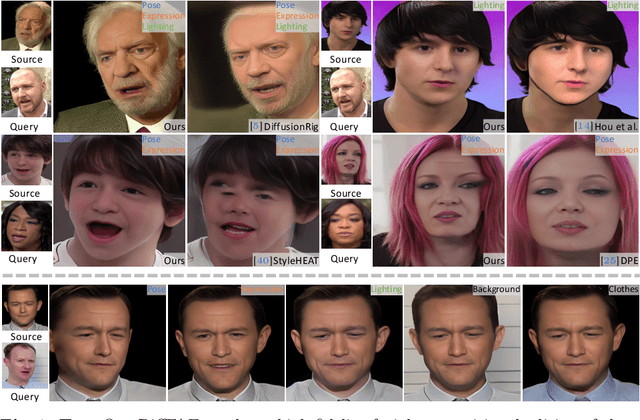
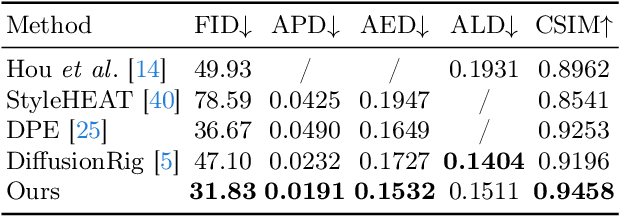
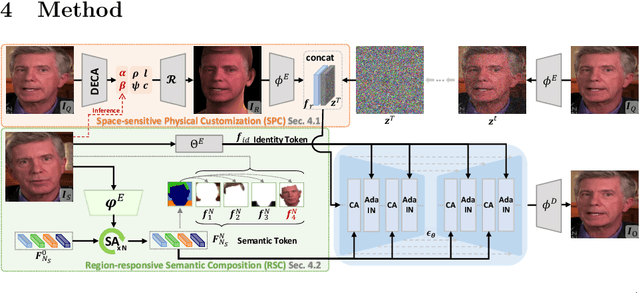
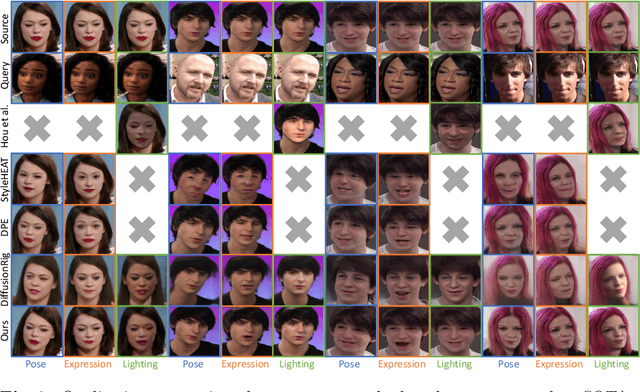
Facial Appearance Editing (FAE) aims to modify physical attributes, such as pose, expression and lighting, of human facial images while preserving attributes like identity and background, showing great importance in photograph. In spite of the great progress in this area, current researches generally meet three challenges: low generation fidelity, poor attribute preservation, and inefficient inference. To overcome above challenges, this paper presents DiffFAE, a one-stage and highly-efficient diffusion-based framework tailored for high-fidelity FAE. For high-fidelity query attributes transfer, we adopt Space-sensitive Physical Customization (SPC), which ensures the fidelity and generalization ability by utilizing rendering texture derived from 3D Morphable Model (3DMM). In order to preserve source attributes, we introduce the Region-responsive Semantic Composition (RSC). This module is guided to learn decoupled source-regarding features, thereby better preserving the identity and alleviating artifacts from non-facial attributes such as hair, clothes, and background. We further introduce a consistency regularization for our pipeline to enhance editing controllability by leveraging prior knowledge in the attention matrices of diffusion model. Extensive experiments demonstrate the superiority of DiffFAE over existing methods, achieving state-of-the-art performance in facial appearance editing.
T-Pixel2Mesh: Combining Global and Local Transformer for 3D Mesh Generation from a Single Image
Mar 20, 2024


Pixel2Mesh (P2M) is a classical approach for reconstructing 3D shapes from a single color image through coarse-to-fine mesh deformation. Although P2M is capable of generating plausible global shapes, its Graph Convolution Network (GCN) often produces overly smooth results, causing the loss of fine-grained geometry details. Moreover, P2M generates non-credible features for occluded regions and struggles with the domain gap from synthetic data to real-world images, which is a common challenge for single-view 3D reconstruction methods. To address these challenges, we propose a novel Transformer-boosted architecture, named T-Pixel2Mesh, inspired by the coarse-to-fine approach of P2M. Specifically, we use a global Transformer to control the holistic shape and a local Transformer to progressively refine the local geometry details with graph-based point upsampling. To enhance real-world reconstruction, we present the simple yet effective Linear Scale Search (LSS), which serves as prompt tuning during the input preprocessing. Our experiments on ShapeNet demonstrate state-of-the-art performance, while results on real-world data show the generalization capability.
Intelligent Director: An Automatic Framework for Dynamic Visual Composition using ChatGPT
Feb 24, 2024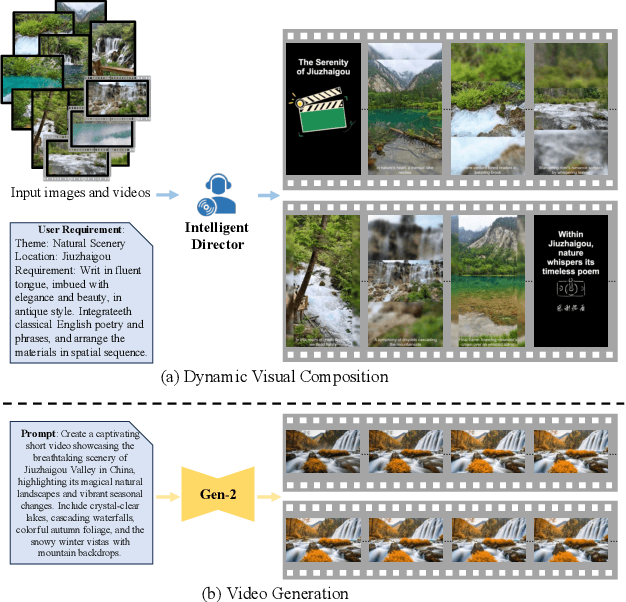

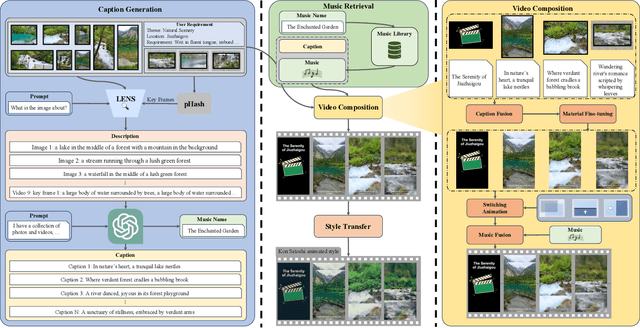
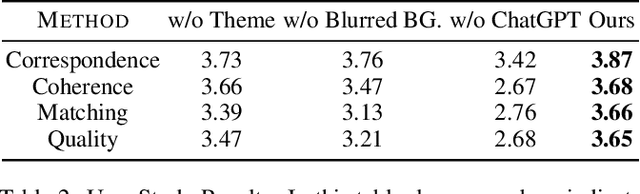
With the rise of short video platforms represented by TikTok, the trend of users expressing their creativity through photos and videos has increased dramatically. However, ordinary users lack the professional skills to produce high-quality videos using professional creation software. To meet the demand for intelligent and user-friendly video creation tools, we propose the Dynamic Visual Composition (DVC) task, an interesting and challenging task that aims to automatically integrate various media elements based on user requirements and create storytelling videos. We propose an Intelligent Director framework, utilizing LENS to generate descriptions for images and video frames and combining ChatGPT to generate coherent captions while recommending appropriate music names. Then, the best-matched music is obtained through music retrieval. Then, materials such as captions, images, videos, and music are integrated to seamlessly synthesize the video. Finally, we apply AnimeGANv2 for style transfer. We construct UCF101-DVC and Personal Album datasets and verified the effectiveness of our framework in solving DVC through qualitative and quantitative comparisons, along with user studies, demonstrating its substantial potential.