 Add to Chrome
 Add to Firefox
 Add to Edge
GhostShell: Streaming LLM Function Calls for Concurrent Embodied Programming
Aug 07, 2025
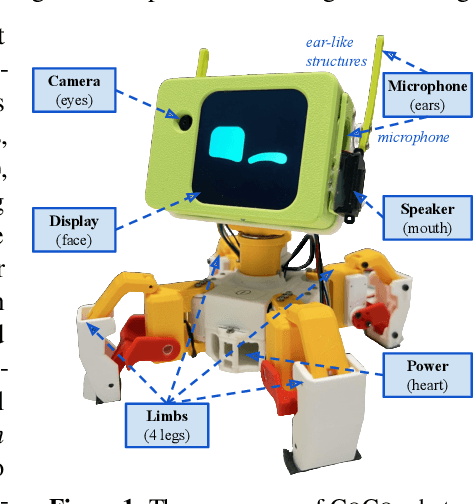
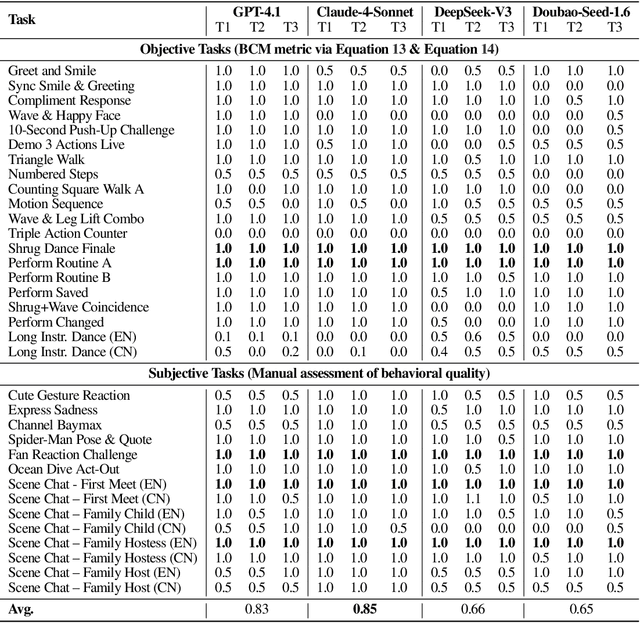
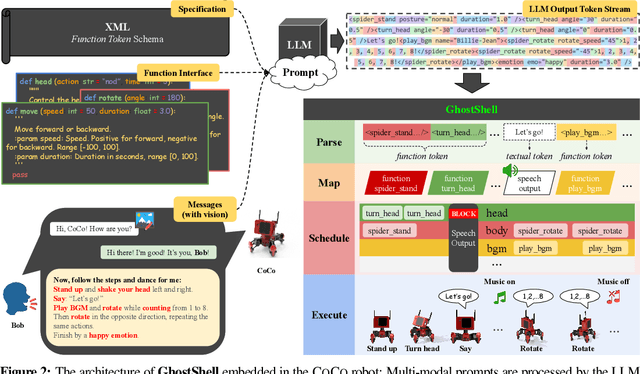
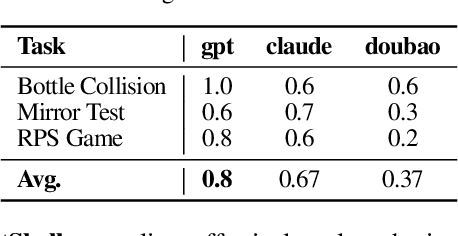
We present GhostShell, a novel approach that leverages Large Language Models (LLMs) to enable streaming and concurrent behavioral programming for embodied systems. In contrast to conventional methods that rely on pre-scheduled action sequences or behavior trees, GhostShell drives embodied systems to act on-the-fly by issuing function calls incrementally as tokens are streamed from the LLM. GhostShell features a streaming XML function token parser, a dynamic function interface mapper, and a multi-channel scheduler that orchestrates intra-channel synchronous and inter-channel asynchronous function calls, thereby coordinating serial-parallel embodied actions across multiple robotic components as directed by the LLM. We evaluate GhostShell on our robot prototype COCO through comprehensive grounded experiments across 34 real-world interaction tasks and multiple LLMs. The results demonstrate that our approach achieves state-of-the-art Behavioral Correctness Metric of 0.85 with Claude-4 Sonnet and up to 66X faster response times compared to LLM native function calling APIs. GhostShell also proves effective in long-horizon multimodal tasks, demonstrating strong robustness and generalization.

Demystify Protein Generation with Hierarchical Conditional Diffusion Models
Jul 24, 2025Generating novel and functional protein sequences is critical to a wide range of applications in biology. Recent advancements in conditional diffusion models have shown impressive empirical performance in protein generation tasks. However, reliable generations of protein remain an open research question in de novo protein design, especially when it comes to conditional diffusion models. Considering the biological function of a protein is determined by multi-level structures, we propose a novel multi-level conditional diffusion model that integrates both sequence-based and structure-based information for efficient end-to-end protein design guided by specified functions. By generating representations at different levels simultaneously, our framework can effectively model the inherent hierarchical relations between different levels, resulting in an informative and discriminative representation of the generated protein. We also propose a Protein-MMD, a new reliable evaluation metric, to evaluate the quality of generated protein with conditional diffusion models. Our new metric is able to capture both distributional and functional similarities between real and generated protein sequences while ensuring conditional consistency. We experiment with the benchmark datasets, and the results on conditional protein generation tasks demonstrate the efficacy of the proposed generation framework and evaluation metric.
StreamME: Simplify 3D Gaussian Avatar within Live Stream
Jul 22, 2025We propose StreamME, a method focuses on fast 3D avatar reconstruction. The StreamME synchronously records and reconstructs a head avatar from live video streams without any pre-cached data, enabling seamless integration of the reconstructed appearance into downstream applications. This exceptionally fast training strategy, which we refer to as on-the-fly training, is central to our approach. Our method is built upon 3D Gaussian Splatting (3DGS), eliminating the reliance on MLPs in deformable 3DGS and relying solely on geometry, which significantly improves the adaptation speed to facial expression. To further ensure high efficiency in on-the-fly training, we introduced a simplification strategy based on primary points, which distributes the point clouds more sparsely across the facial surface, optimizing points number while maintaining rendering quality. Leveraging the on-the-fly training capabilities, our method protects the facial privacy and reduces communication bandwidth in VR system or online conference. Additionally, it can be directly applied to downstream application such as animation, toonify, and relighting. Please refer to our project page for more details: https://songluchuan.github.io/StreamME/.
$π^3$: Scalable Permutation-Equivariant Visual Geometry Learning
Jul 17, 2025We introduce $\pi^3$, a feed-forward neural network that offers a novel approach to visual geometry reconstruction, breaking the reliance on a conventional fixed reference view. Previous methods often anchor their reconstructions to a designated viewpoint, an inductive bias that can lead to instability and failures if the reference is suboptimal. In contrast, $\pi^3$ employs a fully permutation-equivariant architecture to predict affine-invariant camera poses and scale-invariant local point maps without any reference frames. This design makes our model inherently robust to input ordering and highly scalable. These advantages enable our simple and bias-free approach to achieve state-of-the-art performance on a wide range of tasks, including camera pose estimation, monocular/video depth estimation, and dense point map reconstruction. Code and models are publicly available.
UVLM: Benchmarking Video Language Model for Underwater World Understanding
Jul 03, 2025Recently, the remarkable success of large language models (LLMs) has achieved a profound impact on the field of artificial intelligence. Numerous advanced works based on LLMs have been proposed and applied in various scenarios. Among them, video language models (VidLMs) are particularly widely used. However, existing works primarily focus on terrestrial scenarios, overlooking the highly demanding application needs of underwater observation. To overcome this gap, we introduce UVLM, an under water observation benchmark which is build through a collaborative approach combining human expertise and AI models. To ensure data quality, we have conducted in-depth considerations from multiple perspectives. First, to address the unique challenges of underwater environments, we selected videos that represent typical underwater challenges including light variations, water turbidity, and diverse viewing angles to construct the dataset. Second, to ensure data diversity, the dataset covers a wide range of frame rates, resolutions, 419 classes of marine animals, and various static plants and terrains. Next, for task diversity, we adopted a structured design where observation targets are categorized into two major classes: biological and environmental. Each category includes content observation and change/action observation, totaling 20 distinct task types. Finally, we designed several challenging evaluation metrics to enable quantitative comparison and analysis of different methods. Experiments on two representative VidLMs demonstrate that fine-tuning VidLMs on UVLM significantly improves underwater world understanding while also showing potential for slight improvements on existing in-air VidLM benchmarks, such as VideoMME and Perception text. The dataset and prompt engineering will be released publicly.
Kwai Keye-VL Technical Report
Jul 02, 2025While Multimodal Large Language Models (MLLMs) demonstrate remarkable capabilities on static images, they often fall short in comprehending dynamic, information-dense short-form videos, a dominant medium in today's digital landscape. To bridge this gap, we introduce \textbf{Kwai Keye-VL}, an 8-billion-parameter multimodal foundation model engineered for leading-edge performance in short-video understanding while maintaining robust general-purpose vision-language abilities. The development of Keye-VL rests on two core pillars: a massive, high-quality dataset exceeding 600 billion tokens with a strong emphasis on video, and an innovative training recipe. This recipe features a four-stage pre-training process for solid vision-language alignment, followed by a meticulous two-phase post-training process. The first post-training stage enhances foundational capabilities like instruction following, while the second phase focuses on stimulating advanced reasoning. In this second phase, a key innovation is our five-mode ``cold-start'' data mixture, which includes ``thinking'', ``non-thinking'', ``auto-think'', ``think with image'', and high-quality video data. This mixture teaches the model to decide when and how to reason. Subsequent reinforcement learning (RL) and alignment steps further enhance these reasoning capabilities and correct abnormal model behaviors, such as repetitive outputs. To validate our approach, we conduct extensive evaluations, showing that Keye-VL achieves state-of-the-art results on public video benchmarks and remains highly competitive on general image-based tasks (Figure 1). Furthermore, we develop and release the \textbf{KC-MMBench}, a new benchmark tailored for real-world short-video scenarios, where Keye-VL shows a significant advantage.
AirV2X: Unified Air-Ground Vehicle-to-Everything Collaboration
Jun 24, 2025While multi-vehicular collaborative driving demonstrates clear advantages over single-vehicle autonomy, traditional infrastructure-based V2X systems remain constrained by substantial deployment costs and the creation of "uncovered danger zones" in rural and suburban areas. We present AirV2X-Perception, a large-scale dataset that leverages Unmanned Aerial Vehicles (UAVs) as a flexible alternative or complement to fixed Road-Side Units (RSUs). Drones offer unique advantages over ground-based perception: complementary bird's-eye-views that reduce occlusions, dynamic positioning capabilities that enable hovering, patrolling, and escorting navigation rules, and significantly lower deployment costs compared to fixed infrastructure. Our dataset comprises 6.73 hours of drone-assisted driving scenarios across urban, suburban, and rural environments with varied weather and lighting conditions. The AirV2X-Perception dataset facilitates the development and standardized evaluation of Vehicle-to-Drone (V2D) algorithms, addressing a critical gap in the rapidly expanding field of aerial-assisted autonomous driving systems. The dataset and development kits are open-sourced at https://github.com/taco-group/AirV2X-Perception.
A Batch-Insensitive Dynamic GNN Approach to Address Temporal Discontinuity in Graph Streams
Jun 24, 2025In dynamic graphs, preserving temporal continuity is critical. However, Memory-based Dynamic Graph Neural Networks (MDGNNs) trained with large batches often disrupt event sequences, leading to temporal information loss. This discontinuity not only deteriorates temporal modeling but also hinders optimization by increasing the difficulty of parameter convergence. Our theoretical study quantifies this through a Lipschitz upper bound, showing that large batch sizes enlarge the parameter search space. In response, we propose BADGNN, a novel batch-agnostic framework consisting of two core components: (1) Temporal Lipschitz Regularization (TLR) to control parameter search space expansion, and (2) Adaptive Attention Adjustment (A3) to alleviate attention distortion induced by both regularization and batching. Empirical results on three benchmark datasets show that BADGNN maintains strong performance while enabling significantly larger batch sizes and faster training compared to TGN. Our code is available at Code: https://anonymous.4open.science/r/TGN_Lipichitz-C033/.
Robust OOD Graph Learning via Mean Constraints and Noise Reduction
Jun 24, 2025Graph Out-of-Distribution (OOD) classification often suffers from sharp performance drops, particularly under category imbalance and structural noise. This work tackles two pressing challenges in this context: (1) the underperformance of minority classes due to skewed label distributions, and (2) their heightened sensitivity to structural noise in graph data. To address these problems, we propose two complementary solutions. First, Constrained Mean Optimization (CMO) improves minority class robustness by encouraging similarity-based instance aggregation under worst-case conditions. Second, the Neighbor-Aware Noise Reweighting (NNR) mechanism assigns dynamic weights to training samples based on local structural consistency, mitigating noise influence. We provide theoretical justification for our methods, and validate their effectiveness with extensive experiments on both synthetic and real-world datasets, showing significant improvements in Graph OOD generalization and classification accuracy. The code for our method is available at: https://anonymous.4open.science/r/CMO-NNR-2F30.
CXR-LT 2024: A MICCAI challenge on long-tailed, multi-label, and zero-shot disease classification from chest X-ray
Jun 09, 2025The CXR-LT series is a community-driven initiative designed to enhance lung disease classification using chest X-rays (CXR). It tackles challenges in open long-tailed lung disease classification and enhances the measurability of state-of-the-art techniques. The first event, CXR-LT 2023, aimed to achieve these goals by providing high-quality benchmark CXR data for model development and conducting comprehensive evaluations to identify ongoing issues impacting lung disease classification performance. Building on the success of CXR-LT 2023, the CXR-LT 2024 expands the dataset to 377,110 chest X-rays (CXRs) and 45 disease labels, including 19 new rare disease findings. It also introduces a new focus on zero-shot learning to address limitations identified in the previous event. Specifically, CXR-LT 2024 features three tasks: (i) long-tailed classification on a large, noisy test set, (ii) long-tailed classification on a manually annotated "gold standard" subset, and (iii) zero-shot generalization to five previously unseen disease findings. This paper provides an overview of CXR-LT 2024, detailing the data curation process and consolidating state-of-the-art solutions, including the use of multimodal models for rare disease detection, advanced generative approaches to handle noisy labels, and zero-shot learning strategies for unseen diseases. Additionally, the expanded dataset enhances disease coverage to better represent real-world clinical settings, offering a valuable resource for future research. By synthesizing the insights and innovations of participating teams, we aim to advance the development of clinically realistic and generalizable diagnostic models for chest radiography.