 Add to Chrome
 Add to Firefox
 Add to Edge
Minimum Time Dubins Airplane Paths with Asymmetric Climb Rates
Jul 17, 2026
Dubins airplane paths approximate the limited maneuverability of fixed-wing vehicles with minimum curvature and climb rate constraints. However, the symmetric climb rate constraints result in sub-optimal paths and conservative vehicle performance. In this work, we propose asymmetric Dubins airplane paths, which consider asymmetric climb rates for climbing and descending. We revisit the time optimality conditions and show that the asymmetric flight path angle constraints preserve optimality. We show that by considering asymmetric climb rates, we can take advantage of full performance of the vehicle, reducing the minimum time by 71% for connecting randomly generated states. We also demonstrate that the added climb rate results in 2.8 times faster to find the median solution time when integrated into a sampling-based planning task on rugged terrain, due to the added feasibility. We further demonstrate the practicality of the approach with a real-world flight.

SkyJEPA: Learning Long-Horizon World Models for Zero-Shot Sim-to-Real Control of Quadrotors
Jun 23, 2026Accurate dynamics models are critical for informed decision-making in robotic systems, particularly for agile aerial vehicles operating under uncertainty. Neural network dynamics models are attractive for capturing complex nonlinear effects, but existing predictive approaches struggle with long-horizon forecasting because their autoregressive rollout mechanism amplifies errors over time. Joint Embedding Predictive Architectures (JEPAs) offer a compelling alternative by modeling dynamics in latent space, yet prior JEPA-style methods for robot navigation have been studied primarily for kinematic-level planning, with limited investigation in high-frequency control. In this work, we introduce the JEPA-style model for real-time quadrotor control. The proposed approach combines a latent dynamics model with a novel physics-inspired prober that maps frozen latents to interpretable state, enabling physically grounded long-horizon prediction. Additionally, we combine the learned model with a sampling-based optimal control solution to take advantage of its predictive capabilities for real-time control on embedded hardware. Finally, to reduce the dependence on expensive and unsafe real-world data collection, we develop a structured pipeline for automated dataset generation. Extensive open-loop and outdoor closed-loop experiments demonstrate accurate prediction, robust zero-shot sim-to-real transfer, and strong generalization across diverse operating conditions.
Safe and Generalizable Hierarchical Multi-Agent RL via Constraint Manifold Control
Jun 22, 2026Multi-agent systems are widely used in safety-critical applications that require coordinated behavior under strict safety constraints. Existing approaches face a fundamental trade-off: learning-based methods achieve strong empirical performance but lack theoretical safety guarantees, while control-theoretic methods enforce safety but often lead to overly conservative and inefficient behaviors. We propose a hierarchical multi-agent reinforcement learning framework that enforces hard safety constraints under mild assumptions at low level via a constraint manifold, while enabling effective coordination through high-level policy learning. Our approach provides theoretical safety guarantees in the multi-agent setting and yields stationary learning dynamics, thereby enabling stable and efficient training. Empirically, our method achieves competitive performance while maintaining nearly perfect safety rates, and generalizes effectively to varying numbers of agents and obstacles.
HoLoArm: Deformable Arms for Collision-Tolerant Quadrotor Flight
May 25, 2026The increasing use of drones in human-centric applications highlights the need for designs that can survive collisions and recover rapidly, minimizing risks to both humans and the environment. We present HoLoArm, a quadrotor with compliant arms inspired by the nodus structure of dragonfly wings. This design provides natural flexibility and resilience while preserving flight stability, which is further reinforced by the integration of a Reinforcement Learning (RL) control policy that enhances both recovery and hovering performance. Experimental results demonstrate that HoLoArm can passively deform in any direction, including axial one, and recover within 0.3-0.6 s depending on the direction and level of the impact. The drone can survive collisions at speeds up to 7.6 m/s and carry a 540 g payload while maintaining stable flight. This work contributes to the morphological design of soft aerial robots with high agility and reliable safety, enabling operation in cluttered and human shared environments, and lays the groundwork for future fully soft drones that integrate compliant structures with intelligent control.
* 8 pages, 15 figures, 1 table, Accepted at the IEEE Robotics and Automation Letters (RA-L) and the IEEE International Conference on Robotics and Automation (ICRA), 2026
Flying Together: Human-Guided Immersive Shared Control for Aerial Robot Teams in Unknown Environments
May 20, 2026While autonomous multi-robots can achieve safe and coordinated navigation, they often struggle to adapt to unforeseen conditions and to capture operator-driven objectives in unstructured environments. We present a Virtual Reality (VR)-based shared control framework for teams of drones operating in constrained and unknown environments, enabling real-time, user-guided exploration. At the core of our approach is a novel, user-guided motion-primitive-based planner that computes continuous, collision-free trajectories while continuously integrating operator input. This planner is coupled with an admittance controller, allowing the operator to flexibly influence team behavior and guide drones toward regions of interest that autonomous planners may overlook. The system supports mixed-reality operations with both physical and simulated drones, and implements a bilateral VR-based interface, allowing the operator to guide the robot team via migration points while receiving immediate visual feedback of the team state. Experimental results show that shared control improves obstacle avoidance, maintains inter-agent spacing, and reduces operator effort, demonstrating the feasibility and advantages of immersive, human-in-the-loop multi-robot navigation.
Graph Neural Planning and Predictive Control for Multi-Robot Communication-Constrained Unlabeled Motion Planning
May 19, 2026The multi-robot unlabeled motion planning problem of concurrently assigning robots to goals and generating safe trajectories is central in many collaborative tasks. Recent Graph Neural Network methods offer scalable decentralized solutions but rely on simplified dynamics and simulation environments, overlooking key challenges of real-world deployment such as dynamic feasibility and communication constraints. To address these gaps, we propose a hierarchical framework that combines a Graph ATtention Planner (GATP) with a decentralized Nonlinear Model Predictive Controller (NMPC). GATP provides intermediate subgoals through multi-robot cooperation, and the NMPC enforces safety under nonlinear dynamics and actuation constraints. We evaluate our framework in both simulation and real-world quadrotor experiments. Thanks to attention mechanisms and minimal communication requirements, we demonstrate improved generalization to larger teams, robustness to communication delays up to 200 ms and practical feasibility with decentralized on-board inference.
Time-Optimized Safe Navigation in Unstructured Environments through Learning Based Depth Completion
Jun 17, 2025Quadrotors hold significant promise for several applications such as agriculture, search and rescue, and infrastructure inspection. Achieving autonomous operation requires systems to navigate safely through complex and unfamiliar environments. This level of autonomy is particularly challenging due to the complexity of such environments and the need for real-time decision making especially for platforms constrained by size, weight, and power (SWaP), which limits flight time and precludes the use of bulky sensors like Light Detection and Ranging (LiDAR) for mapping. Furthermore, computing globally optimal, collision-free paths and translating them into time-optimized, safe trajectories in real time adds significant computational complexity. To address these challenges, we present a fully onboard, real-time navigation system that relies solely on lightweight onboard sensors. Our system constructs a dense 3D map of the environment using a novel visual depth estimation approach that fuses stereo and monocular learning-based depth, yielding longer-range, denser, and less noisy depth maps than conventional stereo methods. Building on this map, we introduce a novel planning and trajectory generation framework capable of rapidly computing time-optimal global trajectories. As the map is incrementally updated with new depth information, our system continuously refines the trajectory to maintain safety and optimality. Both our planner and trajectory generator outperforms state-of-the-art methods in terms of computational efficiency and guarantee obstacle-free trajectories. We validate our system through robust autonomous flight experiments in diverse indoor and outdoor environments, demonstrating its effectiveness for safe navigation in previously unknown settings.
ES-HPC-MPC: Exponentially Stable Hybrid Perception Constrained MPC for Quadrotor with Suspended Payloads
Apr 10, 2025Aerial transportation using quadrotors with cable-suspended payloads holds great potential for applications in disaster response, logistics, and infrastructure maintenance. However, their hybrid and underactuated dynamics pose significant control and perception challenges. Traditional approaches often assume a taut cable condition, limiting their effectiveness in real-world applications where slack-to-taut transitions occur due to disturbances. We introduce ES-HPC-MPC, a model predictive control framework that enforces exponential stability and perception-constrained control under hybrid dynamics. Our method leverages Exponentially Stabilizing Control Lyapunov Functions (ES-CLFs) to enforce stability during the tasks and Control Barrier Functions (CBFs) to maintain the payload within the onboard camera's field of view (FoV). We validate our method through both simulation and real-world experiments, demonstrating stable trajectory tracking and reliable payload perception. We validate that our method maintains stability and satisfies perception constraints while tracking dynamically infeasible trajectories and when the system is subjected to hybrid mode transitions caused by unexpected disturbances.
Intuitive Human-Drone Collaborative Navigation in Unknown Environments through Mixed Reality
Apr 02, 2025Considering the widespread integration of aerial robots in inspection, search and rescue, and monitoring tasks, there is a growing demand to design intuitive human-drone interfaces. These aim to streamline and enhance the user interaction and collaboration process during drone navigation, ultimately expediting mission success and accommodating users' inputs. In this paper, we present a novel human-drone mixed reality interface that aims to (a) increase human-drone spatial awareness by sharing relevant spatial information and representations between the human equipped with a Head Mounted Display (HMD) and the robot and (b) enable safer and intuitive human-drone interactive and collaborative navigation in unknown environments beyond the simple command and control or teleoperation paradigm. We validate our framework through extensive user studies and experiments in a simulated post-disaster scenarios, comparing its performance against a traditional First-Person View (FPV) control systems. Furthermore, multiple tests on several users underscore the advantages of the proposed solution, which offers intuitive and natural interaction with the system. This demonstrates the solution's ability to assist humans during a drone navigation mission, ensuring its safe and effective execution.
* Approved at ICUAS 25
Optimal Trajectory Planning for Cooperative Manipulation with Multiple Quadrotors Using Control Barrier Functions
Mar 04, 2025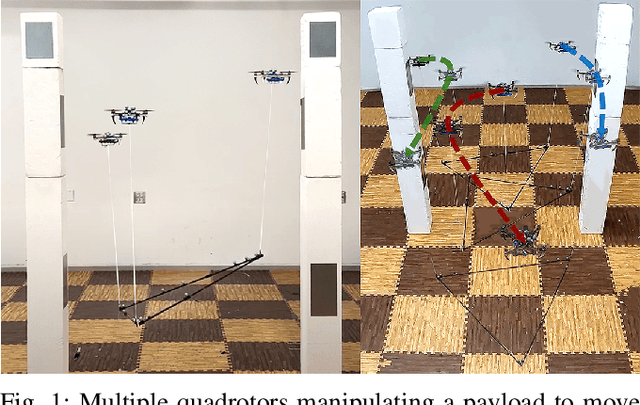
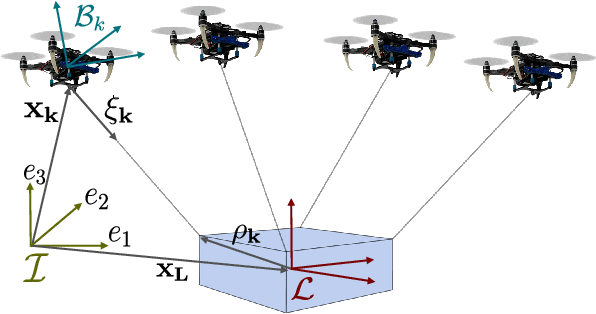
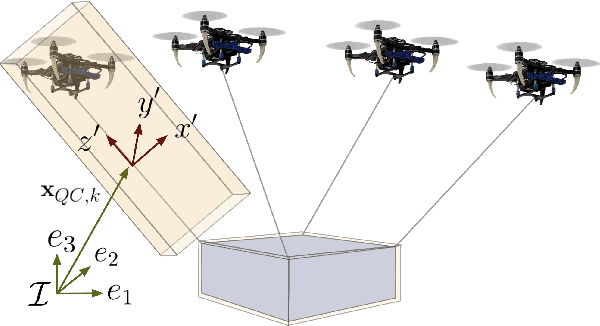
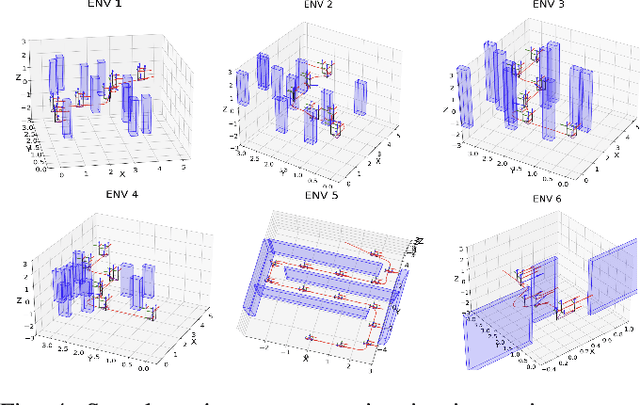
In this paper, we present a novel trajectory planning algorithm for cooperative manipulation with multiple quadrotors using control barrier functions (CBFs). Our approach addresses the complex dynamics of a system in which a team of quadrotors transports and manipulates a cable-suspended rigid-body payload in environments cluttered with obstacles. The proposed algorithm ensures obstacle avoidance for the entire system, including the quadrotors, cables, and the payload in all six degrees of freedom (DoF). We introduce the use of CBFs to enable safe and smooth maneuvers, effectively navigating through cluttered environments while accommodating the system's nonlinear dynamics. To simplify complex constraints, the system components are modeled as convex polytopes, and the Duality theorem is employed to reduce the computational complexity of the optimization problem. We validate the performance of our planning approach both in simulation and real-world environments using multiple quadrotors. The results demonstrate the effectiveness of the proposed approach in achieving obstacle avoidance and safe trajectory generation for cooperative transportation tasks.