 Add to Chrome
 Add to Firefox
 Add to Edge
Detecting Subtle Differences between Human and Model Languages Using Spectrum of Relative Likelihood
Jun 28, 2024
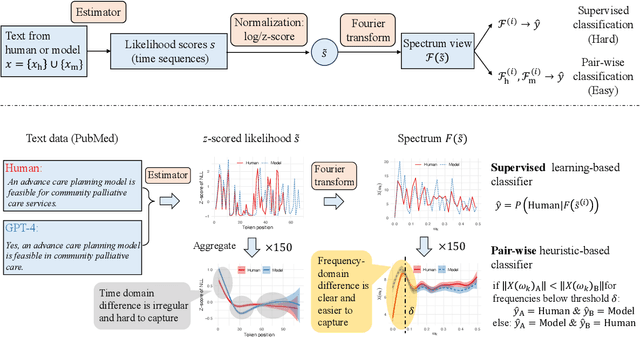
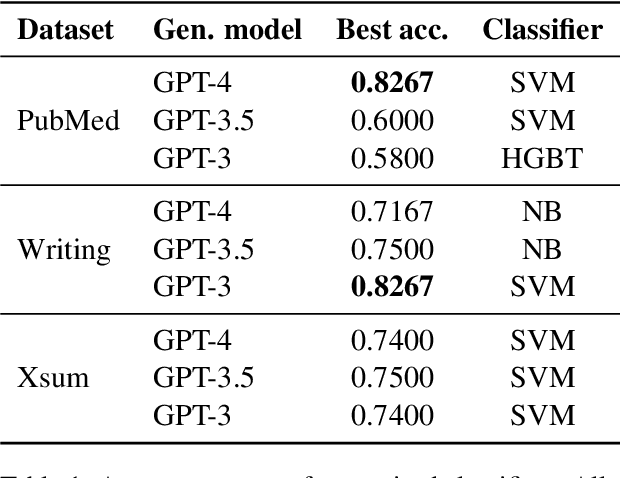
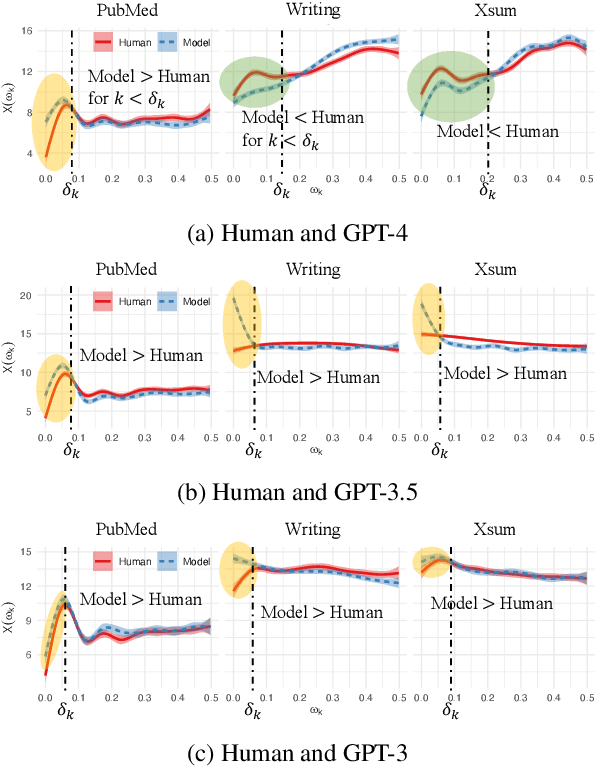
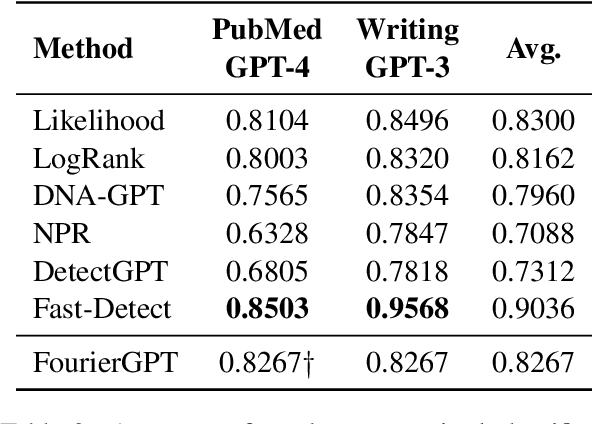
Human and model-generated texts can be distinguished by examining the magnitude of likelihood in language. However, it is becoming increasingly difficult as language model's capabilities of generating human-like texts keep evolving. This study provides a new perspective by using the relative likelihood values instead of absolute ones, and extracting useful features from the spectrum-view of likelihood for the human-model text detection task. We propose a detection procedure with two classification methods, supervised and heuristic-based, respectively, which results in competitive performances with previous zero-shot detection methods and a new state-of-the-art on short-text detection. Our method can also reveal subtle differences between human and model languages, which find theoretical roots in psycholinguistics studies. Our code is available at https://github.com/CLCS-SUSTech/FourierGPT

Self-Constructed Context Decompilation with Fined-grained Alignment Enhancement
Jun 25, 2024Decompilation transforms compiled code back into a high-level programming language for analysis when source code is unavailable. Previous work has primarily focused on enhancing decompilation performance by increasing the scale of model parameters or training data for pre-training. Based on the characteristics of the decompilation task, we propose two methods: (1) Without fine-tuning, the Self-Constructed Context Decompilation (sc$^2$dec) method recompiles the LLM's decompilation results to construct pairs for in-context learning, helping the model improve decompilation performance. (2) Fine-grained Alignment Enhancement (FAE), which meticulously aligns assembly code with source code at the statement level by leveraging debugging information, is employed during the fine-tuning phase to achieve further improvements in decompilation. By integrating these two methods, we achieved a Re-Executability performance improvement of approximately 7.35\% on the Decompile-Eval benchmark, establishing a new state-of-the-art performance of 55.03\%.
RefChecker: Reference-based Fine-grained Hallucination Checker and Benchmark for Large Language Models
May 23, 2024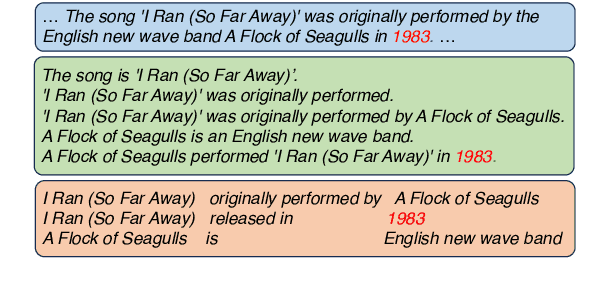


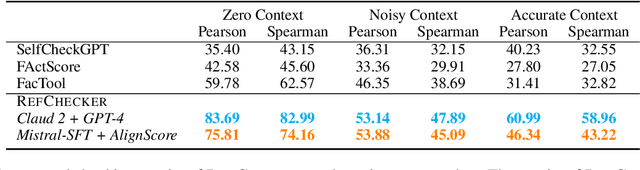
Large Language Models (LLMs) have shown impressive capabilities but also a concerning tendency to hallucinate. This paper presents RefChecker, a framework that introduces claim-triplets to represent claims in LLM responses, aiming to detect fine-grained hallucinations. In RefChecker, an extractor generates claim-triplets from a response, which are then evaluated by a checker against a reference. We delineate three task settings: Zero, Noisy and Accurate Context, to reflect various real-world use cases. We curated a benchmark spanning various NLP tasks and annotated 11k claim-triplets from 2.1k responses by seven LLMs. RefChecker supports both proprietary and open-source models as the extractor and checker. Experiments demonstrate that claim-triplets enable superior hallucination detection, compared to other granularities such as response, sentence and sub-sentence level claims. RefChecker outperforms prior methods by 6.8 to 26.1 points on our benchmark and the checking results of RefChecker are strongly aligned with human judgments. This work is open sourced at https://github.com/amazon-science/RefChecker
VINS-Multi: A Robust Asynchronous Multi-camera-IMU State Estimator
May 23, 2024State estimation is a critical foundational module in robotics applications, where robustness and performance are paramount. Although in recent years, many works have been focusing on improving one of the most widely adopted state estimation methods, visual inertial odometry (VIO), by incorporating multiple cameras, these efforts predominantly address synchronous camera systems. Asynchronous cameras, which offer simpler hardware configurations and enhanced resilience, have been largely overlooked. To fill this gap, this paper presents VINS-Multi, a novel multi-camera-IMU state estimator for asynchronous cameras. The estimator comprises parallel front ends, a front end coordinator, and a back end optimization module capable of handling asynchronous input frames. It utilizes the frames effectively through a dynamic feature number allocation and a frame priority coordination strategy. The proposed estimator is integrated into a customized quadrotor platform and tested in multiple realistic and challenging scenarios to validate its practicality. Additionally, comprehensive benchmark results are provided to showcase the robustness and superior performance of the proposed estimator.
Evaluation of Machine Translation Based on Semantic Dependencies and Keywords
Apr 20, 2024In view of the fact that most of the existing machine translation evaluation algorithms only consider the lexical and syntactic information, but ignore the deep semantic information contained in the sentence, this paper proposes a computational method for evaluating the semantic correctness of machine translations based on reference translations and incorporating semantic dependencies and sentence keyword information. Use the language technology platform developed by the Social Computing and Information Retrieval Research Center of Harbin Institute of Technology to conduct semantic dependency analysis and keyword analysis on sentences, and obtain semantic dependency graphs, keywords, and weight information corresponding to keywords. It includes all word information with semantic dependencies in the sentence and keyword information that affects semantic information. Construct semantic association pairs including word and dependency multi-features. The key semantics of the sentence cannot be highlighted in the semantic information extracted through semantic dependence, resulting in vague semantics analysis. Therefore, the sentence keyword information is also included in the scope of machine translation semantic evaluation. To achieve a comprehensive and in-depth evaluation of the semantic correctness of sentences, the experimental results show that the accuracy of the evaluation algorithm has been improved compared with similar methods, and it can more accurately measure the semantic correctness of machine translation.
Learning to Score Sign Language with Two-stage Method
Apr 17, 2024Human action recognition and performance assessment have been hot research topics in recent years. Recognition problems have mature solutions in the field of sign language, but past research in performance analysis has focused on competitive sports and medical training, overlooking the scoring assessment ,which is an important part of sign language teaching digitalization. In this paper, we analyze the existing technologies for performance assessment and adopt methods that perform well in human pose reconstruction tasks combined with motion rotation embedded expressions, proposing a two-stage sign language performance evaluation pipeline. Our analysis shows that choosing reconstruction tasks in the first stage can provide more expressive features, and using smoothing methods can provide an effective reference for assessment. Experiments show that our method provides good score feedback mechanisms and high consistency with professional assessments compared to end-to-end evaluations.
Teaching Chinese Sign Language with Feedback in Mixed Reality
Apr 16, 2024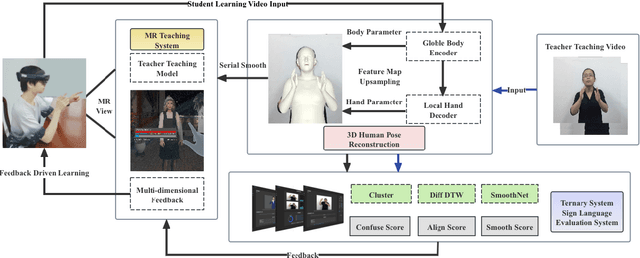
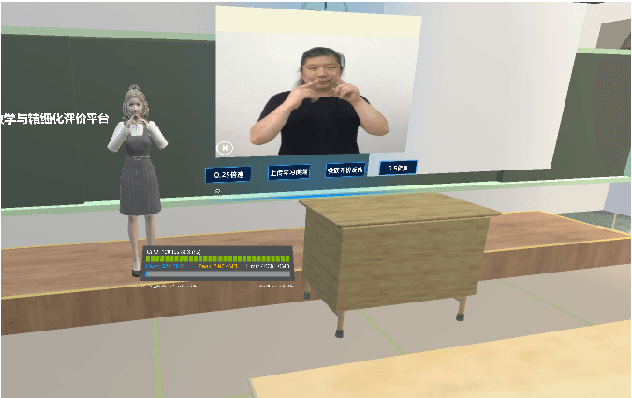
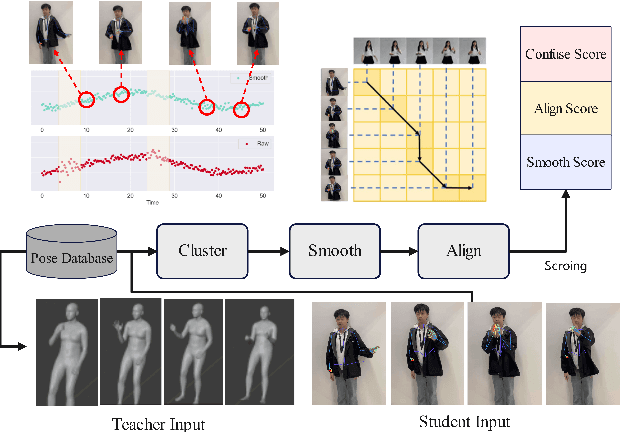
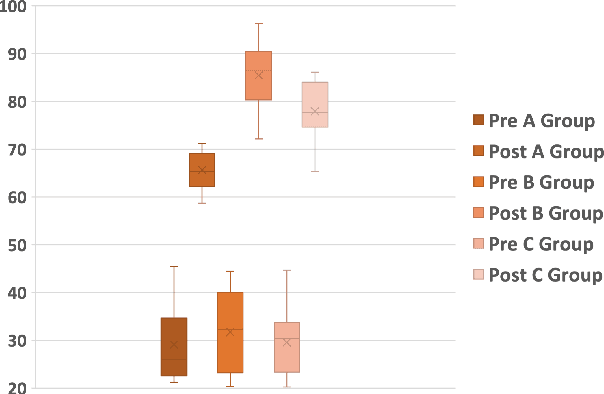
Traditional sign language teaching methods face challenges such as limited feedback and diverse learning scenarios. Although 2D resources lack real-time feedback, classroom teaching is constrained by a scarcity of teacher. Methods based on VR and AR have relatively primitive interaction feedback mechanisms. This study proposes an innovative teaching model that uses real-time monocular vision and mixed reality technology. First, we introduce an improved hand-posture reconstruction method to achieve sign language semantic retention and real-time feedback. Second, a ternary system evaluation algorithm is proposed for a comprehensive assessment, maintaining good consistency with experts in sign language. Furthermore, we use mixed reality technology to construct a scenario-based 3D sign language classroom and explore the user experience of scenario teaching. Overall, this paper presents a novel teaching method that provides an immersive learning experience, advanced posture reconstruction, and precise feedback, achieving positive feedback on user experience and learning effectiveness.
Toward Informal Language Processing: Knowledge of Slang in Large Language Models
Apr 13, 2024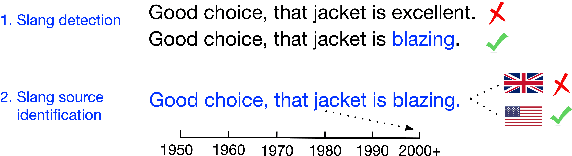
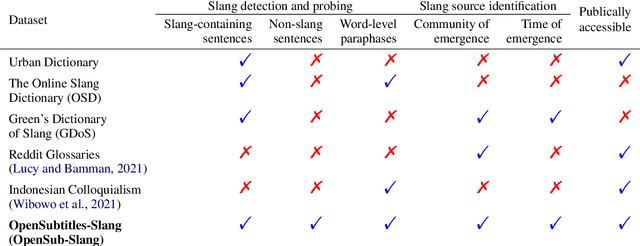
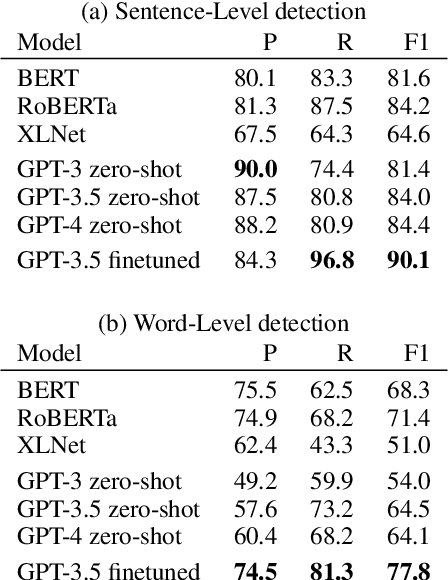
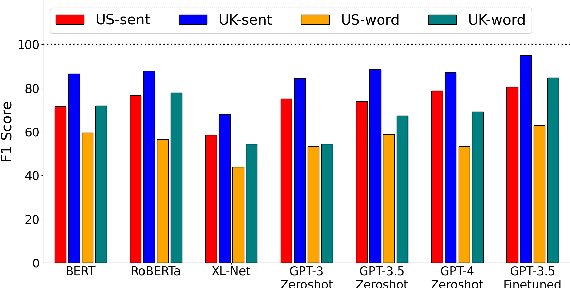
Recent advancement in large language models (LLMs) has offered a strong potential for natural language systems to process informal language. A representative form of informal language is slang, used commonly in daily conversations and online social media. To date, slang has not been comprehensively evaluated in LLMs due partly to the absence of a carefully designed and publicly accessible benchmark. Using movie subtitles, we construct a dataset that supports evaluation on a diverse set of tasks pertaining to automatic processing of slang. For both evaluation and finetuning, we show the effectiveness of our dataset on two core applications: 1) slang detection, and 2) identification of regional and historical sources of slang from natural sentences. We also show how our dataset can be used to probe the output distributions of LLMs for interpretive insights. We find that while LLMs such as GPT-4 achieve good performance in a zero-shot setting, smaller BERT-like models finetuned on our dataset achieve comparable performance. Furthermore, we show that our dataset enables finetuning of LLMs such as GPT-3.5 that achieve substantially better performance than strong zero-shot baselines. Our work offers a comprehensive evaluation and a high-quality benchmark on English slang based on the OpenSubtitles corpus, serving both as a publicly accessible resource and a platform for applying tools for informal language processing.
Improving Language Model Reasoning with Self-motivated Learning
Apr 10, 2024Large-scale high-quality training data is important for improving the performance of models. After trained with data that has rationales (reasoning steps), models gain reasoning capability. However, the dataset with high-quality rationales is relatively scarce due to the high annotation cost. To address this issue, we propose \textit{Self-motivated Learning} framework. The framework motivates the model itself to automatically generate rationales on existing datasets. Based on the inherent rank from correctness across multiple rationales, the model learns to generate better rationales, leading to higher reasoning capability. Specifically, we train a reward model with the rank to evaluate the quality of rationales, and improve the performance of reasoning through reinforcement learning. Experiment results of Llama2 7B on multiple reasoning datasets show that our method significantly improves the reasoning ability of models, even outperforming text-davinci-002 in some datasets.
OmniNxt: A Fully Open-source and Compact Aerial Robot with Omnidirectional Visual Perception
Mar 29, 2024Adopting omnidirectional Field of View (FoV) cameras in aerial robots vastly improves perception ability, significantly advancing aerial robotics's capabilities in inspection, reconstruction, and rescue tasks. However, such sensors also elevate system complexity, e.g., hardware design, and corresponding algorithm, which limits researchers from utilizing aerial robots with omnidirectional FoV in their research. To bridge this gap, we propose OmniNxt, a fully open-source aerial robotics platform with omnidirectional perception. We design a high-performance flight controller NxtPX4 and a multi-fisheye camera set for OmniNxt. Meanwhile, the compatible software is carefully devised, which empowers OmniNxt to achieve accurate localization and real-time dense mapping with limited computation resource occupancy. We conducted extensive real-world experiments to validate the superior performance of OmniNxt in practical applications. All the hardware and software are open-access at https://github.com/HKUST-Aerial-Robotics/OmniNxt, and we provide docker images of each crucial module in the proposed system. Project page: https://hkust-aerial-robotics.github.io/OmniNxt.