 Add to Chrome
 Add to Firefox
 Add to Edge
LiveMem: Maintaining Memory State Continuity in Long-Running LLM Inference
Aug 03, 2026
Long-running assistants and agents consume interaction streams that eventually outgrow the context. Existing context retention, summarization, and retrieval preserve access to selected history, but do not provide a persistent state over the full lifecycle when working context changes. We formulate this missing inference capability as \emph{state continuity under context turnover}: carrying computation forward through a fixed-capacity memory state whose lifetime is independent of the active context. We introduce an intrinsic memory method, \textbf{LiveMem}, which augments a pretrained full-attention LLM with a memory state that preserves the historical information over the whole lifecycle while the main attention path retains a bounded KV window. Context turnover and memory state maintaining, memory-oriented post-training, and state-aware serving jointly make this memory state load bearing after its originating tokens are released. Our experiments show that LiveMem achieves leading overall performance among evaluated systems and other intrinsic memory methods. Experiments on LongMemEval show that LiveMem is able to answer the question based on the memory state, even when the supporting evidence has been removed from the current context, and evidence-distance analysis shows that useful information persists beyond the active window. LiveMem thus establishes state continuity as a distinct and complementary abstraction for continual LLM inference.

WaveDetect: Robust Framework for Machine-Generated Text Detection via Wavelet Transform
Jun 22, 2026As Large Language Models asymptotically approach human-level fluency in natural language generation, solely relying on surface-level semantic artifacts for detecting LLM-generated texts has become increasingly precarious. Existing detectors often falter when facing three critical challenges: adversarial perturbations, cross-domain shifts, and the rapid temporal evolution of the foundation model. To address these issues, we propose \wavedetect, a novel framework that reformulates text detection as a signal processing task within the time-frequency domain. Unlike previous methods that analyze static token probability distributions, \wavedetect models the generated output as a probability signal, upon which a differentiable Continuous Wavelet Transform is applied to convert them into learnable spectral representations. This process reveals the intrinsic ``spectral fingerprints'' in machine-generated texts--patterns that remain invisible in time domain. Comprehensive evaluations on three well-curated datasets (RAID, EvoBench, and Domain-Shift) show that our method achieves a new state-of-the-art. It not only achieves superior accuracy but also exhibits remarkable robustness against sophisticated attacks, generalization across out-of-distribution topics and unseen evolving LLMs. Our results validate the efficacy of spectral analysis as a promising paradigm for LLM-generated texts detection.
Evaluating Memory Capability in Continuous Lifelog Scenario
Apr 13, 2026Nowadays, wearable devices can continuously lifelog ambient conversations, creating substantial opportunities for memory systems. However, existing benchmarks primarily focus on online one-on-one chatting or human-AI interactions, thus neglecting the unique demands of real-world scenarios. Given the scarcity of public lifelogging audio datasets, we propose a hierarchical synthesis framework to curate \textbf{\textsc{LifeDialBench}}, a novel benchmark comprising two complementary subsets: \textbf{EgoMem}, built on real-world egocentric videos, and \textbf{LifeMem}, constructed using simulated virtual community. Crucially, to address the issue of temporal leakage in traditional offline settings, we propose an \textbf{Online Evaluation} protocol that strictly adheres to temporal causality, ensuring systems are evaluated in a realistic streaming fashion. Our experimental results reveal a counterintuitive finding: current sophisticated memory systems fail to outperform a simple RAG-based baseline. This highlights the detrimental impact of over-designed structures and lossy compression in current approaches, emphasizing the necessity of high-fidelity context preservation for lifelog scenarios. We release our code and data at https://github.com/qys77714/LifeDialBench.
Think in Sentences: Explicit Sentence Boundaries Enhance Language Model's Capabilities
Apr 11, 2026Researchers have explored different ways to improve large language models (LLMs)' capabilities via dummy token insertion in contexts. However, existing works focus solely on the dummy tokens themselves, but fail to leverage the inherent sentence-level structure of natural language. This is a critical oversight, as LLMs acquire linguistic capabilities through exposure to human-generated texts, which are inherently structured at the sentence level. Motivated by this gap, we propose an approach that inserts delimiters at sentence boundaries in LLM inputs, which not only integrates dummy tokens into the context, but also facilitates LLMs with sentence-by-sentence processing behavior during reasoning. Two concrete methods: (1). In-context learning and (2). Supervised fine-tuning are experimented using 7B models to 600B Deepseek-V3. Our results demonstrate consistent improvements across various tasks, with notable gains of up to 7.7\% on GSM8k and 12.5\% on DROP. Furthermore, the fine-tuned LLMs can incorporate sentence awareness evidenced by their internal representations. Our work establishes a simple yet effective technique for enhancing LLM's capabilities, offering promising directions for cognitive-inspired LLM enhancement paradigm.
Fast and Accurate Probing of In-Training LLMs' Downstream Performances
Apr 01, 2026The paradigm of scaling Large Language Models (LLMs) in both parameter size and test time has pushed the boundaries of AI capabilities, but at the cost of making the traditional generative evaluation paradigm prohibitively expensive, therefore making the latency of LLM's in-training downstream performance evaluation unbearable. However, simple metrics like training loss (perplexity) are not always correlated with downstream performance, as sometimes their trends diverge from the actual task outcomes. This dilemma calls for a method that is computationally efficient and sufficiently accurate in measuring model capabilities. To address this challenge, we introduce a new in-training evaluation paradigm that uses a lightweight probe for monitoring downstream performance. The probes take the internal representations of LLM checkpoints (during training) as input and directly predict the checkpoint's performance on downstream tasks measured by success probability (i.e., pass@1). We design several probe architectures, validating their effectiveness using the OLMo3-7B's checkpoints across a diverse set of downstream tasks. The probes can accurately predict a checkpoint's performance (with avg. AUROC$>$0.75), have decent generalizability across checkpoints (earlier predicts later), and reduce the computation latency from $\sim$1 hr (using conventional generative evaluation method) to $\sim$3 min. In sum, this work presents a practical and scalable in-training downstream evaluation paradigm, enabling a more agile, informed, and efficient LLM development process.
R2LED: Equipping Retrieval and Refinement in Lifelong User Modeling with Semantic IDs for CTR Prediction
Feb 06, 2026Lifelong user modeling, which leverages users' long-term behavior sequences for CTR prediction, has been widely applied in personalized services. Existing methods generally adopted a two-stage "retrieval-refinement" strategy to balance effectiveness and efficiency. However, they still suffer from (i) noisy retrieval due to skewed data distribution and (ii) lack of semantic understanding in refinement. While semantic enhancement, e.g., LLMs modeling or semantic embeddings, offers potential solutions to these two challenges, these approaches face impractical inference costs or insufficient representation granularity. Obsorbing multi-granularity and lightness merits of semantic identity (SID), we propose a novel paradigm that equips retrieval and refinement in Lifelong User Modeling with SEmantic IDs (R2LED) to address these issues. First, we introduce a Multi-route Mixed Retrieval for the retrieval stage. On the one hand, it captures users' interests from various granularities by several parallel recall routes. On the other hand, a mixed retrieval mechanism is proposed to efficiently retrieve candidates from both collaborative and semantic views, reducing noise. Then, for refinement, we design a Bi-level Fusion Refinement, including a target-aware cross-attention for route-level fusion and a gate mechanism for SID-level fusion. It can bridge the gap between semantic and collaborative spaces, exerting the merits of SID. The comprehensive experimental results on two public datasets demonstrate the superiority of our method in both performance and efficiency. To facilitate the reproduction, we have released the code online https://github.com/abananbao/R2LED.
DiffuMural: Restoring Dunhuang Murals with Multi-scale Diffusion
Apr 13, 2025Large-scale pre-trained diffusion models have produced excellent results in the field of conditional image generation. However, restoration of ancient murals, as an important downstream task in this field, poses significant challenges to diffusion model-based restoration methods due to its large defective area and scarce training samples. Conditional restoration tasks are more concerned with whether the restored part meets the aesthetic standards of mural restoration in terms of overall style and seam detail, and such metrics for evaluating heuristic image complements are lacking in current research. We therefore propose DiffuMural, a combined Multi-scale convergence and Collaborative Diffusion mechanism with ControlNet and cyclic consistency loss to optimise the matching between the generated images and the conditional control. DiffuMural demonstrates outstanding capabilities in mural restoration, leveraging training data from 23 large-scale Dunhuang murals that exhibit consistent visual aesthetics. The model excels in restoring intricate details, achieving a coherent overall appearance, and addressing the unique challenges posed by incomplete murals lacking factual grounding. Our evaluation framework incorporates four key metrics to quantitatively assess incomplete murals: factual accuracy, textural detail, contextual semantics, and holistic visual coherence. Furthermore, we integrate humanistic value assessments to ensure the restored murals retain their cultural and artistic significance. Extensive experiments validate that our method outperforms state-of-the-art (SOTA) approaches in both qualitative and quantitative metrics.
Detecting Subtle Differences between Human and Model Languages Using Spectrum of Relative Likelihood
Jun 28, 2024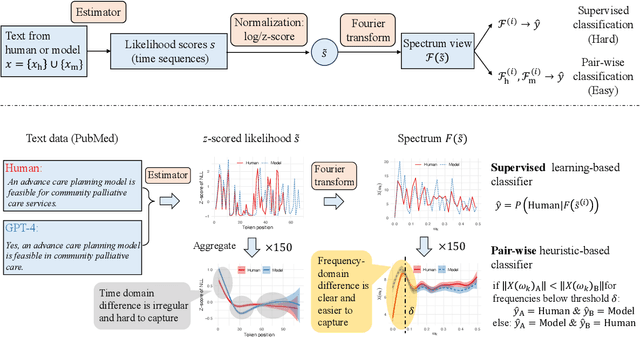
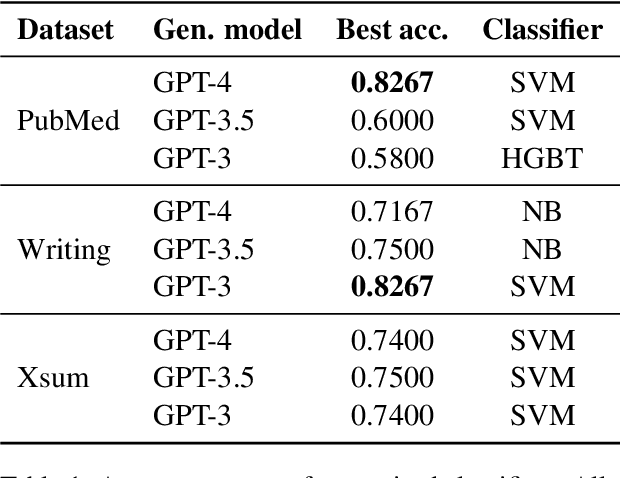
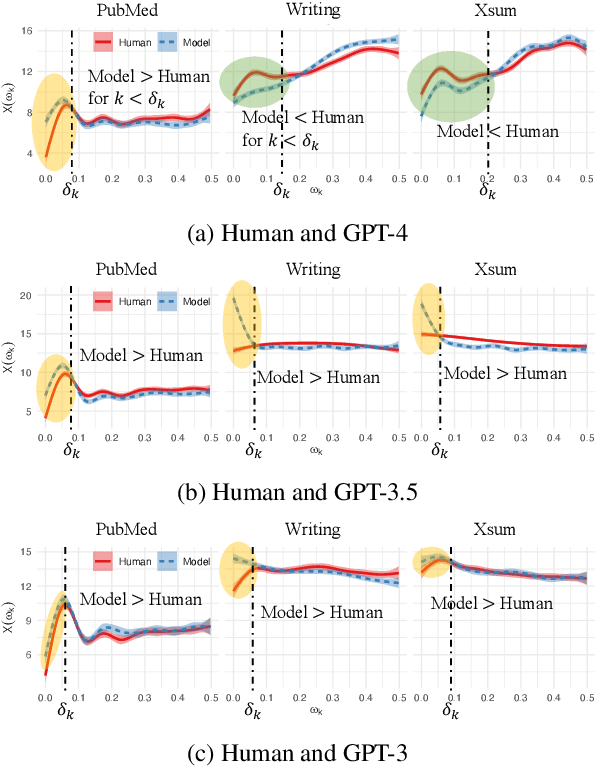
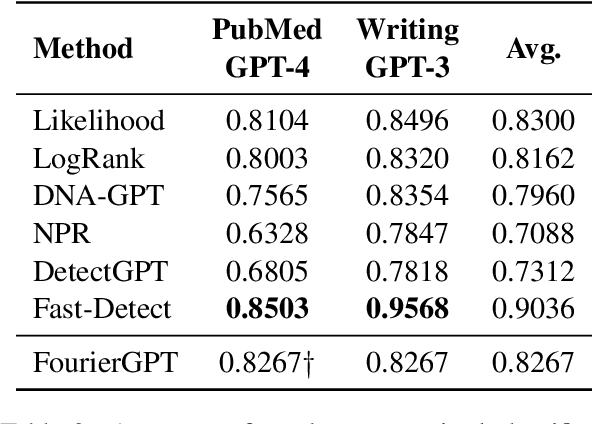
Human and model-generated texts can be distinguished by examining the magnitude of likelihood in language. However, it is becoming increasingly difficult as language model's capabilities of generating human-like texts keep evolving. This study provides a new perspective by using the relative likelihood values instead of absolute ones, and extracting useful features from the spectrum-view of likelihood for the human-model text detection task. We propose a detection procedure with two classification methods, supervised and heuristic-based, respectively, which results in competitive performances with previous zero-shot detection methods and a new state-of-the-art on short-text detection. Our method can also reveal subtle differences between human and model languages, which find theoretical roots in psycholinguistics studies. Our code is available at https://github.com/CLCS-SUSTech/FourierGPT