 Add to Chrome
 Add to Firefox
 Add to Edge
ESAinsTOD: A Unified End-to-End Schema-Aware Instruction-Tuning Framework for Task-Oriented Dialog Modeling
Mar 10, 2026
Existing end-to-end modeling methods for modular task-oriented dialog systems are typically tailored to specific datasets, making it challenging to adapt to new dialog scenarios. In this work, we propose ESAinsTOD, a unified End-to-end Schema-Aware Instruction-tuning framework for general Task-Oriented Dialog modeling. This framework introduces a structured methodology to go beyond simply fine-tuning Large Language Models (LLMs), enabling flexible adaptation to various dialogue task flows and schemas. Specifically, we leverage full-parameter fine-tuning of LLMs and introduce two alignment mechanisms to make the resulting system both instruction-aware and schema-aware: (i) instruction alignment, which ensures that the system faithfully follows task instructions to complete various task flows from heterogeneous TOD datasets; and (ii) schema alignment, which encourages the system to make predictions adhering to the specified schema. In addition, we employ session-level end-to-end modeling, which allows the system to access the results of previously executed task flows within the dialogue history, to bridge the gap between the instruction-tuning paradigm and the real-world application of TOD systems. Empirical results show that while a fine-tuned LLM serves as a strong baseline, our structured approach provides significant additional benefits. In particular, our findings indicate that: (i) ESAinsTOD outperforms state-of-the-art models by a significant margin on end-to-end task-oriented dialog modeling benchmarks: CamRest676, In-Car and MultiWOZ; (ii) more importantly, it exhibits superior generalization capabilities across various low-resource settings, with the proposed alignment mechanisms significantly enhancing zero-shot performance; and (iii) our instruction-tuning paradigm substantially improves the model's robustness against data noise and cascading errors.
* Published at International Journal of Machine Learning and Cybernetics (IJMLC)

Self-Constructed Context Decompilation with Fined-grained Alignment Enhancement
Jun 25, 2024Decompilation transforms compiled code back into a high-level programming language for analysis when source code is unavailable. Previous work has primarily focused on enhancing decompilation performance by increasing the scale of model parameters or training data for pre-training. Based on the characteristics of the decompilation task, we propose two methods: (1) Without fine-tuning, the Self-Constructed Context Decompilation (sc$^2$dec) method recompiles the LLM's decompilation results to construct pairs for in-context learning, helping the model improve decompilation performance. (2) Fine-grained Alignment Enhancement (FAE), which meticulously aligns assembly code with source code at the statement level by leveraging debugging information, is employed during the fine-tuning phase to achieve further improvements in decompilation. By integrating these two methods, we achieved a Re-Executability performance improvement of approximately 7.35\% on the Decompile-Eval benchmark, establishing a new state-of-the-art performance of 55.03\%.
Pro-HAN: A Heterogeneous Graph Attention Network for Profile-Based Spoken Language Understanding
Feb 06, 2024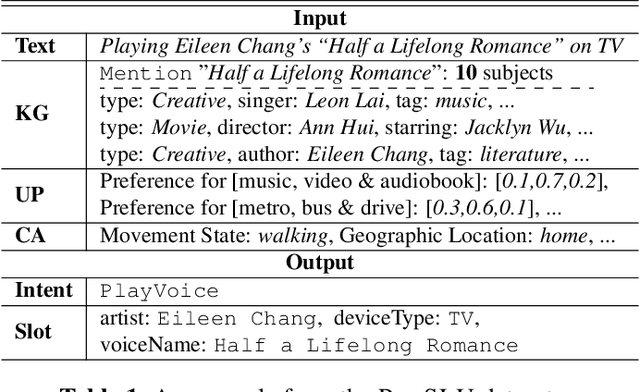
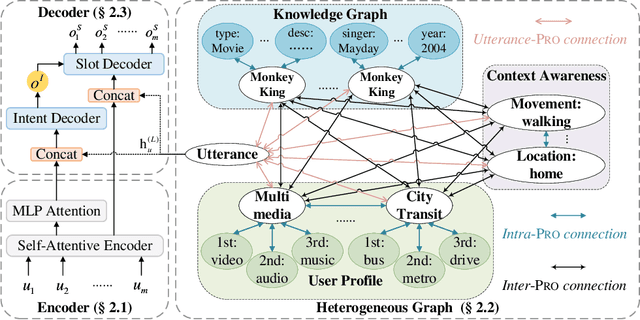
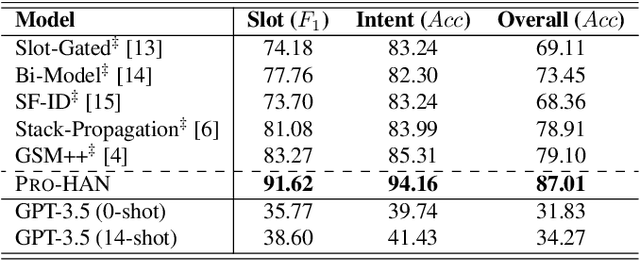
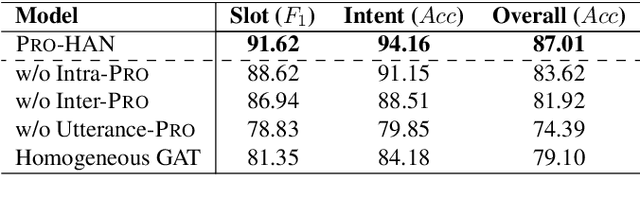
Recently, Profile-based Spoken Language Understanding (SLU) has gained increasing attention, which aims to incorporate various types of supplementary profile information (i.e., Knowledge Graph, User Profile, Context Awareness) to eliminate the prevalent ambiguities in user utterances. However, existing approaches can only separately model different profile information, without considering their interrelationships or excluding irrelevant and conflicting information within them. To address the above issues, we introduce a Heterogeneous Graph Attention Network to perform reasoning across multiple Profile information, called Pro-HAN. Specifically, we design three types of edges, denoted as intra-Pro, inter-Pro, and utterance-Pro, to capture interrelationships among multiple Pros. We establish a new state-of-the-art on the ProSLU dataset, with an improvement of approximately 8% across all three metrics. Further analysis experiments also confirm the effectiveness of our method in modeling multi-source profile information.