 Add to Chrome
 Add to Firefox
 Add to Edge
MetaDecorator: Generating Immersive Virtual Tours through Multimodality
Jan 27, 2025
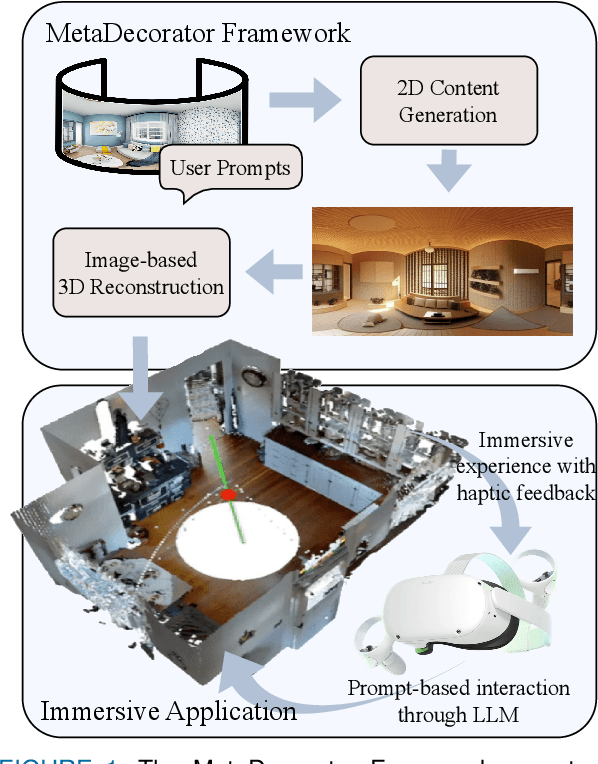
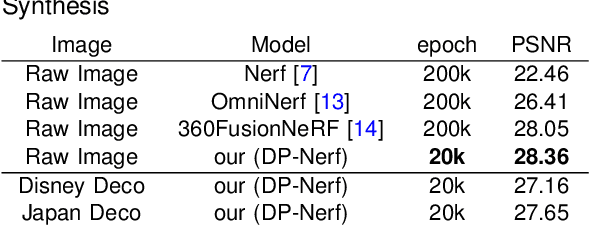
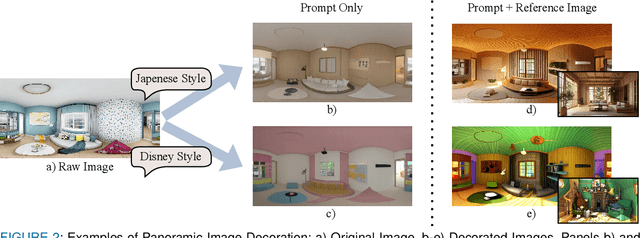
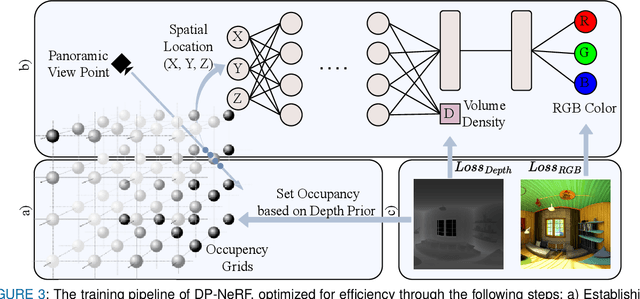
MetaDecorator, is a framework that empowers users to personalize virtual spaces. By leveraging text-driven prompts and image synthesis techniques, MetaDecorator adorns static panoramas captured by 360{\deg} imaging devices, transforming them into uniquely styled and visually appealing environments. This significantly enhances the realism and engagement of virtual tours compared to traditional offerings. Beyond the core framework, we also discuss the integration of Large Language Models (LLMs) and haptics in the VR application to provide a more immersive experience.

CRPO: Confidence-Reward Driven Preference Optimization for Machine Translation
Jan 23, 2025
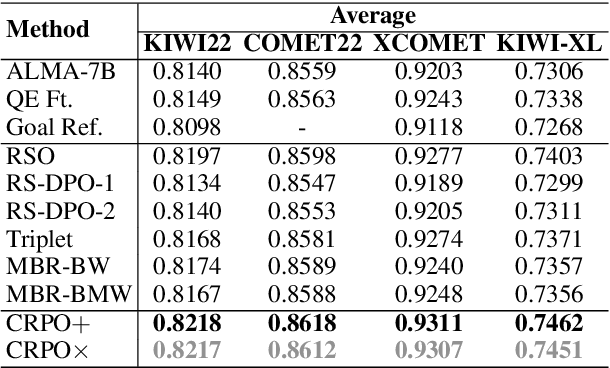
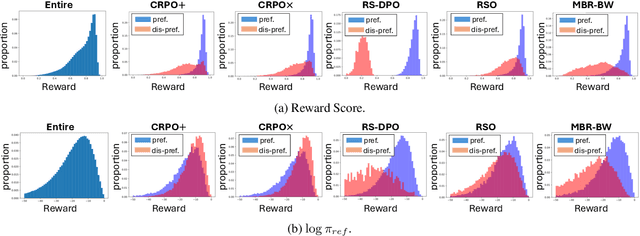
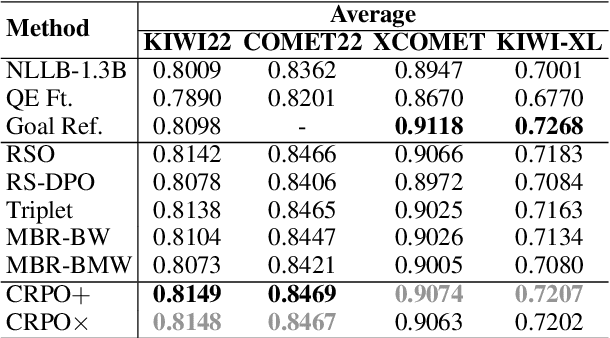
Large language models (LLMs) have shown great potential in natural language processing tasks, but their application to machine translation (MT) remains challenging due to pretraining on English-centric data and the complexity of reinforcement learning from human feedback (RLHF). Direct Preference Optimization (DPO) has emerged as a simpler and more efficient alternative, but its performance depends heavily on the quality of preference data. To address this, we propose Confidence-Reward driven Preference Optimization (CRPO), a novel method that combines reward scores with model confidence to improve data selection for fine-tuning. CRPO selects challenging sentence pairs where the model is uncertain or underperforms, leading to more effective learning. While primarily designed for LLMs, CRPO also generalizes to encoder-decoder models like NLLB, demonstrating its versatility. Empirical results show that CRPO outperforms existing methods such as RS-DPO, RSO and MBR score in both translation accuracy and data efficiency.
Dual-Modal Prototype Joint Learning for Compositional Zero-Shot Learning
Jan 23, 2025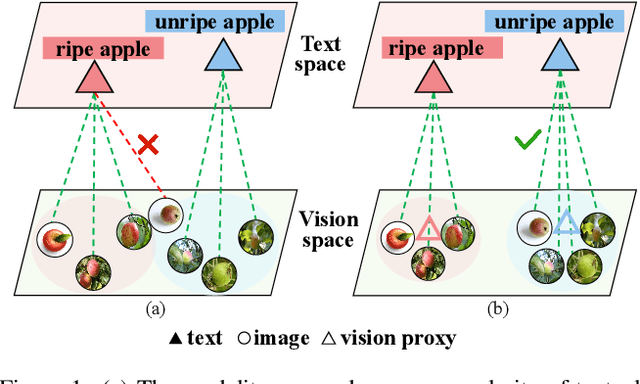
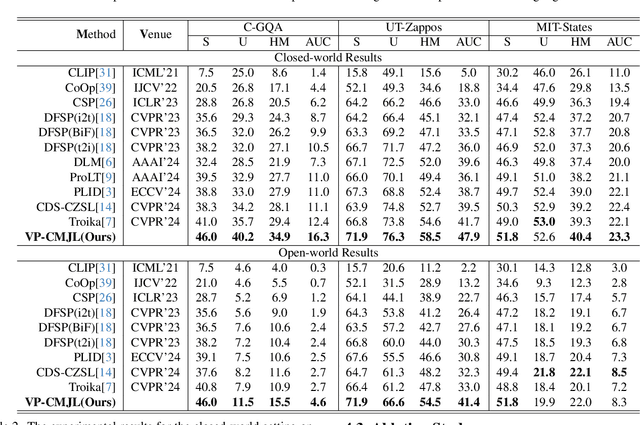
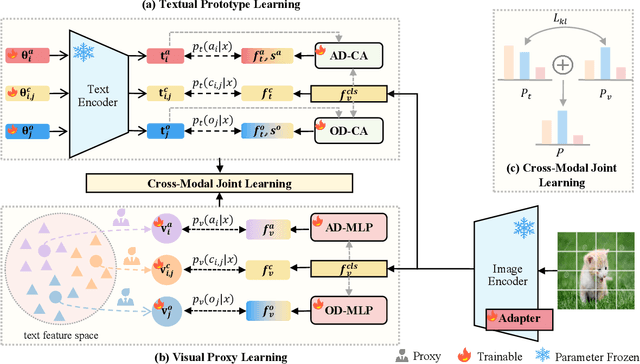
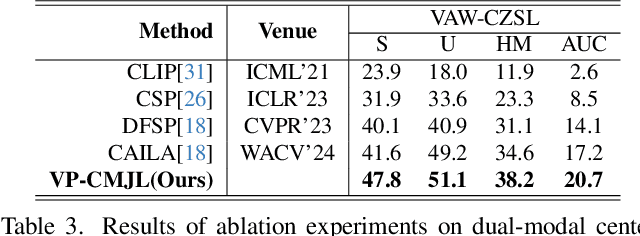
Compositional Zero-Shot Learning (CZSL) aims to recognize novel compositions of attributes and objects by leveraging knowledge learned from seen compositions. Recent approaches have explored the use of Vision-Language Models (VLMs) to align textual and visual modalities. These methods typically employ prompt engineering, parameter-tuning, and modality fusion to generate rich textual prototypes that serve as class prototypes for CZSL. However, the modality gap results in textual prototypes being unable to fully capture the optimal representations of all class prototypes, particularly those with fine-grained features, which can be directly obtained from the visual modality. In this paper, we propose a novel Dual-Modal Prototype Joint Learning framework for the CZSL task. Our approach, based on VLMs, introduces prototypes in both the textual and visual modalities. The textual prototype is optimized to capture broad conceptual information, aiding the model's generalization across unseen compositions. Meanwhile, the visual prototype is used to mitigate the classification errors caused by the modality gap and capture fine-grained details to distinguish images with similar appearances. To effectively optimize these prototypes, we design specialized decomposition modules and a joint learning strategy that enrich the features from both modalities. These prototypes not only capture key category information during training but also serve as crucial reference targets during inference. Experimental results demonstrate that our approach achieves state-of-the-art performance in the closed-world setting and competitive performance in the open-world setting across three publicly available CZSL benchmarks. These findings validate the effectiveness of our method in advancing compositional generalization.
Noise-Resilient Point-wise Anomaly Detection in Time Series Using Weak Segment Labels
Jan 21, 2025


Detecting anomalies in temporal data has gained significant attention across various real-world applications, aiming to identify unusual events and mitigate potential hazards. In practice, situations often involve a mix of segment-level labels (detected abnormal events with segments of time points) and unlabeled data (undetected events), while the ideal algorithmic outcome should be point-level predictions. Therefore, the huge label information gap between training data and targets makes the task challenging. In this study, we formulate the above imperfect information as noisy labels and propose NRdetector, a noise-resilient framework that incorporates confidence-based sample selection, robust segment-level learning, and data-centric point-level detection for multivariate time series anomaly detection. Particularly, to bridge the information gap between noisy segment-level labels and missing point-level labels, we develop a novel loss function that can effectively mitigate the label noise and consider the temporal features. It encourages the smoothness of consecutive points and the separability of points from segments with different labels. Extensive experiments on real-world multivariate time series datasets with 11 different evaluation metrics demonstrate that NRdetector consistently achieves robust results across multiple real-world datasets, outperforming various baselines adapted to operate in our setting.
Panoramic Interests: Stylistic-Content Aware Personalized Headline Generation
Jan 21, 2025Personalized news headline generation aims to provide users with attention-grabbing headlines that are tailored to their preferences. Prevailing methods focus on user-oriented content preferences, but most of them overlook the fact that diverse stylistic preferences are integral to users' panoramic interests, leading to suboptimal personalization. In view of this, we propose a novel Stylistic-Content Aware Personalized Headline Generation (SCAPE) framework. SCAPE extracts both content and stylistic features from headlines with the aid of large language model (LLM) collaboration. It further adaptively integrates users' long- and short-term interests through a contrastive learning-based hierarchical fusion network. By incorporating the panoramic interests into the headline generator, SCAPE reflects users' stylistic-content preferences during the generation process. Extensive experiments on the real-world dataset PENS demonstrate the superiority of SCAPE over baselines.
Rethinking Membership Inference Attacks Against Transfer Learning
Jan 20, 2025Transfer learning, successful in knowledge translation across related tasks, faces a substantial privacy threat from membership inference attacks (MIAs). These attacks, despite posing significant risk to ML model's training data, remain limited-explored in transfer learning. The interaction between teacher and student models in transfer learning has not been thoroughly explored in MIAs, potentially resulting in an under-examined aspect of privacy vulnerabilities within transfer learning. In this paper, we propose a new MIA vector against transfer learning, to determine whether a specific data point was used to train the teacher model while only accessing the student model in a white-box setting. Our method delves into the intricate relationship between teacher and student models, analyzing the discrepancies in hidden layer representations between the student model and its shadow counterpart. These identified differences are then adeptly utilized to refine the shadow model's training process and to inform membership inference decisions effectively. Our method, evaluated across four datasets in diverse transfer learning tasks, reveals that even when an attacker only has access to the student model, the teacher model's training data remains susceptible to MIAs. We believe our work unveils the unexplored risk of membership inference in transfer learning.
A Survey on Diffusion Models for Anomaly Detection
Jan 20, 2025Diffusion models (DMs) have emerged as a powerful class of generative AI models, showing remarkable potential in anomaly detection (AD) tasks across various domains, such as cybersecurity, fraud detection, healthcare, and manufacturing. The intersection of these two fields, termed diffusion models for anomaly detection (DMAD), offers promising solutions for identifying deviations in increasingly complex and high-dimensional data. In this survey, we systematically review recent advances in DMAD research and investigate their capabilities. We begin by presenting the fundamental concepts of AD and DMs, followed by a comprehensive analysis of classic DM architectures including DDPMs, DDIMs, and Score SDEs. We further categorize existing DMAD methods into reconstruction-based, density-based, and hybrid approaches, providing detailed examinations of their methodological innovations. We also explore the diverse tasks across different data modalities, encompassing image, time series, video, and multimodal data analysis. Furthermore, we discuss critical challenges and emerging research directions, including computational efficiency, model interpretability, robustness enhancement, edge-cloud collaboration, and integration with large language models. The collection of DMAD research papers and resources is available at https://github.com/fdjingliu/DMAD.
Perspective Transition of Large Language Models for Solving Subjective Tasks
Jan 16, 2025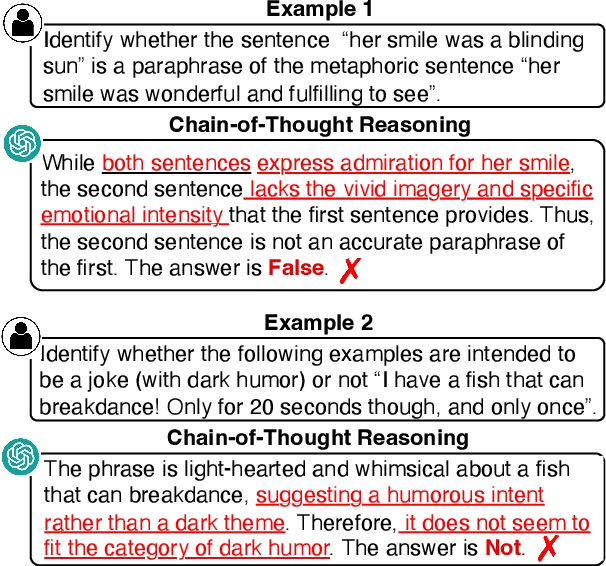
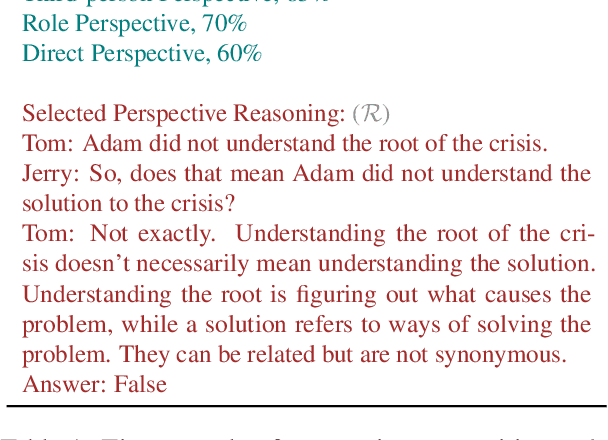
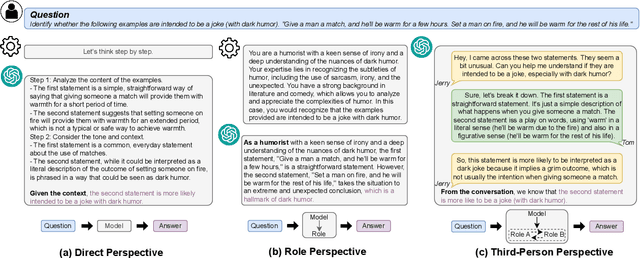
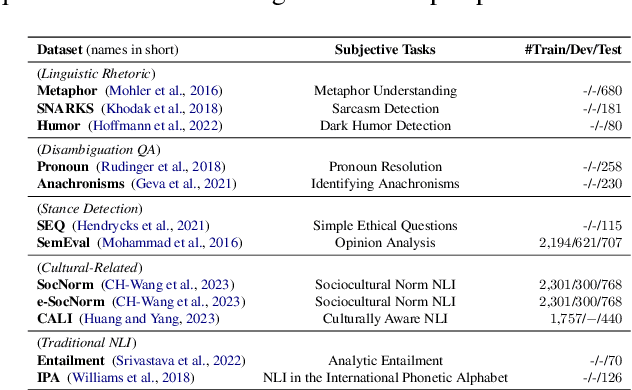
Large language models (LLMs) have revolutionized the field of natural language processing, enabling remarkable progress in various tasks. Different from objective tasks such as commonsense reasoning and arithmetic question-answering, the performance of LLMs on subjective tasks is still limited, where the perspective on the specific problem plays crucial roles for better interpreting the context and giving proper response. For example, in certain scenarios, LLMs may perform better when answering from an expert role perspective, potentially eliciting their relevant domain knowledge. In contrast, in some scenarios, LLMs may provide more accurate responses when answering from a third-person standpoint, enabling a more comprehensive understanding of the problem and potentially mitigating inherent biases. In this paper, we propose Reasoning through Perspective Transition (RPT), a method based on in-context learning that enables LLMs to dynamically select among direct, role, and third-person perspectives for the best way to solve corresponding subjective problem. Through extensive experiments on totally 12 subjective tasks by using both closed-source and open-source LLMs including GPT-4, GPT-3.5, Llama-3, and Qwen-2, our method outperforms widely used single fixed perspective based methods such as chain-of-thought prompting and expert prompting, highlights the intricate ways that LLMs can adapt their perspectives to provide nuanced and contextually appropriate responses for different problems.
Unveiling Provider Bias in Large Language Models for Code Generation
Jan 14, 2025Large Language Models (LLMs) have emerged as the new recommendation engines, outperforming traditional methods in both capability and scope, particularly in code generation applications. Our research reveals a novel provider bias in LLMs, namely without explicit input prompts, these models show systematic preferences for services from specific providers in their recommendations (e.g., favoring Google Cloud over Microsoft Azure). This bias holds significant implications for market dynamics and societal equilibrium, potentially promoting digital monopolies. It may also deceive users and violate their expectations, leading to various consequences. This paper presents the first comprehensive empirical study of provider bias in LLM code generation. We develop a systematic methodology encompassing an automated pipeline for dataset generation, incorporating 6 distinct coding task categories and 30 real-world application scenarios. Our analysis encompasses over 600,000 LLM-generated responses across seven state-of-the-art models, utilizing approximately 500 million tokens (equivalent to \$5,000+ in computational costs). The study evaluates both the generated code snippets and their embedded service provider selections to quantify provider bias. Additionally, we conduct a comparative analysis of seven debiasing prompting techniques to assess their efficacy in mitigating these biases. Our findings demonstrate that LLMs exhibit significant provider preferences, predominantly favoring services from Google and Amazon, and can autonomously modify input code to incorporate their preferred providers without users' requests. Notably, we observe discrepancies between providers recommended in conversational contexts versus those implemented in generated code. The complete dataset and analysis results are available in our repository.
Leveraging Registers in Vision Transformers for Robust Adaptation
Jan 08, 2025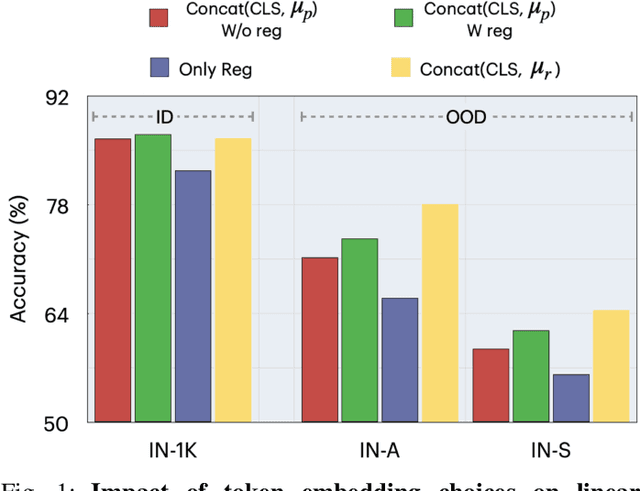
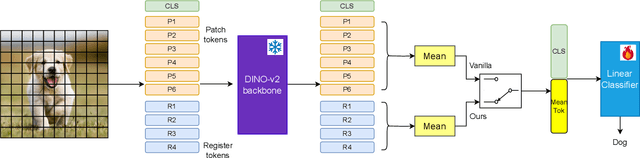
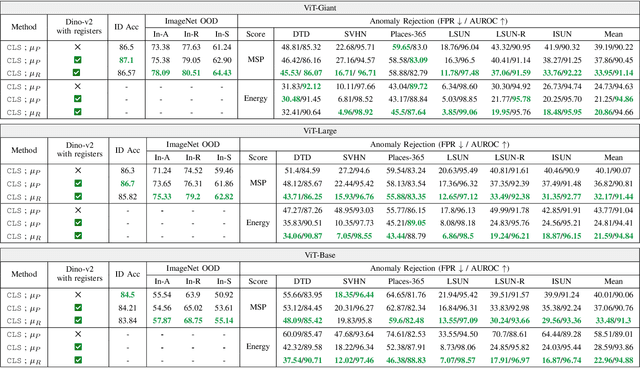
Vision Transformers (ViTs) have shown success across a variety of tasks due to their ability to capture global image representations. Recent studies have identified the existence of high-norm tokens in ViTs, which can interfere with unsupervised object discovery. To address this, the use of "registers" which are additional tokens that isolate high norm patch tokens while capturing global image-level information has been proposed. While registers have been studied extensively for object discovery, their generalization properties particularly in out-of-distribution (OOD) scenarios, remains underexplored. In this paper, we examine the utility of register token embeddings in providing additional features for improving generalization and anomaly rejection. To that end, we propose a simple method that combines the special CLS token embedding commonly employed in ViTs with the average-pooled register embeddings to create feature representations which are subsequently used for training a downstream classifier. We find that this enhances OOD generalization and anomaly rejection, while maintaining in-distribution (ID) performance. Extensive experiments across multiple ViT backbones trained with and without registers reveal consistent improvements of 2-4\% in top-1 OOD accuracy and a 2-3\% reduction in false positive rates for anomaly detection. Importantly, these gains are achieved without additional computational overhead.