 Add to Chrome
 Add to Firefox
 Add to Edge
Agent Lightning v1.0: Towards Harnessed Agentic RL
Aug 18, 2026
Modern agents operate inside agent harnesses that manage tools, context, and control flow, making the harness a critical part of the agent system. Our original Agent Lightning introduced a disaggregated architecture that connects arbitrary agents to RL training through an LLM endpoint proxy, an approach later adopted by frameworks such as verl Uni-Agent, AReaL 2.0, slime, and Polar. We refer to this paradigm as harnessed agentic RL, where the deploy-time harness directly participates in model post-training. Harnessed agentic RL differs fundamentally from traditional agentic RL: the harness, rather than the training engine, owns the environment interaction loop, while the trainer observes only sequences of LLM request-response pairs. This introduces challenges in retokenization, sample merging, advantage calculation, loss normalization, and backend scheduling, which can substantially affect training stability and effectiveness. We present Agent Lightning v1.0, a lightweight framework for harnessed agentic RL implemented in approximately 3,500 lines of code. It supports arbitrary agent harnesses and serves as a practical testbed for studying these challenges. We evaluate it on instruction-following, search, and coding agents, and provide a complete reproducible pipeline for coding-agent RL. Using only 6K training examples and modest compute, RL improves Qwen3.5-9B on SWE-bench Verified from 41.8% to 56.4%, a 14.6-point absolute gain. We release the complete workflow and training scripts to facilitate reproducible research on harnessed agentic RL.

Predicting Functions, Not Features: KANs with Function-Space Joint-Embedding Predictive Learning for Medical Image Segmentation
Aug 12, 2026Kolmogorov--Arnold Networks (KANs) introduce explicit functional representations by parameterizing each network edge as a learnable univariate function. However, existing KAN-based segmentation models optimize edge functions only through objectives defined after edge aggregation, leaving individual functions without an explicit pre-aggregation learning target. To address this limitation, we propose Function-Space Joint-Embedding Predictive Learning (FS-JEPA) for medical image segmentation. Our FS-JEPA framework moves predictive learning into the pre-aggregation function space of KANs. A masked online branch predicts structured signatures of sampled KAN edge functions generated by a full-context exponential moving average target branch, while shared edge indices preserve correspondence between predictions and targets. Rather than predicting an isolated edge response, we represent each sampled edge function using a multi-radius signature composed of function evaluations around its input anchor. This structured representation captures local functional variations that cannot be characterized by a single response and provides a more informative predictive target. The function-space objective is jointly optimized with the segmentation loss during training, while the predictive branch is removed at inference. Experiments on five medical image segmentation benchmarks show that our FS-JEPA achieves the best average Dice and outperforms the strongest competing KAN-based method by +2.25 percentage points.
Detection, Attribution, Narration: An End-to-End Pipeline for Explainable Money Mule Identification
Jul 20, 2026Money mule accounts are critical facilitators of financial fraud, yet detecting them at scale remains challenging due to the heterogeneous nature of transactional and behavioural data. We present an end-to-end pipeline for customer-level mule detection comprising three stages: (1) a LightGBM classifier trained on 280 engineered features spanning transaction patterns, account demographics, network topology, and temporal behaviour; (2) a TreeSHAP attribution layer that decomposes each prediction into feature contributions; and (3) a large language model (LLM) module that converts SHAP attributions into analyst-facing natural-language narratives. We evaluate across three open-weight LLM families and assess explanation quality through analyst feedback. In a live production deployment, the system achieves a yield rate of 89%, up from 61% under the incumbent rule-based system, with monthly alert volume expanding from 211 to 302, reflecting broader true-positive coverage rather than increased noise. This corresponds to a 60% incremental adverse detection beyond existing review workflows, substantially outperforming the rule-based approach. Qualitative feedback from analysts indicates that LLM-generated narratives reduce cognitive load during alert triage. We further discuss implications of deploying LLM-augmented explainability in regulated financial environments.
VisEval: A Benchmark for Data Visualization in the Era of Large Language Models
Jul 01, 2024Translating natural language to visualization (NL2VIS) has shown great promise for visual data analysis, but it remains a challenging task that requires multiple low-level implementations, such as natural language processing and visualization design. Recent advancements in pre-trained large language models (LLMs) are opening new avenues for generating visualizations from natural language. However, the lack of a comprehensive and reliable benchmark hinders our understanding of LLMs' capabilities in visualization generation. In this paper, we address this gap by proposing a new NL2VIS benchmark called VisEval. Firstly, we introduce a high-quality and large-scale dataset. This dataset includes 2,524 representative queries covering 146 databases, paired with accurately labeled ground truths. Secondly, we advocate for a comprehensive automated evaluation methodology covering multiple dimensions, including validity, legality, and readability. By systematically scanning for potential issues with a number of heterogeneous checkers, VisEval provides reliable and trustworthy evaluation outcomes. We run VisEval on a series of state-of-the-art LLMs. Our evaluation reveals prevalent challenges and delivers essential insights for future advancements.
Benchmarking Data Science Agents
Feb 27, 2024
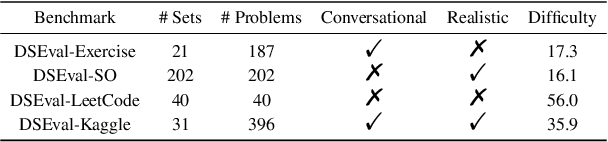
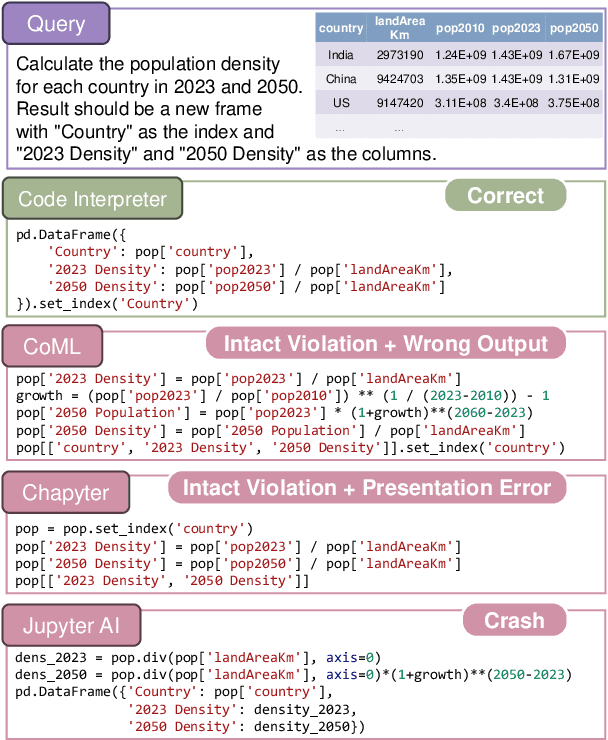

In the era of data-driven decision-making, the complexity of data analysis necessitates advanced expertise and tools of data science, presenting significant challenges even for specialists. Large Language Models (LLMs) have emerged as promising aids as data science agents, assisting humans in data analysis and processing. Yet their practical efficacy remains constrained by the varied demands of real-world applications and complicated analytical process. In this paper, we introduce DSEval -- a novel evaluation paradigm, as well as a series of innovative benchmarks tailored for assessing the performance of these agents throughout the entire data science lifecycle. Incorporating a novel bootstrapped annotation method, we streamline dataset preparation, improve the evaluation coverage, and expand benchmarking comprehensiveness. Our findings uncover prevalent obstacles and provide critical insights to inform future advancements in the field.
MLCopilot: Unleashing the Power of Large Language Models in Solving Machine Learning Tasks
Apr 28, 2023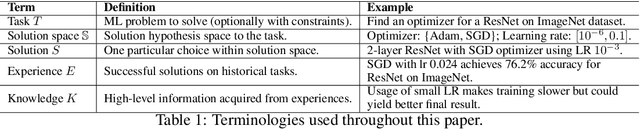
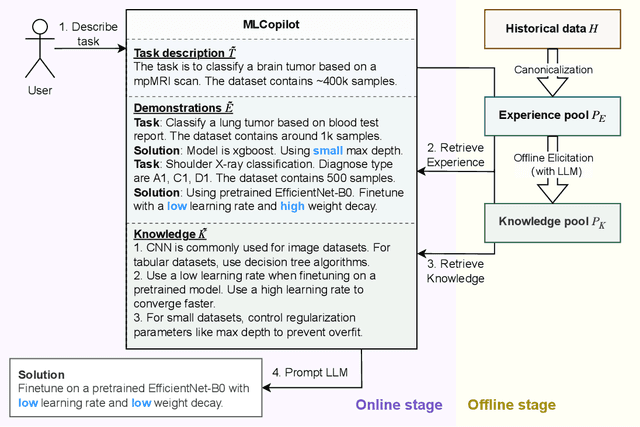
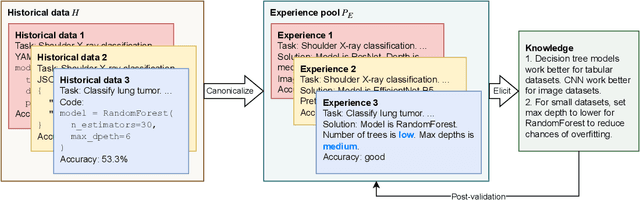
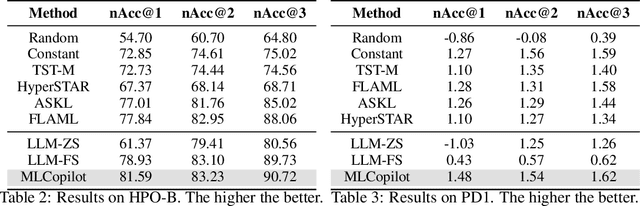
The field of machine learning (ML) has gained widespread adoption, leading to a significant demand for adapting ML to specific scenarios, which is yet expensive and non-trivial. The predominant approaches towards the automation of solving ML tasks (e.g., AutoML) are often time consuming and hard to understand for human developers. In contrast, though human engineers have the incredible ability to understand tasks and reason about solutions, their experience and knowledge are often sparse and difficult to utilize by quantitative approaches. In this paper, we aim to bridge the gap between machine intelligence and human knowledge by introducing a novel framework MLCopilot, which leverages the state-of-the-art LLMs to develop ML solutions for novel tasks. We showcase the possibility of extending the capability of LLMs to comprehend structured inputs and perform thorough reasoning for solving novel ML tasks. And we find that, after some dedicated design, the LLM can (i) observe from the existing experiences of ML tasks and (ii) reason effectively to deliver promising results for new tasks. The solution generated can be used directly to achieve high levels of competitiveness.
AutoTaskFormer: Searching Vision Transformers for Multi-task Learning
Apr 20, 2023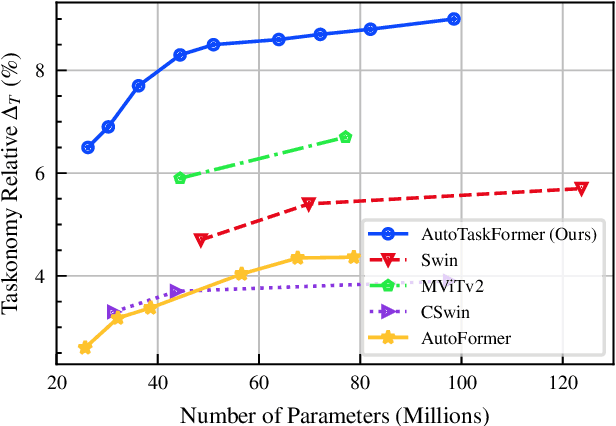
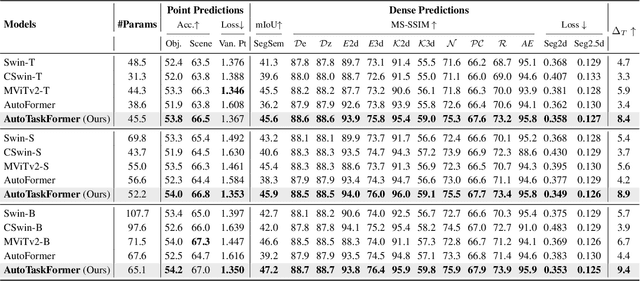
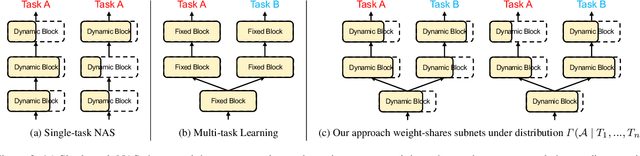

Vision Transformers have shown great performance in single tasks such as classification and segmentation. However, real-world problems are not isolated, which calls for vision transformers that can perform multiple tasks concurrently. Existing multi-task vision transformers are handcrafted and heavily rely on human expertise. In this work, we propose a novel one-shot neural architecture search framework, dubbed AutoTaskFormer (Automated Multi-Task Vision TransFormer), to automate this process. AutoTaskFormer not only identifies the weights to share across multiple tasks automatically, but also provides thousands of well-trained vision transformers with a wide range of parameters (e.g., number of heads and network depth) for deployment under various resource constraints. Experiments on both small-scale (2-task Cityscapes and 3-task NYUv2) and large-scale (16-task Taskonomy) datasets show that AutoTaskFormer outperforms state-of-the-art handcrafted vision transformers in multi-task learning. The entire code and models will be open-sourced.
Reinforcement Learning with Automated Auxiliary Loss Search
Oct 12, 2022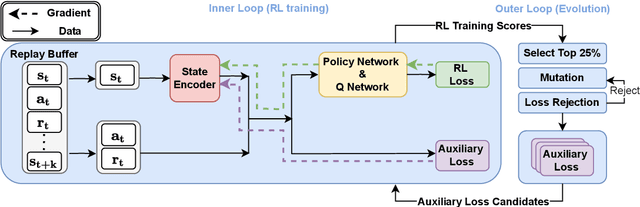
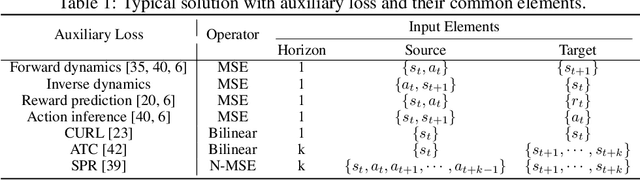
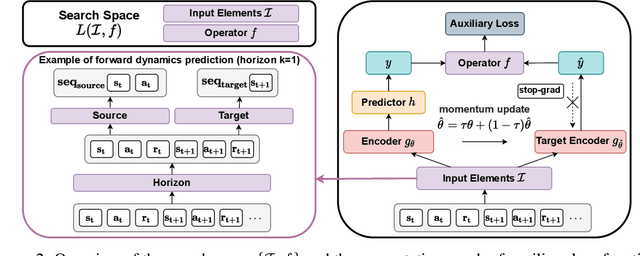
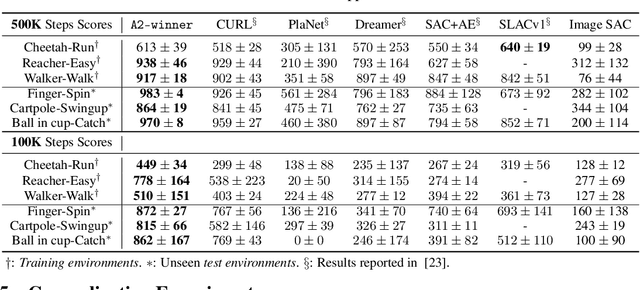
A good state representation is crucial to solving complicated reinforcement learning (RL) challenges. Many recent works focus on designing auxiliary losses for learning informative representations. Unfortunately, these handcrafted objectives rely heavily on expert knowledge and may be sub-optimal. In this paper, we propose a principled and universal method for learning better representations with auxiliary loss functions, named Automated Auxiliary Loss Search (A2LS), which automatically searches for top-performing auxiliary loss functions for RL. Specifically, based on the collected trajectory data, we define a general auxiliary loss space of size $7.5 \times 10^{20}$ and explore the space with an efficient evolutionary search strategy. Empirical results show that the discovered auxiliary loss (namely, A2-winner) significantly improves the performance on both high-dimensional (image) and low-dimensional (vector) unseen tasks with much higher efficiency, showing promising generalization ability to different settings and even different benchmark domains. We conduct a statistical analysis to reveal the relations between patterns of auxiliary losses and RL performance.
Privacy-preserving Online AutoML for Domain-Specific Face Detection
Mar 16, 2022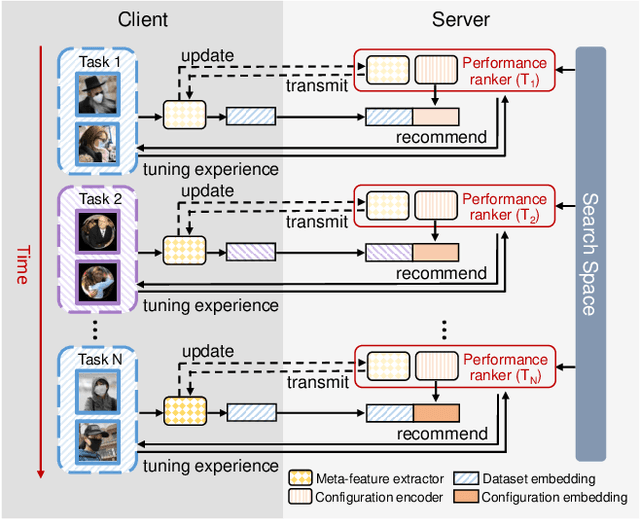
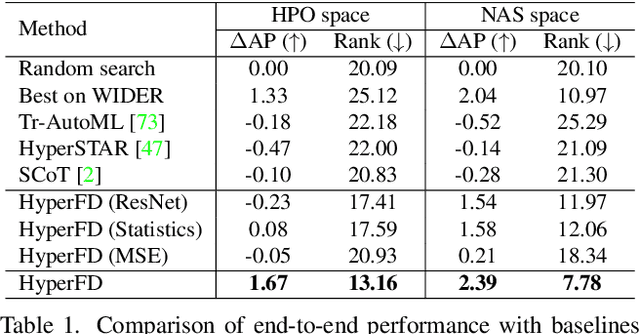
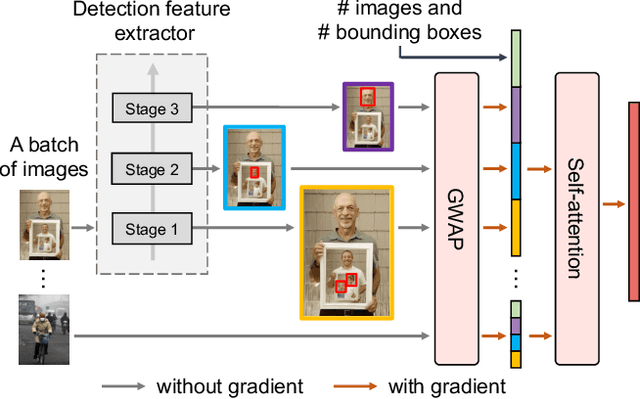
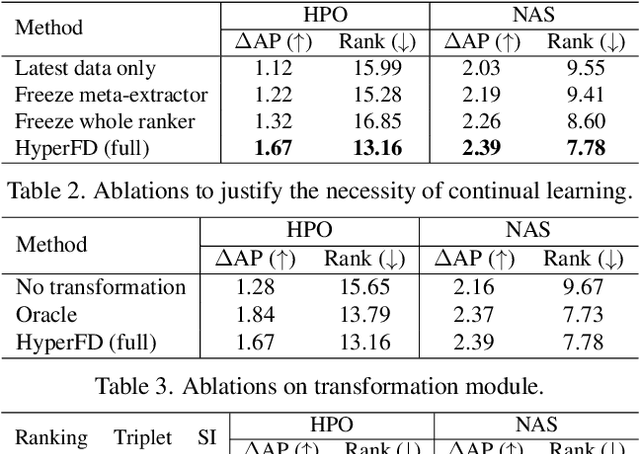
Despite the impressive progress of general face detection, the tuning of hyper-parameters and architectures is still critical for the performance of a domain-specific face detector. Though existing AutoML works can speedup such process, they either require tuning from scratch for a new scenario or do not consider data privacy. To scale up, we derive a new AutoML setting from a platform perspective. In such setting, new datasets sequentially arrive at the platform, where an architecture and hyper-parameter configuration is recommended to train the optimal face detector for each dataset. This, however, brings two major challenges: (1) how to predict the best configuration for any given dataset without touching their raw images due to the privacy concern? and (2) how to continuously improve the AutoML algorithm from previous tasks and offer a better warm-up for future ones? We introduce "HyperFD", a new privacy-preserving online AutoML framework for face detection. At its core part, a novel meta-feature representation of a dataset as well as its learning paradigm is proposed. Thanks to HyperFD, each local task (client) is able to effectively leverage the learning "experience" of previous tasks without uploading raw images to the platform; meanwhile, the meta-feature extractor is continuously learned to better trade off the bias and variance. Extensive experiments demonstrate the effectiveness and efficiency of our design.
Full-Cycle Energy Consumption Benchmark for Low-Carbon Computer Vision
Aug 30, 2021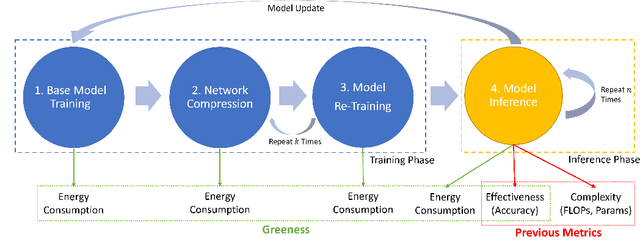
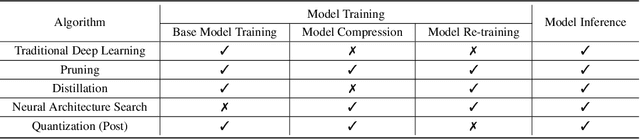

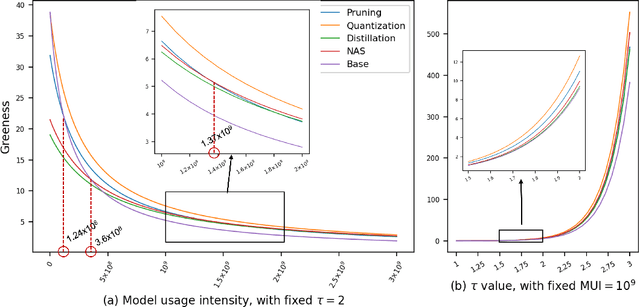
The energy consumption of deep learning models is increasing at a breathtaking rate, which raises concerns due to potential negative effects on carbon neutrality in the context of global warming and climate change. With the progress of efficient deep learning techniques, e.g., model compression, researchers can obtain efficient models with fewer parameters and smaller latency. However, most of the existing efficient deep learning methods do not explicitly consider energy consumption as a key performance indicator. Furthermore, existing methods mostly focus on the inference costs of the resulting efficient models, but neglect the notable energy consumption throughout the entire life cycle of the algorithm. In this paper, we present the first large-scale energy consumption benchmark for efficient computer vision models, where a new metric is proposed to explicitly evaluate the full-cycle energy consumption under different model usage intensity. The benchmark can provide insights for low carbon emission when selecting efficient deep learning algorithms in different model usage scenarios.