 Add to Chrome
 Add to Firefox
 Add to Edge
Geometry-Grounded Unified 3D Perception for Autonomous Driving
Aug 13, 2026
Camera-based autonomous driving perception requires a shared representation that preserves metric 3D structure across synchronized multi-camera streams. However, existing image-based frameworks often rely on backbones pretrained for semantic recognition, and introduce 3D geometry through downstream task-specific modules. As a result, their shared representations may fail to preserve explicit metric geometry and consistent 3D scene structure. In this paper, we present a Geometry-grounded Unified 3D Perception (GeoUP) framework that adapts the reconstruction-oriented latent of VGGT to calibrated, streaming multi-camera driving scenes. GeoUP factorizes cross-image interaction into self, temporal, and view attention to capture structurally distinct temporal and cross-view correspondences. It further injects calibration-aware raymap encodings to provide metric scale and camera geometry. The resulting geometry-grounded latent is decoded for metric depth estimation, 3D object detection, and semantic occupancy prediction, corresponding to surface-, instance-, and volume-level readouts of the same 3D scene. Through joint multi-task and multi-dataset training, GeoUP effectively leverages heterogeneous annotations and generalizes across diverse sensor configurations and perception ranges. Extensive experiments on nuScenes, Argoverse 2, Waymo, KITTI, and DDAD demonstrate that GeoUP achieves SOTA performance across detection, occupancy, and depth estimation. These results validate the effectiveness of geometry-grounded representations for unified 3D driving perception.

ViSTR-Bench: Can MLLMs Reason from Continuous Visual Cues in Dynamic Scenes?
Jul 23, 2026Multimodal Large Language Models (MLLMs) have achieved remarkable success across diverse expert-level tasks, but they still struggle with fundamental abilities that humans naturally develop through continuous observation of the real world, such as spatial perception and dynamic reasoning. Recent studies have recognized this gap and introduced dedicated benchmarks to evaluate the spatial-temporal capabilities of MLLMs. However, existing benchmarks mostly focus on static scenes or require exact quantitative predictions, leaving intuitive reasoning from temporal cues largely underexplored. In this paper, we introduce the Visual Spatial-Temporal Reasoning Benchmark (ViSTR-Bench), a novel evaluation suite designed to systematically assess whether MLLMs can perform qualitative reasoning from continuous visual cues in dynamic scenes. Guided by the principles of temporal emphasis, reasoning orientation, and qualitative evaluation, ViSTR-Bench establishes a comprehensive four-dimensional evaluations covering Motion Perception, Spatial Relations, Outcome Prediction, and Physical Dynamics. The benchmark comprises 15 distinct subtasks and 1,340 high-quality video question-answer pairs spanning diverse tabletop, indoor, and outdoor scenarios. Extensive evaluations of a broad spectrum of state-of-the-art proprietary, open-source, and specialized spatial MLLMs reveal that, despite their strong general video understanding capabilities, current models still face substantial bottlenecks in complex spatial-temporal reasoning and remain far below human performance.
Generative Lane Topology Reasoning via Autoregressive Model with Geometry Prior
Jun 30, 2026Lane topology reasoning aims to construct a lane graph from onboard sensor observations. Existing methods follow a detection and association paradigm that treats each lane instance independently, leading to geometric inconsistency at connected endpoints and incomplete graphs due to visual occlusions. To address these issues, we propose TopoGPT, a generative framework that learns the geometry prior from typical lane graph structures through autoregressive sequence modeling. Specifically, we construct a large-scale map dataset comprising 3.3M scenes. For each lane graph, a lane tokenizer serializes it into discrete tokens, while a scene context encoder converts it into a rasterized image and extracts global features as scene tokens. We pre-train an autoregressive lane sequence transformer via scene-conditioned next-token prediction, endowing the model with the geometry prior over lane graph structures. Building upon this prior, a perception adapter aligns BEV features from multi-view images with the pre-trained scene condition, transferring the learned geometry prior to sensor-based lane graph prediction. On the OpenLane-V2 benchmark, TopoGPT outperforms existing methods by an average of +6.4 on lane-level and +11.6 on point-level metrics, and produces geometrically consistent and structurally complete lane graphs.
Geometry-Guided 3D Visual Token Pruning for Video-Language Models
Apr 20, 2026Multimodal large language models have demonstrated remarkable capabilities in 2D vision, motivating their extension to 3D scene understanding. Recent studies represent 3D scenes as 3D spatial videos composed of image sequences with depth and camera pose information, enabling pre-trained video-language models to perform 3D reasoning tasks. However, the large number of visual tokens in spatial videos remains a major bottleneck for efficient inference and context management. Existing pruning methods overlook the view consistency of spatial videos and the spatial diversity of the remaining tokens, which prevents them from effectively removing inter-frame redundancy and preserving scene completeness. In this paper, we propose Geo3DPruner, a Geometry-Guided 3D Visual Token Pruning framework. Geo3DPruner first models cross-frame relevance through geometry-aware global attention, and then performs a two-stage pruning process. The intra-voxel stage selects representative multi-view features within each voxel, while the inter-voxel stage preserves spatial diversity by selecting a globally distributed subset of voxels. Extensive experiments on multiple 3D scene understanding benchmarks demonstrate that Geo3DPruner retains over 90% of the original performance while pruning 90% of visual tokens, significantly outperforming existing text-guided and vision-guided pruning methods.
Utonia: Toward One Encoder for All Point Clouds
Mar 03, 2026We dream of a future where point clouds from all domains can come together to shape a single model that benefits them all. Toward this goal, we present Utonia, a first step toward training a single self-supervised point transformer encoder across diverse domains, spanning remote sensing, outdoor LiDAR, indoor RGB-D sequences, object-centric CAD models, and point clouds lifted from RGB-only videos. Despite their distinct sensing geometries, densities, and priors, Utonia learns a consistent representation space that transfers across domains. This unification improves perception capability while revealing intriguing emergent behaviors that arise only when domains are trained jointly. Beyond perception, we observe that Utonia representations can also benefit embodied and multimodal reasoning: conditioning vision-language-action policies on Utonia features improves robotic manipulation, and integrating them into vision-language models yields gains on spatial reasoning. We hope Utonia can serve as a step toward foundation models for sparse 3D data, and support downstream applications in AR/VR, robotics, and autonomous driving.
Anchor3DLane++: 3D Lane Detection via Sample-Adaptive Sparse 3D Anchor Regression
Dec 22, 2024In this paper, we focus on the challenging task of monocular 3D lane detection. Previous methods typically adopt inverse perspective mapping (IPM) to transform the Front-Viewed (FV) images or features into the Bird-Eye-Viewed (BEV) space for lane detection. However, IPM's dependence on flat ground assumption and context information loss in BEV representations lead to inaccurate 3D information estimation. Though efforts have been made to bypass BEV and directly predict 3D lanes from FV representations, their performances still fall behind BEV-based methods due to a lack of structured modeling of 3D lanes. In this paper, we propose a novel BEV-free method named Anchor3DLane++ which defines 3D lane anchors as structural representations and makes predictions directly from FV features. We also design a Prototype-based Adaptive Anchor Generation (PAAG) module to generate sample-adaptive sparse 3D anchors dynamically. In addition, an Equal-Width (EW) loss is developed to leverage the parallel property of lanes for regularization. Furthermore, camera-LiDAR fusion is also explored based on Anchor3DLane++ to leverage complementary information. Extensive experiments on three popular 3D lane detection benchmarks show that our Anchor3DLane++ outperforms previous state-of-the-art methods. Code is available at: https://github.com/tusen-ai/Anchor3DLane.
MV2DFusion: Leveraging Modality-Specific Object Semantics for Multi-Modal 3D Detection
Aug 12, 2024The rise of autonomous vehicles has significantly increased the demand for robust 3D object detection systems. While cameras and LiDAR sensors each offer unique advantages--cameras provide rich texture information and LiDAR offers precise 3D spatial data--relying on a single modality often leads to performance limitations. This paper introduces MV2DFusion, a multi-modal detection framework that integrates the strengths of both worlds through an advanced query-based fusion mechanism. By introducing an image query generator to align with image-specific attributes and a point cloud query generator, MV2DFusion effectively combines modality-specific object semantics without biasing toward one single modality. Then the sparse fusion process can be accomplished based on the valuable object semantics, ensuring efficient and accurate object detection across various scenarios. Our framework's flexibility allows it to integrate with any image and point cloud-based detectors, showcasing its adaptability and potential for future advancements. Extensive evaluations on the nuScenes and Argoverse2 datasets demonstrate that MV2DFusion achieves state-of-the-art performance, particularly excelling in long-range detection scenarios.
Enhancing 3D Lane Detection and Topology Reasoning with 2D Lane Priors
Jun 05, 2024


3D lane detection and topology reasoning are essential tasks in autonomous driving scenarios, requiring not only detecting the accurate 3D coordinates on lane lines, but also reasoning the relationship between lanes and traffic elements. Current vision-based methods, whether explicitly constructing BEV features or not, all establish the lane anchors/queries in 3D space while ignoring the 2D lane priors. In this study, we propose Topo2D, a novel framework based on Transformer, leveraging 2D lane instances to initialize 3D queries and 3D positional embeddings. Furthermore, we explicitly incorporate 2D lane features into the recognition of topology relationships among lane centerlines and between lane centerlines and traffic elements. Topo2D achieves 44.5% OLS on multi-view topology reasoning benchmark OpenLane-V2 and 62.6% F-Socre on single-view 3D lane detection benchmark OpenLane, exceeding the performance of existing state-of-the-art methods.
SparseFusion: Efficient Sparse Multi-Modal Fusion Framework for Long-Range 3D Perception
Mar 15, 2024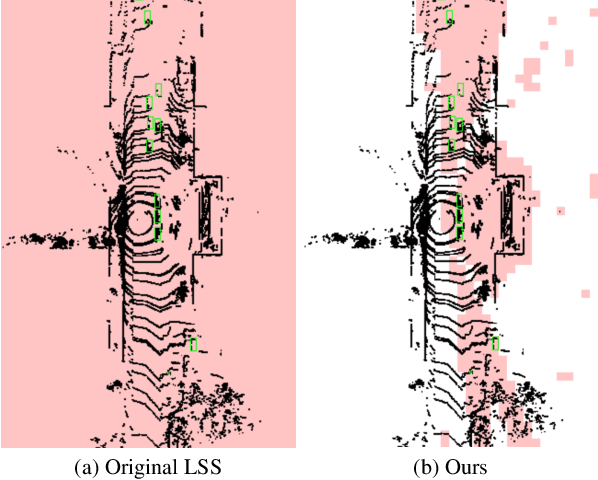


Multi-modal 3D object detection has exhibited significant progress in recent years. However, most existing methods can hardly scale to long-range scenarios due to their reliance on dense 3D features, which substantially escalate computational demands and memory usage. In this paper, we introduce SparseFusion, a novel multi-modal fusion framework fully built upon sparse 3D features to facilitate efficient long-range perception. The core of our method is the Sparse View Transformer module, which selectively lifts regions of interest in 2D image space into the unified 3D space. The proposed module introduces sparsity from both semantic and geometric aspects which only fill grids that foreground objects potentially reside in. Comprehensive experiments have verified the efficiency and effectiveness of our framework in long-range 3D perception. Remarkably, on the long-range Argoverse2 dataset, SparseFusion reduces memory footprint and accelerates the inference by about two times compared to dense detectors. It also achieves state-of-the-art performance with mAP of 41.2% and CDS of 32.1%. The versatility of SparseFusion is also validated in the temporal object detection task and 3D lane detection task. Codes will be released upon acceptance.
TSTTC: A Large-Scale Dataset for Time-to-Contact Estimation in Driving Scenarios
Sep 06, 2023Time-to-Contact (TTC) estimation is a critical task for assessing collision risk and is widely used in various driver assistance and autonomous driving systems. The past few decades have witnessed development of related theories and algorithms. The prevalent learning-based methods call for a large-scale TTC dataset in real-world scenarios. In this work, we present a large-scale object oriented TTC dataset in the driving scene for promoting the TTC estimation by a monocular camera. To collect valuable samples and make data with different TTC values relatively balanced, we go through thousands of hours of driving data and select over 200K sequences with a preset data distribution. To augment the quantity of small TTC cases, we also generate clips using the latest Neural rendering methods. Additionally, we provide several simple yet effective TTC estimation baselines and evaluate them extensively on the proposed dataset to demonstrate their effectiveness. The proposed dataset is publicly available at https://open-dataset.tusen.ai/TSTTC.