 Add to Chrome
 Add to Firefox
 Add to Edge
GL-PGENet: A Parameterized Generation Framework for Robust Document Image Enhancement
May 28, 2025
Document Image Enhancement (DIE) serves as a critical component in Document AI systems, where its performance substantially determines the effectiveness of downstream tasks. To address the limitations of existing methods confined to single-degradation restoration or grayscale image processing, we present Global with Local Parametric Generation Enhancement Network (GL-PGENet), a novel architecture designed for multi-degraded color document images, ensuring both efficiency and robustness in real-world scenarios. Our solution incorporates three key innovations: First, a hierarchical enhancement framework that integrates global appearance correction with local refinement, enabling coarse-to-fine quality improvement. Second, a Dual-Branch Local-Refine Network with parametric generation mechanisms that replaces conventional direct prediction, producing enhanced outputs through learned intermediate parametric representations rather than pixel-wise mapping. This approach enhances local consistency while improving model generalization. Finally, a modified NestUNet architecture incorporating dense block to effectively fuse low-level pixel features and high-level semantic features, specifically adapted for document image characteristics. In addition, to enhance generalization performance, we adopt a two-stage training strategy: large-scale pretraining on a synthetic dataset of 500,000+ samples followed by task-specific fine-tuning. Extensive experiments demonstrate the superiority of GL-PGENet, achieving state-of-the-art SSIM scores of 0.7721 on DocUNet and 0.9480 on RealDAE. The model also exhibits remarkable cross-domain adaptability and maintains computational efficiency for high-resolution images without performance degradation, confirming its practical utility in real-world scenarios.

DenseLoRA: Dense Low-Rank Adaptation of Large Language Models
May 27, 2025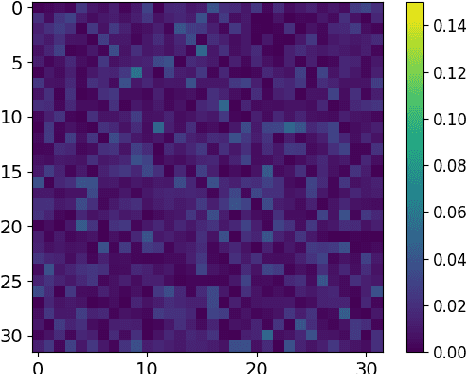
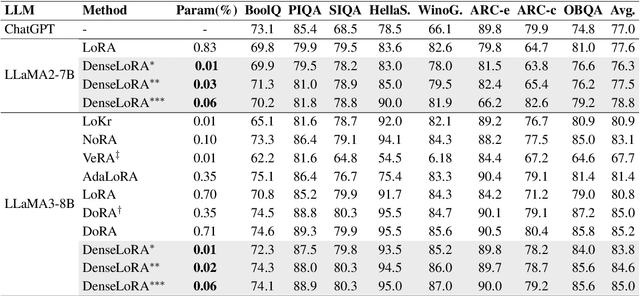
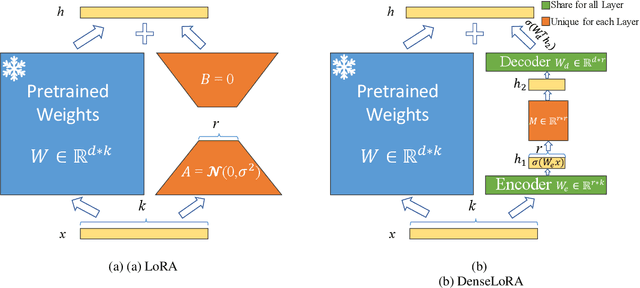

Low-rank adaptation (LoRA) has been developed as an efficient approach for adapting large language models (LLMs) by fine-tuning two low-rank matrices, thereby reducing the number of trainable parameters. However, prior research indicates that many of the weights in these matrices are redundant, leading to inefficiencies in parameter utilization. To address this limitation, we introduce Dense Low-Rank Adaptation (DenseLoRA), a novel approach that enhances parameter efficiency while achieving superior performance compared to LoRA. DenseLoRA builds upon the concept of representation fine-tuning, incorporating a single Encoder-Decoder to refine and compress hidden representations across all adaptation layers before applying adaptation. Instead of relying on two redundant low-rank matrices as in LoRA, DenseLoRA adapts LLMs through a dense low-rank matrix, improving parameter utilization and adaptation efficiency. We evaluate DenseLoRA on various benchmarks, showing that it achieves 83.8% accuracy with only 0.01% of trainable parameters, compared to LoRA's 80.8% accuracy with 0.70% of trainable parameters on LLaMA3-8B. Additionally, we conduct extensive experiments to systematically assess the impact of DenseLoRA's components on overall model performance. Code is available at https://github.com/mulin-ahu/DenseLoRA.
REGen: Multimodal Retrieval-Embedded Generation for Long-to-Short Video Editing
May 24, 2025Short videos are an effective tool for promoting contents and improving knowledge accessibility. While existing extractive video summarization methods struggle to produce a coherent narrative, existing abstractive methods cannot `quote' from the input videos, i.e., inserting short video clips in their outputs. In this work, we explore novel video editing models for generating shorts that feature a coherent narrative with embedded video insertions extracted from a long input video. We propose a novel retrieval-embedded generation framework that allows a large language model to quote multimodal resources while maintaining a coherent narrative. Our proposed REGen system first generates the output story script with quote placeholders using a finetuned large language model, and then uses a novel retrieval model to replace the quote placeholders by selecting a video clip that best supports the narrative from a pool of candidate quotable video clips. We examine the proposed method on the task of documentary teaser generation, where short interview insertions are commonly used to support the narrative of a documentary. Our objective evaluations show that the proposed method can effectively insert short video clips while maintaining a coherent narrative. In a subjective survey, we show that our proposed method outperforms existing abstractive and extractive approaches in terms of coherence, alignment, and realism in teaser generation.
TacCompress: A Benchmark for Multi-Point Tactile Data Compression in Dexterous Manipulation
May 22, 2025Though robotic dexterous manipulation has progressed substantially recently, challenges like in-hand occlusion still necessitate fine-grained tactile perception, leading to the integration of more tactile sensors into robotic hands. Consequently, the increased data volume imposes substantial bandwidth pressure on signal transmission from the hand's controller. However, the acquisition and compression of multi-point tactile signals based on the dexterous hands' physical structures have not been thoroughly explored. In this paper, our contributions are twofold. First, we introduce a Multi-Point Tactile Dataset for Dexterous Hand Grasping (Dex-MPTD). This dataset captures tactile signals from multiple contact sensors across various objects and grasping poses, offering a comprehensive benchmark for advancing dexterous robotic manipulation research. Second, we investigate both lossless and lossy compression on Dex-MPTD by converting tactile data into images and applying six lossless and five lossy image codecs for efficient compression. Experimental results demonstrate that tactile data can be losslessly compressed to as low as 0.0364 bits per sub-sample (bpss), achieving approximately 200$\times$ compression ratio compared to the raw tactile data. Efficient lossy compressors like HM and VTM can achieve about 1000x data reductions while preserving acceptable data fidelity. The exploration of lossy compression also reveals that screen-content-targeted coding tools outperform general-purpose codecs in compressing tactile data.
EcomScriptBench: A Multi-task Benchmark for E-commerce Script Planning via Step-wise Intention-Driven Product Association
May 21, 2025Goal-oriented script planning, or the ability to devise coherent sequences of actions toward specific goals, is commonly employed by humans to plan for typical activities. In e-commerce, customers increasingly seek LLM-based assistants to generate scripts and recommend products at each step, thereby facilitating convenient and efficient shopping experiences. However, this capability remains underexplored due to several challenges, including the inability of LLMs to simultaneously conduct script planning and product retrieval, difficulties in matching products caused by semantic discrepancies between planned actions and search queries, and a lack of methods and benchmark data for evaluation. In this paper, we step forward by formally defining the task of E-commerce Script Planning (EcomScript) as three sequential subtasks. We propose a novel framework that enables the scalable generation of product-enriched scripts by associating products with each step based on the semantic similarity between the actions and their purchase intentions. By applying our framework to real-world e-commerce data, we construct the very first large-scale EcomScript dataset, EcomScriptBench, which includes 605,229 scripts sourced from 2.4 million products. Human annotations are then conducted to provide gold labels for a sampled subset, forming an evaluation benchmark. Extensive experiments reveal that current (L)LMs face significant challenges with EcomScript tasks, even after fine-tuning, while injecting product purchase intentions improves their performance.
GT^2-GS: Geometry-aware Texture Transfer for Gaussian Splatting
May 21, 2025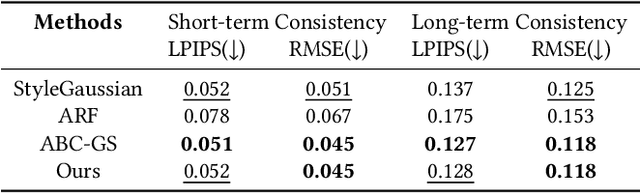
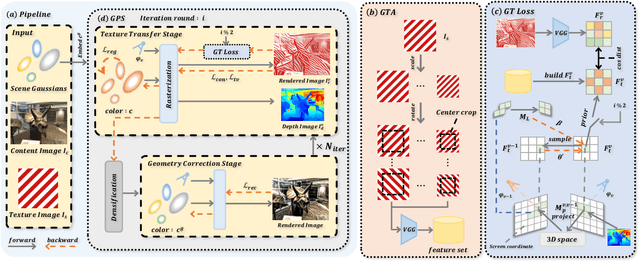

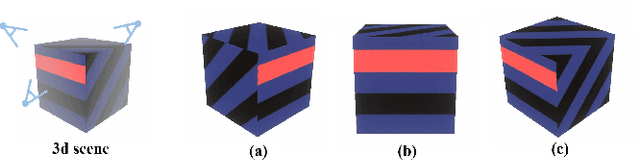
Transferring 2D textures to 3D modalities is of great significance for improving the efficiency of multimedia content creation. Existing approaches have rarely focused on transferring image textures onto 3D representations. 3D style transfer methods are capable of transferring abstract artistic styles to 3D scenes. However, these methods often overlook the geometric information of the scene, which makes it challenging to achieve high-quality 3D texture transfer results. In this paper, we present GT^2-GS, a geometry-aware texture transfer framework for gaussian splitting. From the perspective of matching texture features with geometric information in rendered views, we identify the issue of insufficient texture features and propose a geometry-aware texture augmentation module to expand the texture feature set. Moreover, a geometry-consistent texture loss is proposed to optimize texture features into the scene representation. This loss function incorporates both camera pose and 3D geometric information of the scene, enabling controllable texture-oriented appearance editing. Finally, a geometry preservation strategy is introduced. By alternating between the texture transfer and geometry correction stages over multiple iterations, this strategy achieves a balance between learning texture features and preserving geometric integrity. Extensive experiments demonstrate the effectiveness and controllability of our method. Through geometric awareness, our approach achieves texture transfer results that better align with human visual perception. Our homepage is available at https://vpx-ecnu.github.io/GT2-GS-website.
LMP: Leveraging Motion Prior in Zero-Shot Video Generation with Diffusion Transformer
May 20, 2025In recent years, large-scale pre-trained diffusion transformer models have made significant progress in video generation. While current DiT models can produce high-definition, high-frame-rate, and highly diverse videos, there is a lack of fine-grained control over the video content. Controlling the motion of subjects in videos using only prompts is challenging, especially when it comes to describing complex movements. Further, existing methods fail to control the motion in image-to-video generation, as the subject in the reference image often differs from the subject in the reference video in terms of initial position, size, and shape. To address this, we propose the Leveraging Motion Prior (LMP) framework for zero-shot video generation. Our framework harnesses the powerful generative capabilities of pre-trained diffusion transformers to enable motion in the generated videos to reference user-provided motion videos in both text-to-video and image-to-video generation. To this end, we first introduce a foreground-background disentangle module to distinguish between moving subjects and backgrounds in the reference video, preventing interference in the target video generation. A reweighted motion transfer module is designed to allow the target video to reference the motion from the reference video. To avoid interference from the subject in the reference video, we propose an appearance separation module to suppress the appearance of the reference subject in the target video. We annotate the DAVIS dataset with detailed prompts for our experiments and design evaluation metrics to validate the effectiveness of our method. Extensive experiments demonstrate that our approach achieves state-of-the-art performance in generation quality, prompt-video consistency, and control capability. Our homepage is available at https://vpx-ecnu.github.io/LMP-Website/
Rethinking Predictive Modeling for LLM Routing: When Simple kNN Beats Complex Learned Routers
May 19, 2025As large language models (LLMs) grow in scale and specialization, routing--selecting the best model for a given input--has become essential for efficient and effective deployment. While recent methods rely on complex learned routing strategies, their dependence on disparate training data and evaluation setups makes comparison and generalization difficult. In this work, we revisit LLM routing through the lens of simplicity. We show that a well-tuned k-Nearest Neighbors (kNN) approach not only matches but often outperforms state-of-the-art learned routers across diverse tasks. To support systematic evaluation, we introduce a suite of standardized routing benchmarks spanning instruction-following, question-answering, and reasoning tasks, as well as the first multi-modal routing dataset involving visual inputs. Our findings reveal that the locality properties of model performance in embedding space enable simple non-parametric methods to achieve strong routing decisions with lower sample complexity than parametric approaches. This challenges the prevailing trend toward sophisticated architectures and highlights the importance of thoroughly evaluating simple baselines before investing in complex solutions. To support reproducibility and further exploration, we will release all benchmarks and code upon publication.
MPS-Prover: Advancing Stepwise Theorem Proving by Multi-Perspective Search and Data Curation
May 16, 2025Automated Theorem Proving (ATP) in formal languages remains a formidable challenge in AI, demanding rigorous logical deduction and navigating vast search spaces. While large language models (LLMs) have shown promising performance, existing stepwise provers often suffer from biased search guidance, leading to inefficiencies and suboptimal proof strategies. This paper introduces the Multi-Perspective Search Prover (MPS-Prover), a novel stepwise ATP system designed to overcome these limitations. MPS-Prover incorporates two key innovations: a highly effective post-training data curation strategy that prunes approximately 40% of redundant training data without sacrificing performance, and a multi-perspective tree search mechanism. This search integrates a learned critic model with strategically designed heuristic rules to diversify tactic selection, prevent getting trapped in unproductive states, and enhance search robustness. Extensive evaluations demonstrate that MPS-Prover achieves state-of-the-art performance on multiple challenging benchmarks, including miniF2F and ProofNet, outperforming prior 7B parameter models. Furthermore, our analyses reveal that MPS-Prover generates significantly shorter and more diverse proofs compared to existing stepwise and whole-proof methods, highlighting its efficiency and efficacy. Our work advances the capabilities of LLM-based formal reasoning and offers a robust framework and a comprehensive analysis for developing more powerful theorem provers.
FlowHFT: Imitation Learning via Flow Matching Policy for Optimal High-Frequency Trading under Diverse Market Conditions
May 16, 2025High-frequency trading (HFT) is an investing strategy that continuously monitors market states and places bid and ask orders at millisecond speeds. Traditional HFT approaches fit models with historical data and assume that future market states follow similar patterns. This limits the effectiveness of any single model to the specific conditions it was trained for. Additionally, these models achieve optimal solutions only under specific market conditions, such as assumptions about stock price's stochastic process, stable order flow, and the absence of sudden volatility. Real-world markets, however, are dynamic, diverse, and frequently volatile. To address these challenges, we propose the FlowHFT, a novel imitation learning framework based on flow matching policy. FlowHFT simultaneously learns strategies from numerous expert models, each proficient in particular market scenarios. As a result, our framework can adaptively adjust investment decisions according to the prevailing market state. Furthermore, FlowHFT incorporates a grid-search fine-tuning mechanism. This allows it to refine strategies and achieve superior performance even in complex or extreme market scenarios where expert strategies may be suboptimal. We test FlowHFT in multiple market environments. We first show that flow matching policy is applicable in stochastic market environments, thus enabling FlowHFT to learn trading strategies under different market conditions. Notably, our single framework consistently achieves performance superior to the best expert for each market condition.