 Add to Chrome
 Add to Firefox
 Add to Edge
Earlier Tokens Contribute More: Learning Direct Preference Optimization From Temporal Decay Perspective
Feb 20, 2025
Direct Preference Optimization (DPO) has gained attention as an efficient alternative to reinforcement learning from human feedback (RLHF) for aligning large language models (LLMs) with human preferences. Despite its advantages, DPO suffers from a length bias, generating responses longer than those from the reference model. Existing solutions like SimPO and SamPO address this issue but uniformly treat the contribution of rewards across sequences, overlooking temporal dynamics. To this end, we propose an enhanced preference optimization method that incorporates a temporal decay factor controlled by a gamma parameter. This dynamic weighting mechanism adjusts the influence of each reward based on its position in the sequence, prioritizing earlier tokens that are more critical for alignment. By adaptively focusing on more relevant feedback, our approach mitigates overfitting to less pertinent data and remains responsive to evolving human preferences. Experimental results on several benchmarks show that our approach consistently outperforms vanilla DPO by 5.9-8.8 points on AlpacaEval 2 and 3.3-9.7 points on Arena-Hard across different model architectures and sizes. Furthermore, additional experiments on mathematical and reasoning benchmarks (MMLU, GSM8K, and MATH) confirm that our method enhances performance without compromising general capabilities. Our codebase would be available at \url{https://github.com/LotuSrc/D2PO}.

Beyond Prompt Content: Enhancing LLM Performance via Content-Format Integrated Prompt Optimization
Feb 10, 2025Large Language Models (LLMs) have shown significant capability across various tasks, with their real-world effectiveness often driven by prompt design. While recent research has focused on optimizing prompt content, the role of prompt formatting, a critical but often overlooked dimension, has received limited systematic investigation. In this paper, we introduce Content-Format Integrated Prompt Optimization (CFPO), an innovative methodology that jointly optimizes both prompt content and formatting through an iterative refinement process. CFPO leverages natural language mutations to explore content variations and employs a dynamic format exploration strategy that systematically evaluates diverse format options. Our extensive evaluations across multiple tasks and open-source LLMs demonstrate that CFPO demonstrates measurable performance improvements compared to content-only optimization methods. This highlights the importance of integrated content-format optimization and offers a practical, model-agnostic approach to enhancing LLM performance. Code is available at https://github.com/HenryLau7/CFPO.
Homeomorphism Prior for False Positive and Negative Problem in Medical Image Dense Contrastive Representation Learning
Feb 07, 2025Dense contrastive representation learning (DCRL) has greatly improved the learning efficiency for image-dense prediction tasks, showing its great potential to reduce the large costs of medical image collection and dense annotation. However, the properties of medical images make unreliable correspondence discovery, bringing an open problem of large-scale false positive and negative (FP&N) pairs in DCRL. In this paper, we propose GEoMetric vIsual deNse sImilarity (GEMINI) learning which embeds the homeomorphism prior to DCRL and enables a reliable correspondence discovery for effective dense contrast. We propose a deformable homeomorphism learning (DHL) which models the homeomorphism of medical images and learns to estimate a deformable mapping to predict the pixels' correspondence under topological preservation. It effectively reduces the searching space of pairing and drives an implicit and soft learning of negative pairs via a gradient. We also propose a geometric semantic similarity (GSS) which extracts semantic information in features to measure the alignment degree for the correspondence learning. It will promote the learning efficiency and performance of deformation, constructing positive pairs reliably. We implement two practical variants on two typical representation learning tasks in our experiments. Our promising results on seven datasets which outperform the existing methods show our great superiority. We will release our code on a companion link: https://github.com/YutingHe-list/GEMINI.
Gaze-Assisted Human-Centric Domain Adaptation for Cardiac Ultrasound Image Segmentation
Feb 06, 2025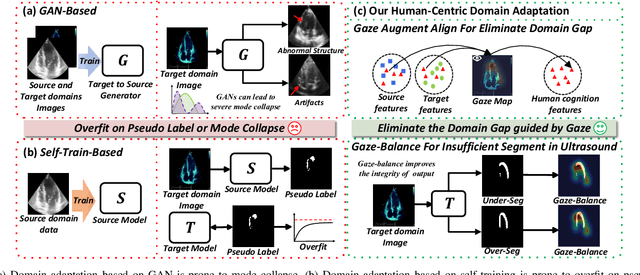
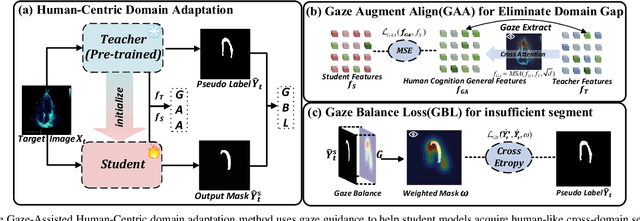
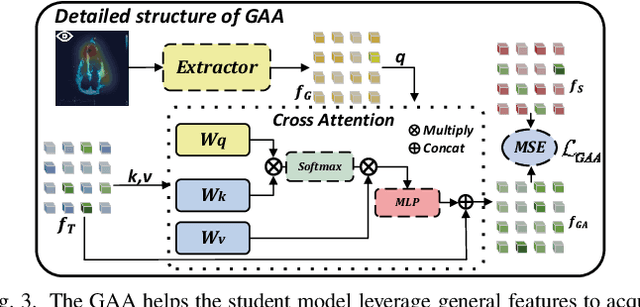
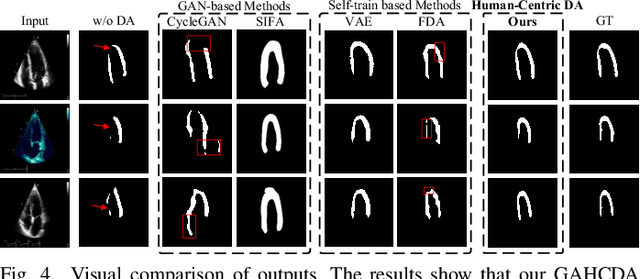
Domain adaptation (DA) for cardiac ultrasound image segmentation is clinically significant and valuable. However, previous domain adaptation methods are prone to be affected by the incomplete pseudo-label and low-quality target to source images. Human-centric domain adaptation has great advantages of human cognitive guidance to help model adapt to target domain and reduce reliance on labels. Doctor gaze trajectories contains a large amount of cross-domain human guidance. To leverage gaze information and human cognition for guiding domain adaptation, we propose gaze-assisted human-centric domain adaptation (GAHCDA), which reliably guides the domain adaptation of cardiac ultrasound images. GAHCDA includes following modules: (1) Gaze Augment Alignment (GAA): GAA enables the model to obtain human cognition general features to recognize segmentation target in different domain of cardiac ultrasound images like humans. (2) Gaze Balance Loss (GBL): GBL fused gaze heatmap with outputs which makes the segmentation result structurally closer to the target domain. The experimental results illustrate that our proposed framework is able to segment cardiac ultrasound images more effectively in the target domain than GAN-based methods and other self-train based methods, showing great potential in clinical application.
Adaptive Margin Contrastive Learning for Ambiguity-aware 3D Semantic Segmentation
Feb 06, 2025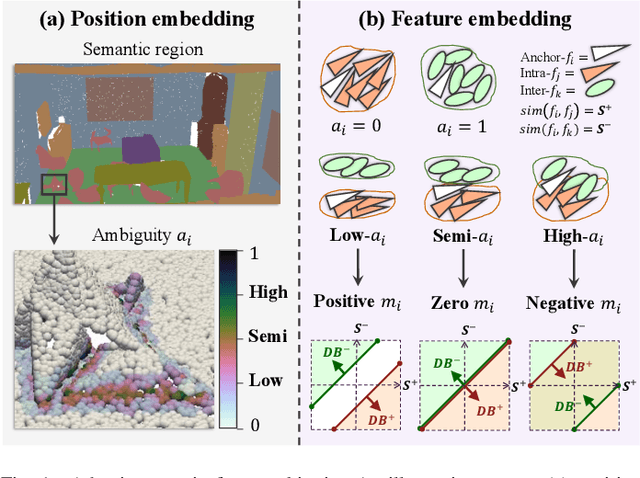
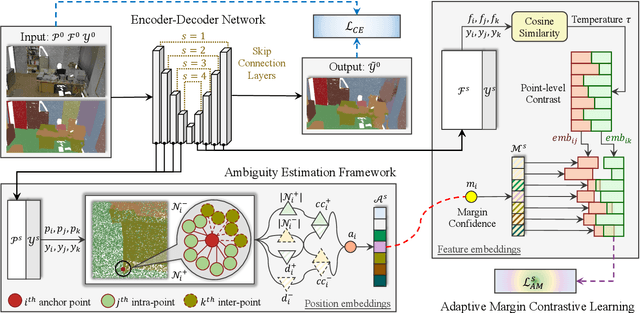
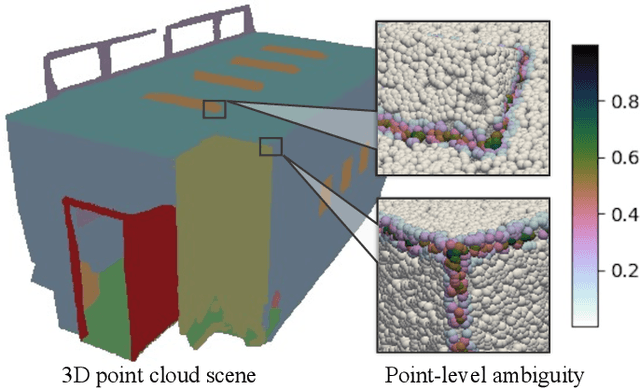
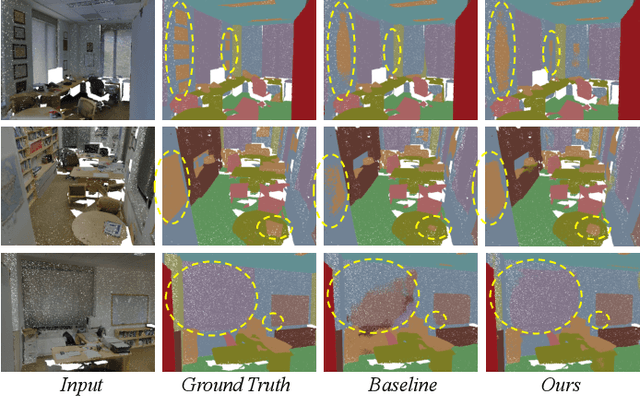
In this paper, we propose an adaptive margin contrastive learning method for 3D point cloud semantic segmentation, namely AMContrast3D. Most existing methods use equally penalized objectives, which ignore per-point ambiguities and less discriminated features stemming from transition regions. However, as highly ambiguous points may be indistinguishable even for humans, their manually annotated labels are less reliable, and hard constraints over these points would lead to sub-optimal models. To address this, we design adaptive objectives for individual points based on their ambiguity levels, aiming to ensure the correctness of low-ambiguity points while allowing mistakes for high-ambiguity points. Specifically, we first estimate ambiguities based on position embeddings. Then, we develop a margin generator to shift decision boundaries for contrastive feature embeddings, so margins are narrowed due to increasing ambiguities with even negative margins for extremely high-ambiguity points. Experimental results on large-scale datasets, S3DIS and ScanNet, demonstrate that our method outperforms state-of-the-art methods.
Exploring Transferable Homogeneous Groups for Compositional Zero-Shot Learning
Jan 18, 2025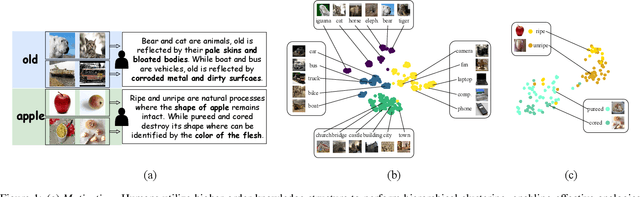
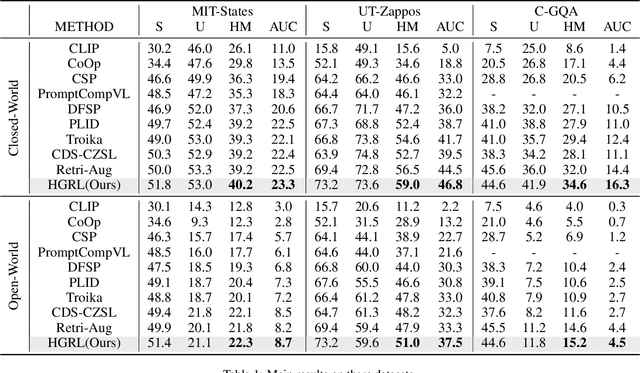
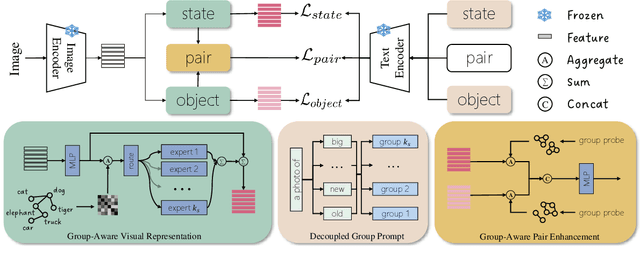
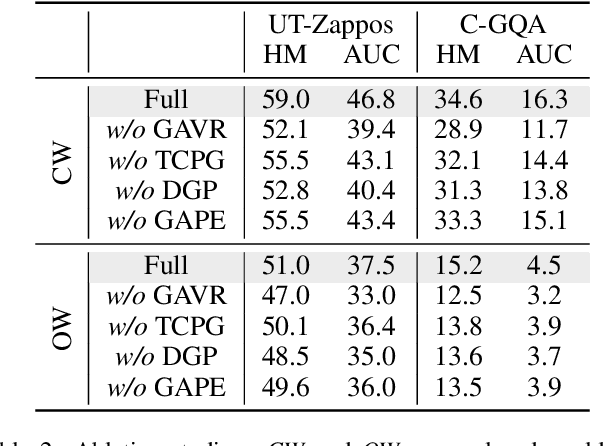
Conditional dependency present one of the trickiest problems in Compositional Zero-Shot Learning, leading to significant property variations of the same state (object) across different objects (states). To address this problem, existing approaches often adopt either all-to-one or one-to-one representation paradigms. However, these extremes create an imbalance in the seesaw between transferability and discriminability, favoring one at the expense of the other. Comparatively, humans are adept at analogizing and reasoning in a hierarchical clustering manner, intuitively grouping categories with similar properties to form cohesive concepts. Motivated by this, we propose Homogeneous Group Representation Learning (HGRL), a new perspective formulates state (object) representation learning as multiple homogeneous sub-group representation learning. HGRL seeks to achieve a balance between semantic transferability and discriminability by adaptively discovering and aggregating categories with shared properties, learning distributed group centers that retain group-specific discriminative features. Our method integrates three core components designed to simultaneously enhance both the visual and prompt representation capabilities of the model. Extensive experiments on three benchmark datasets validate the effectiveness of our method.
Towards Robust and Realistic Human Pose Estimation via WiFi Signals
Jan 16, 2025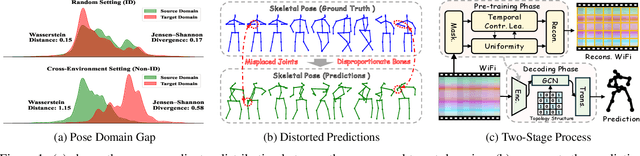
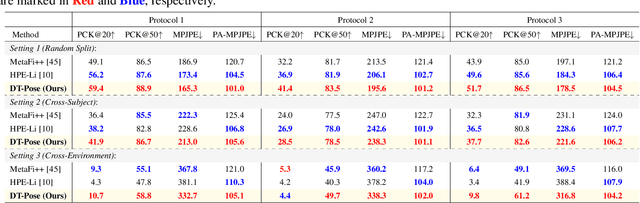
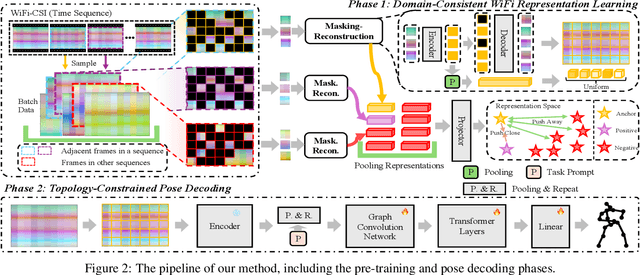
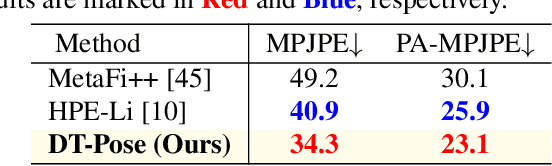
Robust WiFi-based human pose estimation is a challenging task that bridges discrete and subtle WiFi signals to human skeletons. This paper revisits this problem and reveals two critical yet overlooked issues: 1) cross-domain gap, i.e., due to significant variations between source-target domain pose distributions; and 2) structural fidelity gap, i.e., predicted skeletal poses manifest distorted topology, usually with misplaced joints and disproportionate bone lengths. This paper fills these gaps by reformulating the task into a novel two-phase framework dubbed DT-Pose: Domain-consistent representation learning and Topology-constrained Pose decoding. Concretely, we first propose a temporal-consistent contrastive learning strategy with uniformity regularization, coupled with self-supervised masking-reconstruction operations, to enable robust learning of domain-consistent and motion-discriminative WiFi-specific representations. Beyond this, we introduce a simple yet effective pose decoder with task prompts, which integrates Graph Convolution Network (GCN) and Transformer layers to constrain the topology structure of the generated skeleton by exploring the adjacent-overarching relationships among human joints. Extensive experiments conducted on various benchmark datasets highlight the superior performance of our method in tackling these fundamental challenges in both 2D/3D human pose estimation tasks.
DynamicFace: High-Quality and Consistent Video Face Swapping using Composable 3D Facial Priors
Jan 15, 2025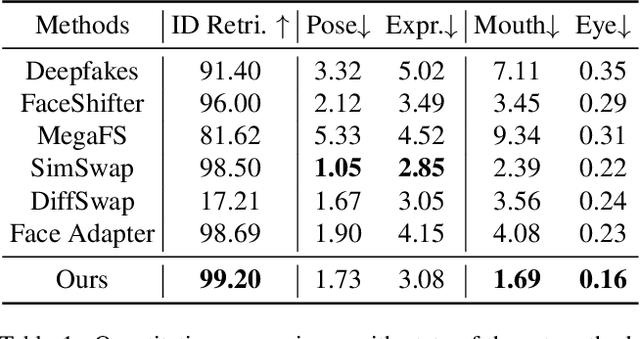
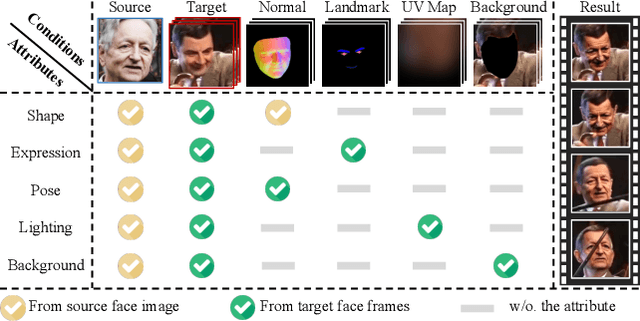

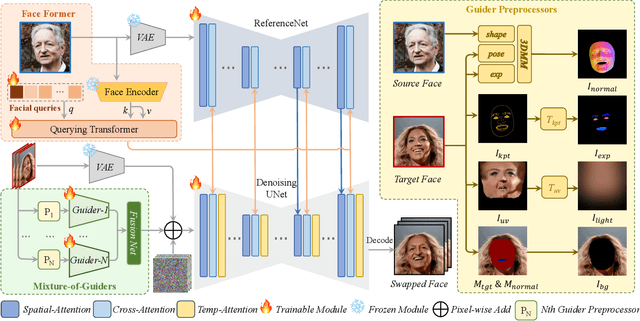
Face swapping transfers the identity of a source face to a target face while retaining the attributes like expression, pose, hair, and background of the target face. Advanced face swapping methods have achieved attractive results. However, these methods often inadvertently transfer identity information from the target face, compromising expression-related details and accurate identity. We propose a novel method DynamicFace that leverages the power of diffusion model and plug-and-play temporal layers for video face swapping. First, we introduce four fine-grained face conditions using 3D facial priors. All conditions are designed to be disentangled from each other for precise and unique control. Then, we adopt Face Former and ReferenceNet for high-level and detailed identity injection. Through experiments on the FF++ dataset, we demonstrate that our method achieves state-of-the-art results in face swapping, showcasing superior image quality, identity preservation, and expression accuracy. Besides, our method could be easily transferred to video domain with temporal attention layer. Our code and results will be available on the project page: https://dynamic-face.github.io/
A Fast Path-Planning Method for Continuous Harvesting of Table-Top Grown Strawberries
Jan 09, 2025
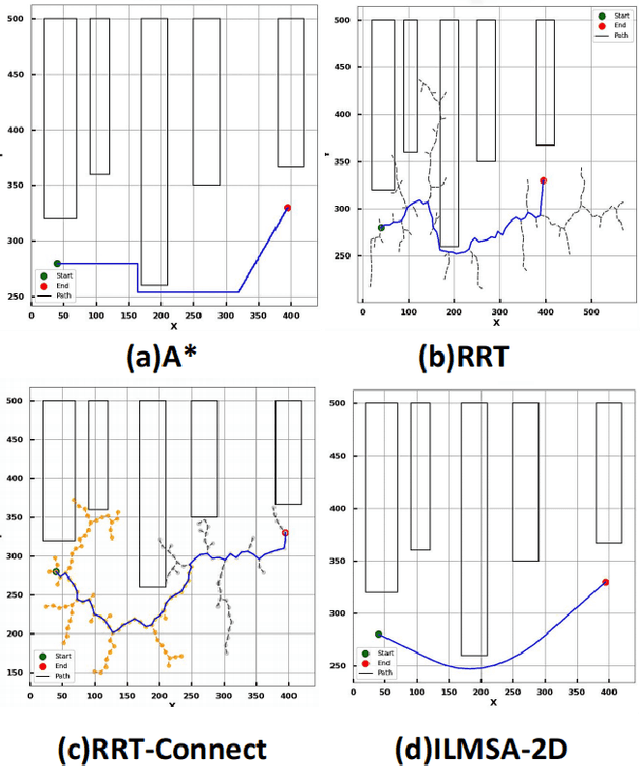
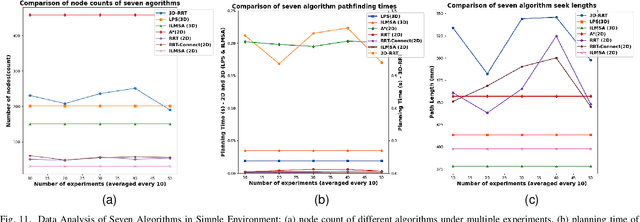
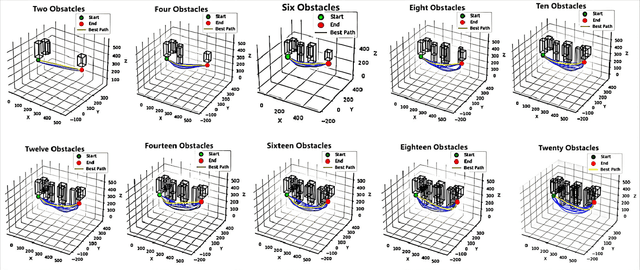
Continuous harvesting and storage of multiple fruits in a single operation allow robots to significantly reduce the travel distance required for repetitive back-and-forth movements. Traditional collision-free path planning algorithms, such as Rapidly-Exploring Random Tree (RRT) and A-star (A), often fail to meet the demands of efficient continuous fruit harvesting due to their low search efficiency and the generation of excessive redundant points. This paper presents the Interactive Local Minima Search Algorithm (ILMSA), a fast path-planning method designed for the continuous harvesting of table-top grown strawberries. The algorithm featured an interactive node expansion strategy that iteratively extended and refined collision-free path segments based on local minima points. To enable the algorithm to function in 3D, the 3D environment was projected onto multiple 2D planes, generating optimal paths on each plane. The best path was then selected, followed by integrating and smoothing the 3D path segments. Simulations demonstrated that ILMSA outperformed existing methods, reducing path length by 21.5% and planning time by 97.1% compared to 3D-RRT, while achieving 11.6% shorter paths and 25.4% fewer nodes than the Lowest Point of the Strawberry (LPS) algorithm in 3D environments. In 2D, ILMSA achieved path lengths 16.2% shorter than A, 23.4% shorter than RRT, and 20.9% shorter than RRT-Connect, while being over 96% faster and generating significantly fewer nodes. Field tests confirmed ILMSA's suitability for complex agricultural tasks, having a combined planning and execution time and an average path length that were approximately 58% and 69%, respectively, of those achieved by the LPS algorithm.
A Large-Scale Study on Video Action Dataset Condensation
Dec 30, 2024Dataset condensation has made significant progress in the image domain. Unlike images, videos possess an additional temporal dimension, which harbors considerable redundant information, making condensation even more crucial. However, video dataset condensation still remains an underexplored area. We aim to bridge this gap by providing a large-scale empirical study with systematic design and fair comparison. Specifically, our work delves into three key aspects to provide valuable empirical insights: (1) temporal processing of video data, (2) establishing a comprehensive evaluation protocol for video dataset condensation, and (3) adaptation of condensation methods to the space-time domain and fair comparisons among them. From this study, we derive several intriguing observations: (i) sample diversity appears to be more crucial than temporal diversity for video dataset condensation, (ii) simple slide-window sampling proves to be effective, and (iii) sample selection currently outperforms dataset distillation in most cases. Furthermore, we conduct experiments on three prominent action recognition datasets (HMDB51, UCF101 and Kinetics-400) and achieve state-of-the-art results on all of them. Our code is available at https://github.com/MCG-NJU/Video-DC.