 Add to Chrome
 Add to Firefox
 Add to Edge
Beyond Text Conditioning: A Systematic Study of MLLM-DiT Fusion for Video Generation
Aug 14, 2026
Diffusion Transformers (DiTs) have become the dominant paradigm for high-fidelity video generation, yet their ability to perform high-level semantic planning remains limited. While hybrid architectures integrating MLLMs with diffusion backbones have shown strong advantages in image synthesis, such designs remain underexplored in video generation, where existing approaches often treat MLLMs primarily as frozen feature encoders rather than semantic generators. To fill this gap, we systematically study how an MLLM should be integrated with a DiT for video generation by answering three questions: what intermediate representation should bridge the MLLM and DiT, how the MLLM should generate it, and how the DiT should incorporate it during diffusion rendering. Our analysis reveals three key findings: (1) discrete semantic visual tokens produced by an EMA-based tokenizer provide a stable and expressive interface, (2) autoregressive causal modeling is effective for generating these tokens, and (3) explicit visual-token conditioning is more effective than prompt refinement or latent bridging. Based on these findings, we propose BiVidGen, a hybrid framework where an MLLM first generates semantic visual tokens and a DiT renders videos conditioned on both text and these tokens via multi-layer cross-attention. Extensive experiments show that BiVidGen improves semantic alignment and temporal coherence over a fine-tuned DiT baseline, achieving stronger performance on VBench-Long. These results demonstrate that explicit MLLM-based visual planning provides an effective intermediate interface for text-to-video generation beyond text-only conditioning.

Ripple: Real-Time Streaming Audio-Video Generation With Cross-Modal Recurrent Memory
Jul 29, 2026Audio-video generative models achieve impressive quality but suffer from high latency, making them unsuitable for real-time applications. Although several streaming audio-video generation methods have been proposed, they remain costly and fail to support long-form generation. To address this, we propose \textbf{Ripple}, a real-time joint audio-video generation system with a cross-modal recurrent memory mechanism. To enable efficient streaming inference while preserving long-term context, Ripple combines a fixed-length sliding-window attention with modality-specific memory states that continuously summarize audio and video context. Cross-modal memory interaction is further introduced to enhance audio-visual synchronization. To learn this memory-augmented model effectively, we devise a three-stage training recipe: (1) adapting a bidirectional audio-video teacher to block-wise causal attention with simulated memory, (2) optimizing the memory construction and interaction pipeline through end-to-end distillation, and (3) applying online reinforcement post-training tailored for streaming audio-video generation. As a result, Ripple achieves ~28 FPS at 480P resolution, over faster than the teacher, while capable of coherent long-form generation. Extensive experiments on both short-video and long-video benchmarks demonstrate our superior performance over existing offline and online joint audio-video generation methods.
OmniMate: Open-Ended Real-Time Streaming Audio-Visual Generation for Interactive Avatars
Jul 25, 2026Recent advances in diffusion-based generative models have enabled real-time audio-driven avatar generation and unified audio-visual synthesis, providing a promising foundation for interactive avatar systems. However, extending these models to real-time interactive streaming remains challenging, as the generation horizon is unknown in advance and cross-modal identity consistency gradually degrades during long-term generation. To address these challenges, we propose OmniMate, a unified framework for open-ended real-time interactive audio-visual avatar generation. OmniMate jointly synthesizes visual content, speech, and audio effects in real time, enabling natural and immersive multi-turn interactions. To achieve adaptive response progression, we introduce a Generation Progress Controller (GPC) that explicitly models the generation progress of each streaming chunk, allowing the model to complete responses according to the desired progress and achieve seamless transitions between execution and listening states. To preserve long-term cross-modal identity consistency, we propose a Multi-Reference Conditioning Module (MRCM), which leverages multiple reference images and a reference speech segment to provide persistent visual and speaker identity cues throughout long-duration streaming interactions. Extensive experiments on an interaction-oriented adaptation of VerseBench demonstrate that OmniMate achieves high-quality, low-latency streaming generation while maintaining strong long-term audio-visual consistency. The results further show that OmniMate supports realistic, coherent, and responsive interactive avatar experiences over extended multi-turn conversations.
World-R1: Reinforcing 3D Constraints for Text-to-Video Generation
Apr 27, 2026Recent video foundation models demonstrate impressive visual synthesis but frequently suffer from geometric inconsistencies. While existing methods attempt to inject 3D priors via architectural modifications, they often incur high computational costs and limit scalability. We propose World-R1, a framework that aligns video generation with 3D constraints through reinforcement learning. To facilitate this alignment, we introduce a specialized pure text dataset tailored for world simulation. Utilizing Flow-GRPO, we optimize the model using feedback from pre-trained 3D foundation models and vision-language models to enforce structural coherence without altering the underlying architecture. We further employ a periodic decoupled training strategy to balance rigid geometric consistency with dynamic scene fluidity. Extensive evaluations reveal that our approach significantly enhances 3D consistency while preserving the original visual quality of the foundation model, effectively bridging the gap between video generation and scalable world simulation.
MotionWeaver: Holistic 4D-Anchored Framework for Multi-Humanoid Image Animation
Feb 11, 2026Character image animation, which synthesizes videos of reference characters driven by pose sequences, has advanced rapidly but remains largely limited to single-human settings. Existing methods struggle to generalize to multi-humanoid scenarios, which involve diverse humanoid forms, complex interactions, and frequent occlusions. We address this gap with two key innovations. First, we introduce unified motion representations that extract identity-agnostic motions and explicitly bind them to corresponding characters, enabling generalization across diverse humanoid forms and seamless extension to multi-humanoid scenarios. Second, we propose a holistic 4D-anchored paradigm that constructs a shared 4D space to fuse motion representations with video latents, and further reinforces this process with hierarchical 4D-level supervision to better handle interactions and occlusions. We instantiate these ideas in MotionWeaver, an end-to-end framework for multi-humanoid image animation. To support this setting, we curate a 46-hour dataset of multi-human videos with rich interactions, and construct a 300-video benchmark featuring paired humanoid characters. Quantitative and qualitative experiments demonstrate that MotionWeaver not only achieves state-of-the-art results on our benchmark but also generalizes effectively across diverse humanoid forms, complex interactions, and challenging multi-humanoid scenarios.
MTVCrafter: 4D Motion Tokenization for Open-World Human Image Animation
May 15, 2025
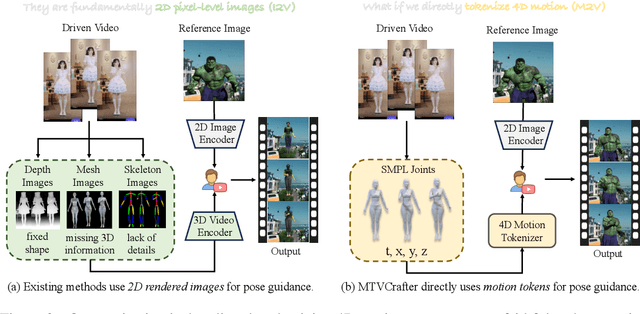

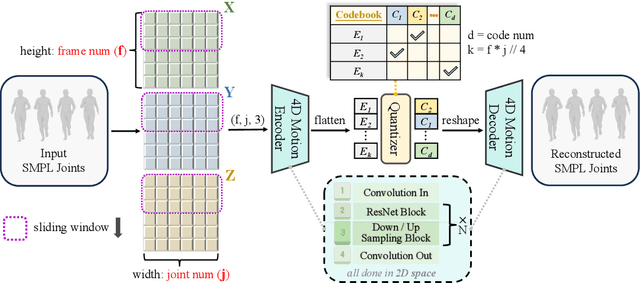
Human image animation has gained increasing attention and developed rapidly due to its broad applications in digital humans. However, existing methods rely largely on 2D-rendered pose images for motion guidance, which limits generalization and discards essential 3D information for open-world animation. To tackle this problem, we propose MTVCrafter (Motion Tokenization Video Crafter), the first framework that directly models raw 3D motion sequences (i.e., 4D motion) for human image animation. Specifically, we introduce 4DMoT (4D motion tokenizer) to quantize 3D motion sequences into 4D motion tokens. Compared to 2D-rendered pose images, 4D motion tokens offer more robust spatio-temporal cues and avoid strict pixel-level alignment between pose image and character, enabling more flexible and disentangled control. Then, we introduce MV-DiT (Motion-aware Video DiT). By designing unique motion attention with 4D positional encodings, MV-DiT can effectively leverage motion tokens as 4D compact yet expressive context for human image animation in the complex 3D world. Hence, it marks a significant step forward in this field and opens a new direction for pose-guided human video generation. Experiments show that our MTVCrafter achieves state-of-the-art results with an FID-VID of 6.98, surpassing the second-best by 65%. Powered by robust motion tokens, MTVCrafter also generalizes well to diverse open-world characters (single/multiple, full/half-body) across various styles and scenarios. Our video demos and code are provided in the supplementary material and at this anonymous GitHub link: https://anonymous.4open.science/r/MTVCrafter-1B13.
V-Stylist: Video Stylization via Collaboration and Reflection of MLLM Agents
Mar 15, 2025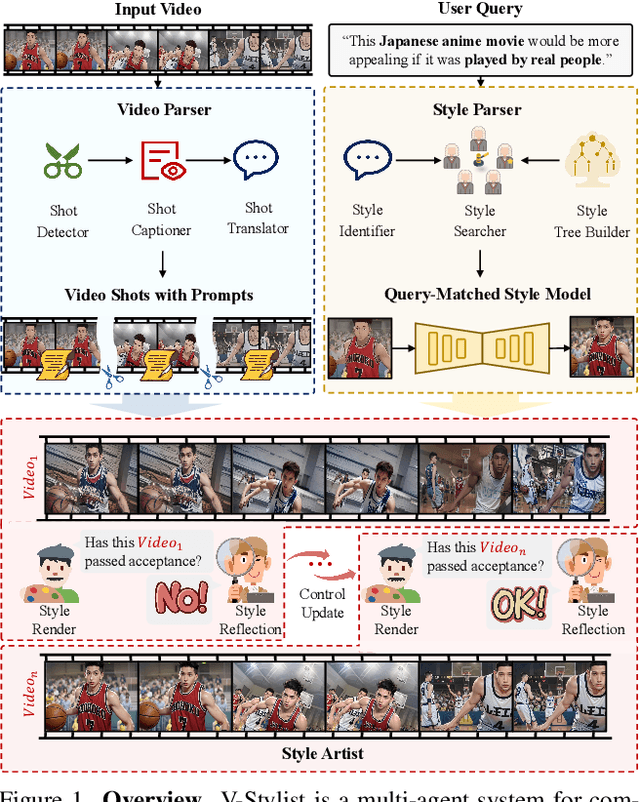
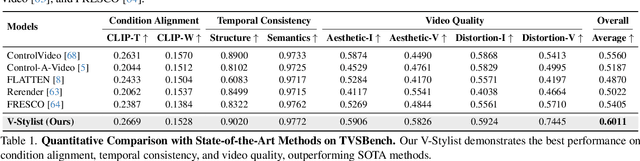
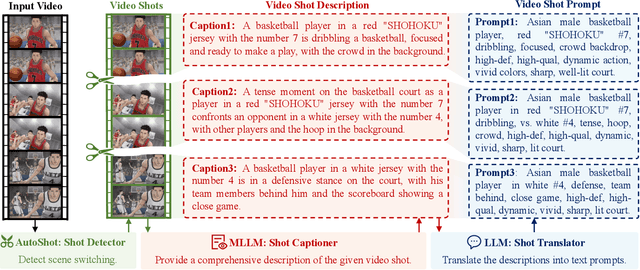

Despite the recent advancement in video stylization, most existing methods struggle to render any video with complex transitions, based on an open style description of user query. To fill this gap, we introduce a generic multi-agent system for video stylization, V-Stylist, by a novel collaboration and reflection paradigm of multi-modal large language models. Specifically, our V-Stylist is a systematical workflow with three key roles: (1) Video Parser decomposes the input video into a number of shots and generates their text prompts of key shot content. Via a concise video-to-shot prompting paradigm, it allows our V-Stylist to effectively handle videos with complex transitions. (2) Style Parser identifies the style in the user query and progressively search the matched style model from a style tree. Via a robust tree-of-thought searching paradigm, it allows our V-Stylist to precisely specify vague style preference in the open user query. (3) Style Artist leverages the matched model to render all the video shots into the required style. Via a novel multi-round self-reflection paradigm, it allows our V-Stylist to adaptively adjust detail control, according to the style requirement. With such a distinct design of mimicking human professionals, our V-Stylist achieves a major breakthrough over the primary challenges for effective and automatic video stylization. Moreover,we further construct a new benchmark Text-driven Video Stylization Benchmark (TVSBench), which fills the gap to assess stylization of complex videos on open user queries. Extensive experiments show that, V-Stylist achieves the state-of-the-art, e.g.,V-Stylist surpasses FRESCO and ControlVideo by 6.05% and 4.51% respectively in overall average metrics, marking a significant advance in video stylization.
TimeStep Master: Asymmetrical Mixture of Timestep LoRA Experts for Versatile and Efficient Diffusion Models in Vision
Mar 10, 2025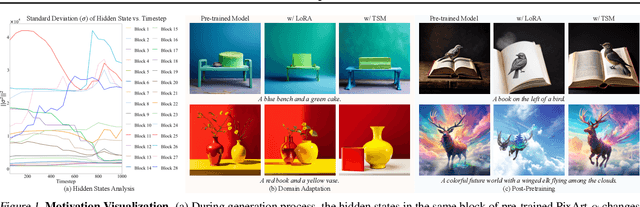
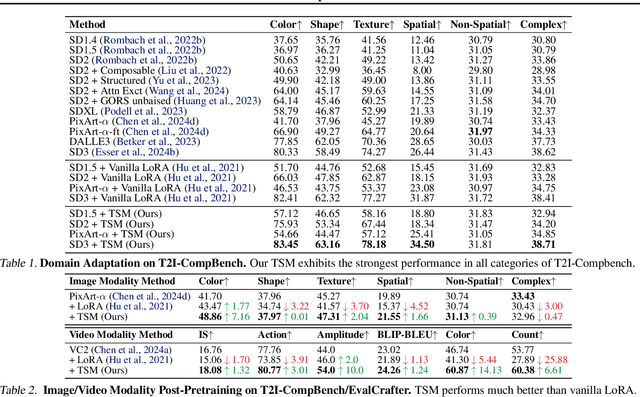
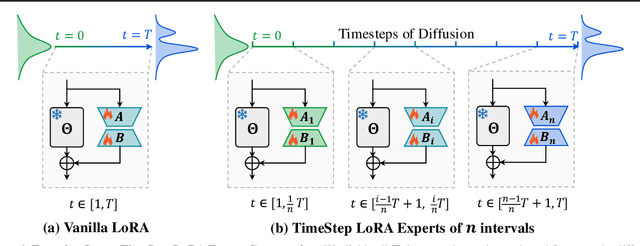
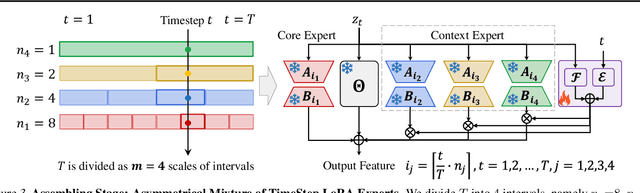
Diffusion models have driven the advancement of vision generation over the past years. However, it is often difficult to apply these large models in downstream tasks, due to massive fine-tuning cost. Recently, Low-Rank Adaptation (LoRA) has been applied for efficient tuning of diffusion models. Unfortunately, the capabilities of LoRA-tuned diffusion models are limited, since the same LoRA is used for different timesteps of the diffusion process. To tackle this problem, we introduce a general and concise TimeStep Master (TSM) paradigm with two key fine-tuning stages. In the fostering stage (1-stage), we apply different LoRAs to fine-tune the diffusion model at different timestep intervals. This results in different TimeStep LoRA experts that can effectively capture different noise levels. In the assembling stage (2-stage), we design a novel asymmetrical mixture of TimeStep LoRA experts, via core-context collaboration of experts at multi-scale intervals. For each timestep, we leverage TimeStep LoRA expert within the smallest interval as the core expert without gating, and use experts within the bigger intervals as the context experts with time-dependent gating. Consequently, our TSM can effectively model the noise level via the expert in the finest interval, and adaptively integrate contexts from the experts of other scales, boosting the versatility of diffusion models. To show the effectiveness of our TSM paradigm, we conduct extensive experiments on three typical and popular LoRA-related tasks of diffusion models, including domain adaptation, post-pretraining, and model distillation. Our TSM achieves the state-of-the-art results on all these tasks, throughout various model structures (UNet, DiT and MM-DiT) and visual data modalities (Image, Video), showing its remarkable generalization capacity.
MUSES: 3D-Controllable Image Generation via Multi-Modal Agent Collaboration
Aug 21, 2024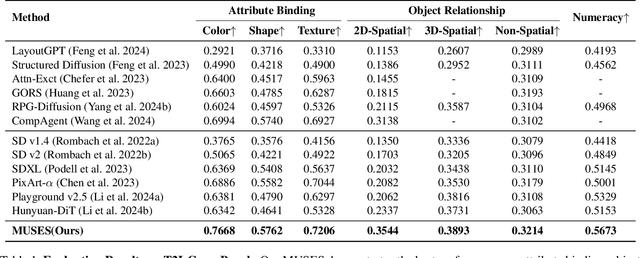
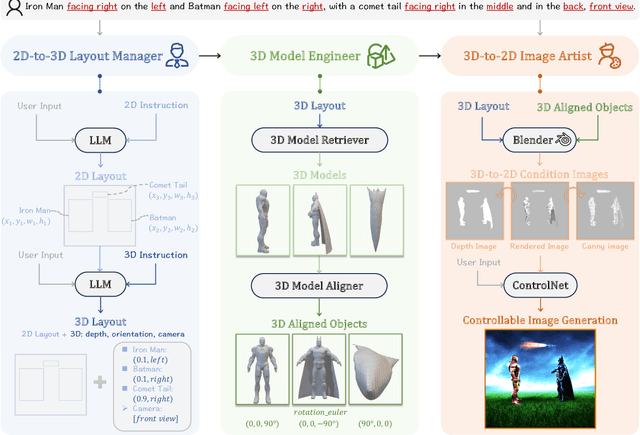
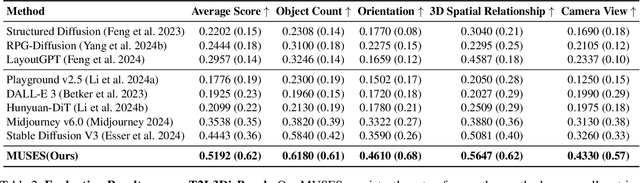
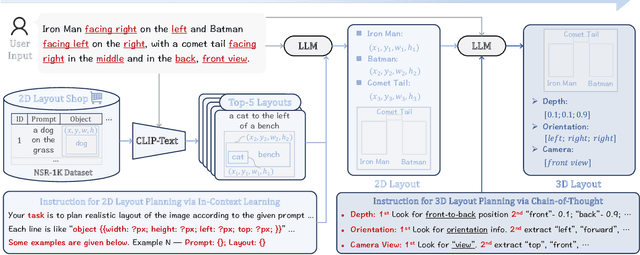
Despite recent advancements in text-to-image generation, most existing methods struggle to create images with multiple objects and complex spatial relationships in 3D world. To tackle this limitation, we introduce a generic AI system, namely MUSES, for 3D-controllable image generation from user queries. Specifically, our MUSES addresses this challenging task by developing a progressive workflow with three key components, including (1) Layout Manager for 2D-to-3D layout lifting, (2) Model Engineer for 3D object acquisition and calibration, (3) Image Artist for 3D-to-2D image rendering. By mimicking the collaboration of human professionals, this multi-modal agent pipeline facilitates the effective and automatic creation of images with 3D-controllable objects, through an explainable integration of top-down planning and bottom-up generation. Additionally, we find that existing benchmarks lack detailed descriptions of complex 3D spatial relationships of multiple objects. To fill this gap, we further construct a new benchmark of T2I-3DisBench (3D image scene), which describes diverse 3D image scenes with 50 detailed prompts. Extensive experiments show the state-of-the-art performance of MUSES on both T2I-CompBench and T2I-3DisBench, outperforming recent strong competitors such as DALL-E 3 and Stable Diffusion 3. These results demonstrate a significant step of MUSES forward in bridging natural language, 2D image generation, and 3D world.