 Add to Chrome
 Add to Firefox
 Add to Edge
OmniMate: Open-Ended Real-Time Streaming Audio-Visual Generation for Interactive Avatars
Jul 25, 2026
Recent advances in diffusion-based generative models have enabled real-time audio-driven avatar generation and unified audio-visual synthesis, providing a promising foundation for interactive avatar systems. However, extending these models to real-time interactive streaming remains challenging, as the generation horizon is unknown in advance and cross-modal identity consistency gradually degrades during long-term generation. To address these challenges, we propose OmniMate, a unified framework for open-ended real-time interactive audio-visual avatar generation. OmniMate jointly synthesizes visual content, speech, and audio effects in real time, enabling natural and immersive multi-turn interactions. To achieve adaptive response progression, we introduce a Generation Progress Controller (GPC) that explicitly models the generation progress of each streaming chunk, allowing the model to complete responses according to the desired progress and achieve seamless transitions between execution and listening states. To preserve long-term cross-modal identity consistency, we propose a Multi-Reference Conditioning Module (MRCM), which leverages multiple reference images and a reference speech segment to provide persistent visual and speaker identity cues throughout long-duration streaming interactions. Extensive experiments on an interaction-oriented adaptation of VerseBench demonstrate that OmniMate achieves high-quality, low-latency streaming generation while maintaining strong long-term audio-visual consistency. The results further show that OmniMate supports realistic, coherent, and responsive interactive avatar experiences over extended multi-turn conversations.

InteractiveAvatar: Real-Time Streaming Video Generation for Consistent and Intent-Aware Avatars
Jun 22, 2026Recent diffusion-based models have enabled realistic audio-driven avatar generation in real-time streaming. However, existing approaches struggle to maintain visual temporal consistency and fail to explicitly perceive user intent in complex interactive streaming scenarios. To address these challenges, we propose InteractiveAvatar, a real-time infinite-streaming video generation framework that supports visually consistent avatar video generation and intent-aware interactions. With autoregressive distillation, InteractiveAvatar achieves real-time str-eaming generation of human avatars over arbitrarily long durations. For visual consistency, we introduce a Long-Short Visual Memory (LSVM) mechanism that flexibly compresses historical visual information into compact tokens, preserving both short-range coherence and long-term consistency. To generate avatars with speeches and actions aligned with user intent, we propose a Reasoning-Reaction Module (RRM), which incorporates a State-Cycling strategy and a Cache-Switching mechanism. Extensive experimental results over diverse scenarios demonstrate that our method achieves state-of-the-art visual consistency in long-duration generation, while enabling complex user-avatar interaction in real time.
PAS3R: Pose-Adaptive Streaming 3D Reconstruction for Long Video Sequences
Mar 22, 2026Online monocular 3D reconstruction enables dense scene recovery from streaming video but remains fundamentally limited by the stability-adaptation dilemma: the reconstruction model must rapidly incorporate novel viewpoints while preserving previously accumulated scene structure. Existing streaming approaches rely on uniform or attention-based update mechanisms that often fail to account for abrupt viewpoint transitions, leading to trajectory drift and geometric inconsistencies over long sequences. We introduce PAS3R, a pose-adaptive streaming reconstruction framework that dynamically modulates state updates according to camera motion and scene structure. Our key insight is that frames contributing significant geometric novelty should exert stronger influence on the reconstruction state, while frames with minor viewpoint variation should prioritize preserving historical context. PAS3R operationalizes this principle through a motion-aware update mechanism that jointly leverages inter-frame pose variation and image frequency cues to estimate frame importance. To further stabilize long-horizon reconstruction, we introduce trajectory-consistent training objectives that incorporate relative pose constraints and acceleration regularization. A lightweight online stabilization module further suppresses high-frequency trajectory jitter and geometric artifacts without increasing memory consumption. Extensive experiments across multiple benchmarks demonstrate that PAS3R significantly improves trajectory accuracy, depth estimation, and point cloud reconstruction quality in long video sequences while maintaining competitive performance on shorter sequences.
W2S-AlignTree: Weak-to-Strong Inference-Time Alignment for Large Language Models via Monte Carlo Tree Search
Nov 14, 2025
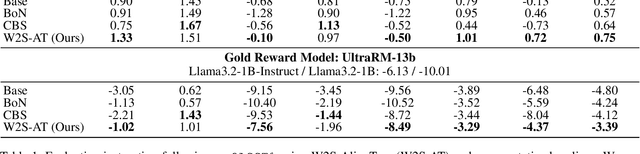
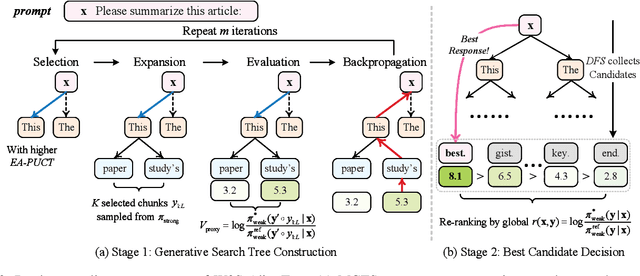
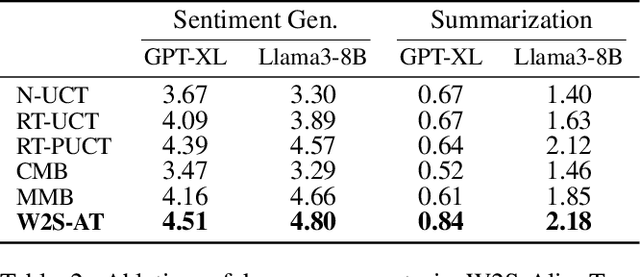
Large Language Models (LLMs) demonstrate impressive capabilities, yet their outputs often suffer from misalignment with human preferences due to the inadequacy of weak supervision and a lack of fine-grained control. Training-time alignment methods like Reinforcement Learning from Human Feedback (RLHF) face prohibitive costs in expert supervision and inherent scalability limitations, offering limited dynamic control during inference. Consequently, there is an urgent need for scalable and adaptable alignment mechanisms. To address this, we propose W2S-AlignTree, a pioneering plug-and-play inference-time alignment framework that synergistically combines Monte Carlo Tree Search (MCTS) with the Weak-to-Strong Generalization paradigm for the first time. W2S-AlignTree formulates LLM alignment as an optimal heuristic search problem within a generative search tree. By leveraging weak model's real-time, step-level signals as alignment proxies and introducing an Entropy-Aware exploration mechanism, W2S-AlignTree enables fine-grained guidance during strong model's generation without modifying its parameters. The approach dynamically balances exploration and exploitation in high-dimensional generation search trees. Experiments across controlled sentiment generation, summarization, and instruction-following show that W2S-AlignTree consistently outperforms strong baselines. Notably, W2S-AlignTree raises the performance of Llama3-8B from 1.89 to 2.19, a relative improvement of 15.9 on the summarization task.
Towards Semantic 3D Hand-Object Interaction Generation via Functional Text Guidance
Feb 28, 2025Hand-object interaction(HOI) is the fundamental link between human and environment, yet its dexterous and complex pose significantly challenges for gesture control. Despite significant advances in AI and robotics, enabling machines to understand and simulate hand-object interactions, capturing the semantics of functional grasping tasks remains a considerable challenge. While previous work can generate stable and correct 3D grasps, they are still far from achieving functional grasps due to unconsidered grasp semantics. To address this challenge, we propose an innovative two-stage framework, Functional Grasp Synthesis Net (FGS-Net), for generating 3D HOI driven by functional text. This framework consists of a text-guided 3D model generator, Functional Grasp Generator (FGG), and a pose optimization strategy, Functional Grasp Refiner (FGR). FGG generates 3D models of hands and objects based on text input, while FGR fine-tunes the poses using Object Pose Approximator and energy functions to ensure the relative position between the hand and object aligns with human intent and remains physically plausible. Extensive experiments demonstrate that our approach achieves precise and high-quality HOI generation without requiring additional 3D annotation data.
VectorTalker: SVG Talking Face Generation with Progressive Vectorisation
Dec 18, 2023High-fidelity and efficient audio-driven talking head generation has been a key research topic in computer graphics and computer vision. In this work, we study vector image based audio-driven talking head generation. Compared with directly animating the raster image that most widely used in existing works, vector image enjoys its excellent scalability being used for many applications. There are two main challenges for vector image based talking head generation: the high-quality vector image reconstruction w.r.t. the source portrait image and the vivid animation w.r.t. the audio signal. To address these, we propose a novel scalable vector graphic reconstruction and animation method, dubbed VectorTalker. Specifically, for the highfidelity reconstruction, VectorTalker hierarchically reconstructs the vector image in a coarse-to-fine manner. For the vivid audio-driven facial animation, we propose to use facial landmarks as intermediate motion representation and propose an efficient landmark-driven vector image deformation module. Our approach can handle various styles of portrait images within a unified framework, including Japanese manga, cartoon, and photorealistic images. We conduct extensive quantitative and qualitative evaluations and the experimental results demonstrate the superiority of VectorTalker in both vector graphic reconstruction and audio-driven animation.
iComMa: Inverting 3D Gaussians Splatting for Camera Pose Estimation via Comparing and Matching
Dec 14, 2023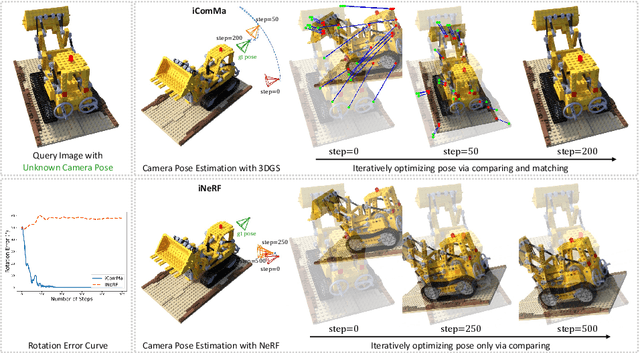

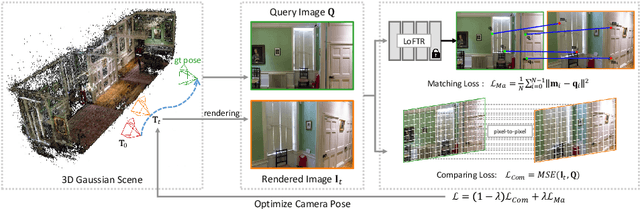
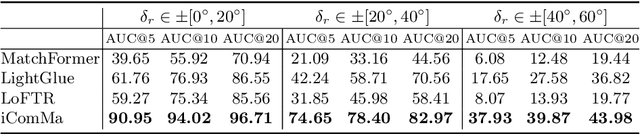
We present a method named iComMa to address the 6D pose estimation problem in computer vision. The conventional pose estimation methods typically rely on the target's CAD model or necessitate specific network training tailored to particular object classes. Some existing methods address mesh-free 6D pose estimation by employing the inversion of a Neural Radiance Field (NeRF), aiming to overcome the aforementioned constraints. However, it still suffers from adverse initializations. By contrast, we model the pose estimation as the problem of inverting the 3D Gaussian Splatting (3DGS) with both the comparing and matching loss. In detail, a render-and-compare strategy is adopted for the precise estimation of poses. Additionally, a matching module is designed to enhance the model's robustness against adverse initializations by minimizing the distances between 2D keypoints. This framework systematically incorporates the distinctive characteristics and inherent rationale of render-and-compare and matching-based approaches. This comprehensive consideration equips the framework to effectively address a broader range of intricate and challenging scenarios, including instances with substantial angular deviations, all while maintaining a high level of prediction accuracy. Experimental results demonstrate the superior precision and robustness of our proposed jointly optimized framework when evaluated on synthetic and complex real-world data in challenging scenarios.