 Add to Chrome
 Add to Firefox
 Add to Edge
Ripple: Real-Time Streaming Audio-Video Generation With Cross-Modal Recurrent Memory
Jul 29, 2026
Audio-video generative models achieve impressive quality but suffer from high latency, making them unsuitable for real-time applications. Although several streaming audio-video generation methods have been proposed, they remain costly and fail to support long-form generation. To address this, we propose \textbf{Ripple}, a real-time joint audio-video generation system with a cross-modal recurrent memory mechanism. To enable efficient streaming inference while preserving long-term context, Ripple combines a fixed-length sliding-window attention with modality-specific memory states that continuously summarize audio and video context. Cross-modal memory interaction is further introduced to enhance audio-visual synchronization. To learn this memory-augmented model effectively, we devise a three-stage training recipe: (1) adapting a bidirectional audio-video teacher to block-wise causal attention with simulated memory, (2) optimizing the memory construction and interaction pipeline through end-to-end distillation, and (3) applying online reinforcement post-training tailored for streaming audio-video generation. As a result, Ripple achieves ~28 FPS at 480P resolution, over faster than the teacher, while capable of coherent long-form generation. Extensive experiments on both short-video and long-video benchmarks demonstrate our superior performance over existing offline and online joint audio-video generation methods.

OmniMate: Open-Ended Real-Time Streaming Audio-Visual Generation for Interactive Avatars
Jul 25, 2026Recent advances in diffusion-based generative models have enabled real-time audio-driven avatar generation and unified audio-visual synthesis, providing a promising foundation for interactive avatar systems. However, extending these models to real-time interactive streaming remains challenging, as the generation horizon is unknown in advance and cross-modal identity consistency gradually degrades during long-term generation. To address these challenges, we propose OmniMate, a unified framework for open-ended real-time interactive audio-visual avatar generation. OmniMate jointly synthesizes visual content, speech, and audio effects in real time, enabling natural and immersive multi-turn interactions. To achieve adaptive response progression, we introduce a Generation Progress Controller (GPC) that explicitly models the generation progress of each streaming chunk, allowing the model to complete responses according to the desired progress and achieve seamless transitions between execution and listening states. To preserve long-term cross-modal identity consistency, we propose a Multi-Reference Conditioning Module (MRCM), which leverages multiple reference images and a reference speech segment to provide persistent visual and speaker identity cues throughout long-duration streaming interactions. Extensive experiments on an interaction-oriented adaptation of VerseBench demonstrate that OmniMate achieves high-quality, low-latency streaming generation while maintaining strong long-term audio-visual consistency. The results further show that OmniMate supports realistic, coherent, and responsive interactive avatar experiences over extended multi-turn conversations.
InteractiveAvatar: Real-Time Streaming Video Generation for Consistent and Intent-Aware Avatars
Jun 22, 2026Recent diffusion-based models have enabled realistic audio-driven avatar generation in real-time streaming. However, existing approaches struggle to maintain visual temporal consistency and fail to explicitly perceive user intent in complex interactive streaming scenarios. To address these challenges, we propose InteractiveAvatar, a real-time infinite-streaming video generation framework that supports visually consistent avatar video generation and intent-aware interactions. With autoregressive distillation, InteractiveAvatar achieves real-time str-eaming generation of human avatars over arbitrarily long durations. For visual consistency, we introduce a Long-Short Visual Memory (LSVM) mechanism that flexibly compresses historical visual information into compact tokens, preserving both short-range coherence and long-term consistency. To generate avatars with speeches and actions aligned with user intent, we propose a Reasoning-Reaction Module (RRM), which incorporates a State-Cycling strategy and a Cache-Switching mechanism. Extensive experimental results over diverse scenarios demonstrate that our method achieves state-of-the-art visual consistency in long-duration generation, while enabling complex user-avatar interaction in real time.
Learning Polar Encodings for Arbitrary-Oriented Ship Detection in SAR Images
Mar 24, 2021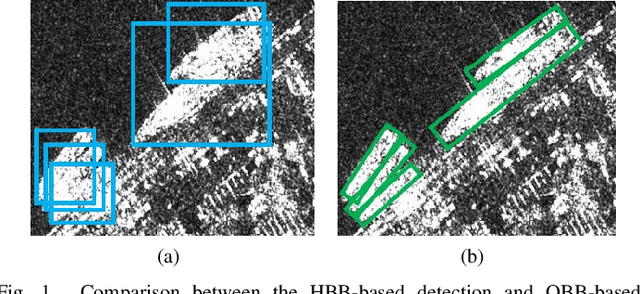
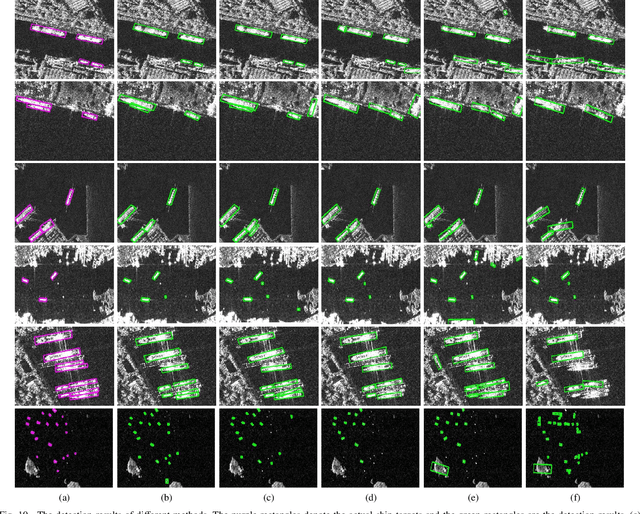
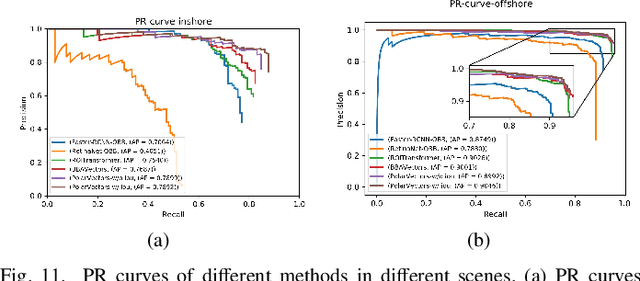
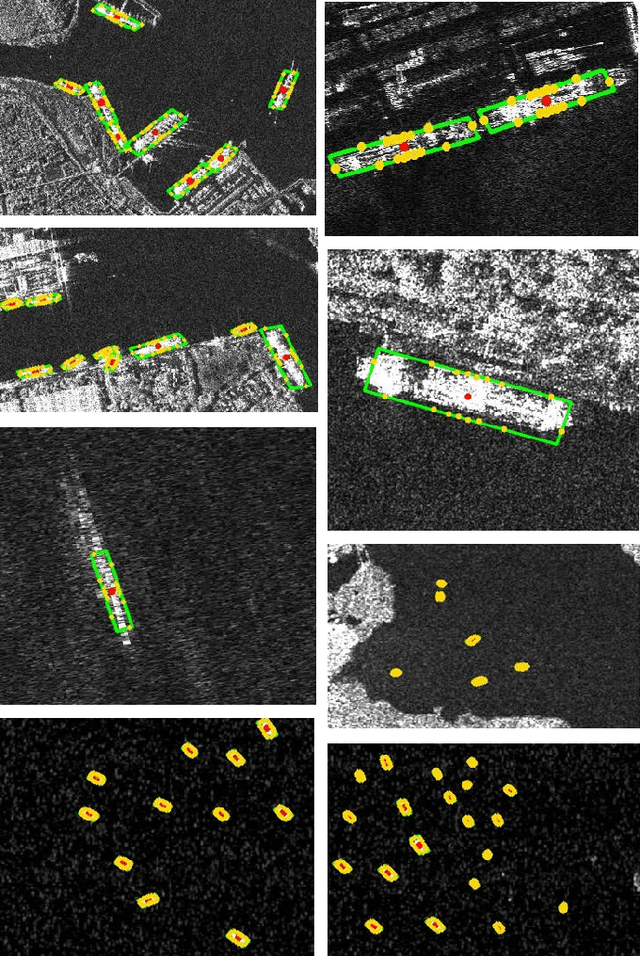
Common horizontal bounding box (HBB)-based methods are not capable of accurately locating slender ship targets with arbitrary orientations in synthetic aperture radar (SAR) images. Therefore, in recent years, methods based on oriented bounding box (OBB) have gradually received attention from researchers. However, most of the recently proposed deep learning-based methods for OBB detection encounter the boundary discontinuity problem in angle or key point regression. In order to alleviate this problem, researchers propose to introduce some manually set parameters or extra network branches for distinguishing the boundary cases, which make training more diffcult and lead to performance degradation. In this paper, in order to solve the boundary discontinuity problem in OBB regression, we propose to detect SAR ships by learning polar encodings. The encoding scheme uses a group of vectors pointing from the center of the ship target to the boundary points to represent an OBB. The boundary discontinuity problem is avoided by training and inference directly according to the polar encodings. In addition, we propose an Intersect over Union (IOU) -weighted regression loss, which further guides the training of polar encodings through the IOU metric and improves the detection performance. Experiments on the Rotating SAR Ship Detection Dataset (RSSDD) show that the proposed method can achieve better detection performance over other comparison algorithms and other OBB encoding schemes, demonstrating the effectiveness of our method.