 Add to Chrome
 Add to Firefox
 Add to Edge
Beyond Text Conditioning: A Systematic Study of MLLM-DiT Fusion for Video Generation
Aug 14, 2026
Diffusion Transformers (DiTs) have become the dominant paradigm for high-fidelity video generation, yet their ability to perform high-level semantic planning remains limited. While hybrid architectures integrating MLLMs with diffusion backbones have shown strong advantages in image synthesis, such designs remain underexplored in video generation, where existing approaches often treat MLLMs primarily as frozen feature encoders rather than semantic generators. To fill this gap, we systematically study how an MLLM should be integrated with a DiT for video generation by answering three questions: what intermediate representation should bridge the MLLM and DiT, how the MLLM should generate it, and how the DiT should incorporate it during diffusion rendering. Our analysis reveals three key findings: (1) discrete semantic visual tokens produced by an EMA-based tokenizer provide a stable and expressive interface, (2) autoregressive causal modeling is effective for generating these tokens, and (3) explicit visual-token conditioning is more effective than prompt refinement or latent bridging. Based on these findings, we propose BiVidGen, a hybrid framework where an MLLM first generates semantic visual tokens and a DiT renders videos conditioned on both text and these tokens via multi-layer cross-attention. Extensive experiments show that BiVidGen improves semantic alignment and temporal coherence over a fine-tuned DiT baseline, achieving stronger performance on VBench-Long. These results demonstrate that explicit MLLM-based visual planning provides an effective intermediate interface for text-to-video generation beyond text-only conditioning.

World-R1: Reinforcing 3D Constraints for Text-to-Video Generation
Apr 27, 2026Recent video foundation models demonstrate impressive visual synthesis but frequently suffer from geometric inconsistencies. While existing methods attempt to inject 3D priors via architectural modifications, they often incur high computational costs and limit scalability. We propose World-R1, a framework that aligns video generation with 3D constraints through reinforcement learning. To facilitate this alignment, we introduce a specialized pure text dataset tailored for world simulation. Utilizing Flow-GRPO, we optimize the model using feedback from pre-trained 3D foundation models and vision-language models to enforce structural coherence without altering the underlying architecture. We further employ a periodic decoupled training strategy to balance rigid geometric consistency with dynamic scene fluidity. Extensive evaluations reveal that our approach significantly enhances 3D consistency while preserving the original visual quality of the foundation model, effectively bridging the gap between video generation and scalable world simulation.
DepthArb: Training-Free Depth-Arbitrated Generation for Occlusion-Robust Image Synthesis
Mar 25, 2026Text-to-image diffusion models frequently exhibit deficiencies in synthesizing accurate occlusion relationships of multiple objects, particularly within dense overlapping regions. Existing training-free layout-guided methods predominantly rely on rigid spatial priors that remain agnostic to depth order, often resulting in concept mixing or illogical occlusion. To address these limitations, we propose DepthArb, a training-free framework that resolves occlusion ambiguities by arbitrating attention competition between interacting objects. Specifically, DepthArb employs two core mechanisms: Attention Arbitration Modulation (AAM), which enforces depth-ordered visibility by suppressing background activations in overlapping regions, and Spatial Compactness Control (SCC), which preserves structural integrity by curbing attention divergence. These mechanisms enable robust occlusion generation without model retraining. To systematically evaluate this capability, we propose OcclBench, a comprehensive benchmark designed to evaluate diverse occlusion scenarios. Extensive evaluations demonstrate that DepthArb consistently outperforms state-of-the-art baselines in both occlusion accuracy and visual fidelity. As a plug-and-play method, DepthArb seamlessly enhances the compositional capabilities of diffusion backbones, offering a novel perspective on spatial layering within generative models.
MotionWeaver: Holistic 4D-Anchored Framework for Multi-Humanoid Image Animation
Feb 11, 2026Character image animation, which synthesizes videos of reference characters driven by pose sequences, has advanced rapidly but remains largely limited to single-human settings. Existing methods struggle to generalize to multi-humanoid scenarios, which involve diverse humanoid forms, complex interactions, and frequent occlusions. We address this gap with two key innovations. First, we introduce unified motion representations that extract identity-agnostic motions and explicitly bind them to corresponding characters, enabling generalization across diverse humanoid forms and seamless extension to multi-humanoid scenarios. Second, we propose a holistic 4D-anchored paradigm that constructs a shared 4D space to fuse motion representations with video latents, and further reinforces this process with hierarchical 4D-level supervision to better handle interactions and occlusions. We instantiate these ideas in MotionWeaver, an end-to-end framework for multi-humanoid image animation. To support this setting, we curate a 46-hour dataset of multi-human videos with rich interactions, and construct a 300-video benchmark featuring paired humanoid characters. Quantitative and qualitative experiments demonstrate that MotionWeaver not only achieves state-of-the-art results on our benchmark but also generalizes effectively across diverse humanoid forms, complex interactions, and challenging multi-humanoid scenarios.
DynamicID: Zero-Shot Multi-ID Image Personalization with Flexible Facial Editability
Mar 09, 2025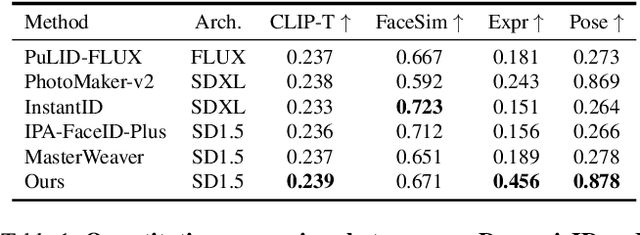
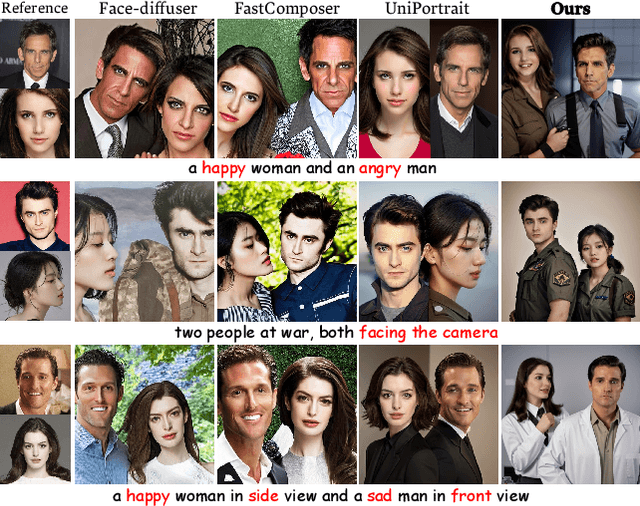
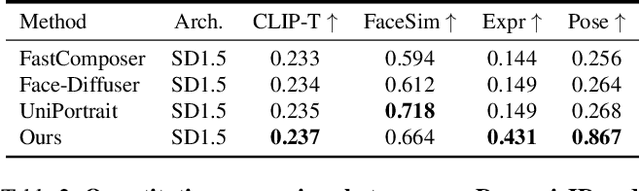
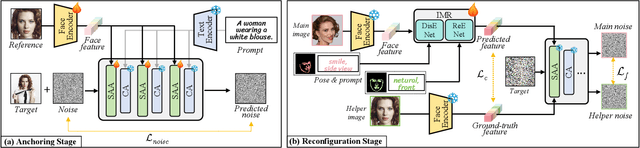
Recent advancements in text-to-image generation have spurred interest in personalized human image generation, which aims to create novel images featuring specific human identities as reference images indicate. Although existing methods achieve high-fidelity identity preservation, they often struggle with limited multi-ID usability and inadequate facial editability. We present DynamicID, a tuning-free framework supported by a dual-stage training paradigm that inherently facilitates both single-ID and multi-ID personalized generation with high fidelity and flexible facial editability. Our key innovations include: 1) Semantic-Activated Attention (SAA), which employs query-level activation gating to minimize disruption to the original model when injecting ID features and achieve multi-ID personalization without requiring multi-ID samples during training. 2) Identity-Motion Reconfigurator (IMR), which leverages contrastive learning to effectively disentangle and re-entangle facial motion and identity features, thereby enabling flexible facial editing. Additionally, we have developed a curated VariFace-10k facial dataset, comprising 10k unique individuals, each represented by 35 distinct facial images. Experimental results demonstrate that DynamicID outperforms state-of-the-art methods in identity fidelity, facial editability, and multi-ID personalization capability.