 Add to Chrome
 Add to Firefox
 Add to Edge
GAOKAO-MM: A Chinese Human-Level Benchmark for Multimodal Models Evaluation
Feb 24, 2024
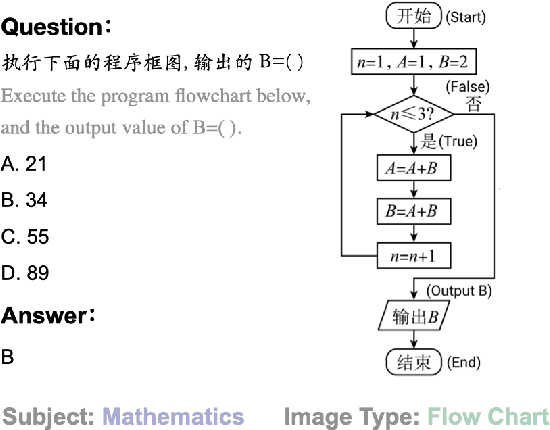
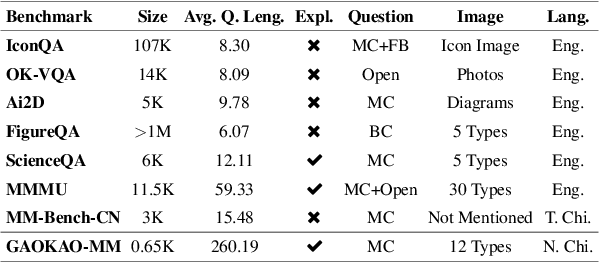
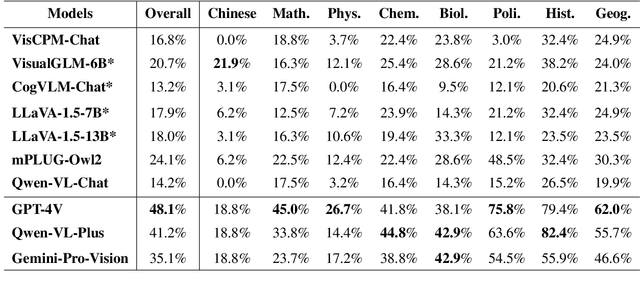
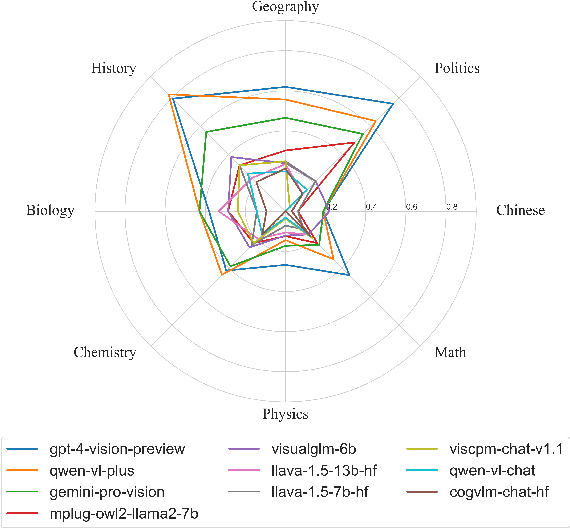
The Large Vision-Language Models (LVLMs) have demonstrated great abilities in image perception and language understanding. However, existing multimodal benchmarks focus on primary perception abilities and commonsense knowledge which are insufficient to reflect the comprehensive capabilities of LVLMs. We propose GAOKAO-MM, a multimodal benchmark based on the Chinese College Entrance Examination (GAOKAO), comprising of 8 subjects and 12 types of images, such as diagrams, function graphs, maps and photos. GAOKAO-MM derives from native Chinese context and sets human-level requirements for the model's abilities, including perception, understanding, knowledge and reasoning. We evaluate 10 LVLMs and find that the accuracies of all of them are lower than 50%, with GPT-4-Vison (48.1%), Qwen-VL-Plus (41.2%) and Gemini-Pro-Vision (35.1%) ranking in the top three positions. The results of our multi-dimension analysis indicate that LVLMs have moderate distance towards Artificial General Intelligence (AGI) and provide insights facilitating the development of multilingual LVLMs.

Balanced Data Sampling for Language Model Training with Clustering
Feb 22, 2024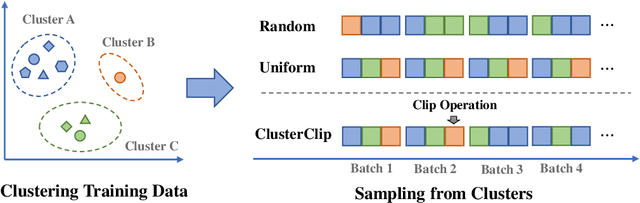
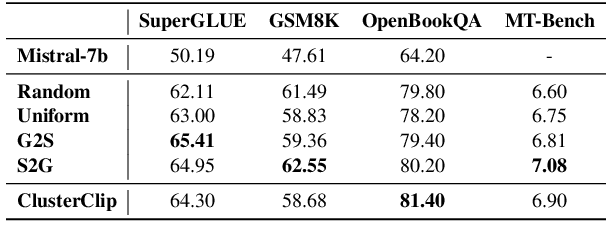
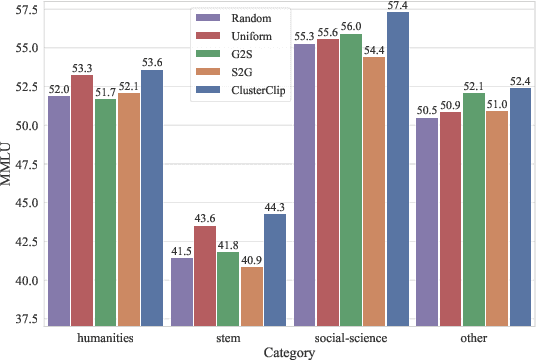
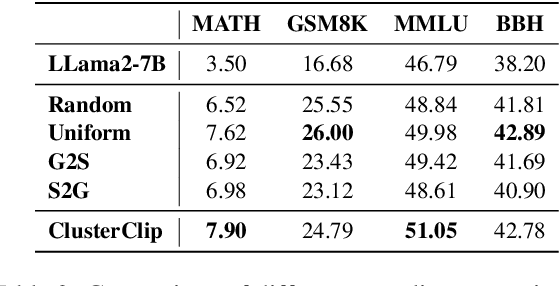
Data plays a fundamental role in the training of Large Language Models (LLMs). While attention has been paid to the collection and composition of datasets, determining the data sampling strategy in training remains an open question. Most LLMs are trained with a simple strategy, random sampling. However, this sampling strategy ignores the unbalanced nature of training data distribution, which can be sub-optimal. In this paper, we propose ClusterClip Sampling to balance the text distribution of training data for better model training. Specifically, ClusterClip Sampling utilizes data clustering to reflect the data distribution of the training set and balances the common samples and rare samples during training based on the cluster results. A repetition clip operation is introduced to mitigate the overfitting issue led by samples from certain clusters. Extensive experiments validate the effectiveness of ClusterClip Sampling, which outperforms random sampling and other cluster-based sampling variants under various training datasets and large language models.
LongWanjuan: Towards Systematic Measurement for Long Text Quality
Feb 22, 2024The quality of training data are crucial for enhancing the long-text capabilities of foundation models. Despite existing efforts to refine data quality through heuristic rules and evaluations based on data diversity and difficulty, there's a lack of systematic approaches specifically tailored for assessing long texts. Addressing this gap, our work systematically measures the quality of long texts by evaluating three fundamental linguistic dimensions: coherence, cohesion, and complexity. Drawing inspiration from the aforementioned three dimensions, we introduce a suite of metrics designed to evaluate the quality of long texts, encompassing both statistical and pre-trained language model-based ones. Leveraging these metrics, we present LongWanjuan, a bilingual dataset specifically tailored to enhance the training of language models for long-text tasks with over 160B tokens. In LongWanjuan, we categorize long texts into holistic, aggregated, and chaotic types, enabling a detailed analysis of long-text quality. Furthermore, we devise a data mixture recipe that strategically balances different types of long texts within LongWanjuan, leading to significant improvements in model performance on long-text tasks. The code and dataset are available at https://github.com/OpenLMLab/LongWanjuan.
Hint-before-Solving Prompting: Guiding LLMs to Effectively Utilize Encoded Knowledge
Feb 22, 2024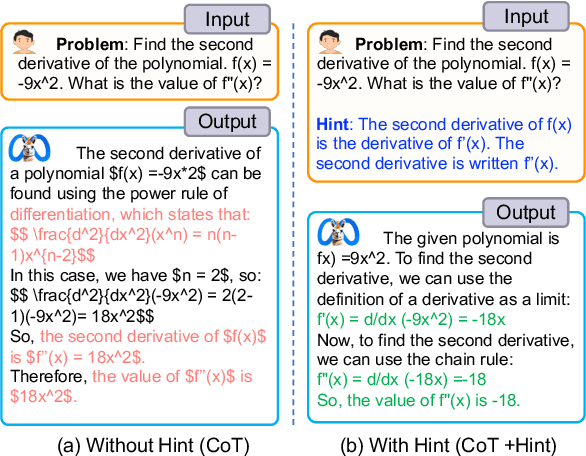
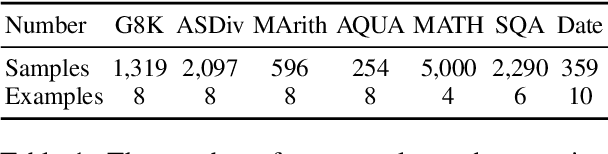
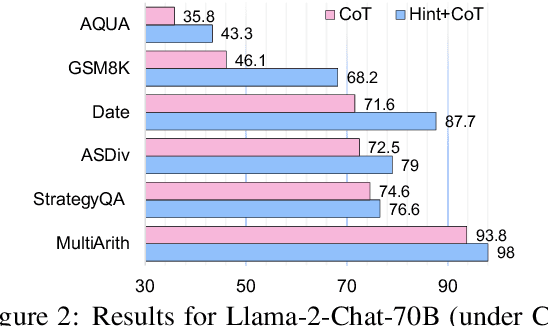
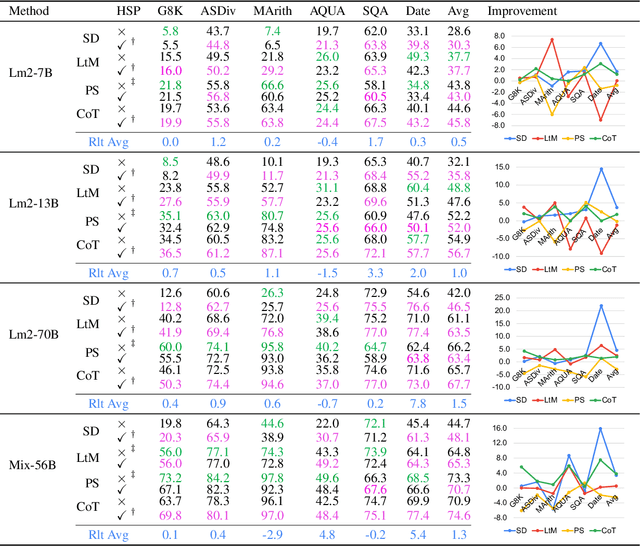
Large Language Models (LLMs) have recently showcased remarkable generalizability in various domains. Despite their extensive knowledge, LLMs still face challenges in efficiently utilizing encoded knowledge to develop accurate and logical reasoning processes. To mitigate this problem, we introduced Hint-before-Solving Prompting (HSP), which guides the model to generate hints (e.g., specific knowledge or key ideas) for solving the problem and then generate solutions containing intermediate reasoning steps. Since HSP is orthogonal to prompting methods (e.g., Chain-of-Thought (CoT)), we applied HSP to CoT, Least-to-Most, Plan-and-Solve, and Standard promptings. The results of extensive experiments on 6 reasoning benchmarks and 4 open-source LLMs demonstrate that HSP can effectively improve the accuracy of reasoning tasks: (1) By applying high-quality hint-enhanced HSP to CoT prompting, Llama2-70B-Chat shows an improvement of 9.7. (2) Beyond exploring training-free LLM capabilities, we built the HSPMATH dataset based on HSP and fine-tuned Llemma-7B, reaching 64.3 accuracy, surpassing GPT-3.5 and WizardMath-13B. We make our code and dataset publicly available at \url{https://github.com/jinlanfu/HSP}.
Turn Waste into Worth: Rectifying Top-$k$ Router of MoE
Feb 21, 2024


Sparse Mixture of Experts (MoE) models are popular for training large language models due to their computational efficiency. However, the commonly used top-$k$ routing mechanism suffers from redundancy computation and memory costs due to the unbalanced routing. Some experts are overflow, where the exceeding tokens are dropped. While some experts are vacant, which are padded with zeros, negatively impacting model performance. To address the dropped tokens and padding, we propose the Rectify-Router, comprising the Intra-GPU Rectification and the Fill-in Rectification. The Intra-GPU Rectification handles dropped tokens, efficiently routing them to experts within the GPU where they are located to avoid inter-GPU communication. The Fill-in Rectification addresses padding by replacing padding tokens with the tokens that have high routing scores. Our experimental results demonstrate that the Intra-GPU Rectification and the Fill-in Rectification effectively handle dropped tokens and padding, respectively. Furthermore, the combination of them achieves superior performance, surpassing the accuracy of the vanilla top-1 router by 4.7%.
Identifying Semantic Induction Heads to Understand In-Context Learning
Feb 20, 2024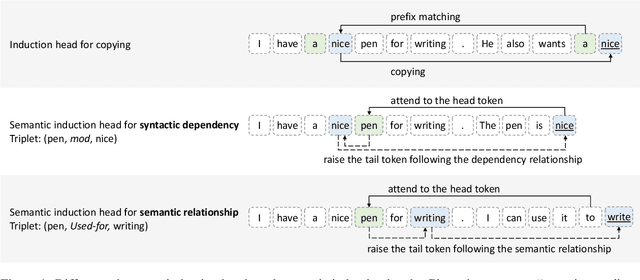

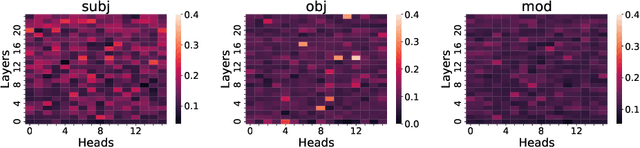

Although large language models (LLMs) have demonstrated remarkable performance, the lack of transparency in their inference logic raises concerns about their trustworthiness. To gain a better understanding of LLMs, we conduct a detailed analysis of the operations of attention heads and aim to better understand the in-context learning of LLMs. Specifically, we investigate whether attention heads encode two types of relationships between tokens present in natural languages: the syntactic dependency parsed from sentences and the relation within knowledge graphs. We find that certain attention heads exhibit a pattern where, when attending to head tokens, they recall tail tokens and increase the output logits of those tail tokens. More crucially, the formulation of such semantic induction heads has a close correlation with the emergence of the in-context learning ability of language models. The study of semantic attention heads advances our understanding of the intricate operations of attention heads in transformers, and further provides new insights into the in-context learning of LLMs.
Code Needs Comments: Enhancing Code LLMs with Comment Augmentation
Feb 20, 2024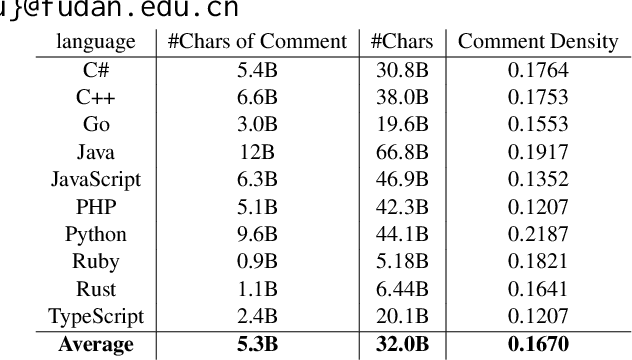
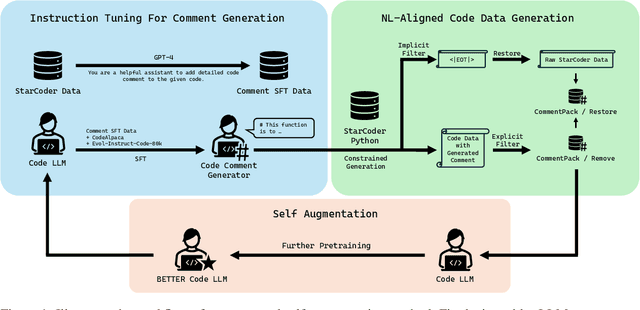
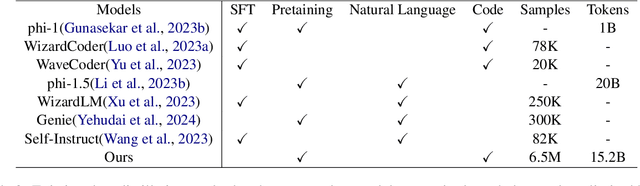
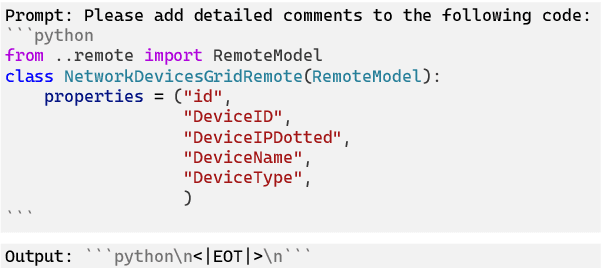
The programming skill is one crucial ability for Large Language Models (LLMs), necessitating a deep understanding of programming languages (PLs) and their correlation with natural languages (NLs). We examine the impact of pre-training data on code-focused LLMs' performance by assessing the comment density as a measure of PL-NL alignment. Given the scarcity of code-comment aligned data in pre-training corpora, we introduce a novel data augmentation method that generates comments for existing code, coupled with a data filtering strategy that filters out code data poorly correlated with natural language. We conducted experiments on three code-focused LLMs and observed consistent improvements in performance on two widely-used programming skill benchmarks. Notably, the model trained on the augmented data outperformed both the model used for generating comments and the model further trained on the data without augmentation.
Dictionary Learning Improves Patch-Free Circuit Discovery in Mechanistic Interpretability: A Case Study on Othello-GPT
Feb 19, 2024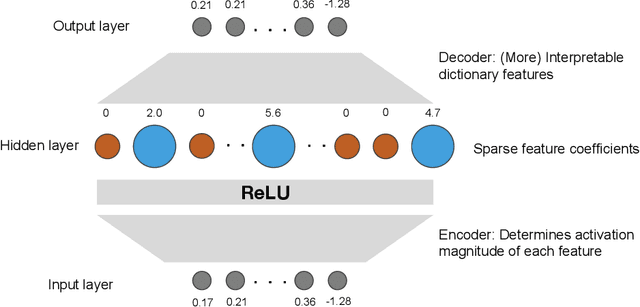
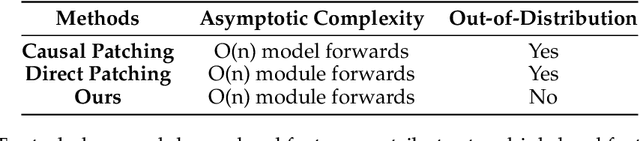
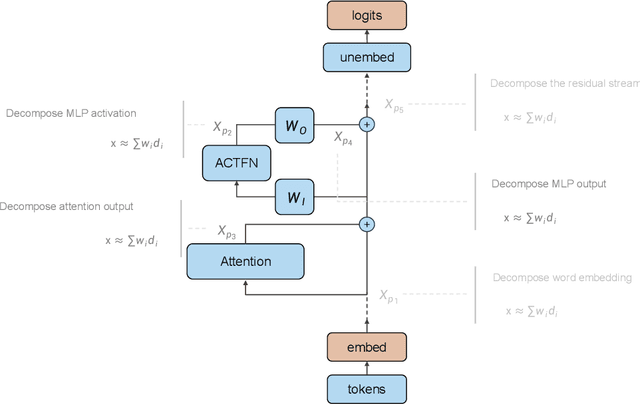
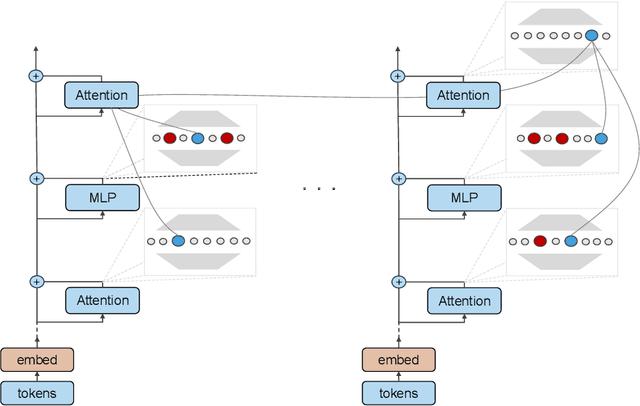
Sparse dictionary learning has been a rapidly growing technique in mechanistic interpretability to attack superposition and extract more human-understandable features from model activations. We ask a further question based on the extracted more monosemantic features: How do we recognize circuits connecting the enormous amount of dictionary features? We propose a circuit discovery framework alternative to activation patching. Our framework suffers less from out-of-distribution and proves to be more efficient in terms of asymptotic complexity. The basic unit in our framework is dictionary features decomposed from all modules writing to the residual stream, including embedding, attention output and MLP output. Starting from any logit, dictionary feature or attention score, we manage to trace down to lower-level dictionary features of all tokens and compute their contribution to these more interpretable and local model behaviors. We dig in a small transformer trained on a synthetic task named Othello and find a number of human-understandable fine-grained circuits inside of it.
LLM can Achieve Self-Regulation via Hyperparameter Aware Generation
Feb 17, 2024In the realm of Large Language Models (LLMs), users commonly employ diverse decoding strategies and adjust hyperparameters to control the generated text. However, a critical question emerges: Are LLMs conscious of the existence of these decoding strategies and capable of regulating themselves? The current decoding generation process often relies on empirical and heuristic manual adjustments to hyperparameters based on types of tasks and demands. However, this process is typically cumbersome, and the decoding hyperparameters may not always be optimal for each sample. To address the aforementioned challenges, we propose a novel text generation paradigm termed Hyperparameter Aware Generation (HAG). By leveraging hyperparameter-aware instruction tuning, the LLM autonomously determines the optimal decoding strategy and configs based on the input samples, enabling self-regulation. Our approach eliminates the need for extensive manual tuning, offering a more autonomous, self-regulate model behavior. Experimental results spanning six datasets across reasoning, creativity, translation, and mathematics tasks demonstrate that hyperparameter-aware instruction tuning empowers the LLMs to self-regulate the decoding strategy and hyperparameter. HAG extends the current paradigm in the text generation process, highlighting the feasibility of endowing the LLMs with self-regulate decoding strategies.
InternLM-Math: Open Math Large Language Models Toward Verifiable Reasoning
Feb 09, 2024


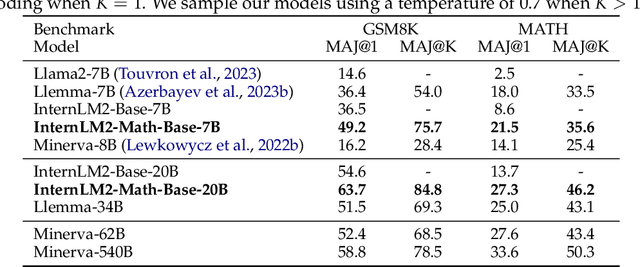
The math abilities of large language models can represent their abstract reasoning ability. In this paper, we introduce and open-source our math reasoning LLMs InternLM-Math which is continue pre-trained from InternLM2. We unify chain-of-thought reasoning, reward modeling, formal reasoning, data augmentation, and code interpreter in a unified seq2seq format and supervise our model to be a versatile math reasoner, verifier, prover, and augmenter. These abilities can be used to develop the next math LLMs or self-iteration. InternLM-Math obtains open-sourced state-of-the-art performance under the setting of in-context learning, supervised fine-tuning, and code-assisted reasoning in various informal and formal benchmarks including GSM8K, MATH, Hungary math exam, MathBench-ZH, and MiniF2F. Our pre-trained model achieves 30.3 on the MiniF2F test set without fine-tuning. We further explore how to use LEAN to solve math problems and study its performance under the setting of multi-task learning which shows the possibility of using LEAN as a unified platform for solving and proving in math. Our models, codes, and data are released at \url{https://github.com/InternLM/InternLM-Math}.