 Add to Chrome
 Add to Firefox
 Add to Edge
FARS: A Fully Automated Research System Deployed at Scale
Jun 30, 2026
Recent automated research systems show that language-model agents can generate hypotheses, run experiments, and write complete manuscripts, but most evidence still comes from selected examples, human-framed topics, or a few pre-defined research tasks. We present FARS (Fully Automated Research System), a fully automated AI-for-AI research system designed to operate across research topics at scale. FARS autonomously generates and advances projects through ideation, planning, experimentation, and writing, using stage-specific agents coordinated through a shared workspace that records proposals, code, logs, results, and manuscripts. In its first public deployment, FARS produced 166 complete research papers spanning 67 fine-grained AI/ML topics while preserving intermediate artifacts as an auditable corpus rather than a curated set of successes. We evaluate this corpus with 282 structured reviews from volunteer reviewers covering 140 papers, including overall ratings, sub-scores, integrity checks, and LLM-use disclosure. The reviews indicate that FARS can produce review-worthy and occasionally strong AI/ML research artifacts in a large-scale public deployment, while also exposing recurring failure modes in narrow experimental scope, methodological limitations, and integrity issues.

Position Bias Correction is Insufficient for One-Pass Attention Sorting
Jun 26, 2026Long-context language models suffer from position bias, where information in middle positions is underutilized. Attention Sorting addresses this by iteratively reordering documents based on attention patterns, but its multiple sort-and-generate cycles increase deployment cost. We hypothesize that position bias is the primary bottleneck and propose Debiased One-Pass Attention Sorting, which estimates a per-prompt position-bias curve from the low-attention majority of documents and uses it to correct raw attention scores (via subtraction or division) to enable single-pass sorting. Our experiments on two models refute this hypothesis in the tested setting: on LLaMA-2-7B-32K-Instruct, debiasing produces identical results to uncalibrated single-pass sorting (94.83\% containment accuracy), while on YaRN-Llama-2-7b-64k, debiasing improves accuracy by 8.67 percentage points but remains 14.84pp behind iterative sorting, closing only 37\% of the gap. These results suggest that position-bias correction is insufficient to match iterative sorting, and that repeated reordering provides additional benefits beyond bias correction.
NLL-Guided Full-Attention Layer Selection for Training-Free Sliding-Window Adaptation
Jun 26, 2026Hybrid attention models that mix full and sliding-window attention across layers offer a promising approach to efficient long-context inference, but the critical question of \emph{which layers} should retain full attention remains unsolved. Existing methods use either fixed periodic patterns or attention-based heuristics that may not capture what matters for downstream accuracy. We propose NLL-guided layer selection, a training-free method that directly measures each layer's importance by computing the negative log-likelihood degradation on answer tokens when that layer uses sliding-window instead of full attention. On LongMemEval with Qwen3-4B, our method achieves 64.6\% accuracy using only 1/4 full-attention layers, matching the 1/2-FA periodic baseline (65.0\%) while halving the computational budget. NLL-guided selection outperforms the SWAA-reported periodic 1/4-FA baseline by 10.4 percentage points and a matched LightTransfer-style baseline by 26.4 percentage points. De-confounding analysis shows the signal is consistent with long-range attention needs rather than generic layer sensitivity. The method requires only $\sim$15 minutes of one-time calibration, advancing the efficiency-accuracy Pareto frontier for long-context LLM deployment.
Output-Space Allocation Costs for Calibration-Guided LLM Compression: An Empirical Study
Jun 26, 2026Training-free compression methods for large language models (LLMs) often use calibration data to guide compression decisions. ROCKET, a recent method combining sparse-dictionary factorization with multi-choice knapsack problem (MCKP) allocation, derives its per-layer factorization from an output reconstruction objective but uses weight-space Frobenius error as the MCKP allocation cost. We investigate whether aligning the allocation cost with the output-space objective improves compressed model fidelity. On Qwen3-8B at 50\% compression, our ROCKET-ActCost achieves +0.8 percentage points higher average accuracy across 8 zero-shot benchmarks (53.1\% vs 52.3\%), but increases WikiText perplexity by 16\% (61.46 vs 52.98). This accuracy-perplexity tradeoff reveals that different allocation objectives favor different downstream metrics. The high correlation ($>$0.99) between weight-space and output-space errors limits allocation divergence, explaining the modest effect size. On Llama-3.2-1B at 20\% compression, the two methods produce near-identical results (53.3\% vs 53.5\% accuracy, 14.45 vs 14.66 PPL), suggesting that the effect of the cost function is minor at lower compression ratios.
Towards Understanding the Nature of Attention with Low-Rank Sparse Decomposition
Apr 29, 2025We propose Low-Rank Sparse Attention (Lorsa), a sparse replacement model of Transformer attention layers to disentangle original Multi Head Self Attention (MHSA) into individually comprehensible components. Lorsa is designed to address the challenge of attention superposition to understand attention-mediated interaction between features in different token positions. We show that Lorsa heads find cleaner and finer-grained versions of previously discovered MHSA behaviors like induction heads, successor heads and attention sink behavior (i.e., heavily attending to the first token). Lorsa and Sparse Autoencoder (SAE) are both sparse dictionary learning methods applied to different Transformer components, and lead to consistent findings in many ways. For instance, we discover a comprehensive family of arithmetic-specific Lorsa heads, each corresponding to an atomic operation in Llama-3.1-8B. Automated interpretability analysis indicates that Lorsa achieves parity with SAE in interpretability while Lorsa exhibits superior circuit discovery properties, especially for features computed collectively by multiple MHSA heads. We also conduct extensive experiments on architectural design ablation, Lorsa scaling law and error analysis.
Towards Universality: Studying Mechanistic Similarity Across Language Model Architectures
Oct 10, 2024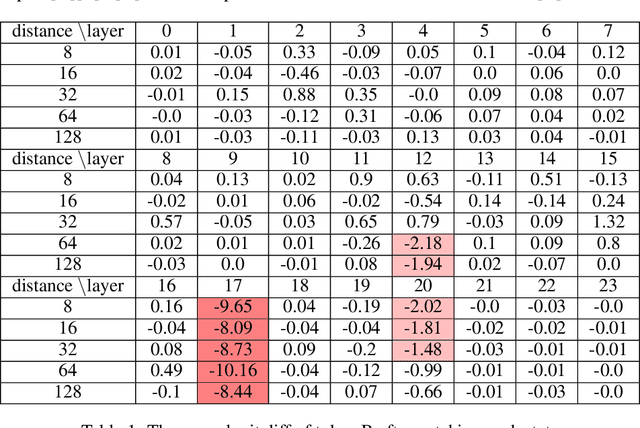
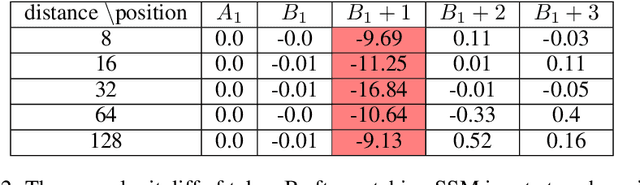
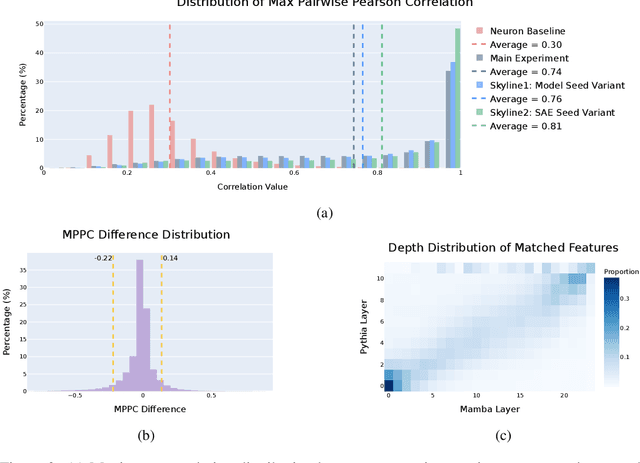
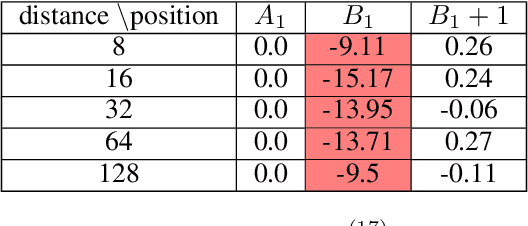
The hypothesis of Universality in interpretability suggests that different neural networks may converge to implement similar algorithms on similar tasks. In this work, we investigate two mainstream architectures for language modeling, namely Transformers and Mambas, to explore the extent of their mechanistic similarity. We propose to use Sparse Autoencoders (SAEs) to isolate interpretable features from these models and show that most features are similar in these two models. We also validate the correlation between feature similarity and Universality. We then delve into the circuit-level analysis of Mamba models and find that the induction circuits in Mamba are structurally analogous to those in Transformers. We also identify a nuanced difference we call \emph{Off-by-One motif}: The information of one token is written into the SSM state in its next position. Whilst interaction between tokens in Transformers does not exhibit such trend.
Dictionary Learning Improves Patch-Free Circuit Discovery in Mechanistic Interpretability: A Case Study on Othello-GPT
Feb 19, 2024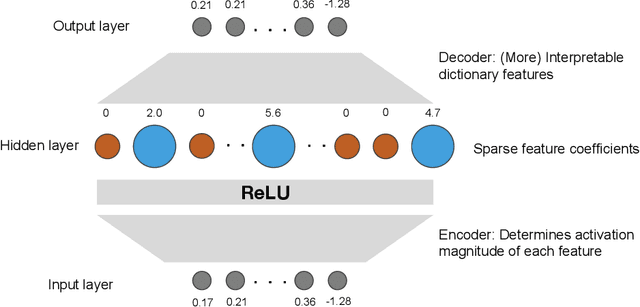
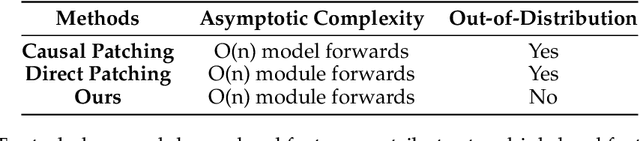
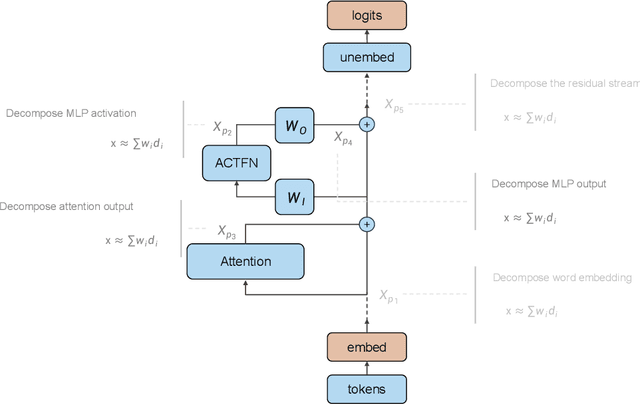
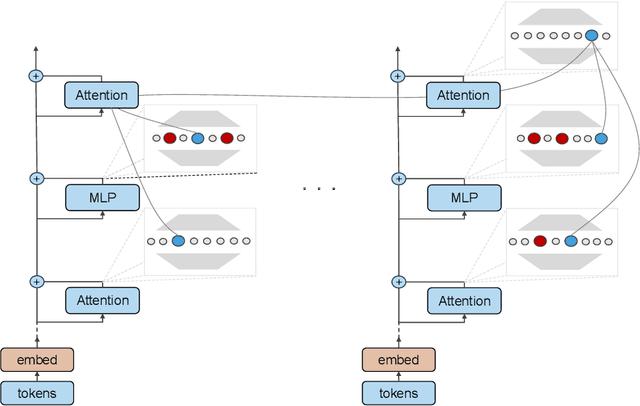
Sparse dictionary learning has been a rapidly growing technique in mechanistic interpretability to attack superposition and extract more human-understandable features from model activations. We ask a further question based on the extracted more monosemantic features: How do we recognize circuits connecting the enormous amount of dictionary features? We propose a circuit discovery framework alternative to activation patching. Our framework suffers less from out-of-distribution and proves to be more efficient in terms of asymptotic complexity. The basic unit in our framework is dictionary features decomposed from all modules writing to the residual stream, including embedding, attention output and MLP output. Starting from any logit, dictionary feature or attention score, we manage to trace down to lower-level dictionary features of all tokens and compute their contribution to these more interpretable and local model behaviors. We dig in a small transformer trained on a synthetic task named Othello and find a number of human-understandable fine-grained circuits inside of it.
CodeIE: Large Code Generation Models are Better Few-Shot Information Extractors
May 11, 2023Large language models (LLMs) pre-trained on massive corpora have demonstrated impressive few-shot learning ability on many NLP tasks. A common practice is to recast the task into a text-to-text format such that generative LLMs of natural language (NL-LLMs) like GPT-3 can be prompted to solve it. However, it is nontrivial to perform information extraction (IE) tasks with NL-LLMs since the output of the IE task is usually structured and therefore is hard to be converted into plain text. In this paper, we propose to recast the structured output in the form of code instead of natural language and utilize generative LLMs of code (Code-LLMs) such as Codex to perform IE tasks, in particular, named entity recognition and relation extraction. In contrast to NL-LLMs, we show that Code-LLMs can be well-aligned with these IE tasks by designing code-style prompts and formulating these IE tasks as code generation tasks. Experiment results on seven benchmarks show that our method consistently outperforms fine-tuning moderate-size pre-trained models specially designed for IE tasks (e.g., UIE) and prompting NL-LLMs under few-shot settings. We further conduct a series of in-depth analyses to demonstrate the merits of leveraging Code-LLMs for IE tasks.