 Add to Chrome
 Add to Firefox
 Add to Edge
Low Light Image Enhancement Challenge at NTIRE 2026
Apr 19, 2026
This paper presents a comprehensive review of the NTIRE 2026 Low Light Image Enhancement Challenge, highlighting the proposed solutions and final results. The objective of this challenge is to identify effective networks capable of producing clearer and visually compelling images in diverse and challenging conditions by learning representative visual cues with the purpose of restoring information loss due to low-contrast and noisy images. A total of 195 participants registered for the first track and 153 for the second track of the competition, and 22 teams ultimately submitted valid entries. This paper thoroughly evaluates the state-of-the-art advances in (joint denoising and) low-light image enhancement, showcasing the significant progress in the field, while leveraging samples of our novel dataset.

The Fourth Challenge on Image Super-Resolution ($\times$4) at NTIRE 2026: Benchmark Results and Method Overview
Apr 16, 2026This paper presents the NTIRE 2026 image super-resolution ($\times$4) challenge, one of the associated competitions of the NTIRE 2026 Workshop at CVPR 2026. The challenge aims to reconstruct high-resolution (HR) images from low-resolution (LR) inputs generated through bicubic downsampling with a $\times$4 scaling factor. The objective is to develop effective super-resolution solutions and analyze recent advances in the field. To reflect the evolving objectives of image super-resolution, the challenge includes two tracks: (1) a restoration track, which emphasizes pixel-wise fidelity and ranks submissions based on PSNR; and (2) a perceptual track, which focuses on visual realism and evaluates results using a perceptual score. A total of 194 participants registered for the challenge, with 31 teams submitting valid entries. This report summarizes the challenge design, datasets, evaluation protocol, main results, and methods of participating teams. The challenge provides a unified benchmark and offers insights into current progress and future directions in image super-resolution.
OmniCam: Unified Multimodal Video Generation via Camera Control
Apr 03, 2025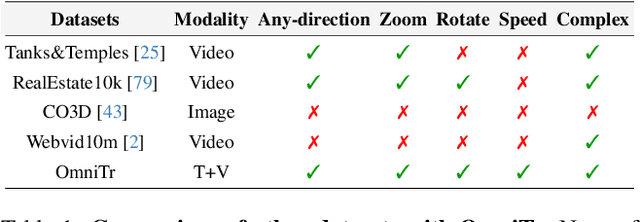
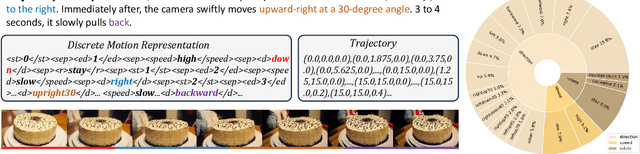
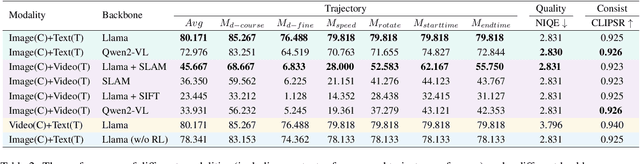
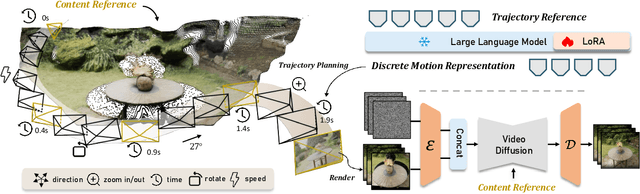
Camera control, which achieves diverse visual effects by changing camera position and pose, has attracted widespread attention. However, existing methods face challenges such as complex interaction and limited control capabilities. To address these issues, we present OmniCam, a unified multimodal camera control framework. Leveraging large language models and video diffusion models, OmniCam generates spatio-temporally consistent videos. It supports various combinations of input modalities: the user can provide text or video with expected trajectory as camera path guidance, and image or video as content reference, enabling precise control over camera motion. To facilitate the training of OmniCam, we introduce the OmniTr dataset, which contains a large collection of high-quality long-sequence trajectories, videos, and corresponding descriptions. Experimental results demonstrate that our model achieves state-of-the-art performance in high-quality camera-controlled video generation across various metrics.