 Add to Chrome
 Add to Firefox
 Add to Edge
Graph-Augmented Topological Internalization with Dual-Stream Classifiers for Medical Report Generation
May 04, 2026
Automated medical report generation, MRG, holds substantial value for alleviating radiologist workload and enhancing diagnostic efficiency. However, mainstream approaches typically treat diverse chest abnormalities as isolated classification targets. This paradigm often overlooks inherent disease co-occurrences and struggles to translate medical topological structures into explicit data correlations, constraining the model's reasoning capacity on complex or subtle lesions. To address this, we propose a Graph-Augmented Dual-Stream Medical Report Generation with Topological Internalization, GDMRG. Our framework introduces a Topological Knowledge Internalization module, TKI, which leverages a Graph Convolutional Network, GCN, to generate an explicit parameterized weight matrix based on global disease co-occurrence priors. This facilitates efficient topological knowledge injection without relying on external retrieval mechanisms. Building upon this, we construct a dual-stream classification system: the main branch generates discrete diagnostic prompts under topological constraints, while the auxiliary branch employs an asymmetric optimization strategy to dynamically calibrate decision boundaries for highly imbalanced samples. Concurrently, to establish a logical closed loop between diagnosis and visual grounding, we design a diagnostic-driven Diagnosis-Guided Spatial Attention, DGSA, that utilizes high-dimensional clinical semantics to recalibrate the visual encoder, mitigating feature hallucinations. Comprehensive experiments on the MIMIC-CXR dataset demonstrate that GDMRG achieves competitive clinical efficacy, CE, while maintaining natural language fluency. Furthermore, our model exhibits robust zero-shot generalization on the IU X-Ray dataset. In summary, this work presents an integrated and interpretable paradigm for medical report generation.

PathMoG: A Pathway-Centric Modular Graph Neural Network for Multi-Omics Survival Prediction
Apr 27, 2026Cancer survival prediction from multi-omics data remains challenging because prognostic signals are high-dimensional, heterogeneous, and distributed across interacting genes and pathways. We propose PathMoG, a pathway-centric modular graph neural network for multi-omics survival prediction. PathMoG reorganizes genome-scale inputs into 354 KEGG-informed pathway modules, introduces a Hierarchical Omics Modulation module to condition gene-expression representations on mutation, copy number variation, pathway, and clinical context, and uses dual-level attention to capture both intra-pathway driver signals and inter-pathway clinical relevance. We evaluated PathMoG on 5,650 patients across 10 TCGA cancer types and observed consistent improvements over representative survival baselines. The framework further provides gene-level, pathway-level, and patient-level interpretability, supporting biologically grounded and clinically relevant risk stratification.
HBGSA: Hydrogen Bond Graph with Self-Attention for Drug-Target Binding Affinity Prediction
Apr 25, 2026Accurate prediction of drug-target binding affinity accelerates drug discovery by prioritizing compounds for experimental validation. Current methods face three limitations: sequence-based approaches discard spatial geometric constraints, structure-based methods fail to exploit hydrogen bond features, and conventional loss functions neglect prediction-target correlation, a key factor for identifying high-affinity compounds in virtual screening. We developed HBGSA (Hydrogen Bond Graph with Self-Attention), a 3.06M-parameter model that encodes hydrogen bond spatial features. HBGSA uses graph neural networks to model hydrogen bond spatial topology with self-attention enhancement and Pearson correlation loss. Experimental results on PDBbind Core Set and CSAR-HiQ dataset demonstrate that HBGSA outperforms baseline methods with strong generalization capability. Ablation studies confirm the effectiveness of hydrogen bond modeling and Pearson correlation loss.
MEDNA-DFM: A Dual-View FiLM-MoE Model for Explainable DNA Methylation Prediction
Feb 26, 2026Accurate computational identification of DNA methylation is essential for understanding epigenetic regulation. Although deep learning excels in this binary classification task, its "black-box" nature impedes biological insight. We address this by introducing a high-performance model MEDNA-DFM, alongside mechanism-inspired signal purification algorithms. Our investigation demonstrates that MEDNA-DFM effectively captures conserved methylation patterns, achieving robust distinction across diverse species. Validation on external independent datasets confirms that the model's generalization is driven by conserved intrinsic motifs (e.g., GC content) rather than phylogenetic proximity. Furthermore, applying our developed algorithms extracted motifs with significantly higher reliability than prior studies. Finally, empirical evidence from a Drosophila 6mA case study prompted us to propose a "sequence-structure synergy" hypothesis, suggesting that the GAGG core motif and an upstream A-tract element function cooperatively. We further validated this hypothesis via in silico mutagenesis, confirming that the ablation of either or both elements significantly degrades the model's recognition capabilities. This work provides a powerful tool for methylation prediction and demonstrates how explainable deep learning can drive both methodological innovation and the generation of biological hypotheses.
Multi-view Hand Reconstruction with a Point-Embedded Transformer
Aug 20, 2024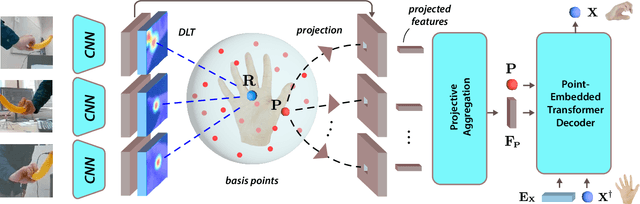
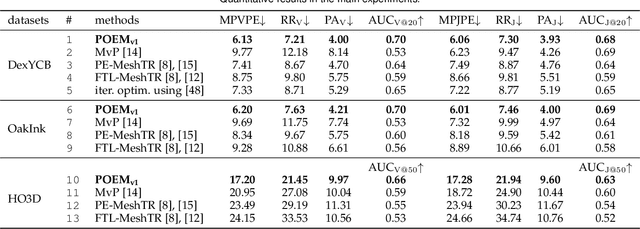
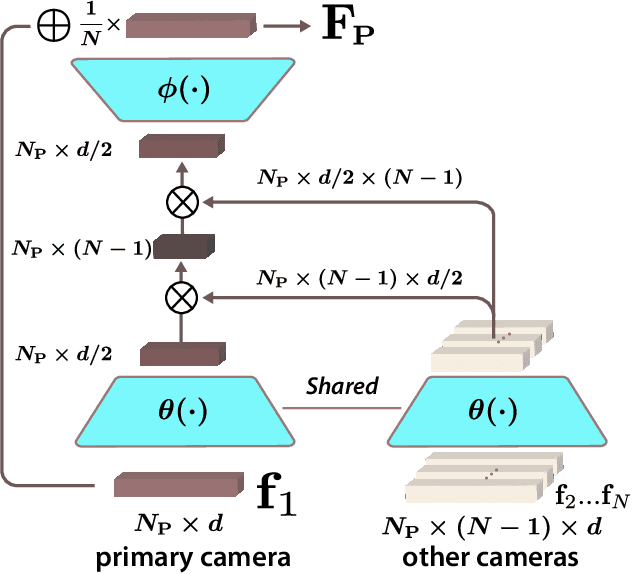
This work introduces a novel and generalizable multi-view Hand Mesh Reconstruction (HMR) model, named POEM, designed for practical use in real-world hand motion capture scenarios. The advances of the POEM model consist of two main aspects. First, concerning the modeling of the problem, we propose embedding a static basis point within the multi-view stereo space. A point represents a natural form of 3D information and serves as an ideal medium for fusing features across different views, given its varied projections across these views. Consequently, our method harnesses a simple yet effective idea: a complex 3D hand mesh can be represented by a set of 3D basis points that 1) are embedded in the multi-view stereo, 2) carry features from the multi-view images, and 3) encompass the hand in it. The second advance lies in the training strategy. We utilize a combination of five large-scale multi-view datasets and employ randomization in the number, order, and poses of the cameras. By processing such a vast amount of data and a diverse array of camera configurations, our model demonstrates notable generalizability in the real-world applications. As a result, POEM presents a highly practical, plug-and-play solution that enables user-friendly, cost-effective multi-view motion capture for both left and right hands. The model and source codes are available at https://github.com/JubSteven/POEM-v2.