 Add to Chrome
 Add to Firefox
 Add to Edge
GD$^2$PO: Mitigating Multi-Reward Conflicts via Group-Dynamic reward-Decoupled Policy Optimization
Jun 15, 2026
As LLMs advance, post-training reinforcement learning (RL) increasingly relies on multi-dimensional rewards to cultivate comprehensive capabilities. This shift demands new algorithms capable of optimizing diverse and potentially competing objectives simultaneously. To address this, existing methods such as Group reward-Decoupled Policy Optimization (GDPO) decompose the overall score into independent reward groups, then compute the RL loss separately within each group. However, this strategy still encounters multi-reward conflicts: a single rollout can yield positive advantages on certain reward dimensions but negative ones on others, causing opposing signals to cancel each other out during aggregation, further hindering RL training efficiency. Inspired by Dynamic sAmpling Policy Optimization (DAPO), which improves RL training efficiency by filtering out ineffective rollouts with near-zero advantages, we propose Group-Dynamic reward-Decoupled Policy Optimization (GD$^2$PO). Specifically, GD$^2$PO employs a conflict-aware filtering mechanism to mask out rollouts suffering from severe reward-wise disagreement. By preventing conflicting signals from canceling each other out, this masking strategy preserves and enhances the magnitude of effective RL advantages, thereby significantly accelerating learning efficiency. Furthermore, we introduce query-level reweighting to dynamically adjust the update intensity of each query based on its overall reward consensus. Experiments on various multi-reward scenarios, including tool calling and human preference alignment, demonstrate that GD$^2$PO consistently and significantly outperforms existing baselines. The code is available at https://github.com/Qwen-Applications/GD2PO.

ThinkBooster: A Unified Framework for Seamless Test-Time Scaling of LLM Reasoning
Jun 05, 2026Test-time compute (TTC) scaling has emerged as a powerful paradigm for improving large language model (LLM) reasoning by allocating additional compute during inference, e.g., via multi-sample generation and verifier-based reranking. Existing TTC scaling strategies and reasoning scorers remain fragmented, evaluated under inconsistent protocols, and are rarely analyzed through the lens of quality-cost trade-offs. We introduce ThinkBooster, a unified framework for seamless test-time compute scaling of LLM reasoning, which consists of (i) a modular Python library implementing state-of-the-art TTC scaling strategy and scorer families, (ii) a benchmark that jointly evaluates performance and computational efficiency, and (iii) a deployable OpenAI-compatible proxy service that enables drop-in integration of adaptive reasoning into real-world applications. We further provide a demo visual debugger for inspecting the reasoning trajectories, intermediate selection decisions, and alternative reasoning paths. Empirical results on mathematical and coding tasks reveal the performance-compute trade-offs of TTC scaling strategies and scoring methods and demonstrate that ThinkBooster provides practical gains in real-world tasks. The code is available online under an MIT license.
Skill-RM: Unifying Heterogeneous Evaluation Criteria via Agent Skill
Jun 02, 2026Reward models (RMs) provide critical feedback signals for LLM post-training, notably in reinforced fine-tuning (RFT) and reinforcement learning (RL) pipelines. However, current reward evaluation relies on heterogeneous criteria such as rule-based verifiers, ground-truth references, procedural checklists, and complex rubrics, where a unified mechanism to integrate all types of evidence remains unexplored. To this end, we propose Skill Reward Model (Skill-RM), a unified framework that reformulates reward modeling as the execution of a reusable Reward-Evaluation Skill. By treating reward computation as a structured agentic task, Skill-RM provides a consistent interface to orchestrate heterogeneous resources, dynamically selecting and aggregating evidence tailored to the specific requirements of each input. This approach enables the reward model to move beyond static evaluation, ensuring consistency and transparency across diverse tasks. Extensive experiments on reward benchmarks and downstream applications, including best-of-N selection and reinforcement learning, demonstrate that Skill-RM consistently outperforms traditional judge baselines. Our findings suggest that Skill-RM not only provides a unified solution for reward modeling but also achieves superior performance through the strategic and dynamic orchestration of evidence. The code is at https://github.com/Qwen-Applications/Skill-RM.
Tackling the Root of Misinformation by Teaching Laypeople about Logical Fallacies via Socratic Questioning and Critical Argumentation
May 31, 2026Identifying logical fallacies in everyday discourse is challenging for many people. This challenge is amplified in the era of Large Language Models (LLMs), where malicious agents can deploy fallacious arguments to disseminate misinformation at scale. In this work, we explore the potential of LLMs as part of the solution. We introduce LFTutor, an intelligent tutoring system which uses LLMs to tutor laypeople and help them learn about logical fallacies. LFTutor integrates intent-driven Socratic questioning and critical argumentation principles to actively engage learners to reflect on their reasoning. Through both automatic and human evaluations, we demonstrate that LFTutor significantly outperforms baseline LLMs lacking these pedagogical strategies. This work highlights the promise of combining LLMs with pedagogical scaffolding to foster critical thinking and argument literacy in the age of AI.
* This paper has been accepted to Proceedings of the 64th Annual Meeting of the Association for Computational Linguistics (Long Paper), Main Conference
Trace2Skill: Distill Trajectory-Local Lessons into Transferable Agent Skills
Mar 26, 2026Equipping Large Language Model (LLM) agents with domain-specific skills is critical for tackling complex tasks. Yet, manual authoring creates a severe scalability bottleneck. Conversely, automated skill generation often yields fragile or fragmented results because it either relies on shallow parametric knowledge or sequentially overfits to non-generalizable trajectory-local lessons. To overcome this, we introduce Trace2Skill, a framework that mirrors how human experts author skills: by holistically analyzing broad execution experience before distilling it into a single, comprehensive guide. Instead of reacting sequentially to individual trajectories, Trace2Skill dispatches a parallel fleet of sub-agents to analyze a diverse pool of executions. It extracts trajectory-specific lessons and hierarchically consolidates them into a unified, conflict-free skill directory via inductive reasoning. Trace2Skill supports both deepening existing human-written skills and creating new ones from scratch. Experiments in challenging domains, such as spreadsheet, VisionQA and math reasoning, show that Trace2Skill significantly improves upon strong baselines, including Anthropic's official xlsx skills. Crucially, this trajectory-grounded evolution does not merely memorize task instances or model-specific quirks: evolved skills transfer across LLM scales and generalize to OOD settings. For example, skills evolved by Qwen3.5-35B on its own trajectories improved a Qwen3.5-122B agent by up to 57.65 absolute percentage points on WikiTableQuestions. Ultimately, our results demonstrate that complex agent experience can be packaged into highly transferable, declarative skills -- requiring no parameter updates, no external retrieval modules, and utilizing open-source models as small as 35B parameters.
When AI Benchmarks Plateau: A Systematic Study of Benchmark Saturation
Feb 18, 2026Artificial Intelligence (AI) benchmarks play a central role in measuring progress in model development and guiding deployment decisions. However, many benchmarks quickly become saturated, meaning that they can no longer differentiate between the best-performing models, diminishing their long-term value. In this study, we analyze benchmark saturation across 60 Large Language Model (LLM) benchmarks selected from technical reports by major model developers. To identify factors driving saturation, we characterize benchmarks along 14 properties spanning task design, data construction, and evaluation format. We test five hypotheses examining how each property contributes to saturation rates. Our analysis reveals that nearly half of the benchmarks exhibit saturation, with rates increasing as benchmarks age. Notably, hiding test data (i.e., public vs. private) shows no protective effect, while expert-curated benchmarks resist saturation better than crowdsourced ones. Our findings highlight which design choices extend benchmark longevity and inform strategies for more durable evaluation.
pdfQA: Diverse, Challenging, and Realistic Question Answering over PDFs
Jan 06, 2026PDFs are the second-most used document type on the internet (after HTML). Yet, existing QA datasets commonly start from text sources or only address specific domains. In this paper, we present pdfQA, a multi-domain 2K human-annotated (real-pdfQA) and 2K synthetic dataset (syn-pdfQA) differentiating QA pairs in ten complexity dimensions (e.g., file type, source modality, source position, answer type). We apply and evaluate quality and difficulty filters on both datasets, obtaining valid and challenging QA pairs. We answer the questions with open-source LLMs, revealing existing challenges that correlate with our complexity dimensions. pdfQA presents a basis for end-to-end QA pipeline evaluation, testing diverse skill sets and local optimizations (e.g., in information retrieval or parsing).
Reasoning with Confidence: Efficient Verification of LLM Reasoning Steps via Uncertainty Heads
Nov 11, 2025Solving complex tasks usually requires LLMs to generate long multi-step reasoning chains. Previous work has shown that verifying the correctness of individual reasoning steps can further improve the performance and efficiency of LLMs on such tasks and enhance solution interpretability. However, existing verification approaches, such as Process Reward Models (PRMs), are either computationally expensive, limited to specific domains, or require large-scale human or model-generated annotations. Thus, we propose a lightweight alternative for step-level reasoning verification based on data-driven uncertainty scores. We train transformer-based uncertainty quantification heads (UHeads) that use the internal states of a frozen LLM to estimate the uncertainty of its reasoning steps during generation. The approach is fully automatic: target labels are generated either by another larger LLM (e.g., DeepSeek R1) or in a self-supervised manner by the original model itself. UHeads are both effective and lightweight, containing less than 10M parameters. Across multiple domains, including mathematics, planning, and general knowledge question answering, they match or even surpass the performance of PRMs that are up to 810x larger. Our findings suggest that the internal states of LLMs encode their uncertainty and can serve as reliable signals for reasoning verification, offering a promising direction toward scalable and generalizable introspective LLMs.
Apertus: Democratizing Open and Compliant LLMs for Global Language Environments
Sep 17, 2025
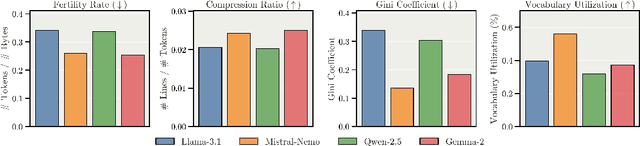

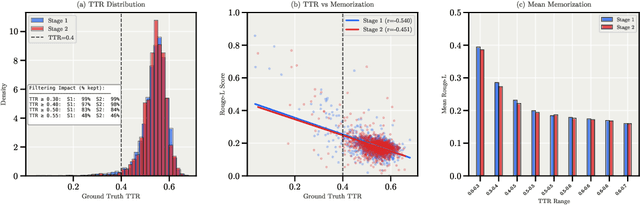
We present Apertus, a fully open suite of large language models (LLMs) designed to address two systemic shortcomings in today's open model ecosystem: data compliance and multilingual representation. Unlike many prior models that release weights without reproducible data pipelines or regard for content-owner rights, Apertus models are pretrained exclusively on openly available data, retroactively respecting robots.txt exclusions and filtering for non-permissive, toxic, and personally identifiable content. To mitigate risks of memorization, we adopt the Goldfish objective during pretraining, strongly suppressing verbatim recall of data while retaining downstream task performance. The Apertus models also expand multilingual coverage, training on 15T tokens from over 1800 languages, with ~40% of pretraining data allocated to non-English content. Released at 8B and 70B scales, Apertus approaches state-of-the-art results among fully open models on multilingual benchmarks, rivalling or surpassing open-weight counterparts. Beyond model weights, we release all scientific artifacts from our development cycle with a permissive license, including data preparation scripts, checkpoints, evaluation suites, and training code, enabling transparent audit and extension.
Can Large Language Models Capture Human Annotator Disagreements?
Jun 24, 2025Human annotation variation (i.e., annotation disagreements) is common in NLP and often reflects important information such as task subjectivity and sample ambiguity. While Large Language Models (LLMs) are increasingly used for automatic annotation to reduce human effort, their evaluation often focuses on predicting the majority-voted "ground truth" labels. It is still unclear, however, whether these models also capture informative human annotation variation. Our work addresses this gap by extensively evaluating LLMs' ability to predict annotation disagreements without access to repeated human labels. Our results show that LLMs struggle with modeling disagreements, which can be overlooked by majority label-based evaluations. Notably, while RLVR-style (Reinforcement learning with verifiable rewards) reasoning generally boosts LLM performance, it degrades performance in disagreement prediction. Our findings highlight the critical need for evaluating and improving LLM annotators in disagreement modeling. Code and data at https://github.com/EdisonNi-hku/Disagreement_Prediction.