 Add to Chrome
 Add to Firefox
 Add to Edge
A Self-Evolving Framework for Efficient Terminal Agents via Observational Context Compression
Apr 21, 2026
As model capabilities advance, research has increasingly shifted toward long-horizon, multi-turn terminal-centric agentic tasks, where raw environment feedback is often preserved in the interaction history to support future decisions. However, repeatedly retaining such feedback introduces substantial redundancy and causes cumulative token cost to grow quadratically with the number of steps, hindering long-horizon reasoning. Although observation compression can mitigate this issue, the heterogeneity of terminal environments makes heuristic-based or fixed-prompt methods difficult to generalize. We propose TACO, a plug-and-play, self-evolving Terminal Agent Compression framework that automatically discovers and refines compression rules from interaction trajectories for existing terminal agents. Experiments on TerminalBench (TB 1.0 and TB 2.0) and four additional terminal-related benchmarks (i.e., SWE-Bench Lite, CompileBench, DevEval, and CRUST-Bench) show that TACO consistently improves performance across mainstream agent frameworks and strong backbone models. With MiniMax-2.5, it improves performance on most benchmarks while reducing token overhead by around 10%. On TerminalBench, it brings consistent gains of 1%-4% across strong agentic models, and further improves accuracy by around 2%-3% under the same token budget. These results demonstrate the effectiveness and generalization of self-evolving, task-aware compression for terminal agents.

Story2Proposal: A Scaffold for Structured Scientific Paper Writing
Mar 28, 2026Generating scientific manuscripts requires maintaining alignment between narrative reasoning, experimental evidence, and visual artifacts across the document lifecycle. Existing language-model generation pipelines rely on unconstrained text synthesis with validation applied only after generation, often producing structural drift, missing figures or tables, and cross-section inconsistencies. We introduce Story2Proposal, a contract-governed multi-agent framework that converts a research story into a structured manuscript through coordinated agents operating under a persistent shared visual contract. The system organizes architect, writer, refiner, and renderer agents around a contract state that tracks section structure and registered visual elements, while evaluation agents supply feedback in a generate evaluate adapt loop that updates the contract during generation. Experiments on tasks derived from the Jericho research corpus show that Story2Proposal achieved an expert evaluation score of 6.145 versus 3.963 for DirectChat (+2.182) across GPT, Claude, Gemini, and Qwen backbones. Compared with the structured generation baseline Fars, Story2Proposal obtained an average score of 5.705 versus 5.197, indicating improved structural consistency and visual alignment.
JSSAnet: Theory-Guided Subchannel Partitioning and Joint Spatial Attention for Near-Field Channel Estimation
Mar 25, 2026The deployment of extremely large-scale antenna array (ELAA) in sixth-generation (6G) communication systems introduces unique challenges for efficient near-field channel estimation. To tackle these issues, this paper presents a theory-guided approach that incorporates angular information into an attention-based estimation framework. A piecewise Fourier representation is proposed to implicitly encode the near-field channel's inherent nonlinearity, enabling the entire channel to be segmented into multiple subchannels, each mapped to the angular domain via the discrete Fourier transform (DFT). Then, we develop a joint subchannel-spatial-attention network (JSSAnet) to extract the spatial features of both intra- and inter-subchannels. To guide theoretically the design of the joint attention mechanism, we derive upper and lower bounds based on approximation criteria and DFT quantization loss mitigation, respectively. Following by both bounds, a JSSA layer of an attention block is constructed to assign independent and adaptive spatial attention weights to each subchannel in parallel. Subsequently, a feed-forward network (FFN) of an attention block further captures and refines the residual nonlinear dependencies across subchannels. Moreover, the proposed JSSA map is linearly computed via element-wise product combining large-kernel convolutions (DLKC), maintaining strong contextual learning capability. Numerical results verify the effectiveness of embedding sparsity information into the attention network and demonstrate JSSAnet achieves superior estimation performance compared with existing methods.
Search More, Think Less: Rethinking Long-Horizon Agentic Search for Efficiency and Generalization
Feb 26, 2026Recent deep research agents primarily improve performance by scaling reasoning depth, but this leads to high inference cost and latency in search-intensive scenarios. Moreover, generalization across heterogeneous research settings remains challenging. In this work, we propose \emph{Search More, Think Less} (SMTL), a framework for long-horizon agentic search that targets both efficiency and generalization. SMTL replaces sequential reasoning with parallel evidence acquisition, enabling efficient context management under constrained context budgets. To support generalization across task types, we further introduce a unified data synthesis pipeline that constructs search tasks spanning both deterministic question answering and open-ended research scenarios with task appropriate evaluation metrics. We train an end-to-end agent using supervised fine-tuning and reinforcement learning, achieving strong and often state of the art performance across benchmarks including BrowseComp (48.6\%), GAIA (75.7\%), Xbench (82.0\%), and DeepResearch Bench (45.9\%). Compared to Mirothinker-v1.0, SMTL with maximum 100 interaction steps reduces the average number of reasoning steps on BrowseComp by 70.7\%, while improving accuracy.
A Multi-Scale Spatial Attention Network for Near-field MIMO Channel Estimation
Jul 30, 2025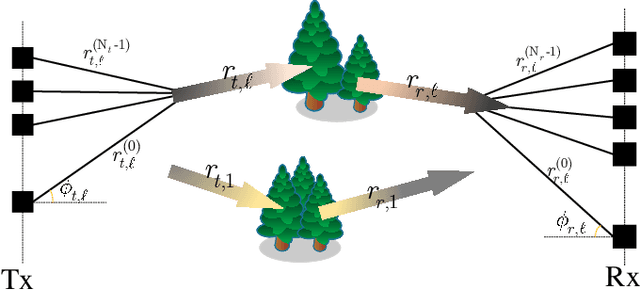
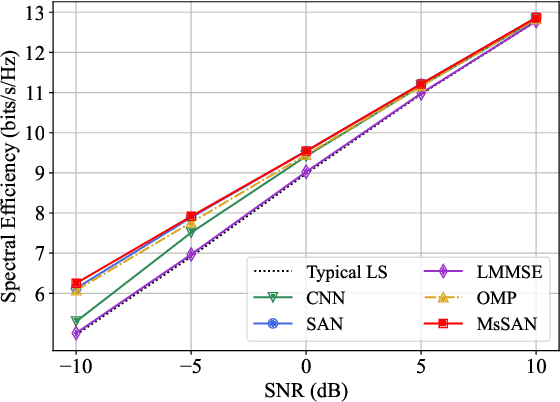
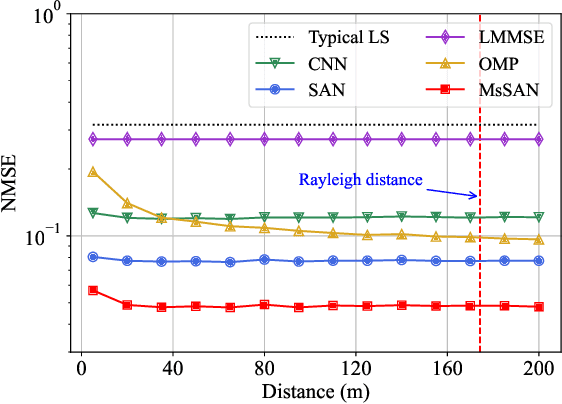
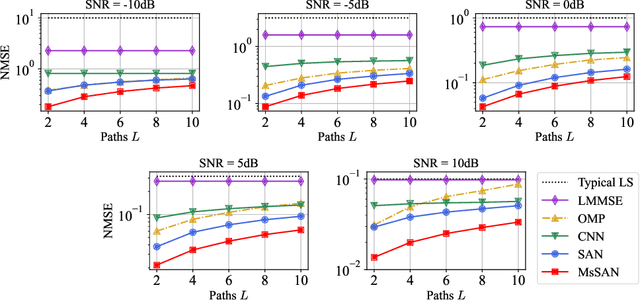
The deployment of extremely large-scale array (ELAA) brings higher spectral efficiency and spatial degree of freedom, but triggers issues on near-field channel estimation. Existing near-field channel estimation schemes primarily exploit sparsity in the transform domain. However, these schemes are sensitive to the transform matrix selection and the stopping criteria. Inspired by the success of deep learning (DL) in far-field channel estimation, this paper proposes a novel spatial-attention-based method for reconstructing extremely large-scale MIMO (XL-MIMO) channel. Initially, the spatial antenna correlations of near-field channels are analyzed as an expectation over the angle-distance space, which demonstrate correlation range of an antenna element varies with its position. Due to the strong correlation between adjacent antenna elements, interactions of inter-subchannel are applied to describe inherent correlation of near-field channels instead of inter-element. Subsequently, a multi-scale spatial attention network (MsSAN) with the inter-subchannel correlation learning capabilities is proposed tailed to near-field MIMO channel estimation. We employ the multi-scale architecture to refine the subchannel size in MsSAN. Specially, we inventively introduce the sum of dot products as spatial attention (SA) instead of cross-covariance to weight subchannel features at different scales in the SA module. Simulation results are presented to validate the proposed MsSAN achieves remarkable the inter-subchannel correlation learning capabilities and outperforms others in terms of near-field channel reconstruction.
Artificial Intelligence Security Competition (AISC)
Dec 07, 2022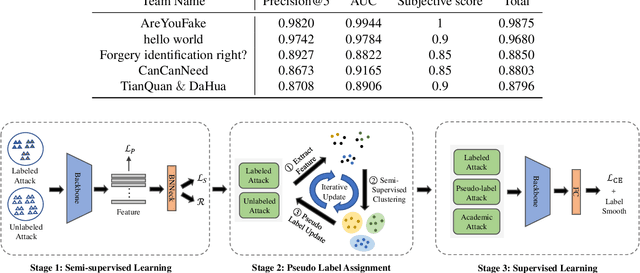
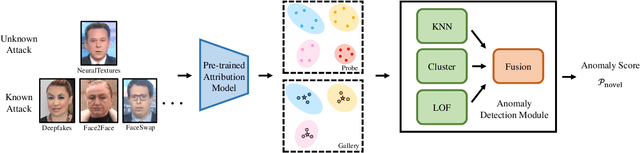


The security of artificial intelligence (AI) is an important research area towards safe, reliable, and trustworthy AI systems. To accelerate the research on AI security, the Artificial Intelligence Security Competition (AISC) was organized by the Zhongguancun Laboratory, China Industrial Control Systems Cyber Emergency Response Team, Institute for Artificial Intelligence, Tsinghua University, and RealAI as part of the Zhongguancun International Frontier Technology Innovation Competition (https://www.zgc-aisc.com/en). The competition consists of three tracks, including Deepfake Security Competition, Autonomous Driving Security Competition, and Face Recognition Security Competition. This report will introduce the competition rules of these three tracks and the solutions of top-ranking teams in each track.