 Add to Chrome
 Add to Firefox
 Add to Edge
FLFL: Federated Latent Factor Learning for Private Recovery of Spatio-Temporal Signals
Jun 22, 2026
Wireless sensor network (WSNs) stands out as a burgeoning and promising domain in intelligent sensing. Owing to various factors such as sudden sensor malfunctions or deliberate shutdown of partial nodes to save energy, the collected sensing signals from WSNs commonly have massive missing data, leading to adverse effects on subsequent analysis or decision-making. Latent factor learning (LFL) has proven to be highly effective in recovering the missing data for WSNs. However, the existing LFL models require the collected sensing signals to be maintained in one central place like a central server, which is becoming unacceptable for data owners who are getting increasingly privacy-sensitive. To address this issue, this paper innovatively proposes a federated latent factor learning (FLFL) model for privacy-preserving spatio-temporal signal recovery. Its main idea is two-fold: 1) it designs a sensor-level federated learning framework based on LFL, where each sensor only needs to upload gradient information rather than raw data for training a privacy-preserving recovery model, and 2) it incorporates the spatio-temporal correlation into the designed federated learning framework as the regularization constraint to improve its recovery accuracy. With such designs, FLFL can not only accurately recover the missing data of WSNs but also ensure data owners' privacy-preserving of raw data. To evaluate the proposed FLFL model, extensive experiments have been conducted on four real-world WSN datasets. The results demonstrate that FLFL significantly outperforms eight state-of-the-art federated and non-federated signal recovery models in terms of recovery accuracy with privacy-preserving.

Self-Consistent Latent Reasoning: Long Latent Sequence Reasoning for Vision-Language Model
May 13, 2026In language reasoning, longer chains of thought consistently yield better performance, which naturally suggests that visual latent reasoning may likewise benefit from longer latent sequences. However, we discover a counterintuitive phenomenon: the performance of existing latent visual reasoning methods systematically degrades as the latent sequence grows longer. We reveal the root cause: Information Gain Collapse -- autoregressive generation makes each step highly dependent on prior outputs, so subsequent tokens can barely introduce new information. We further identify that heavily pooled ($\geq 128\times$) image embeddings used as supervision targets provide no more signal than meaningless placeholders. Motivated by these insights, we propose SCOLAR (Self-COnsistent LAtent Reasoning), which introduces a lightweight detransformer that leverages the LLM's full-sequence hidden states to generate auxiliary visual tokens in a single shot, with each token independently anchored to the original visual space. Combined with three-stage SFT and ALPO reinforcement learning, SCOLAR extends acceptable latent CoT length by over $30\times$, achieves state-of-the-art among open-source models on real-world reasoning benchmarks (+14.12% over backbone), and demonstrates strong out-of-distribution generalization.
StreamingClaw Technical Report
Mar 23, 2026Applications such as embodied intelligence rely on a real-time perception-decision-action closed loop, posing stringent challenges for streaming video understanding. However, current agents suffer from fragmented capabilities, such as supporting only offline video understanding, lacking long-term multimodal memory mechanisms, or struggling to achieve real-time reasoning and proactive interaction under streaming inputs. These shortcomings have become a key bottleneck for preventing them from sustaining perception, making real-time decisions, and executing actions in real-world environments. To alleviate these issues, we propose StreamingClaw, a unified agent framework for streaming video understanding and embodied intelligence. It is also an OpenClaw-compatible framework that supports real-time, multimodal streaming interaction. StreamingClaw integrates five core capabilities: (1) It supports real-time streaming reasoning. (2) It supports reasoning about future events and proactive interaction under the online evolution of interaction objectives. (3) It supports multimodal long-term storage, hierarchical evolution, and efficient retrieval of shared memory across multiple agents. (4) It supports a closed-loop of perception-decision-action. In addition to conventional tools and skills, it also provides streaming tools and action-centric skills tailored for real-world physical environments. (5) It is compatible with the OpenClaw framework, allowing it to fully leverage the resources and support of the open-source community. With these designs, StreamingClaw integrates online real-time reasoning, multimodal long-term memory, and proactive interaction within a unified framework. Moreover, by translating decisions into executable actions, it enables direct control of the physical world, supporting practical deployment of embodied interaction.
EXPLORE-Bench: Egocentric Scene Prediction with Long-Horizon Reasoning
Mar 12, 2026Multimodal large language models (MLLMs) are increasingly considered as a foundation for embodied agents, yet it remains unclear whether they can reliably reason about the long-term physical consequences of actions from an egocentric viewpoint. We study this gap through a new task, Egocentric Scene Prediction with LOng-horizon REasoning: given an initial-scene image and a sequence of atomic action descriptions, a model is asked to predict the final scene after all actions are executed. To enable systematic evaluation, we introduce EXPLORE-Bench, a benchmark curated from real first-person videos spanning diverse scenarios. Each instance pairs long action sequences with structured final-scene annotations, including object categories, visual attributes, and inter-object relations, which supports fine-grained, quantitative assessment. Experiments on a range of proprietary and open-source MLLMs reveal a significant performance gap to humans, indicating that long-horizon egocentric reasoning remains a major challenge. We further analyze test-time scaling via stepwise reasoning and show that decomposing long action sequences can improve performance to some extent, while incurring non-trivial computational overhead. Overall, EXPLORE-Bench provides a principled testbed for measuring and advancing long-horizon reasoning for egocentric embodied perception.
Search More, Think Less: Rethinking Long-Horizon Agentic Search for Efficiency and Generalization
Feb 26, 2026Recent deep research agents primarily improve performance by scaling reasoning depth, but this leads to high inference cost and latency in search-intensive scenarios. Moreover, generalization across heterogeneous research settings remains challenging. In this work, we propose \emph{Search More, Think Less} (SMTL), a framework for long-horizon agentic search that targets both efficiency and generalization. SMTL replaces sequential reasoning with parallel evidence acquisition, enabling efficient context management under constrained context budgets. To support generalization across task types, we further introduce a unified data synthesis pipeline that constructs search tasks spanning both deterministic question answering and open-ended research scenarios with task appropriate evaluation metrics. We train an end-to-end agent using supervised fine-tuning and reinforcement learning, achieving strong and often state of the art performance across benchmarks including BrowseComp (48.6\%), GAIA (75.7\%), Xbench (82.0\%), and DeepResearch Bench (45.9\%). Compared to Mirothinker-v1.0, SMTL with maximum 100 interaction steps reduces the average number of reasoning steps on BrowseComp by 70.7\%, while improving accuracy.
Federated Latent Factor Learning for Recovering Wireless Sensor Networks Signal with Privacy-Preserving
Apr 22, 2025Wireless Sensor Networks (WSNs) are a cutting-edge domain in the field of intelligent sensing. Due to sensor failures and energy-saving strategies, the collected data often have massive missing data, hindering subsequent analysis and decision-making. Although Latent Factor Learning (LFL) has been proven effective in recovering missing data, it fails to sufficiently consider data privacy protection. To address this issue, this paper innovatively proposes a federated latent factor learning (FLFL) based spatial signal recovery (SSR) model, named FLFL-SSR. Its main idea is two-fold: 1) it designs a sensor-level federated learning framework, where each sensor uploads only gradient updates instead of raw data to optimize the global model, and 2) it proposes a local spatial sharing strategy, allowing sensors within the same spatial region to share their latent feature vectors, capturing spatial correlations and enhancing recovery accuracy. Experimental results on two real-world WSNs datasets demonstrate that the proposed model outperforms existing federated methods in terms of recovery performance.
HERO: Human Reaction Generation from Videos
Mar 11, 2025Human reaction generation represents a significant research domain for interactive AI, as humans constantly interact with their surroundings. Previous works focus mainly on synthesizing the reactive motion given a human motion sequence. This paradigm limits interaction categories to human-human interactions and ignores emotions that may influence reaction generation. In this work, we propose to generate 3D human reactions from RGB videos, which involves a wider range of interaction categories and naturally provides information about expressions that may reflect the subject's emotions. To cope with this task, we present HERO, a simple yet powerful framework for Human rEaction geneRation from videOs. HERO considers both global and frame-level local representations of the video to extract the interaction intention, and then uses the extracted interaction intention to guide the synthesis of the reaction. Besides, local visual representations are continuously injected into the model to maximize the exploitation of the dynamic properties inherent in videos. Furthermore, the ViMo dataset containing paired Video-Motion data is collected to support the task. In addition to human-human interactions, these video-motion pairs also cover animal-human interactions and scene-human interactions. Extensive experiments demonstrate the superiority of our methodology. The code and dataset will be publicly available at https://jackyu6.github.io/HERO.
EgoChoir: Capturing 3D Human-Object Interaction Regions from Egocentric Views
May 22, 2024
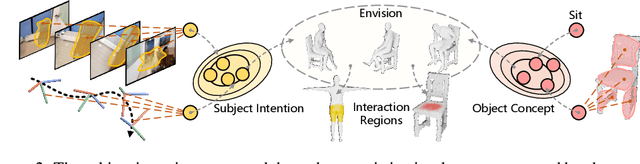
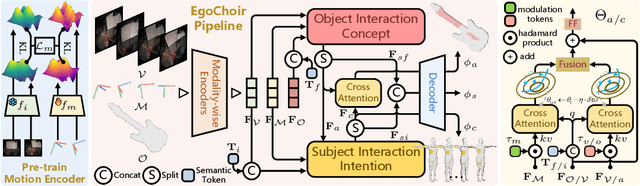

Understanding egocentric human-object interaction (HOI) is a fundamental aspect of human-centric perception, facilitating applications like AR/VR and embodied AI. For the egocentric HOI, in addition to perceiving semantics e.g., ''what'' interaction is occurring, capturing ''where'' the interaction specifically manifests in 3D space is also crucial, which links the perception and operation. Existing methods primarily leverage observations of HOI to capture interaction regions from an exocentric view. However, incomplete observations of interacting parties in the egocentric view introduce ambiguity between visual observations and interaction contents, impairing their efficacy. From the egocentric view, humans integrate the visual cortex, cerebellum, and brain to internalize their intentions and interaction concepts of objects, allowing for the pre-formulation of interactions and making behaviors even when interaction regions are out of sight. In light of this, we propose harmonizing the visual appearance, head motion, and 3D object to excavate the object interaction concept and subject intention, jointly inferring 3D human contact and object affordance from egocentric videos. To achieve this, we present EgoChoir, which links object structures with interaction contexts inherent in appearance and head motion to reveal object affordance, further utilizing it to model human contact. Additionally, a gradient modulation is employed to adopt appropriate clues for capturing interaction regions across various egocentric scenarios. Moreover, 3D contact and affordance are annotated for egocentric videos collected from Ego-Exo4D and GIMO to support the task. Extensive experiments on them demonstrate the effectiveness and superiority of EgoChoir. Code and data will be open.