 Add to Chrome
 Add to Firefox
 Add to Edge
Agentic Transaction: Towards ACID-Compliant Agent Systems
Aug 14, 2026
Large language model (LLM) agents are evolving from conversational assistants into autonomous systems that execute long-horizon tasks through reasoning, tool use, code generation, and workspace manipulation. As agents increasingly operate over persistent environments and multi-step workflows, they face challenges analogous to those addressed by transactional database systems: reliable execution, consistent outcomes, safe concurrency, and durable state management. We introduce the concept of an agentic transaction and propose an ACID-compliant agent system framework that reinterprets the classical ACID properties for agent execution through four semantic guarantees: Semantic Atomicity, Semantic Consistency, Semantic Isolation, and Semantic Durability. Together, these properties provide a principled foundation for building reliable agent systems despite model uncertainty and dynamic execution environments. To instantiate this framework, we develop an ACID-compliant data agent that realizes these guarantees through transactional exploration-execution-validation cycles, transactional skill hubs, confidence divergence-based validation, semantic dependency-aware isolation, and transaction-aware semantic state management. Experimental results on widely used benchmarks show that our system achieves a 10.6% improvement over state-of-the-art agents, including Claude Code. This work opens a broader research agenda on extending transactional principles and system architectures toward building trustworthy, scalable, and self-evolving AI agent systems.

Switch-KD: Visual-Switch Knowledge Distillation for Vision-Language Models
Apr 16, 2026Vision-Language Models (VLMs) have shown remarkable capabilities in joint vision-language understanding, but their large scale poses significant challenges for deployment in resource-constrained scenarios. Knowledge Distillation (KD) offers a viable way to improve model capabilities without increasing model size or data requirements, making deployment more efficient. However, applying KD to VLMs is challenged by modality-specific supervision: although multimodal knowledge in VLMs is fused within the language space, current methods supervise each modality separately without explicitly addressing multimodal alignment, leading to inconsistent multimodal knowledge transfer. To address this, we propose Switch-KD, a visual-switch distillation framework that unifies vision-language knowledge transfer within a shared text-probability space. Switch-KD comprises two key components: (1) Visual-Switch Distillation, which switches the student's visual outputs into the teacher's language pathway to construct cross-modal probabilistic references for implicit visual knowledge transfer; and (2) Dynamic Bi-directional Logits Difference (DBiLD) loss, which adaptively aligns informative probability regions while preserving the distributional structures of teacher and student through bidirectional supervision. Guided by Switch-KD, a 0.5B TinyLLaVA effectively distills rich multimodal knowledge from its 3B teacher, yielding an average improvement of 3.6 points across 10 multimodal benchmarks without any architectural modification.
* 11 pages, 3 figures
Prior Knowledge-enhanced Spatio-temporal Epidemic Forecasting
Feb 25, 2026Spatio-temporal epidemic forecasting is critical for public health management, yet existing methods often struggle with insensitivity to weak epidemic signals, over-simplified spatial relations, and unstable parameter estimation. To address these challenges, we propose the Spatio-Temporal priOr-aware Epidemic Predictor (STOEP), a novel hybrid framework that integrates implicit spatio-temporal priors and explicit expert priors. STOEP consists of three key components: (1) Case-aware Adjacency Learning (CAL), which dynamically adjusts mobility-based regional dependencies using historical infection patterns; (2) Space-informed Parameter Estimating (SPE), which employs learnable spatial priors to amplify weak epidemic signals; and (3) Filter-based Mechanistic Forecasting (FMF), which uses an expert-guided adaptive thresholding strategy to regularize epidemic parameters. Extensive experiments on real-world COVID-19 and influenza datasets demonstrate that STOEP outperforms the best baseline by 11.1% in RMSE. The system has been deployed at one provincial CDC in China to facilitate downstream applications.
STAR : Bridging Statistical and Agentic Reasoning for Large Model Performance Prediction
Feb 12, 2026As comprehensive large model evaluation becomes prohibitively expensive, predicting model performance from limited observations has become essential. However, existing statistical methods struggle with pattern shifts, data sparsity, and lack of explanation, while pure LLM methods remain unreliable. We propose STAR, a framework that bridges data-driven STatistical expectations with knowledge-driven Agentic Reasoning. STAR leverages specialized retrievers to gather external knowledge and embeds semantic features into Constrained Probabilistic Matrix Factorization (CPMF) to generate statistical expectations with uncertainty. A reasoning module guided by Expectation Violation Theory (EVT) then refines predictions through intra-family analysis, cross-model comparison, and credibility-aware aggregation, producing adjustments with traceable explanations. Extensive experiments show that STAR consistently outperforms all baselines on both score-based and rank-based metrics, delivering a 14.46% gain in total score over the strongest statistical method under extreme sparsity, with only 1--2 observed scores per test model.
Bridging the Gap Between Ideal and Real-world Evaluation: Benchmarking AI-Generated Image Detection in Challenging Scenarios
Sep 11, 2025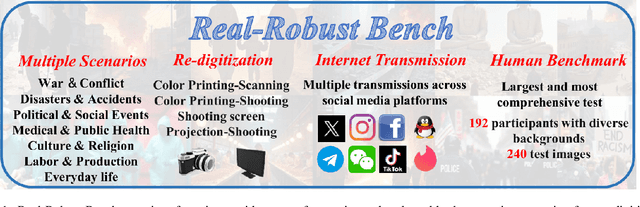
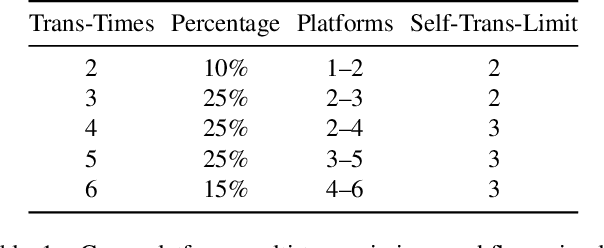
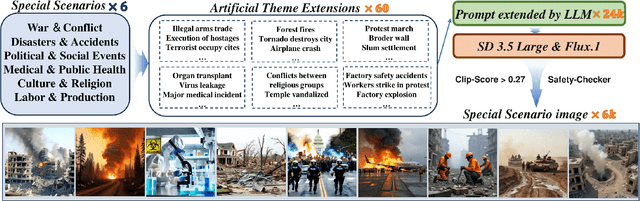
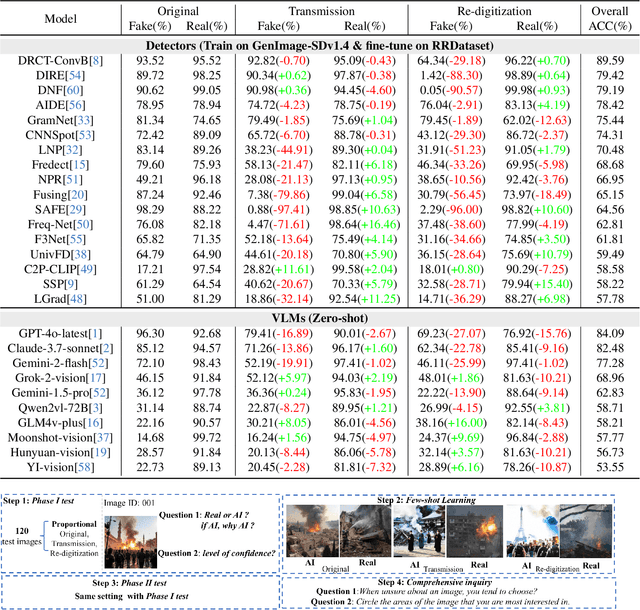
With the rapid advancement of generative models, highly realistic image synthesis has posed new challenges to digital security and media credibility. Although AI-generated image detection methods have partially addressed these concerns, a substantial research gap remains in evaluating their performance under complex real-world conditions. This paper introduces the Real-World Robustness Dataset (RRDataset) for comprehensive evaluation of detection models across three dimensions: 1) Scenario Generalization: RRDataset encompasses high-quality images from seven major scenarios (War and Conflict, Disasters and Accidents, Political and Social Events, Medical and Public Health, Culture and Religion, Labor and Production, and everyday life), addressing existing dataset gaps from a content perspective. 2) Internet Transmission Robustness: examining detector performance on images that have undergone multiple rounds of sharing across various social media platforms. 3) Re-digitization Robustness: assessing model effectiveness on images altered through four distinct re-digitization methods. We benchmarked 17 detectors and 10 vision-language models (VLMs) on RRDataset and conducted a large-scale human study involving 192 participants to investigate human few-shot learning capabilities in detecting AI-generated images. The benchmarking results reveal the limitations of current AI detection methods under real-world conditions and underscore the importance of drawing on human adaptability to develop more robust detection algorithms.
FLARE: A Framework for Stellar Flare Forecasting using Stellar Physical Properties and Historical Records
Feb 25, 2025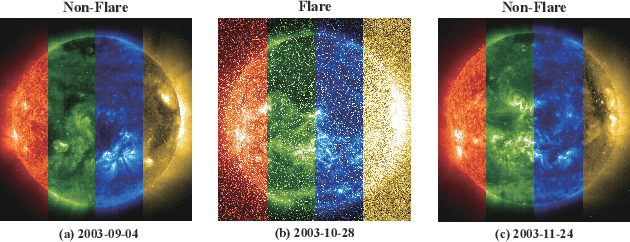
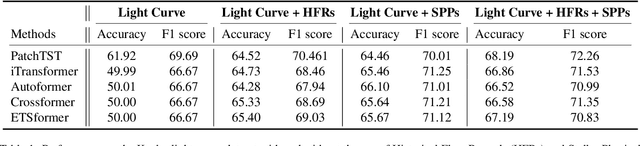
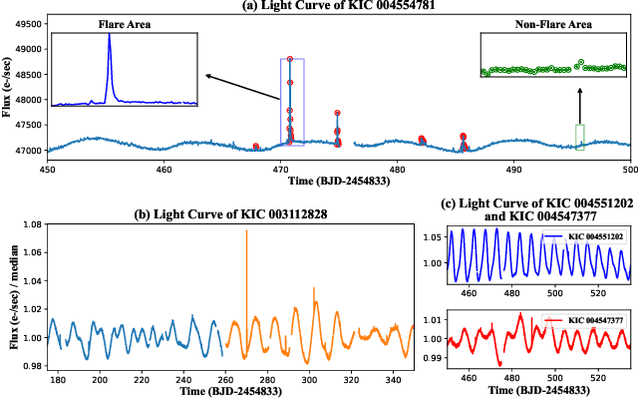
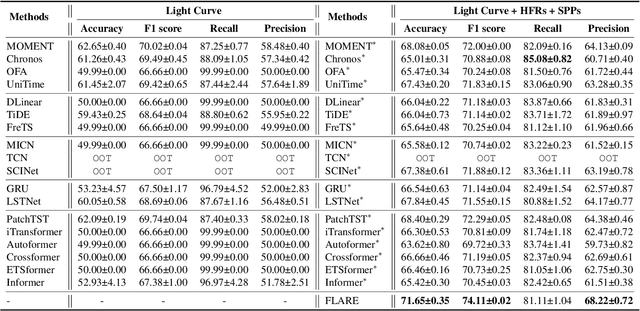
Stellar flare events are critical observational samples for astronomical research; however, recorded flare events remain limited. Stellar flare forecasting can provide additional flare event samples to support research efforts. Despite this potential, no specialized models for stellar flare forecasting have been proposed to date. In this paper, we present extensive experimental evidence demonstrating that both stellar physical properties and historical flare records are valuable inputs for flare forecasting tasks. We then introduce FLARE (Forecasting Light-curve-based Astronomical Records via features Ensemble), the first-of-its-kind large model specifically designed for stellar flare forecasting. FLARE integrates stellar physical properties and historical flare records through a novel Soft Prompt Module and Residual Record Fusion Module. Our experiments on the publicly available Kepler light curve dataset demonstrate that FLARE achieves superior performance compared to other methods across all evaluation metrics. Finally, we validate the forecast capability of our model through a comprehensive case study.
An Efficient Framework for Enhancing Discriminative Models via Diffusion Techniques
Dec 12, 2024Image classification serves as the cornerstone of computer vision, traditionally achieved through discriminative models based on deep neural networks. Recent advancements have introduced classification methods derived from generative models, which offer the advantage of zero-shot classification. However, these methods suffer from two main drawbacks: high computational overhead and inferior performance compared to discriminative models. Inspired by the coordinated cognitive processes of rapid-slow pathway interactions in the human brain during visual signal recognition, we propose the Diffusion-Based Discriminative Model Enhancement Framework (DBMEF). This framework seamlessly integrates discriminative and generative models in a training-free manner, leveraging discriminative models for initial predictions and endowing deep neural networks with rethinking capabilities via diffusion models. Consequently, DBMEF can effectively enhance the classification accuracy and generalization capability of discriminative models in a plug-and-play manner. We have conducted extensive experiments across 17 prevalent deep model architectures with different training methods, including both CNN-based models such as ResNet and Transformer-based models like ViT, to demonstrate the effectiveness of the proposed DBMEF. Specifically, the framework yields a 1.51\% performance improvement for ResNet-50 on the ImageNet dataset and 3.02\% on the ImageNet-A dataset. In conclusion, our research introduces a novel paradigm for image classification, demonstrating stable improvements across different datasets and neural networks.
Noise Diffusion for Enhancing Semantic Faithfulness in Text-to-Image Synthesis
Nov 25, 2024


Diffusion models have achieved impressive success in generating photorealistic images, but challenges remain in ensuring precise semantic alignment with input prompts. Optimizing the initial noisy latent offers a more efficient alternative to modifying model architectures or prompt engineering for improving semantic alignment. A latest approach, InitNo, refines the initial noisy latent by leveraging attention maps; however, these maps capture only limited information, and the effectiveness of InitNo is highly dependent on the initial starting point, as it tends to converge on a local optimum near this point. To this end, this paper proposes leveraging the language comprehension capabilities of large vision-language models (LVLMs) to guide the optimization of the initial noisy latent, and introduces the Noise Diffusion process, which updates the noisy latent to generate semantically faithful images while preserving distribution consistency. Furthermore, we provide a theoretical analysis of the condition under which the update improves semantic faithfulness. Experimental results demonstrate the effectiveness and adaptability of our framework, consistently enhancing semantic alignment across various diffusion models. The code is available at https://github.com/Bomingmiao/NoiseDiffusion.
MRGazer: Decoding Eye Gaze Points from Functional Magnetic Resonance Imaging in Individual Space
Nov 27, 2023Eye-tracking research has proven valuable in understanding numerous cognitive functions. Recently, Frey et al. provided an exciting deep learning method for learning eye movements from fMRI data. However, it needed to co-register fMRI into standard space to obtain eyeballs masks, and thus required additional templates and was time consuming. To resolve this issue, in this paper, we propose a framework named MRGazer for predicting eye gaze points from fMRI in individual space. The MRGazer consisted of eyeballs extraction module and a residual network-based eye gaze prediction. Compared to the previous method, the proposed framework skips the fMRI co-registration step, simplifies the processing protocol and achieves end-to-end eye gaze regression. The proposed method achieved superior performance in a variety of eye movement tasks than the co-registration-based method, and delivered objective results within a shorter time (~ 0.02 Seconds for each volume) than prior method (~0.3 Seconds for each volume).
Causal Explanation for Reinforcement Learning: Quantifying State and Temporal Importance
Oct 24, 2022Explainability plays an increasingly important role in machine learning. Because reinforcement learning (RL) involves interactions between states and actions over time, explaining an RL policy is more challenging than that of supervised learning. Furthermore, humans view the world from causal lens and thus prefer causal explanations over associational ones. Therefore, in this paper, we develop a causal explanation mechanism that quantifies the causal importance of states on actions and such importance over time. Moreover, via a series of simulation studies including crop irrigation, Blackjack, collision avoidance, and lunar lander, we demonstrate the advantages of our mechanism over state-of-the-art associational methods in terms of RL policy explanation.